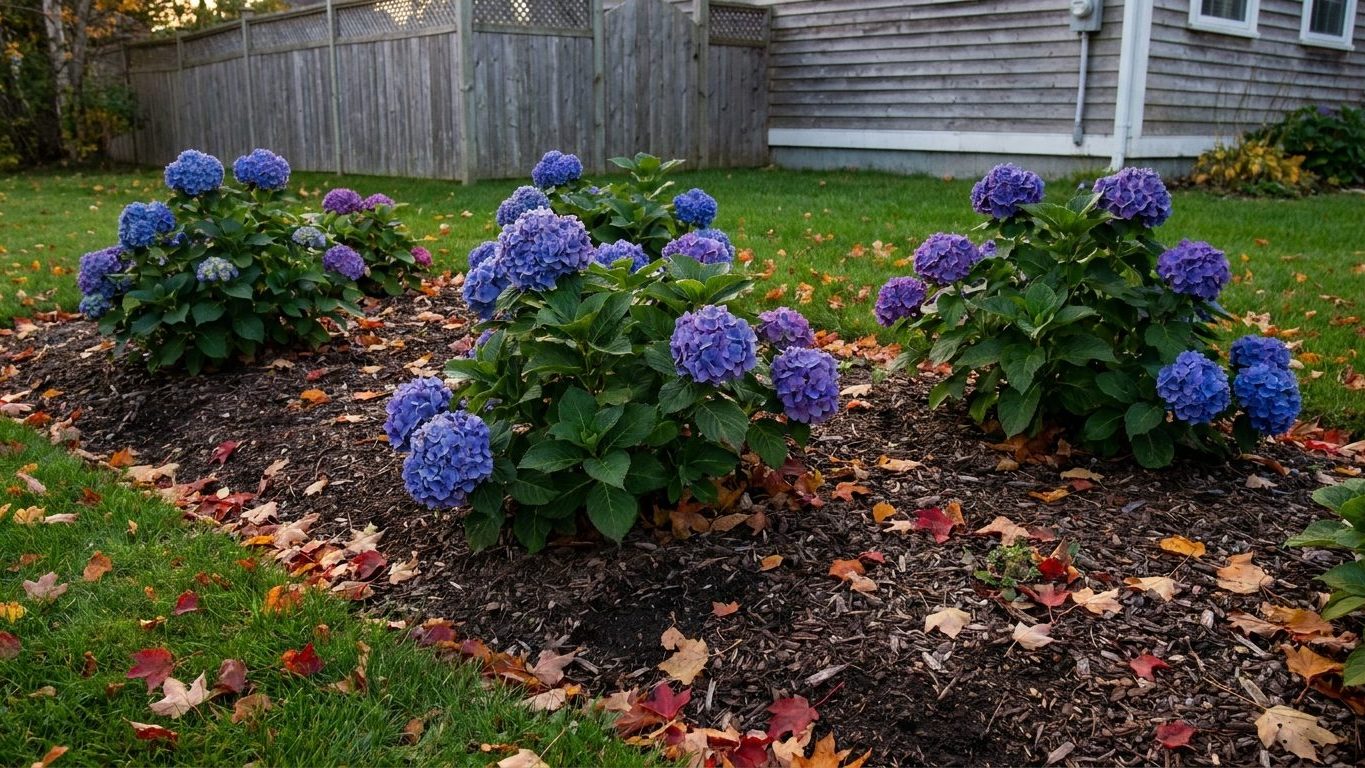
Plant hydrangeas in Newfoundland and Labrador in May, June, August, or September, and prune bigleaf types in June or July. Those four planting months sit inside the frost-free stretch that runs, on average, from May 30 to October 17 at St. John’s.
When to prune hydrangeas in Newfoundland and Labrador: The Short Answer
Environment and Climate Change Canada’s Canadian Climate Normals put St. John’s average last frost at May 30 and the average first fall frost at October 17, and the province’s four safe planting months, May, June, August, and September, all fall inside that stretch.
- January: The ground is frozen solid and no planting or pruning is possible. Use the quiet weeks to plan next year’s bed and check on any catalog orders.
- February: Still deep in dormancy, well ahead of the average last frost. Order bare-root stock now so it arrives once soil opens.
- March: Frost risk remains high across the province. Hold off on any planting and instead check winter mulch for heaving.
- April: Soil is still cold and frost is weeks from clearing. Wait rather than rush a shrub into ground that has not warmed.
- May: Planting opens this month, right around the average last frost date, and it is also the first of the two fertilizing months. Get new shrubs in once the soil has drained and warmed.
- June: Both planting and bigleaf pruning fall in this month, since frost risk has passed for most of the season. Prune spent bigleaf blooms right after they fade.
- July: This is the second fertilizing month and the second pruning month for bigleaf types. Feed once and finish any pruning before next year’s buds set.
- August: Planting resumes, well clear of spring frost and still more than two months from the average fall frost. A container-grown shrub has time to root in before cold returns.
- September: The last of the four planting months, close enough to the average fall frost that a new shrub needs mulch right away to settle before dormancy.
- October: The average first fall frost lands on the 17th. Stop planting, water deeply once, and mound mulch over the root zone before the ground locks up.
- November: Frost has typically already arrived. Hydrangeas go fully dormant, and the job now is winter protection, not planting or pruning.
- December: Deep dormancy continues. Resist any temptation to prune, since bigleaf varieties set next year’s flower buds on old wood that winter damage can still take.
Every date above bends around that St. John’s average, and a year that runs late pushes all of it back by a week or two.
Newfoundland and Labrador — the year and the numbers
- State
- Newfoundland and Labrador
- Hardiness zones
- 6a
- Last spring frost
- May 30
- First fall frost
- October 17
- Annual rain
- 60 in
- Lawn zone
- cool-season
- Source
- Environment and Climate Change Canada — Canadian Climate Normals 1981-2010, station ST JOHN'S A · St. John's
How to Work Out the Dates for Your Own Yard
The calendar above works from a single number, so use these steps to translate it into a plan for the actual patch of ground behind your house.
- Start from the frost midpoint, not a fixed date: Environment and Climate Change Canada’s Canadian Climate Normals list May 30 as the average last spring frost at St. John’s, which means roughly half the years run later, so treat late May as the early edge of the window rather than the safe date itself.
- Count back from the average fall frost: October 17 is the average first fall frost, so a September planting gives a new shrub barely a month to root before cold weather typically arrives, which is why September sits at the tail end of the four planting months rather than the middle.
- Check your own microclimate against the coast: a yard set back from the harbor, uphill, or inland of St. John’s commonly sees frost days earlier in fall and later in spring than the reference station, so push your personal window a week or two tighter on both ends.
- Watch soil drainage before the calendar: hydrangeas planted into cold, waterlogged clay in May, even after the average frost date passes, sit in worse conditions than a slightly later planting into soil that has actually warmed and drained.
- Match the pruning month to what you planted: bigleaf hydrangeas take their pruning in June or July, right after bloom, while a shrub still establishing its first year is better left unpruned entirely until it has a full season of roots down.
None of this replaces watching your own thermometer, since the St. John’s station is one point in a large province.
Newfoundland and Labrador North to South: How the Dates Shift
Newfoundland and Labrador is not one climate, and the same four planting months land differently depending on where you sit in the province.
- The Avalon Peninsula and the coast (St. John’s, Cape Spear, Bay Bulls): the reference station sits here, so this is the closest match to the dates above, though harbor fog can hold spring soil cold longer than the average suggests.
- Central Newfoundland and inland valleys (Gander, Grand Falls-Windsor): distance from the ocean lets spring warm faster once it arrives, but it also opens the door to a sharper, earlier fall frost than the coastal average.
- The West Coast and the Northern Peninsula (Corner Brook, St. Anthony): higher latitude and more exposed terrain push both ends of the frost-free stretch tighter, favoring the later half of each planting month rather than the early days.
- Labrador (Happy Valley-Goose Bay, Labrador City): a shorter, colder season than the island overall compresses the planting window further still, and gardeners here should lean on local extension guidance rather than the St. John’s figures.
If you garden outside the immediate St. John’s area, treat the province’s dates as a starting point and adjust with what your own soil and thermometer tell you.
Mistakes Newfoundland and Labrador Punishes
Pruning bigleaf hydrangeas after July
Bigleaf varieties set next year’s flower buds on old wood soon after bloom, so a fall cleanup cut removes the very growth that would have flowered next summer. The safe window is June or July, right after the blooms fade, not a tidy-up in September or October.
Planting the week the calendar turns to May
Environment and Climate Change Canada’s Canadian Climate Normals put the average last frost at St. John’s on May 30, and roughly half of all years run later, so a shrub planted in early May often meets a freeze it cannot shake off. Wait for warm soil, not just the date.
Leaving new roots bare going into October
A shrub planted in August or September has only a few weeks before the average first fall frost on October 17, and unmulched roots can heave loose in the freeze-thaw cycles that follow. Mound bark mulch over the root zone as soon as planting is done, not after the first cold snap.
Newfoundland and Labrador Extension Offices and County Contacts
The province-wide dates above are a starting point, and the province’s fisheries, forestry and agriculture office, along with local county offices, can fill in what a single climate station cannot capture for your yard.
- The Newfoundland and Labrador hydrangea guide: the frost dates and pruning window for the whole province in one place.
- Which hydrangeas hold up here: the varieties worth planting in this climate, ranked from safest to riskiest.
- What goes wrong with hydrangeas here: the pests and problems specific to this province, and what actually fixes them.
Reach the province’s office directly at gov.nl.ca/ffa before you plan a planting weekend around a single date.
Common questions
Can I plant hydrangeas in containers instead of the ground in Newfoundland and Labrador?
Yes, and it buys flexibility the ground planting months do not offer, since a container can move into a shed or garage once the average first fall frost on October 17 approaches, extending the growing window past what an in-ground shrub gets.
What Canadian hardiness zone is Newfoundland and Labrador for hydrangeas?
Natural Resources Canada’s Plant Hardiness Site places St. John’s at zone 6a in the Canadian system, which is built on seven climate variables and does not convert directly to the USDA zones used elsewhere on this site. Treat it as a rough guide to winter survival, not a hard line.
Is it too late to plant hydrangeas in September?
No, September is still one of the four planting months, but mulch the root zone immediately after planting, since the average first fall frost on October 17 leaves only a few weeks for roots to settle before the ground locks up.