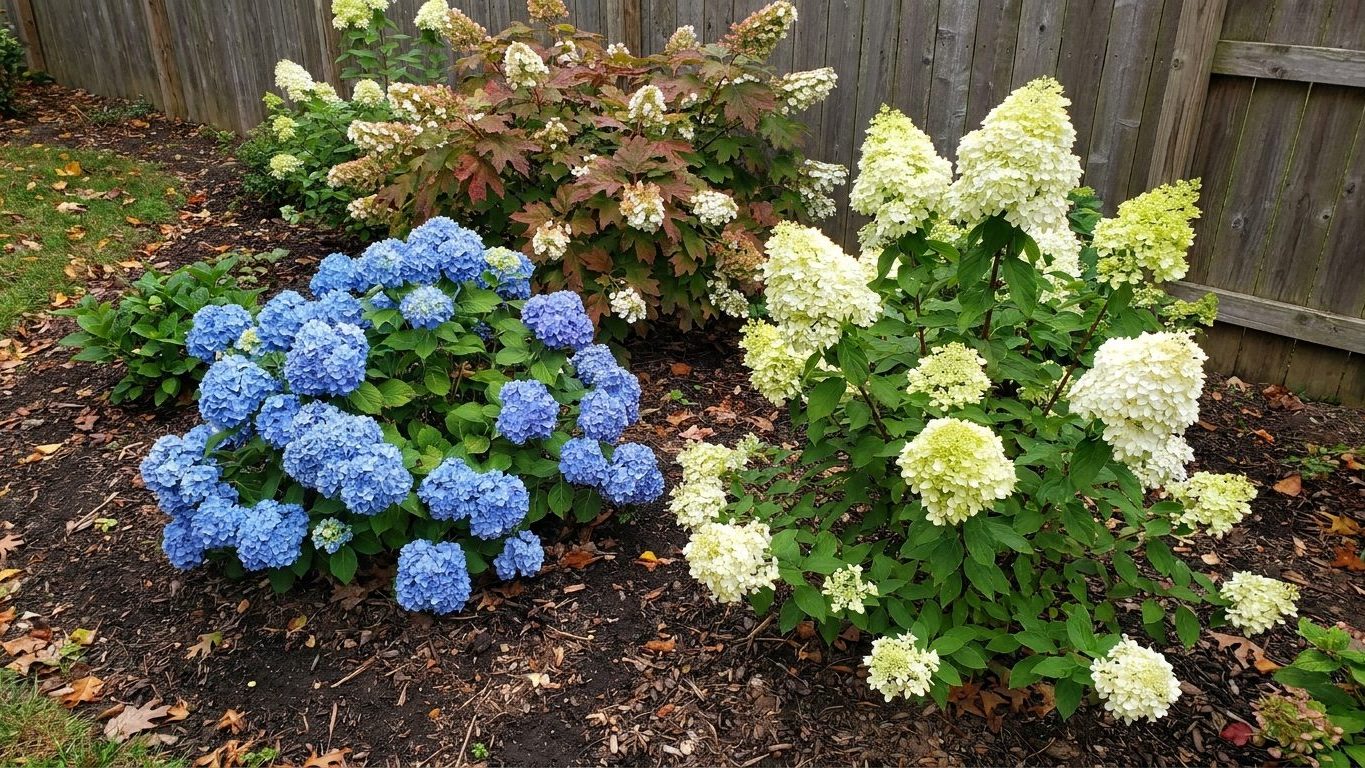
Panicle and smooth hydrangeas are the two safe bets for a Newfoundland and Labrador yard: both flower on new wood, so a hard winter that kills the top growth doesn’t cost you the blooms. Bigleaf, mountain, climbing, and oakleaf hydrangeas can grow here too, but each asks for more shelter, more patience, or more luck than the first two.
Hydrangeas that grow well in Newfoundland and Labrador: The Short Answer
Natural Resources Canada’s Plant Hardiness Site puts St. John’s, the province’s reference city, at Canadian zone 6a, with an average last spring frost of May 30 and an average first fall frost around October 17. That short growing season, bracketed by two frost dates that are averages rather than guarantees, is the reason some hydrangeas thrive here while others just limp along.
Smooth hydrangea (Hydrangea arborescens)

Native to cold parts of eastern North America, it dies back to the ground most winters without any real damage. It blooms on new growth every year, so it’s the safest name on this list for a Newfoundland and Labrador yard.
Panicle hydrangea (Hydrangea paniculata)

Just as tough as smooth hydrangea and just as reliable, since flowers form on wood the plant grows fresh each spring. A hard winter or a late frost barely touches the summer bloom show.
Climbing hydrangea (Hydrangea anomala subsp. petiolaris)

A hardy vine that takes a few seasons to settle in before it flowers well. Give it a sheltered wall or fence and the short season here stops being a problem once the roots catch on.
Mountain hydrangea (Hydrangea serrata)

Hardier than its bigleaf cousin, but it still sets some buds on old wood, which a rough winter can kill. Mulch and a sheltered corner improve the odds, though bloom stays a gamble most years.
Bigleaf hydrangea (Hydrangea macrophylla)

Buds form on last summer’s growth, and a Canadian zone 6a winter regularly kills them before spring. The shrub often survives and leafs out fine, it just skips flowering more years than it flowers.
Oakleaf hydrangea (Hydrangea quercifolia)

Built for a longer, warmer season than this coast offers, so foliage scorch and stem dieback are common complaints. It’s the riskiest name here, worth a try only in the mildest, most sheltered yard you have.
Newfoundland and Labrador — the year and the numbers
- State
- Newfoundland and Labrador
- Hardiness zones
- 6a
- Last spring frost
- May 30
- First fall frost
- October 17
- Annual rain
- 60 in
- Lawn zone
- cool-season
- Source
- Environment and Climate Change Canada — Canadian Climate Normals 1981-2010, station ST JOHN'S A · St. John's
How to Work Out the Dates for Your Own Yard
The zone number on a plant tag is a starting point, not a verdict, and a few minutes of checking narrows it down for your own patch of ground.
- Check the wood it blooms on: a hydrangea that flowers on new wood, like panicle or smooth, only needs the roots to survive winter, not the stems.
- Count back from your last frost: Environment and Climate Change Canada’s Canadian Climate Normals put St. John’s at an average last spring frost of May 30, so treat any date before early June as a real risk for young growth.
- Walk your yard for wind: a spot open to the harbour or the open sea strips buds faster than a spot behind a fence or a house wall.
- Test the soil for drainage: hydrangeas planted where water sits over winter lose roots before spring, no matter what the zone number says.
- Watch the fall frost date: an average of October 17 means new growth pushed too late in September rarely has time to harden off.
- Match the variety to the wall: a bigleaf or mountain hydrangea against a south-facing wall gets extra weeks of warmth the open lawn never sees.
Panicle hydrangea passes this test easily in an open yard here. It roots fine through a Canadian zone 6a winter and blooms on wood it grows fresh each spring.
Bigleaf hydrangea fails the same test in that same open, wind-exposed spot. Its buds formed the summer before rarely survive an unprotected winter, so it leafs out but skips flowering more often than not.
Newfoundland and Labrador North to South: How the Dates Shift
The zone 6a figure for St. John’s is a single point on a very long coastline, and the rest of the province runs colder or milder depending on how close it sits to open water.
- The Avalon Peninsula (St. John’s, Conception Bay, the southern shore): the mildest part of the province, with the ocean holding back the coldest air and keeping the last frost close to the provincial average.
- Central Newfoundland (Gander, Grand Falls-Windsor): more continental once you’re away from the coast, with colder nights and a shorter frost-free stretch than St. John’s sees.
- Western Newfoundland (Corner Brook, the Bay of Islands): fjord-sheltered pockets can run milder than the map suggests, though open stretches of the west coast still take a hard winter wind.
- Labrador (Happy Valley-Goose Bay, the north coast): a much shorter growing season and a harder winter than the island, where even the toughest hydrangeas struggle without heavy shelter.
None of this changes the hardiness zone printed on a plant tag, but it changes how much you should trust that number for your own address.
Mistakes Newfoundland and Labrador Punishes
Planting bigleaf without shelter
Bigleaf hydrangea sets its flower buds the summer before, and Natural Resources Canada’s Plant Hardiness Site puts St. John’s winters at Canadian zone 6a, cold enough to kill those buds most years in an open yard. Choose panicle or smooth hydrangea instead, or plant bigleaf against a sheltered, south-facing wall with heavy mulch each fall.
Pruning bigleaf in the fall
Cutting bigleaf hydrangea back after summer removes the buds set to overwinter into next year’s blooms. This province’s pruning window for bigleaf runs June and July, right after flowering and well before the first frost, so save the shears for those two months only.
Planting into September without a plan
A hydrangea set in the ground in late September has only weeks before the average first fall frost on October 17 near St. John’s. Stick to the May, June, and August planting windows here, treating September as a last resort with heavy mulch.
Newfoundland and Labrador Extension Offices and County Contacts
Natural Resources Canada’s Plant Hardiness Site puts St. John’s at Canadian zone 6a, and that number is only a starting point, since the province’s own extension contact fills in the rest, from soil questions to local pest reports.
- Newfoundland and Labrador Forestry and Agrifoods: the provincial office to call for site-specific planting advice and local pest alerts.
- Your regional calendar page: the month-by-month frost and pruning windows for this province, laid out in order.
- What goes wrong here: the pests and problems this province’s climate actually produces, and how to spot them early.
Common questions
Can bigleaf hydrangeas survive winter in Newfoundland and Labrador?
Some do, especially against a sheltered wall with heavy mulch, but zone 6a winters kill flower buds most years. Expect green growth without blooms more often than not, and plant panicle or smooth hydrangea if flowers matter every summer.
When should I plant a hydrangea in this province?
Stick to the May, June, August, and September windows, and avoid late fall planting so roots have time to establish before the average October 17 first frost arrives.
Do hydrangeas need winter protection here?
Panicle and smooth hydrangeas need none. Mulch helps bigleaf and mountain hydrangea’s buried buds survive, and wrapping stems in burlap adds another layer of protection on wind-exposed sites.