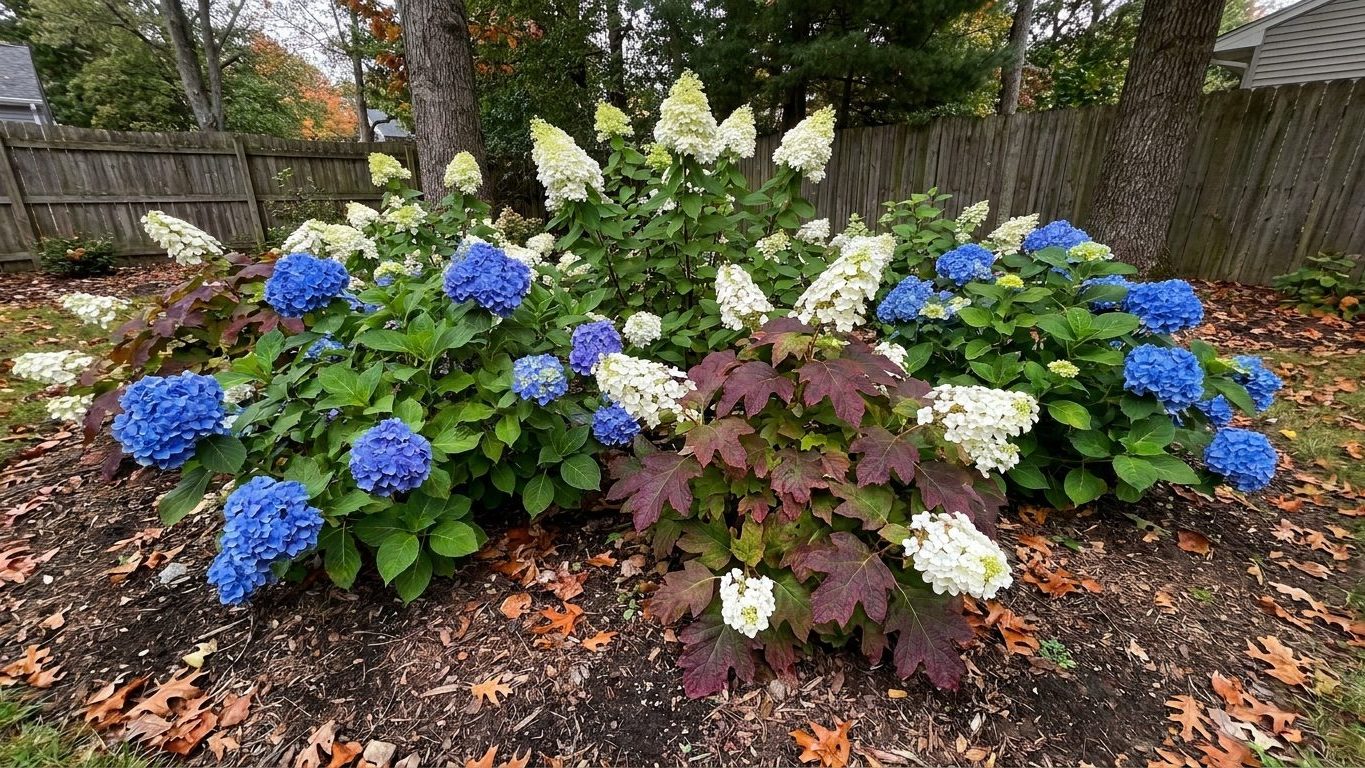
Smooth and panicle hydrangeas grow reliably across Arkansas, from the Ozarks down to the Delta, because they bloom on new wood and shrug off a late freeze. Oakleaf does nearly as well, since it’s native to the state’s woodlands. Bigleaf hydrangea, the classic mophead, is the gamble: its flower buds form the previous fall, and a hard freeze near Little Rock can wipe out a season’s blooms before they open.
The Short Answer
The USDA Plant Hardiness Zone Map puts Arkansas at 6b to 8a, with Little Rock sitting in the milder middle of that range, and that spread explains why new-wood bloomers outperform old-wood types here. I sort the common varieties below from the one that almost never disappoints to the one that needs the most babying.
Smooth Hydrangea (Hydrangea arborescens)

Native to the Ozark and Ouachita woodlands, this is the workhorse for Arkansas yards. It blooms on new wood, so a late spring freeze just delays flowering instead of erasing it, and it tolerates the heavy clay soil common statewide.
Panicle Hydrangea (Hydrangea paniculata)

Also a new-wood bloomer, panicle handles Arkansas’s humid summer heat better than any other type on this list. It takes more sun than the others, which makes it the safest pick for a Delta yard without much afternoon shade.
Oakleaf Hydrangea (Hydrangea quercifolia)

Native to river bottoms across the southeastern United States, oakleaf tolerates drought once established and adds fall color the others don’t. It blooms mostly on old wood, so it loses a little reliability in years with a late freeze, but it’s still a strong statewide choice.
Mountain Hydrangea (Hydrangea serrata)

A smaller-leaved relative of bigleaf, mountain hydrangea sets sturdier flower buds and some cultivars rebloom on new growth after a rough spring. It still isn’t bulletproof against a hard late frost, but it beats straight bigleaf for consistency.
Bigleaf Hydrangea (Hydrangea macrophylla)

The classic mophead blooms almost entirely on old wood, meaning the flower buds set the previous September sit exposed through winter. A freeze inside Little Rock’s spring window can knock out that year’s flowers even though the shrub itself survives fine.
Climbing Hydrangea (Hydrangea anomala subsp. petiolaris)

This one takes three to five years just to settle in and bloom, and it wants steady moisture and part shade to do it. Between the slow start and Arkansas’s swings between drought and downpour, it’s the riskiest of the six unless it’s tucked against a shaded north wall.
Arkansas — the year and the numbers
- State
- Arkansas
- USDA zones
- 6b-8a
- Last spring frost
- March 12 to March 28
- First fall frost
- November 7 to November 20
- Annual rain
- 50 in
- Lawn zone
- warm-season
- Source
- NOAA NCEI 1991-2020 Climate Normals, 32F freeze probabilities · Little Rock
How to Work Out the Dates for Your Own Yard
Picking the right hydrangea for a specific lot means checking bloom wood against frost risk before checking the tag at the nursery.
- Find your frost window: NOAA NCEI 1991-2020 Climate Normals put Little Rock’s last spring frost between March 12 and March 28, and the first fall frost between November 7 and November 20.
- Identify the bloom wood: check the tag or ask, since new-wood bloomers like panicle and smooth shrug off a late freeze while old-wood bloomers like bigleaf don’t.
- Match the hardiness zone: USDA places most of the state at 6b to 8a, and a plant rated hardy to zone 6 handles a cold snap that a zone 7-only variety can’t.
- Walk the site in late winter: a low spot that collects cold air runs colder than the official average, and a spot against a south-facing wall runs warmer.
- Watch bud swell in spring: if flower buds are already swelling before the frost window closes, an old-wood bloomer is at risk that year.
- Hold off on fall pruning: cutting an old-wood variety back before November strips next year’s flowers before they ever form.
Panicle hydrangea passes this test easily in Little Rock, since its buds form on the current season’s growth and a March freeze just resets the clock. Bigleaf often fails it, because buds set the previous September sit through the whole winter waiting for a spring that doesn’t always cooperate.
Arkansas North to South: How the Dates Shift
Elevation, the big rivers and plain latitude nudge these dates from one end of Arkansas to the other, and a yard in the hills doesn’t run on the same calendar as one near the state line.
- The Ozark Highlands and Northwest (Fayetteville, Bentonville, Harrison): higher elevation cools spring nights, pushing the safe planting date a little later than the rest of the state.
- The Arkansas River Valley and Central Arkansas (Little Rock, Conway, Hot Springs): the reference climate used throughout this guide, with the mildest swings between the two ranges.
- The Delta and South Arkansas (Pine Bluff, Jonesboro, El Dorado): lower elevation and river humidity soften winter lows, letting heat-loving panicle and oakleaf settle in a bit earlier.
For the exact county-level frost dates, the Arkansas state guide breaks the picture down further than a regional list can.
Mistakes Arkansas Punishes
Pruning bigleaf too late in fall
Cutting an old-wood bloomer back in October or November removes flower buds already set for next year, since bigleaf and mountain hydrangea bloom on the previous season’s growth. Prune right after summer blooms fade instead.
Full afternoon sun in the Delta
South Arkansas’s added summer heat scorches hydrangea leaves fast when a shrub sits in unbroken afternoon sun, especially bigleaf and mountain varieties with thinner leaves. Give afternoon shade, or lean on panicle where full sun can’t be avoided.
Planting right at the average last frost date
Setting a young hydrangea out during the week of Little Rock’s average last frost, March 12 to March 28, ignores that the window is an average, not a guarantee. Wait until soil has warmed and new growth has hardened a little before planting.
Arkansas Extension Offices and County Contacts
The state’s USDA zone and Little Rock’s frost dates are a starting point, not the final word, since soil, drainage and county microclimate shift the picture. The University of Arkansas Division of Agriculture extension office for a home county fills in the rest.
- Your state page: the frost dates and the pruning window for the whole state, region by region.
- What goes wrong here: the pests and problems local to Arkansas hydrangeas, and how to spot them early.
A call to the county office confirms which of these varieties the neighbors down the road have actually had luck with.
Common questions
Do hydrangeas need full sun or shade in Arkansas?
Most do best with morning sun and afternoon shade given the state’s summer heat, except panicle hydrangea, which tolerates full sun even in the Delta.
Can bigleaf hydrangea reliably bloom in Arkansas?
It can, but a late frost landing inside Little Rock’s March 12 to March 28 window can kill the previous year’s flower buds, so bloom is inconsistent in some years.
What is the easiest hydrangea to grow in Arkansas?
Smooth hydrangea, native to the Ozarks, is the most forgiving statewide since it blooms on new wood and rebounds from a late freeze on its own.