Skip to content

Goosegrass in Lawns: How to Identify It and Kill It

Goosegrass in Lawns: How to Identify It and Kill It

In summer, a flat, pale-centered rosette often shows up in hard, trampled lawn areas, along the driveway or where the kids cut the corner. That is goosegrass, a weed that thrives where turf struggles and stays low beneath the mower. Knowing it on sight, and what lets it settle in, decides how you get rid of it.

How to Identify Goosegrass

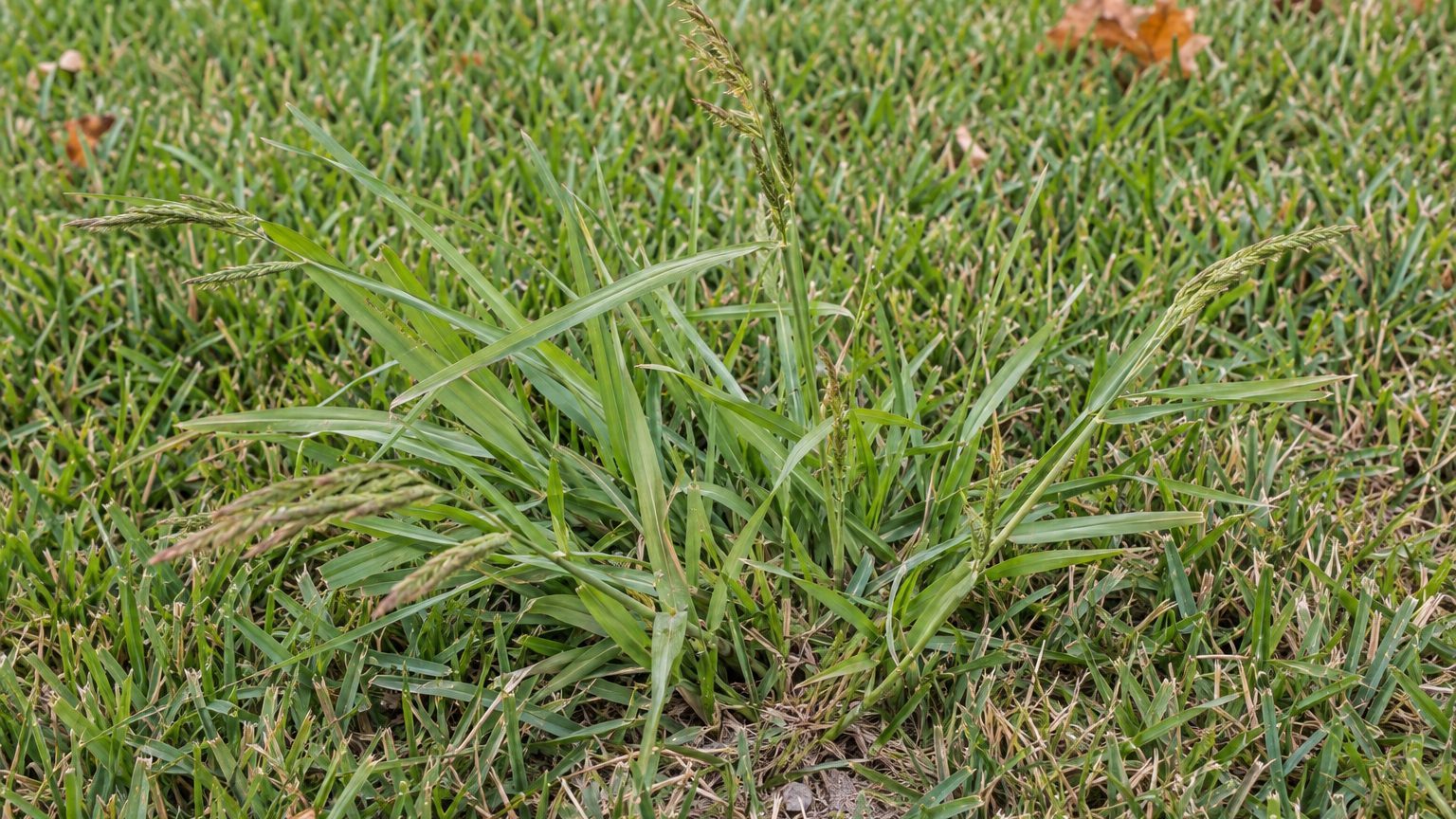
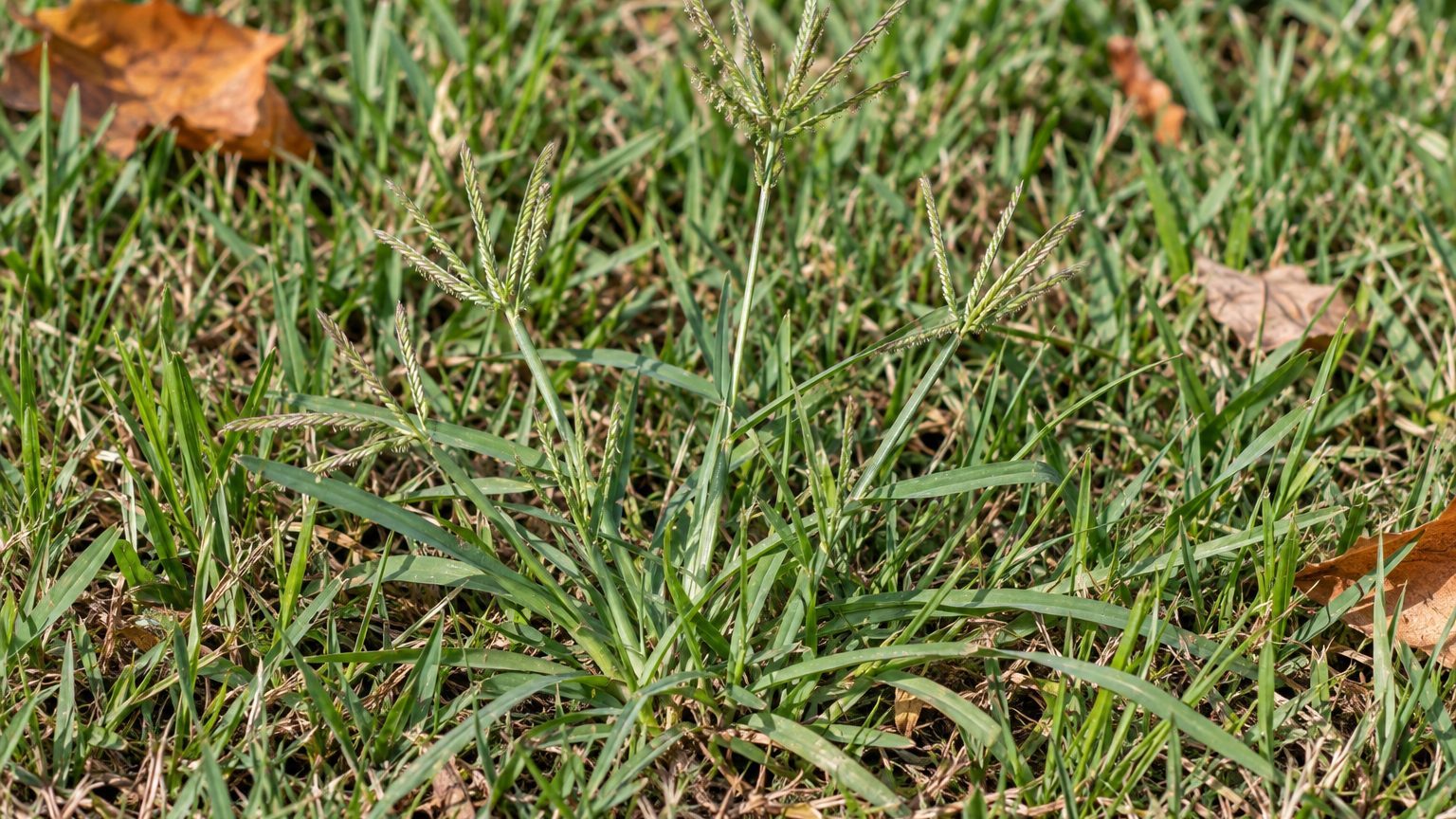
Goosegrass on a lawn

Look low, at the center of the plant, because that is where it gives itself away.

  • The center of each plant is pale, almost silvery white, and the flattened stems fan out from it like the spokes of a wheel.
  • Leaves are folded along the middle with blunt tips, and they are usually up to 6 inches long.
  • Blades are 0.2–0.4 inch wide, coarser and darker green than most lawn grasses around them.
  • Seedheads form on upright stalks, with 4–8 fingerlike branches radiating from the top.
  • Where the leaf meets the stem, a short membrane (1 to 1.5 mm) sits there with a jagged top and a split down the middle.
  • It appears as the soil warms and keeps growing through summer, becoming more noticeable in warm weather.

Pull a plant up and look at the base, because the flattened, whitish center is a useful confirmation.

Weeds Mistaken for Goosegrass

Several warm-season grasses sprawl and send up fingered seedheads, so goosegrass gets confused with them all the time. Their differences make it important to check the plant’s growth habit together with the season before identifying it.

Check the habit of the plant and the season it shows up, and the right name usually becomes clear.

Looks like How to tell them apart
Crabgrass Leaves are hairy and lighter green, and the plant comes up earlier, once soil stays above 55° to 60°F for 7 to10 days in Maryland. Goosegrass has smooth blades and a whitish center.
Bermudagrass A perennial that spreads by runners and returns in the same patch. Goosegrass is generally a summer annual that returns from seed, though in Florida’s tropical climate it can persist as a short-lived perennial.

Other low, spreading summer grasses can pass for goosegrass at a glance, but the flat, silvery rosette remains a strong clue when you part the leaves and look at the crown.

What Causes Goosegrass in Lawns

Goosegrass takes over where turf is weak and the ground is hard. Goosegrass is common in compacted soils, high-traffic areas, sites with full sun and light shade, and stands of thinning turf. It prefers full sun but can persist in partial shade.

Low mowing hands it an extra advantage. Because it grows so close to the ground, it tolerates mowing heights of ½ inch or less in Pennsylvania, while taller lawn grass is stressed by the same cut. A scalped, compacted lawn gives goosegrass favorable conditions.

Seed does the rest. It rides in on maintenance equipment and shoes, and with soil moved from infested sites, so a weedy patch at one edge can seed a whole yard. It germinates once the soil warms, with some reports from Florida putting that at 60°F–65°F. Goosegrass is a summer annual, though in Florida’s tropical climate it often lives on as a short-lived perennial.

How to Get Rid of Goosegrass

Young plants come out by hand, and the steps after that deal with the conditions that let it in.

  1. Pull small plants by hand when the soil is damp, taking the whole crown before the plant produces seed.
  2. Rake out seedheads and bag them, because loose seed will carry the problem to the next patch.
  3. Brush off the mower deck and your shoes after working the weedy area, since seed travels on both.
  4. Core aerate compacted spots, which in Pennsylvania helps turf cover and competition against goosegrass.
  5. Repair the bare spots at the recommended time for your grass type so the gaps do not simply refill with seedlings.
  6. Ask your state extension office which preemergence and postemergence herbicides are approved for your lawn grass, and follow the label closely.

Mature plants are hard to kill with herbicides, so removal by hand and a thicker lawn do most of the work. Treat this season’s cleanup as groundwork for next spring, when stopping seedlings is far easier.

How to Prevent Goosegrass

Prevention follows the season, and most of the work happens before you ever see a plant.

  • According to Penn State Extension, apply an approved preemergence product before maximum daily soil temperatures at the 2-inch depth reach between 62 and 65°F.
  • Once the lawn starts growing, raise the mower and keep it at 3-4 inches, the height suggested in Maryland to keep turf dense and shade the soil.
  • In late spring, hold off on extra watering where grass is cut tall, since in New Jersey grass mowed above 2 inches rarely needs supplemental irrigation in spring.
  • In Pennsylvania, steer foot and vehicle traffic off worn areas, and clean equipment before moving from a weedy area to a clean one.
  • Seed thin or bare spots at the recommended time for your grass type so goosegrass has less open soil to claim.

Adding organic matter to clay soil can improve turf cover and help it compete with goosegrass.

Common Questions

Does Goosegrass Come Back Every Year?

It does, from seed. Cold ends the plants in most places, but the seed they dropped stays in the soil and sprouts when the ground warms again. In Florida, a plant may survive as a short-lived perennial instead.

Is Goosegrass a Grass or a Broadleaf Weed?

It is a grass, in the same family as your lawn. That is why it blends in with turf, and why products meant for broadleaf weeds do little against it.

Is It Too Late to Stop Goosegrass Once It Is Up?

A preemergence treatment is intended to stop seeds before they sprout, so established plants need a different approach. Pull what you can, keep seedheads from forming, and plan the preventive work for the next warm season.
Foxtail in Lawns: How to Identify It and Kill It

Foxtail in Lawns: How to Identify It and Kill It

Pull a clump of grass from a summer lawn and you may find a stiff, bristly seedhead standing above the turf, soft as a bottlebrush. That is foxtail, a grassy weed that moves into thin or bare patches and spreads by seed; learning to recognize it helps you remove it before it seeds again.

How to Identify Foxtail

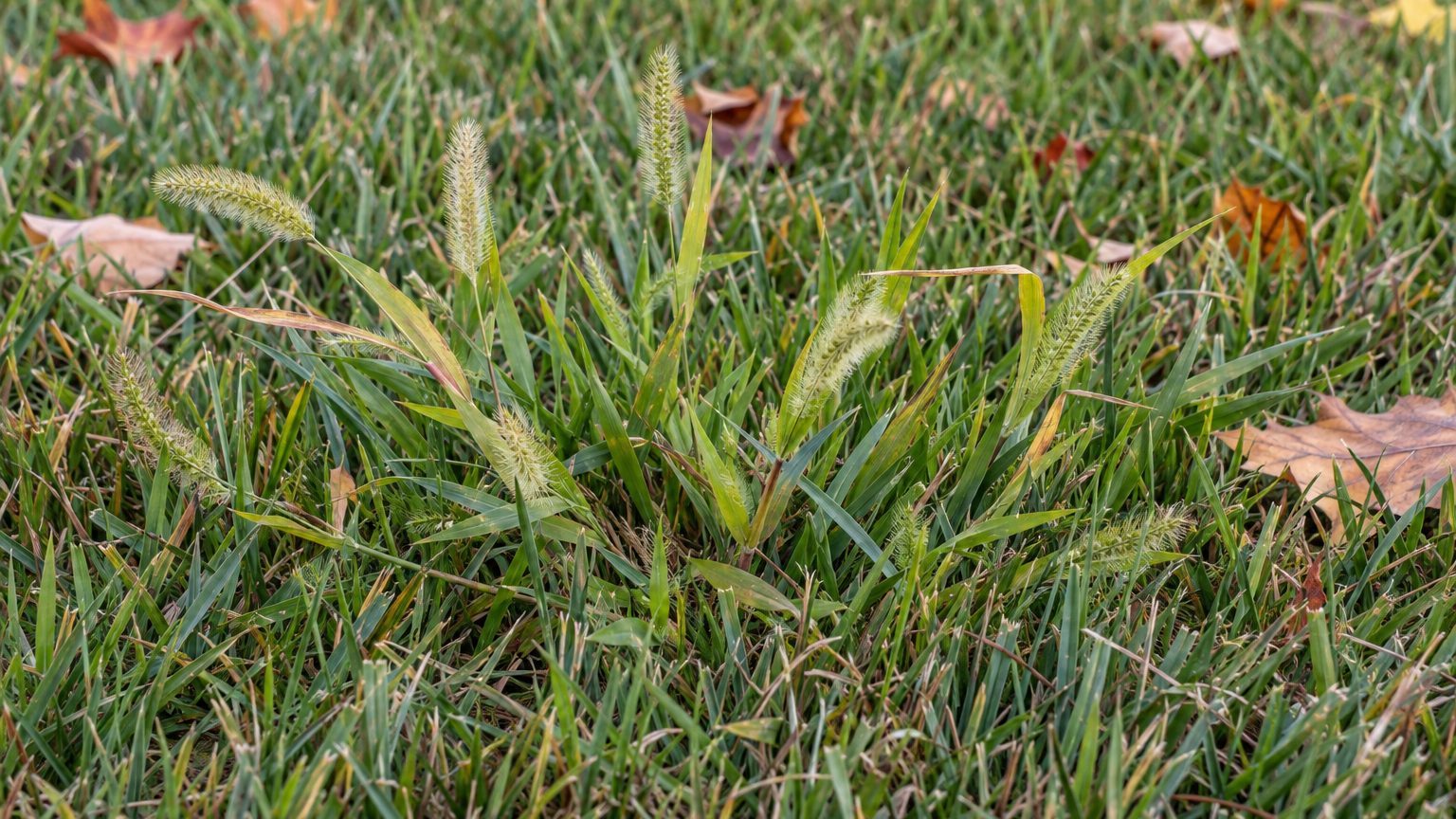
Foxtail on a lawn

The seedhead is a useful sign, so look up from the blades first.

  • On yellow foxtail, the flowering head is yellow, cylindrical, dense, bristly and erect, growing 2 to 5 inches long.
  • A yellow foxtail seedhead can be as short as 0.75 inch and as long as 6 inches, and it is about 0.5 inches wide, making it the smallest of the three species.
  • At the collar, where the blade meets the stem, a fringe of fine hairs about 1 mm long stands in for a ligule.
  • No auricles (small clasping flaps) sit at the collar, so the base of the blade looks plain.
  • The plant appears in spring, grows through summer and dies in fall, so its seasonal growth is a useful clue.

Short mowing can hide the seedheads below the mower deck, where they still drop seed.

Weeds Mistaken for Foxtail

Timothy grass and crabgrass can be confused with foxtail in lawns and fields. Look closely at the seedhead and leaf base before identifying the weed.

Looks like How to tell them apart
Timothy grass The seedhead looks much the same at first glance, but dig up the base of the stem. Timothy has an enlarged bulbous corm there, and foxtail has none.
Crabgrass Both are summer annual grasses that fill thin turf, but crabgrass has a membranous ligule at the collar, while foxtail has a hairy one.

A hand lens helps with the ligule, which is tiny. Check collars across the patch because an atypical clump can mislead you.

What Causes Foxtail in Lawns

Foxtail comes from seed, and it is a prolific seed producer. Unchecked plants can load the soil with seed, so the weed returns wherever turf is thin enough to let seedlings in.

Open ground is the invitation. In Illinois, yellow foxtail turns up in moist, fertile soil in the middle to late part of the growing season, and it is often found in new seedings, open turf or bare spots. Sun helps it too. In Pennsylvania, these species do best in sunny areas but can also survive in partly shaded lawns.

Timing follows soil warmth. According to Penn State Extension, seeds can germinate once soil reaches 65°F, and germination is best between 70 and 85°F. In Maryland, foxtails tend to emerge from mid-spring to early summer, though later flushes are not uncommon. Regular close mowing adds to the trouble because seedheads can form below the mower height and keep making seed.

How to Get Rid of Foxtail

Work with the plant’s one-year life, and stop seed from reaching the soil.

  1. Pull small infestations by hand or lift them with a trowel, since in Pennsylvania a few plants in a lawn can be removed this way, and it keeps the plants from setting seed.
  2. Remove the whole plant, roots included, and bag it rather than composting, so ripened seedheads do not spread into clean turf.
  3. Avoid mowing so short that foxtail seedheads form below the mower deck.
  4. Repair the bare spots at the recommended seeding time for your grass type, because open soil is where foxtail can start.
  5. Keep heavy traffic off new lawn seedings while their roots develop.
  6. For a larger infestation, ask your state extension office which preemergence products are approved where you live, and follow the label.

Timing matters if you do use a preemergence product. According to UC IPM, University of California, apply it 2 to 3 weeks before weeds germinate, and a lawn that is already full of seedlings will not be helped by a late application.

How to Prevent Foxtail

Prevention is a matter of keeping turf thick and acting before the seeds sprout.

  • Rake out dead patches and reseed thin areas at the recommended time for your grass type.
  • According to Penn State Extension, foxtail seed can germinate once soil reaches 65°F, so any approved preemergence treatment must be in place before germination.
  • Keep the mower at the appropriate height for your grass type so the canopy shades open soil.
  • When seedheads appear, pull the plants before the seed ripens and bag them.
  • After the plants die back, rake up the dead stalks and repair bare ground at the recommended seeding time for your grass type.

A dense lawn leaves foxtail little room to start where grass already covers the soil.

Common Questions

Is Foxtail a Perennial or an Annual?

Foxtail is a warm-season annual that lives one year, so each plant dies in fall and future plants grow from seed.

Can You Mow Foxtail Down to Get Rid of It?

Mowing alone rarely works, because plants cut short can still make seedheads below the blade. Combine mowing with pulling and thicker turf.

Does Foxtail Grow in Shade?

It prefers sun, but in Pennsylvania these species can also survive in partly shaded lawns, so shade alone will not keep it away.

Field Bindweed in Lawns: How to Identify It and Kill It

Field Bindweed in Lawns: How to Identify It and Kill It

Slender vines twist through the turf in summer, pulling at the grass blades and sending arrowhead-shaped leaves across the lawn. That is field bindweed, a perennial that lives mostly underground, which is why mowing never ends it. Telling it from similar vines comes first, then digging out the roots and keeping it from returning.

How to Identify Field Bindweed

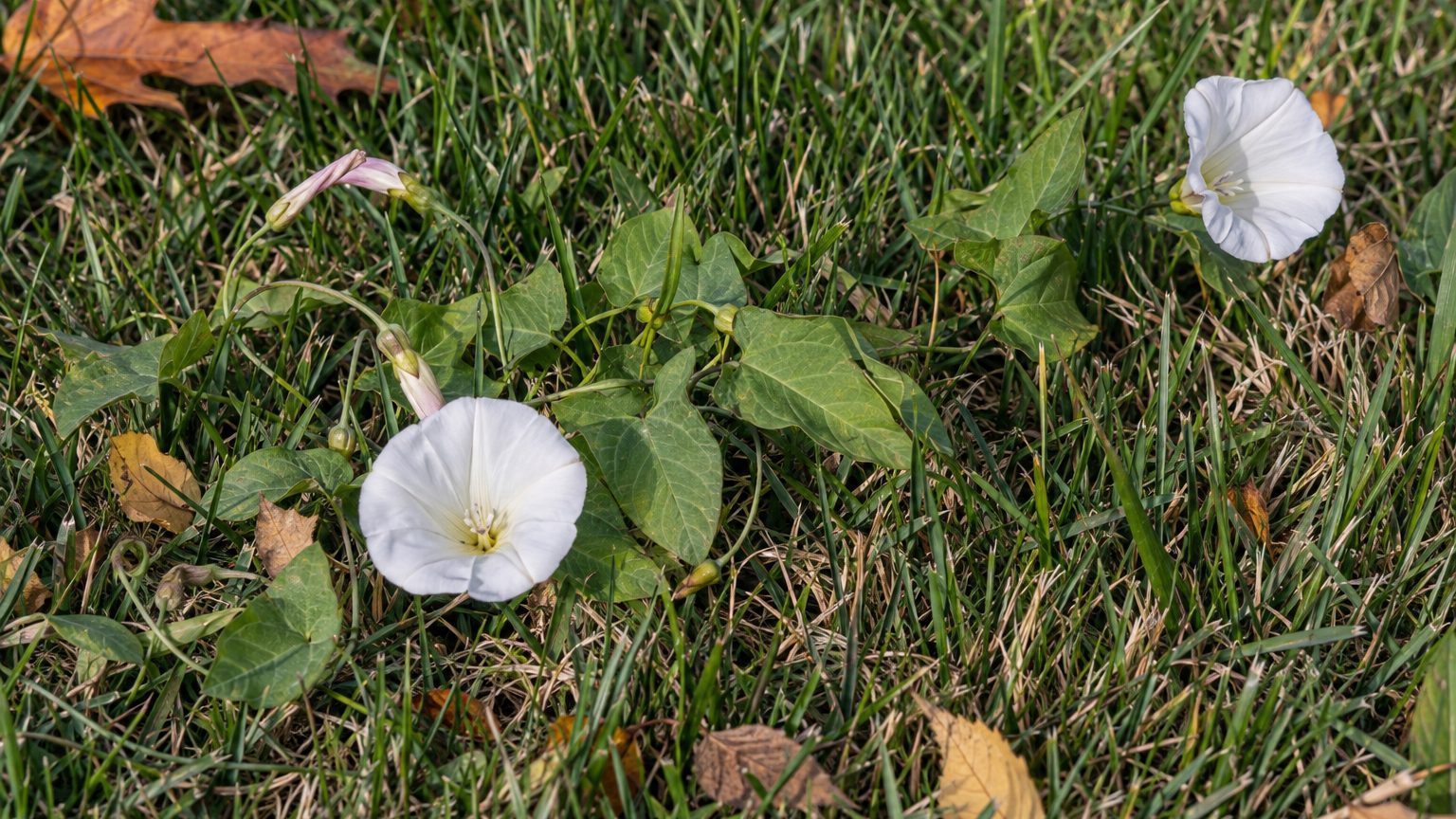
Field Bindweed on a lawn

Start with the leaves, then confirm with the vine and the blossoms.

  • The leaves are shaped like arrowheads, with pointed lobes at the base, and mature ones can be 1/2 to 2 inches long depending on conditions.
  • The thin stems twine around grass blades, fence wire and anything else upright, or trail flat across the soil.
  • The trumpet-shaped flowers are white to pink and 1 to 1 1/2 inches wide.
  • Flowering months run from June through September, so summer is when the vines show most clearly in the lawn.
  • Pulling a stem gives little resistance at first, then it snaps, because the plant is anchored by deep vertical roots and creeping rhizomes you cannot see.

If the leaf has that pointed, backward-reaching shape and the stem winds around its neighbors, you are almost certainly looking at the right plant.

Weeds Mistaken for Field Bindweed

Several twining vines share the same trumpet blossoms and sprawling habit, so a quick glance can mislead. Check the leaf shape and the size of the flower together before choosing a control method.

Looks like How to tell them apart
Ornamental annual morningglory The flower is larger at 2 inches wide and more showy, white to blue or purple, and the stem is thicker and sometimes hairy, with heart-shaped leaves 1 1/2 inches wide and 2 inches or more long.

Hedge bindweed is the other close relative. The easiest way to separate it from field bindweed is the leaf shape, so hold a leaf in your hand and compare the outline with the arrowhead described above. Morningglory is an annual, so it will not return from the roots the way bindweed does.

What Causes Field Bindweed in Lawns

Field bindweed is a perennial that came from Eurasia and spreads by seed and by rhizomes. Once it is in the soil, it does not need much help. Seed lands in a thin spot, the roots settle in, and the plant keeps coming back each year from the same root system.

Moving soil or tools can spread it. Fragments of vertical roots and rhizomes as short as 2 inches can form new plants, so tilling an infested patch or dragging a shovel through it sends pieces into new ground. In California, seed can germinate at 41° to 104°F once the seed coat has weakened.

Irrigation alone does not discourage field bindweed. Field bindweed survives with sprinkler or drip irrigation, so regular watering alone is no protection. Thin, bare or worn turf is the usual opening, because open soil gives seedlings light and room, while a dense lawn crowds them.

How to Get Rid of Field Bindweed

Field bindweed cannot be beaten in one pass, so the work is a steady wearing down of the roots, done in this order.

  1. For a small patch, loosen the soil carefully and remove as much of the root system as possible, because fragments as short as 2 inches can regrow into new plants.
  2. Collect every piece of root you find and bag it, so nothing is left to resprout in the loosened soil.
  3. On bare ground, cultivate about every 2 to 3 weeks and repeat whenever necessary, as practiced in California, to keep the plant from rebuilding its energy.
  4. Smother patches in beds and borders beside the lawn with a light-blocking cover, and expect it to take 3 to 5 years in California for the plant under mulch to die completely.
  5. Watch for new shoots and remove them as soon as the arrowhead leaves appear, since each leaf feeds the roots below.
  6. Ask your state’s extension office which lawn herbicides are labeled for bindweed where you live, because approved products and timing differ from state to state.

Patience matters more than force here. According to UC IPM, University of California, it might take more than 3 years of light exclusion before the bindweed dies, so a single season without regrowth does not mean the job is finished.

How to Prevent Field Bindweed

A thick lawn helps resist new bindweed seedlings, and timely lawn care helps keep bare soil covered.

  • Overseed thin and bare spots at the recommended time for your grass type, so seedlings fill the gaps before bindweed does.
  • In late spring, set the mower at the taller end of the range for your grass type, because taller turf shades the soil and slows weed seedlings.
  • From June through September, walk the edges of the lawn, fences and beds, and pull any twining runners before they climb and spread.
  • Through summer, water deeply and not too often, which favors the grass roots over shallow weed seedlings, though irrigation alone will not stop an established plant.
  • After working a patch that had bindweed, clean soil from digging tools before moving to clean areas so root pieces do not travel.

These habits help keep turf dense and leave less open soil for new bindweed seedlings.

Common Questions

Will Mowing Kill Field Bindweed?

No. Mowing removes the leaves and vines, but the deep roots and rhizomes stay alive and send up new shoots. Mowing only keeps the plant from climbing and slows its spread until you dig or smother it.

Does Field Bindweed Grow in Sandy Soil?

It can, but in California it seems to prefer heavy clay soils rather than sandy soils. A sandy lawn is not safe, so keep an eye out for arrowhead leaves whatever your soil type.

Does Field Bindweed Grow at High Elevations?

It is a hardy perennial found throughout California below the 5,000-foot elevation line. Use the leaf shape, not elevation alone, to identify any twining vine you find.

English Daisy in Lawns: How to Identify It and Kill It

English Daisy in Lawns: How to Identify It and Kill It

A low mat of leaf rosettes dotted with small white-and-yellow heads can be English daisy. It is a perennial that spreads by seed and underground stems, so control means removing the whole plant and repairing the turf around it.

How to Identify English Daisy

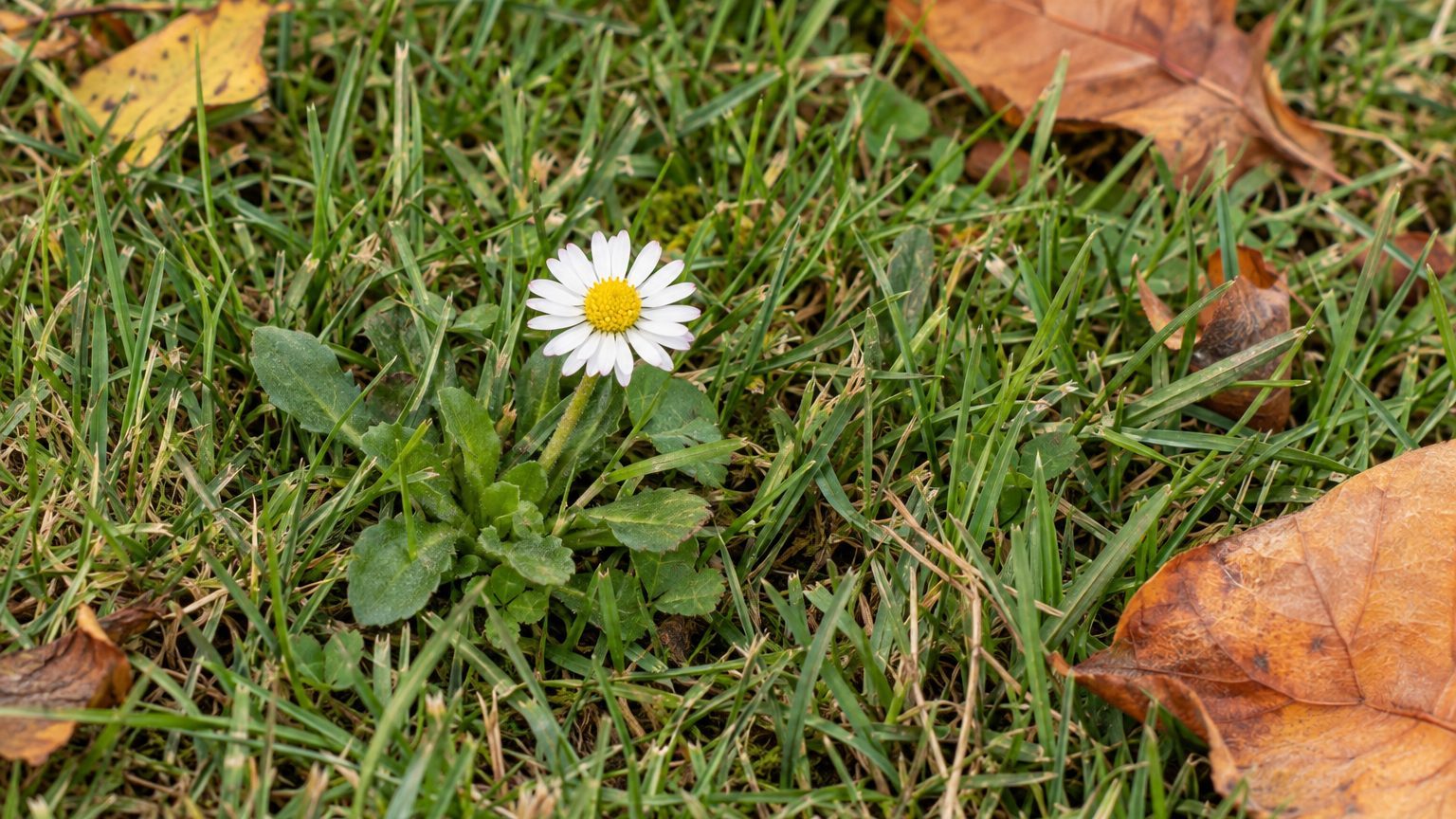
English Daisy on a lawn

Look low, at the level of the mower deck, because this weed hugs the ground and the clues are all in the rosette.

  • Spatula-shaped leaves form short rosettes, each leaf 1 to 2.5 inches long and widest toward the tip.
  • The plants grow prostrate, spreading flat across the turf to as much as 8 inches in length.
  • Each flower head has many white petals around a yellow center and measures 1 to 1.5 inches across.
  • Patches thicken in spring and early summer, with scattered flowering continuing until frost in North Carolina.
  • Pull a rosette and you will find creeping horizontal stems underground, which is why a patch widens each year.

A plant that matches the leaf shape and the flat habit is English daisy, even before it flowers.

Weeds Mistaken for English Daisy

Any white daisy in a lawn gets called by this name, but the plant you are looking at may be something else. The mistake matters because a different weed may need a different approach.

A common mix-up is oxeye daisy, a taller meadow plant that turns up along lawn edges and in unmowed corners.

Looks like How to tell them apart
Oxeye daisy (Leucanthemum vulgare), with white petals around a yellow center It stands upright on stems instead of lying flat. English daisy keeps its spatula-shaped leaves in a rosette close to the soil, with flower heads of 1 to 1.5 inches.

Other small white-flowered weeds can pass at a glance, so check the leaves and the growth habit together. Spatula-shaped leaves in a flat rosette, plus creeping stems underground, point to English daisy. If the plant stays tall after mowing, it is a different weed.

What Causes English Daisy in Lawns

English daisy began as a garden ornamental and has escaped into turf. In North Carolina it often moves from flower beds into the lawn next to them, and in California it is described as primarily a weed of turf, sometimes found in moist grassy areas. It spreads by seed and by its creeping stems, so plants can grow into a mat.

Conditions decide how fast it takes hold. In North Carolina, it prefers cool temperatures and cool, moist, fertile soil, with sun and afternoon shade. Those conditions can occur in lawns that are watered often or kept in damp low spots.

Fertility is part of the story too. In North Carolina, English daisy likes heavy fertility, so generous feeding can encourage it. A thin lawn with bare patches gives seed a place to start, and a thick, healthy one leaves much less room.

How to Get Rid of English Daisy

Because the plant spreads underground as well as by seed, remove the whole plant and then fill the space with grass.

  1. In Washington, hoe or rototill infested ground to eliminate the plants.
  2. Dig scattered rosettes carefully, and lift the creeping stems with them so they do not regrow.
  3. Rake the disturbed soil level and remove the pulled plants, since digging can bring weed seed to the surface and encourage more of it to sprout.
  4. Reseed bare spots when conditions favor your turfgrass, so grass can fill the space before daisy seedlings do.
  5. In North Carolina, avoid heavy feeding in infested areas because English daisy likes heavy fertility.
  6. Check the area regularly and dig out any new rosettes while they are still small.

If the patch is too large to dig, your state extension office can tell you which herbicides are registered in your state and when to apply them.

How to Prevent English Daisy

Prevention follows the weed’s season. In North Carolina, it grows in cool weather, so watch for it as the lawn wakes up and wherever turf thins.

  • In North Carolina, walk the lawn and edges for flat rosettes during the plant’s spring-to-early-summer active season, and dig them out before they spread.
  • Base fertilizer on the needs of your turfgrass rather than feeding the lawn heavily, especially in North Carolina, where English daisy likes heavy fertility.
  • Remove flower heads before they set seed, and dig out the rosettes and creeping stems.
  • Avoid needless watering in damp areas; in North Carolina, English daisy prefers cool, moist soil.
  • Overseed thin or bare patches when conditions favor your turfgrass, so grass fills gaps before daisy can move in.
  • In North Carolina, watch lawn edges beside flower beds, because English daisy often escapes from ornamental plantings into turf.

A thick lawn leaves less room for English daisy and makes any dig-out job easier.

Common Questions

Does English Daisy Come Back Every Year?

Yes, because it is a low-growing perennial. Leftover roots or creeping stems can regrow, and seed already in the soil can sprout, so a cleared patch needs watching.

Can English Daisy Spread from a Flower Bed into the Lawn?

It can. In North Carolina, it often escapes from the flower garden into lawns, where it is treated as a weed. Check bed edges and keep the lawn dense beside them.

How Long Does It Take for English Daisy to Reach Full Size?

A plant reaches its mature height in a maximum of 5 years, and in as little as 2 years. A patch you ignore will keep getting bigger and harder to clear.

Dandelion in Lawns: How to Identify It and Kill It

Dandelion in Lawns: How to Identify It and Kill It

A yellow-headed weed sitting in a flat green rosette can be a dandelion. Dandelion is easy to identify, can be removed from the yard, and the lawn can be made far less welcoming to it.

How to Identify Dandelion

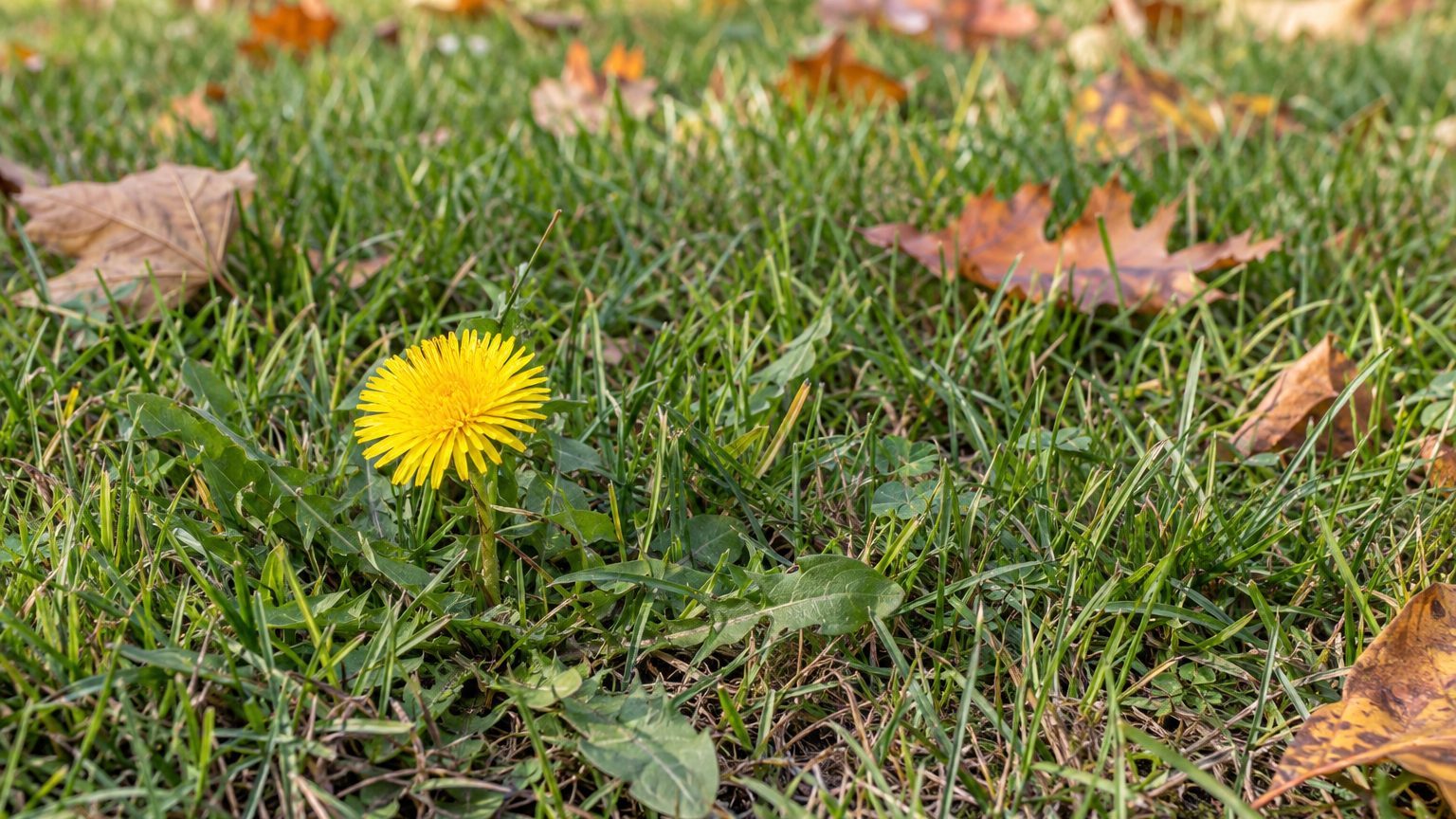
Dandelion on a lawn

Break a leaf or stalk and look at what comes out, then check the shape of the plant against these signs.

  • Milky sap oozes from a broken leaf, which sets dandelion apart from many other low rosette weeds.
  • The leaves form a flat rosette hugging the ground; they are smooth, with no hairs, and grow 2–10 inches long.
  • Leaf edges are jagged, ranging from deeply cut to almost entire, so neighboring plants can look slightly different.
  • Each yellow head sits alone on a hollow, leafless stalk that can reach 2-20 inches long.
  • A thick, fleshy taproot anchors the plant, and it is what you meet when you try to pull one by hand.

Once you have seen the rosette and the single hollow stalk together, you will recognize the plant at a glance, even in short grass.

Weeds Mistaken for Dandelion

Other yellow-headed plants pop up in lawns and get blamed on dandelion. The treatment can differ, so a quick look at the stems and the leaf surface saves effort.

Catsear is the usual culprit. Check the stems and run a finger over a leaf before you decide.

Looks like How to tell them apart
Catsear Long, slender, branching stems carry yellow heads 24 to 32 inches from the ground, and the leaves feel textured and hairy. Dandelion has one head per stem and smooth leaves without hairs.

Other yellow-headed weeds also turn up in turf. If a plant fits neither description, compare its leaves, stems, and growth habit before choosing a treatment.

What Causes Dandelion in Lawns

Dandelion gets in through seed. It reseeds prolifically, and the seed lands on any bare or thin spot where grass is not dense enough to block it.

Mowing habits make it easier. In Iowa, dandelion tolerates even low mowing heights, so a lawn cut short leaves the weed untouched while the grass is weakened. Scalped turf also opens up more bare soil for seed to settle on.

Soil can tip things too. In New York State, excessive liming is noted as a factor that promotes dandelion growth, so adding lime without a soil test can work against you.

Seasonal habits keep the plant going. Dandelion is a perennial that sends more resources to its roots as winter approaches, so a plant you cut back in autumn is simply storing energy for the next year.

How to Get Rid of Dandelion

Scattered plants respond well to hand work, and bigger patches take a mix of digging and follow-up. Work in this order.

  1. Water the area before digging, so the soil is soft and the taproot is easier to lift intact.
  2. Dig each plant out with a long, narrow weeder, lifting the whole fleshy taproot, because a piece left behind can regrow.
  3. Remove seed heads from any plants you cannot dig yet, since dandelion reseeds prolifically.
  4. Fill each hole with soil and sprinkle grass seed on top, so turf rather than weeds claims the gap.
  5. Ask your state extension office which herbicides are approved for lawns where you live, and follow the label if you choose one for large infestations.
  6. Recheck the lawn regularly and dig out new rosettes while they are small and the roots are still shallow.

Expect some plants to return. Seedlings keep arriving, so steady follow-up matters.

How to Prevent Dandelion

A dense lawn does much of the work, and seasonal habits help keep it that way.

  • Test the soil before you add lime. In New York State, excessive liming is known to promote dandelion.
  • In South Dakota, mow at a higher setting of approximately 3 inches. Taller grass shades the soil and starves seedlings of light.
  • In South Dakota, remove no more than 1/3 of the blade length at each mowing, so the grass stays vigorous and thick.
  • In planting beds next to the lawn in the Pacific Northwest, keep mulch at a minimum of 3 inches deep to make it harder for dandelion seed to establish.
  • Overseed thin or bare patches when conditions favor your grass, so turf fills the spaces where dandelion can establish.

Lawn gaps close on a different schedule in every climate, so adjust these timings to when your own grass grows strongest.

Common Questions

Will Dandelions Keep Coming Back After You Remove Them?

Yes. New plants appear from seed each year, even with the best weeding effort, so the aim is to keep the lawn dense enough that fewer seedlings take hold.

Does Dandelion Die Back in Winter?

In Maryland, the leaves may die back, but the fleshy taproot survives cold weather and regrows in spring. That is why cutting off the top rarely ends the problem.

Does Dandelion Show Up Only in Spring?

No. In Iowa, yellow heads appear first thing in spring and then sporadically all season, so you can find new ones in summer and fall as well.

Dallisgrass in Lawns: How to Identify It and Kill It

Dallisgrass in Lawns: How to Identify It and Kill It

Dallisgrass shows up in a lawn as coarse, clumpy patches that stay green and keep growing after the rest of the turf slows down, and tall seed stalks that rise above the mower deck. It is a perennial bunchgrass with deep roots, so pulling and mowing rarely settle it. Getting rid of it comes down to catching it early and cutting off its seed.

How to Identify Dallisgrass

Dallisgrass on a lawn

The seedhead is a useful clue, and the leaves and base help confirm it.

  • Look for seedheads with 3 to 7 finger-like branches (racemes) on one stem, each under 2 inches long, with hairy spikelets lined up in 4 rows.
  • Check the stalks, which can climb up to 5 feet tall where the grass goes unmowed.
  • Watch for seedheads from late May through October in Texas, which means the weed keeps reseeding through most of the growing season there.
  • Look at the base of a leaf, where a thin, see-through ligule up to 0.2 inches long sits, sharp pointed to blunt.
  • Notice the growth habit, a tight, coarse clump spreading from a short rhizome rather than a creeping mat.

Dig up a clump and you will find thick, deep fibrous roots, which explains why it holds on so stubbornly.

Weeds Mistaken for Dallisgrass

Several grasses get called dallisgrass in yards, and the mix-up matters because the right treatment depends on a correct identification. Check the seedhead and the leaf base before deciding.

Crabgrass is the usual confusion, since both grow as bunches. Field paspalum and thin paspalum are other common look-alikes.

Looks like How to tell them apart
Crabgrass Also a bunch-type weed, but dallisgrass has a membranous ligule and a prominent midrib on the leaf.
Thin paspalum Young leaves look glossier and shinier than dallisgrass, and the seedhead structure is different when you compare them side by side.
Field paspalum Often called dallisgrass by mistake, so check the seedhead branches and the ligule rather than going by overall clump shape.

What Causes Dallisgrass in Lawns

Seed is the cause. Dallisgrass produces abundant seed, its primary means of spreading.

Bare or thin turf gives that seed a place to land. Dallisgrass turns up often in lawns and disturbed areas, and its fast growth and heavy seeding let it invade managed urban sites quickly.

Mowing low does not hold it back. Dallisgrass adapts to low mowing heights and spreads through managed turfgrass, so a closely shaved lawn can end up favoring the weed over the grass you want. Once a clump is established, its deep roots let it outcompete the turf around it.

How to Get Rid of Dallisgrass

Small infestations can be handled by hand, especially before plants form rhizomes or set seed.

  1. Dig out young plants before they form rhizomes or set seed, because in home landscapes this is the strategy that works for control.
  2. Remove the whole clump with a spade, including the short rhizome and thick, deep roots.
  3. Bag the plants and any seedheads instead of composting them, so the seed does not get spread around the yard.
  4. Fill the hole with good soil and reseed or patch with sod, so bare ground does not invite fresh seedlings.
  5. Check the spot regularly and dig out any regrowth soon after it appears.

Large or mature stands are harder to remove by hand. For those, your state’s extension service can tell you which herbicides are registered locally and when to apply them for your turf type.

How to Prevent Dallisgrass

Dense, healthy turf leaves the seed little room to establish, and seasonal maintenance helps keep it that way.

  • In spring, walk the lawn and dig out any young clumps before they form rhizomes or set seed.
  • Water deeply when rain falls short. According to Clemson Cooperative Extension, 1 inch of water a week moistens the soil down to 6 inches and encourages deep turf roots.
  • Through summer, mow at the recommended height for your grass type rather than scalping it, since thin turf lets seed take hold.
  • From late May through October in Texas, watch for seedheads and cut or remove them before they ripen.
  • In fall, clean mower decks and shoes after working in any infested area so seed does not travel to clean turf.

When dallisgrass is kept as a pasture grass, maintain it at 2 to 3 inches because a lower height can cause it to decline.

Common Questions

Can You Mow Dallisgrass Out of a Lawn?

No. It adapts to low mowing and keeps growing, and cutting only trims the seedheads for a while. Digging out the young plants works better.

Is Dallisgrass an Annual or a Perennial?

It is a perennial bunchgrass, so remove the whole clump, including its short rhizome and roots, to keep it from returning.

How Do You Tell Dallisgrass from Crabgrass?

Look at the leaf base and the midrib together. Dallisgrass has a membranous ligule and a prominent midrib, and it grows as a perennial clump rather than a spreading annual.

Crabgrass in Lawns: How to Identify It and Kill It

Crabgrass in Lawns: How to Identify It and Kill It

Coarse, sprawling grass that fans out from thin spots and driveway edges each summer is usually crabgrass. It sprouts in spring, spreads through the warm months, and leaves seed behind before the season turns. Knowing what it looks like and what feeds it tells you when to pull it, when to mow, and when to ask your state extension office about a lawn product.

How to Identify Crabgrass

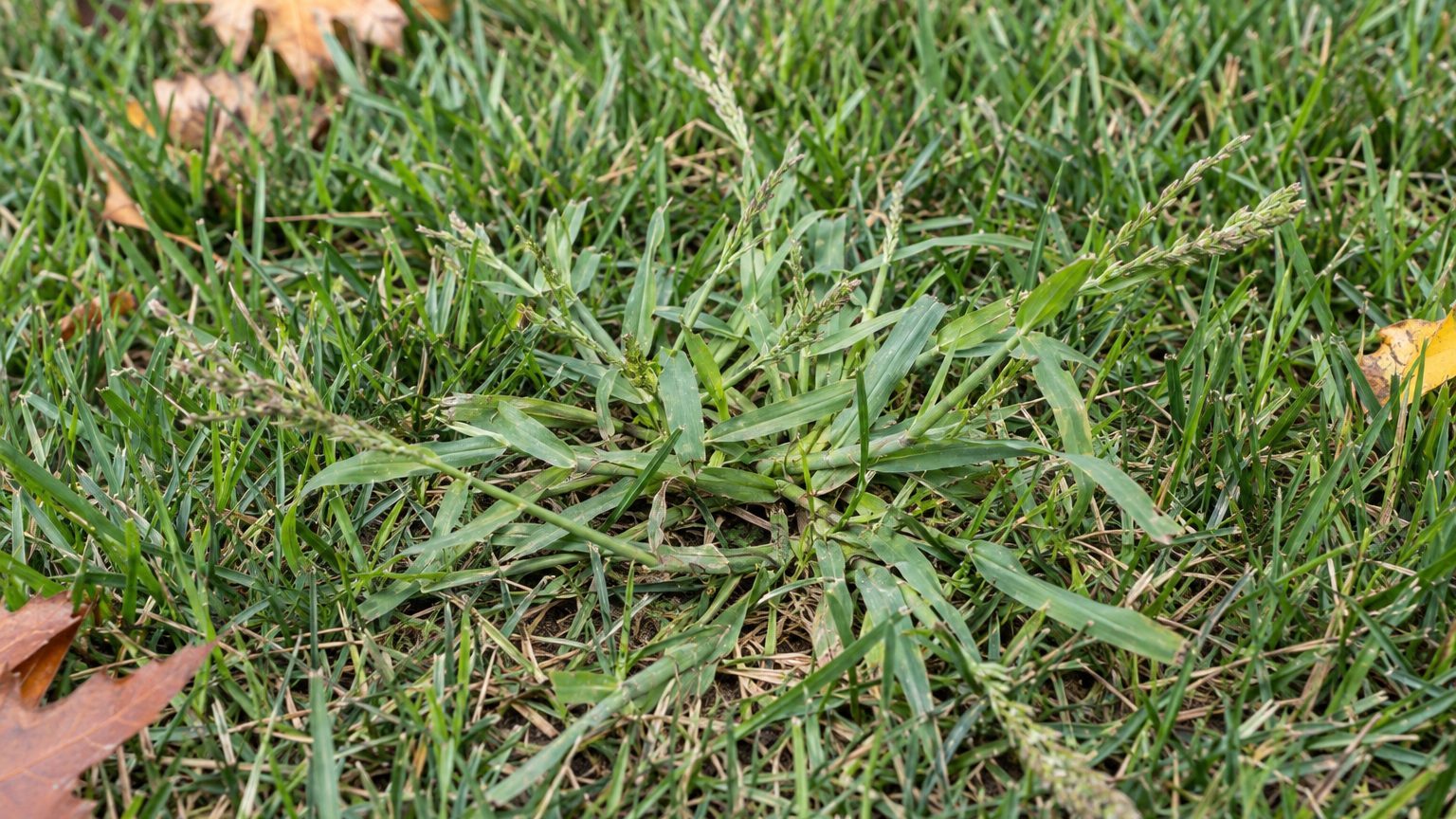
Crabgrass on a lawn

Look first at the seedheads, then at the leaves and the base of the plant.

  • The seedheads look finger-like, with spikes arising from different points at the top of the stem.
  • Large crabgrass has leaves and leaf sheaths covered in dense hairs, so a hand run along the blade feels fuzzy.
  • Smooth crabgrass is hairless and turns purple at the base of the plant.
  • Both kinds sprawl outward from the center in a low, wide clump that stands out against fine, upright turf.
  • Each plant can make thousands of seeds that may germinate the next spring.

Check along sunny edges and thin areas first, since that is where the clumps usually start.

Weeds Mistaken for Crabgrass

Other summer grasses sprawl and seed in much the same way. Telling them apart matters because the timing and the fix are not always the same.

Foxtail can be confused with crabgrass in a lawn, and it gives itself away once it flowers.

Looks like How to tell them apart
Foxtails Late summer seedheads hold bristly awns, and the plants sprout 3 to 4 weeks after crabgrass in New Jersey.

Goosegrass is another sprawler that gets mistaken for crabgrass. In New Jersey, it turns up in hard, compacted soil where foot or equipment traffic is heavy and the turf cover is poor, so a clump growing in a packed path or beside a drive is worth a second look before you decide what it is.

What Causes Crabgrass in Lawns

Crabgrass moves in where the turf is thin and weak. In Iowa, extension guidance points to thin, poorly growing stands as where it becomes a problem, because open soil gives the seed light and warmth with no competition from grass.

Warm soil is the trigger. According to Iowa State University Extension, seeds begin germinating once soil reaches 55°F, and sprouting continues from spring into mid-summer, so new plants keep arriving long after the first flush.

Feeding at the wrong time makes it worse. In New Jersey, nitrogen fertilizer applied from mid-June through mid-August favors crabgrass and other summer weeds more than the lawn grass.

Seed already in the ground keeps the problem going. Seeds stay viable in the soil for several years, so a lawn can keep producing crabgrass after the visible plants are cleared.

How to Get Rid of Crabgrass

Once crabgrass is up, act on small plants and then fix the conditions that let them in.

  1. Pull young plants by hand when the soil is moist, so the roots come out whole and the clump cannot regrow.
  2. Cut and bag any seedheads before they ripen in late summer, so fewer seeds drop into the soil for next year.
  3. Rake out dead clumps and loosen the bare spot, so new grass seed can reach the soil.
  4. Overseed the patch with a grass suited to your region, so turf fills in before more crabgrass can.
  5. Mow the surrounding lawn high and regularly, so the grass shades the soil and holds back new sprouts.
  6. Contact your state’s extension office about herbicides labeled for lawns in your state, and ask when to apply them, since products and timing differ from place to place.

Expect to repeat the work as seedlings emerge from seed already in the soil. The plants die with the first frost, but seed left in the soil can remain viable for several years, so dense turf matters after the visible plants are gone.

How to Prevent Crabgrass

Prevention is mostly a matter of keeping the turf dense and the soil shaded through the months when seed is germinating.

  • In spring, rake away leaves and debris and look for thin areas where crabgrass can start.
  • Once the soil warms, mow at 3-4 inches, which is the height Iowa guidance gives to reduce crabgrass germination.
  • According to Rutgers Cooperative Extension, grasses mowed above 2.5 inches rarely need supplemental irrigation in spring.
  • In late summer, remove any seedheads that appear so the plants cannot refill the soil with seed.
  • After the first frost, rake out the dead plants so the lawn is clear for fall seeding.
  • Repair thin spots with grass suited to your region so dense turf can compete with crabgrass.

Dense turf leaves less open ground for crabgrass the following season.

Common Questions

Which Crabgrass Is More Common in the Northeast?

Smooth crabgrass and large crabgrass are common in the Northeast. In the northeastern and mid-Atlantic regions, smooth crabgrass is more prevalent than large crabgrass.

Does Crabgrass Come Back After Winter?

The plants themselves do not. Crabgrass is a true annual in the northeastern United States, so it sprouts in spring, makes seed in late summer, and dies at the first frost. New plants come from the seed left behind.

When Does Crabgrass Start Growing in New Jersey?

In central and northern New Jersey, it typically germinates in mid- to late April. In the southern parts of the state, it starts in early to mid-April.

Chickweed in Lawns: How to Identify It and Kill It

Chickweed in Lawns: How to Identify It and Kill It

A low, bright green mat that looks fresh while the rest of the lawn sits tired and thin is usually chickweed. It thrives in cool weather and leaves seed behind in the soil. Knowing the plant, and which lookalike you are really facing, decides how you deal with it in your lawn.

How to Identify Chickweed

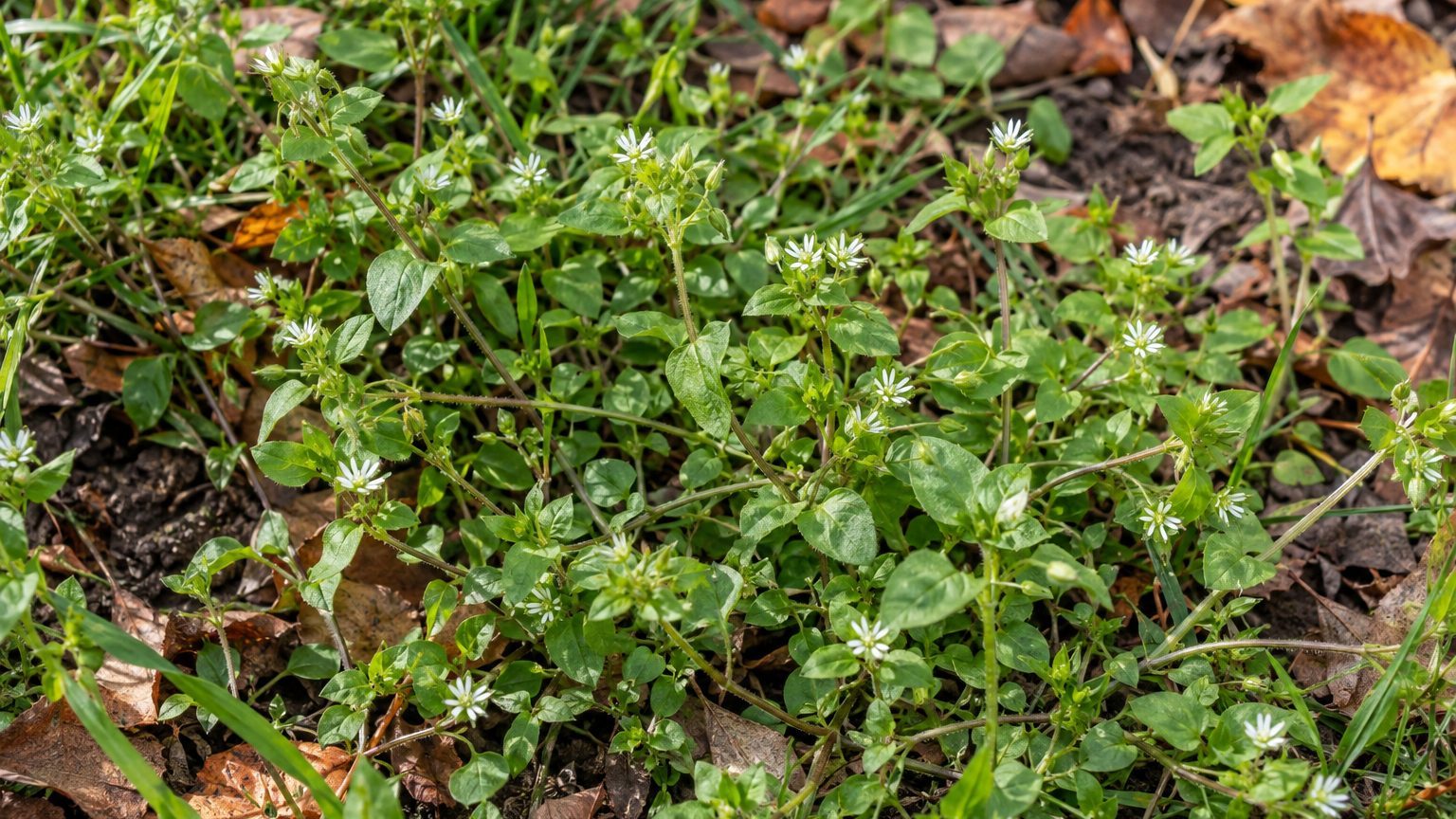
Chickweed in Lawns: How to Identify It and Kill It

Start with the stems, because they give the plant away more reliably than the leaves do.

  • Each stem carries a single vertical line of hairs, which separates common chickweed from its fuzzier relatives.
  • Leaves are small, oval, pointed, and bright green, arranged opposite each other along thin stems.
  • In sun, the plant stays low and sprawling at 3-6″ tall.
  • In shade, it stretches up to 18″ and looks loose and leggy.
  • Creeping stems root where they touch soil, so one plant spreads into a mat.
  • It sprouts in fall and grows through the winter, then sets seed from spring to early summer before dying back.

Those brown, collapsed patches in early summer are often chickweed finishing its season.

Weeds Mistaken for Chickweed

Close relatives share the opposite leaves and mat-forming habit. Telling them apart matters because perennial mouse-ear chickweed can spread from rooted stems, while common chickweed spreads by both seed and creeping stems.

Check the hairs and the stems together. A hand lens helps, and so does gently lifting a runner to see whether it has rooted.

Looks like How to tell them apart
Sticky chickweed Fuzzy, opposite leaves like mouse-ears, and the whole plant is hairy and larger than common chickweed. It is a mat-forming winter annual.
Perennial mouse-ear chickweed Fuzzy leaves like sticky chickweed, plus creeping stems that often take root and start new plants.
Field chickweed Shorter hairs on stems and leaves, and narrower, more linear leaves. Its petals are 2-3 times longer than the sepals, and it is a perennial.

Mouseear chickweed can grow up to about 20 inches long, so a sprawling, fuzzy patch with rooted stems points to it rather than to common chickweed.

What Causes Chickweed in Lawns

Seed is the starting point. Common chickweed sheds it in spring, and in Maryland that seed can stay viable up to 10 years, so a lawn can carry a hidden supply long after you clear the plants.

Open ground gives that seed its chance. In South Carolina, common chickweed commonly infests thin or dormant lawn areas, where grass is not shading the soil or competing for room. In South Carolina, fall germination gives seed room to establish in thin turf.

Conditions matter as well. In Washington, common and mouseear chickweed grow best in cool, moist spots with rich soil. In mild regions, common chickweed grows vigorously in cool weather and produces seeds throughout the winter, so the cycle never fully pauses there.

How to Get Rid of Chickweed

Work in the order below, starting while the plants are still green and growing in the cool season.

  1. Pull small patches by hand when the soil is moist, lifting the whole stem, because pieces left behind can root at the nodes.
  2. Bag the pulled plants instead of composting them, so no rooting stems or seed stay on the lawn.
  3. Treat larger patches with a broadleaf weed killer labeled for chickweed and for your type of grass, since some lawn grasses are harmed by products meant for others.
  4. Read the label for weather limits and application rules, and apply only as directed.
  5. Check the area again later and spot-treat or pull any regrowth, because survivors will keep spreading by creeping stems.
  6. Reseed or patch bare spots once the weeds are gone, so grass fills the gap before new seedlings do.

Timing matters. In South Carolina, control this weed before it produces seed. Your state extension office can tell you which products are labeled in your state and when to apply them.

How to Prevent Chickweed

Prevention follows the weed’s own calendar, from fall germination through seed production from spring to early summer.

  • In Washington, maintain healthy turf so it can compete with chickweed seedlings before they establish.
  • Through fall, walk the lawn and pull tiny seedlings while they are easy to lift.
  • In winter in mild regions, keep checking, because chickweed grows and sets seed all winter there.
  • In early spring, pull or treat any survivors before they flower and set seed.
  • According to Clemson Cooperative Extension, in ornamental beds along the lawn, spread a 2- to 3-inch layer of mulch to suppress germinating weed seeds.
  • In early summer, rake out the dead mats and mow at the height recommended for your grass so the lawn can fill in.

A dense lawn through the cool months leaves chickweed little bare soil to start in.

Common Questions

How Do You Tell Chickweed from Clover in a Lawn?

Look at the leaves and the stems together. Chickweed has simple, oval, opposite leaves along thin trailing stems with a line of hairs, while clover leaves are divided into leaflets that meet at the end of a leaf stalk.

Why Does Chickweed Show Up in a New Lawn?

Young turf is thin, and chickweed favors cool, moist places with rich soil. New lawns are among the spots where common and mouseear chickweed turn up.

Can Chickweed in a Flower Bed Spread to the Lawn?

Yes. It grows in flower beds and ornamental plantings as well as lawns, and it spreads by seed and by creeping stems, so beds and turf can pass it back and forth. Clearing the weed from both keeps the supply down.

Burclover in Lawns: How to Identify It and Kill It

Burclover in Lawns: How to Identify It and Kill It

A patch of low, yellow-green, clover-like leaves can spread across thin spots in the lawn, and its coiled burs can cling to socks and paws. That is burclover, an annual weed that takes over wherever turf is thin. Knowing it on sight makes it easier to remove.

How to Identify Burclover

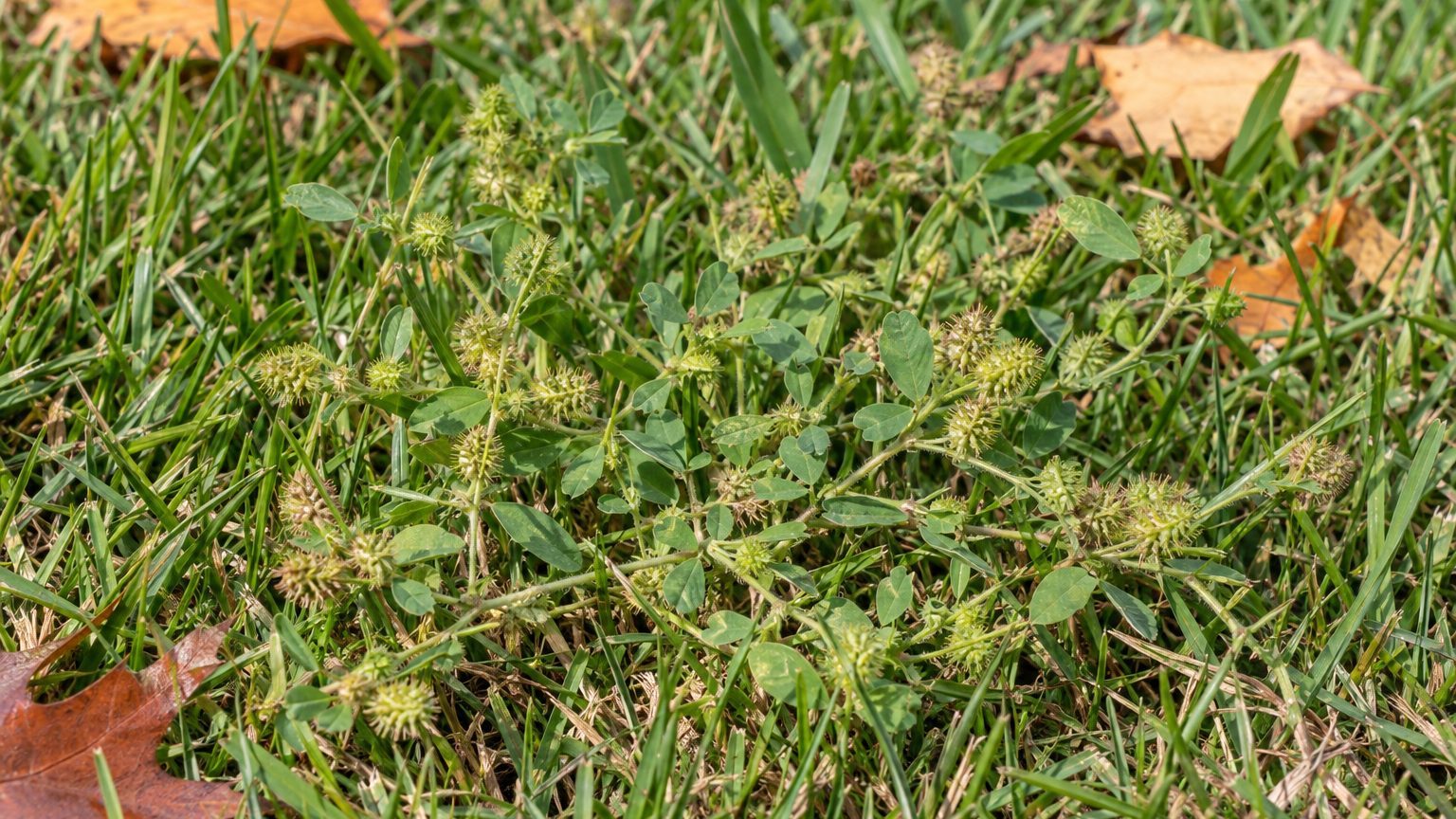
Burclover on a lawn

Start at ground level, because the pods and the way the plant sprawls give it away faster than the leaves do.

  • The seed pod is a flattened, tightly coiled bur, commonly up to 1/4 inch wide, and it often carries small prickles that catch on shoes and fur.
  • Each leaf has small leaflets with finely toothed edges, a look that reads as clover at a glance.
  • Stems radiate from a central crown like spokes, and the plant spreads out 6 to 30 inches in a flat mat.
  • The stems trail along the ground and can reach 2 feet long, though they may rise upright when the plant is crowded.
  • In California, it germinates in fall and continues through winter and early spring.

Finding a coiled pod is a strong sign that the plant is burclover.

Weeds Mistaken for Burclover

Oxalis is commonly confused with clovers, and it grows in many of the same thin, bare spots. A quick look at the leaf stalk and the leaflet tip separates oxalis from burclover.

Looks like How to tell them apart
Oxalis, with leaves in a clover-like arrangement Each leaflet has a more pronounced notch at the top, and there is no stipule (the small leafy flap) where the leaf stalk meets the stem.

Black medic is the other near twin, and plant guides often mix it up with Medicago polymorpha, the burclover in your lawn. Both are annual clovers that cause trouble in turf. Check the pods: burclover makes a coiled bur, while black medic makes tiny dark pods without that spiny coil.

What Causes Burclover in Lawns

Seed is the cause. A well-developed plant can produce more than 1,000 pods, and those seeds wait in the soil until conditions suit them. A thin, stressed lawn gives them room to sprout and spread, which is why bare patches and worn edges fill first.

According to UC IPM, University of California, seeds begin to germinate in fall when soil temperatures are in the 50° to 60°F range, and germination continues through the winter and early spring months. Also in California, high phosphorus in the soil promotes the invasion of clovers, so a soil test before you fertilize is worth the small effort.

The weed is adaptable, too. It is often found along roadsides, disturbed areas, and stream banks, and it tolerates most soil types and moisture levels. Disturbed areas are common places to find it.

How to Get Rid of Burclover

Control can follow a sequence, starting with the plants you can see and ending with the bare ground they leave behind.

  1. Pull young plants by hand when the soil is moist, because the whole crown comes out and the mat cannot regrow from it.
  2. Mow regularly with the bag attached, since cutting the trailing stems keeps the mat from spreading and the bag keeps pods off the soil.
  3. Rake the patch and bag everything, so loose pods and stems do not reseed the area.
  4. Fill the bare spots with grass seed or sod, because a dense lawn leaves little room for the next round of seedlings.
  5. Control options include hand pulling, mowing, and herbicides; ask your state extension office which lawn products and timing fit your area.

Mulch can also control seedlings in planting beds beside the lawn. According to UC IPM, University of California, mulch laid after seedlings have sprouted needs to be 4 to 6 inches deep and cover the plants completely.

How to Prevent Burclover

Prevention follows the weed’s own calendar, since it sprouts in the cool months and sets seed as the weather warms.

  • Repair thin turf so grass can fill the gaps before burclover establishes.
  • Before seeds germinate, lay a 4-inch layer of organic mulch over bare beds beside the lawn, which in California prevents clovers from establishing.
  • In California, scan the lawn edges through winter and early spring and pull seedlings as they appear, since germination continues through those months.
  • Before fertilizing in California, test the soil and skip extra phosphorus if the test shows plenty, because high levels favor clovers.
  • Mow with a bag and clean the mower deck and your shoes after working a weedy patch, so pods do not travel to clean turf.

Use these measures together, and burclover will find very little open ground in which to establish.

Common Questions

Does Burclover Come Back Every Year?

It returns from seed, not from old roots. Burclover is an annual, so the plants die after setting pods, but seed left in the soil can sprout later. Stopping the pods from dropping is what ends the cycle.

Is Burclover the Same as White Clover?

No. Depending on the species, clovers have an annual or a perennial life cycle. Burclover is an annual with coiled pods, so it can be pulled out and kept from reseeding, while a perennial clover keeps coming back from its roots.

Are Burclover Burs a Problem for Pets and Bare Feet?

They can be. The prickly coiled pods stick to fur, socks, and shoe soles, and they are uncomfortable underfoot. Brush pets after a walk across a patch of the weed and clear the pods from the lawn before the play season.

Buckhorn Plantain in Lawns: How to Identify It and Kill It

Buckhorn Plantain in Lawns: How to Identify It and Kill It

A rosette of narrow, ribbed leaves hugging the ground, with a slim stalk topped by a small brown spike, is the signature of buckhorn plantain in a lawn. It settles into thin, dry, worn turf and persists as a perennial. Getting it out means working on the roots and on the conditions that let it in.

How to Identify Buckhorn Plantain

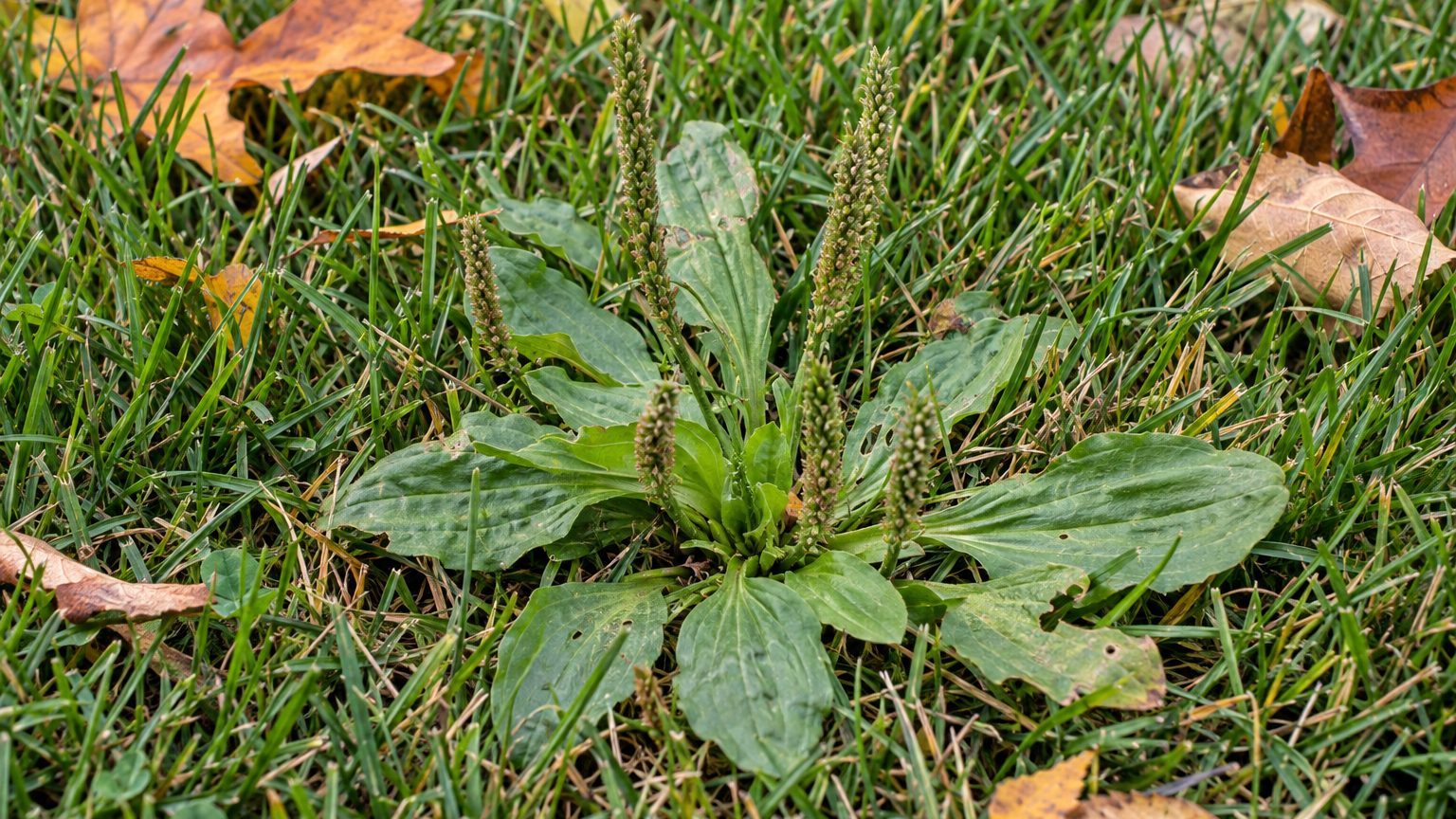
Buckhorn Plantain on a lawn

Look low, at the crown where the leaves meet the soil.

  • The leaves are long and narrow, 3 to 12 inches long, with veins running parallel from base to tip.
  • Each leaf blade merges smoothly into a short stalk, so the plant looks like a flat starburst pressed against the turf.
  • Pull the plant and you will find a taproot heading straight down rather than a mat of fine roots.
  • Slim flower stalks rise 6 to 30 inches tall, and flowers occur from May to October.
  • The seeds are black, shiny, and about 1/16 inch across, small enough to ride in on a mower deck or a shoe.

Because the leaves lie so close to the ground, a plant can look harmless until the stalks stand above the grass.

Weeds Mistaken for Buckhorn Plantain

Broadleaf plantain and bracted plantain can be confused with buckhorn plantain. Broadleaf plantain shares the rosette habit and perennial lifecycle, making it easy to confuse with buckhorn plantain.

Check leaf shape together with growing conditions before deciding.

Looks like How to tell them apart
Broadleaf plantain Wider, oval leaves on a longer stalk, while buckhorn has long narrow leaves that merge into a shorter stalk. Buckhorn also has a taproot and favors disturbed sites.
Bracted plantain (Plantago aristata) Narrow leaves and a similar rosette, but the flower spike carries long, leafy bracts that buckhorn lacks. Check the spike when it forms.

Broadleaf plantain tends to occur in moist, compacted ground, making site moisture a useful clue.

What Causes Buckhorn Plantain in Lawns

Seeds are the starting point. According to UC IPM, University of California: Plantains, the seeds germinate at or near the soil surface once moisture is adequate and the soil reaches 50°F. In California, germination speeds up as soil warms, so bare soil is vulnerable.

Turf conditions decide whether those seedlings survive. Buckhorn plantain is described as better adapted to areas with less irrigation and mowing, and it is treated as an indicator of dry, low-fertility soil. Thin turf, worn paths and edges, and spots where grass struggles give it room.

It also grows best in disturbed sites, unlike broadleaf plantain. Soil churned up by construction, pet traffic, or a bad patch repair is an open invitation. The weed is a perennial, so once a plant roots in, it returns each year and flowers through summer, from May to August or September.

How to Get Rid of Buckhorn Plantain

Because it is a perennial with a taproot, removal is a matter of getting the whole plant and then filling the gap with grass.

  1. Moisten the soil before digging so the taproot is less likely to break.
  2. Dig out each plant with a narrow weeder or knife, cutting well below the crown, since leftover root can sprout again.
  3. Remove flower stalks before they set seed, because the black seeds are what spread the problem to new patches.
  4. Fill the hole with fresh soil and seed or sod, so grass claims the space before new seedlings do.
  5. Cover any bare ground in beds with organic mulch, which in California can control seedlings alone when applied 2 to 4 inches deep.
  6. Repeat the digging regularly, since removing perennial plantain in California must go on for several years to succeed.

Mowing does not help, because the leaves lie too close to the ground to be cut. For herbicide choices registered in your state, ask your state extension office.

How to Prevent Buckhorn Plantain

Dense, well-fed turf helps prevent buckhorn plantain when care is matched to local growing conditions.

  • According to UC IPM, University of California: Plantains, check for thin or bare patches when the soil reaches 50°F and repair them at the locally appropriate time.
  • Keep irrigation and fertility appropriate for the turf because buckhorn plantain is adapted to dry, low-fertility soil.
  • Maintain irrigation and mowing appropriate for the turf, because buckhorn plantain is better adapted to areas with less irrigation and mowing.
  • Remove flower stalks before seeds ripen; flowering begins in May and continues to August or September.
  • Repair ground disturbed by projects with seed or sod at the locally appropriate time so bare soil is not left for seedlings.

Seedlings can take 8 to 15 weeks to reach the next stage, which gives you a real window to spot and pull young plants easily.

Common Questions

Can Buckhorn Plantain Be Killed by Mowing?

No. Mowing passes over the flat rosette, and the plant keeps growing from its taproot. Mowing at a steady height still helps the turf stay thick enough to crowd out seedlings.

Does Buckhorn Plantain Come Back After Digging?

It can, if a piece of the taproot stays in the soil or if seeds are already in the ground. Regular digging for several years is what finally exhausts the population.

Why Does Buckhorn Plantain Grow in the Driest Part of the Yard?

Buckhorn plantain indicates dry, low-fertility soil and grows best in disturbed sites. Where grass thins, bare soil gives plantain room to establish.

The almanac, state by state. Every date on this site comes from a state’s own frost facts and its extension service’s calendar — and says where it comes from.