Skip to content

Hydrangea Pests and Diseases in Alberta

Hydrangea Pests and Diseases in Alberta

In Calgary, the short answer is that hydrangeas fight winter more than they fight bugs. Zone 4a winters kill unprotected flower buds and scorch leaves before any insect gets a chance, while powdery mildew, aphids, and botrytis only show up after a wet or crowded summer.

Hydrangea pests and diseases Alberta: The Short Answer

Bark stripped near the ground

Voles and rabbits tunnel under deep snow all winter and gnaw the bark at the base, girdling the stem below where next year’s growth should start. Wrap the lower foot of each shrub in hardware cloth before the first real snowfall, because bark chewed all the way around usually kills that stem outright.

No flower buds after winter

No flower buds after winter — Hydrangea Pests and Diseases in Alberta

Natural Resources Canada’s Plant Hardiness Site puts Calgary at zone 4a, cold enough that an unprotected bigleaf hydrangea loses its old wood flower buds in most winters. Pick a reblooming or panicle variety instead, or pile mulch over the crown before the ground freezes solid, so next spring’s blooms come from wood that actually made it through.

Leaf edges scorched brown in spring

Leaf edges scorched brown in spring — Hydrangea Pests and Diseases in Alberta

Dry chinook winds pull moisture out of exposed leaves faster than frozen roots underneath can replace it, leaving a papery brown edge by the time growth resumes in spring. Wrap the shrub in burlap or pile loose mulch around it to break the wind, and skip fall pruning that would expose more stem to that drying air.

Yellow leaves with green veins

Yellow leaves with green veins — Hydrangea Pests and Diseases in Alberta

Alberta’s alkaline prairie soil locks up iron before hydrangea roots can use it, turning new leaves yellow while the veins stay noticeably dark green. A simple soil test tells you the actual pH, and a chelated iron drench applied to the roots usually greens the leaves back up within a few weeks.

Sticky curled new leaves

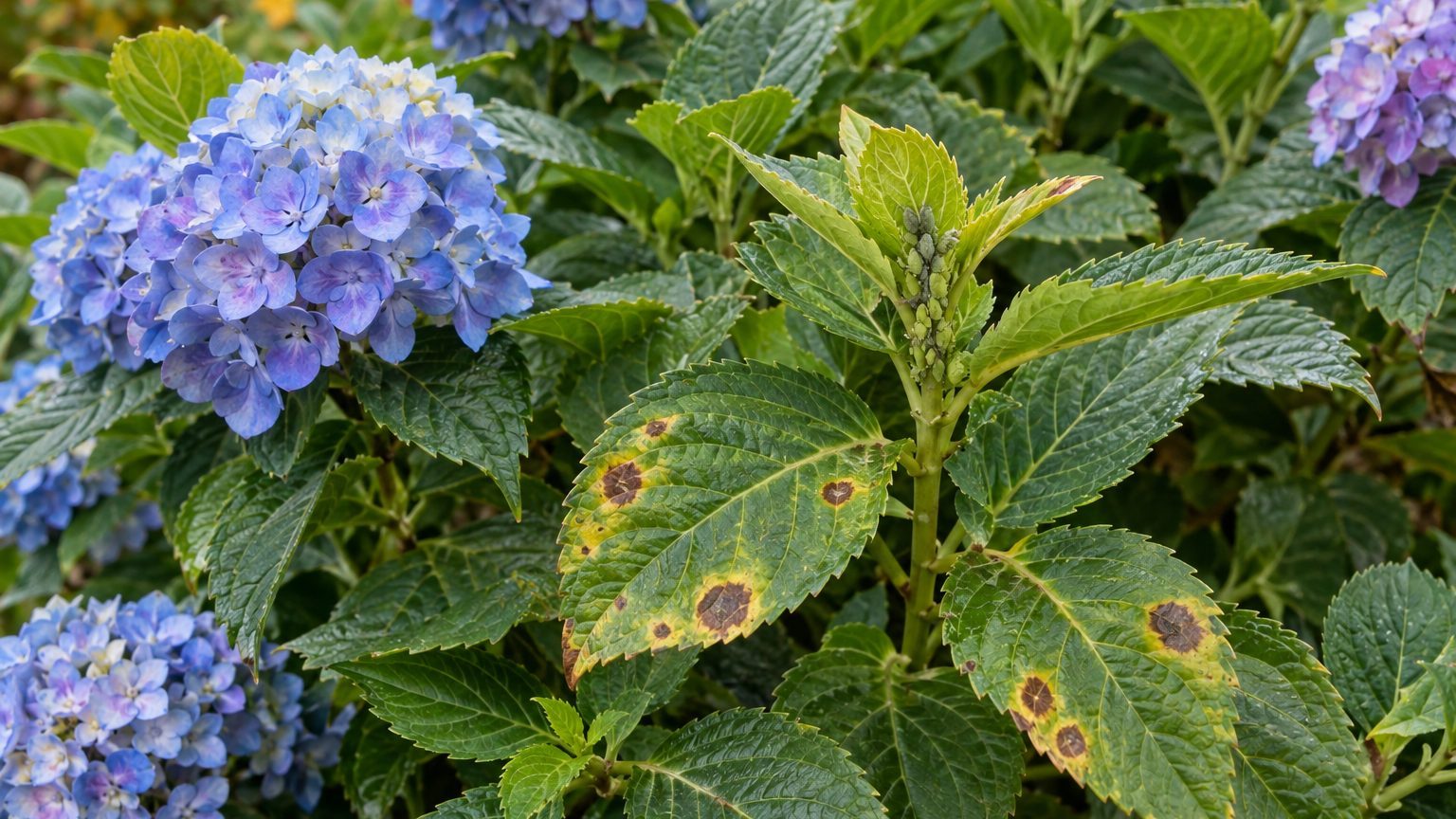
Aphids cluster on tender spring growth and leave behind a sticky honeydew residue that curls the newest leaves inward. A strong jet of water from the hose knocks most of them off, and insecticidal soap handles the rest without hurting the bees working the blooms later in summer.

Purple-brown spots scattered on leaves

Purple-brown spots scattered on leaves — Hydrangea Pests and Diseases in Alberta

Cercospora leaf spot shows up as small purple-brown spots scattered across older leaves after a stretch of humid weather, sometimes causing early leaf drop. Rake up and discard fallen leaves each fall instead of composting them, and water the soil rather than the leaves to keep the fungus from spreading further.

White powdery coating on leaves

Powdery mildew builds up on leaves crowded together in humid August air with poor circulation between the branches. Space plants for airflow, water the soil instead of the foliage, and snip off the worst affected leaves so spores do not spread to the rest of the shrub.

Brown mushy flower clusters after rain

Botrytis blight moves into flower heads that stay wet after a summer storm, turning the petals brown and slimy within a day or two. Cut the affected blooms off right away, and water at the base of the plant instead of overhead so the flowers stay dry.

How to Work Out the Dates for Your Own Yard

I work backward from Calgary’s own frost window instead of trusting a bag tag, and most of these problems sort themselves out by the calendar rather than by guesswork.

  1. Mark the average last frost: Environment and Climate Change Canada’s Canadian Climate Normals put Calgary’s mean last spring frost at May 21, but that is a midpoint, since frost lands later than that in half of all years.
  2. Wait two extra weeks before judging leaf scorch: brown edges that show up before early June are almost always winter desiccation, not disease, since fresh growth has not even had time to get infected yet.
  3. Scratch the bark in late April: green underneath means the stem is alive even with no visible buds, so hold off on cutting anything back until new growth actually appears.
  4. Check new growth by June for aphids: curled, sticky leaf tips this early point to insects, while spotting or powder this early is rare before the air turns humid.
  5. Watch for the first fall frost: the same station puts the average at September 16, so any fertilizing after July risks new growth that never has time to harden off.
  6. Test soil pH once a season: a reading above 6.5 explains yellow leaves faster than any pest search does, and it points straight at the fix.

None of these dates are a guarantee, they are the middle of a range, and the actual day in your yard depends on the microclimate around your house as much as the calendar.

Alberta North to South: How the Dates Shift

Calgary’s numbers are one point on a large map, and moving across the province shifts every date in this guide by weeks in either direction.

  • Southern Alberta and the Chinook belt (Lethbridge, Medicine Hat, Calgary): frequent winter thaws break dormancy early and then refreeze it, which raises the desiccation and bud kill risk above rather than lowering it.
  • Central Alberta (Red Deer, Edmonton): colder, steadier winters without the same thaw and freeze swings mean less scorch, but the frost free season itself runs shorter, so bud survival is not any easier.
  • Northern Alberta and the Peace Country (Grande Prairie, Peace River): an even shorter frost free stretch and drier air keep powdery mildew rare, while winter dieback stays the dominant problem all the way north.
  • The foothills and mountain valleys (Canmore, Banff): elevation adds harder, earlier frosts on top of the provincial averages, making bud loss and bark damage the two problems to plan around first.

Check the Alberta guide page for this province’s own frost dates before deciding how much winter protection your yard actually needs.

Mistakes Alberta Punishes

Planting bigleaf without any winter cover

Bigleaf hydrangea blooms on the previous year’s wood, and Calgary’s zone 4a winters kill that wood if it sits exposed. Choose a panicle or smooth variety instead, or commit to mounding mulch over the crown every fall, since skipping this step is the single biggest reason for a shrub with leaves but no flowers.

Pruning bigleaf in September or October

Cutting back bigleaf stems in fall removes next year’s flower buds along with the growth, since this variety only flowers on wood grown the year before. Keep pruning inside the June and July window instead, and remove only what is clearly dead once new growth shows where it stopped.

Fertilizing after the July window closes

A late feeding pushes soft new growth that has no time to harden before frost, and Environment and Climate Change Canada’s Canadian Climate Normals put Calgary’s average first fall frost at September 16. Stick to the May and July fertilizing windows only, and let the plant slow down naturally through August.

Alberta Extension Offices and County Contacts

Calgary’s frost dates and zone 4a rating are a province wide starting point, not a diagnosis for your particular yard. Alberta Agriculture and Irrigation and your county’s horticulture desk fill in the rest, from a soil test to a look at whatever is eating your leaves.

  • Alberta Agriculture and Irrigation: the provincial extension service for soil testing, pest identification, and horticulture questions specific to your county.
  • Your province guide: the frost dates and hardiness zone for wherever you garden in Alberta.
  • The Alberta planting calendar: month by month planting, fertilizing, and pruning windows for this province.

Bring a photo of the actual leaf or stem when you call, it settles the diagnosis faster than any guide ever will.

Common questions

Do hydrangeas survive Alberta winters without protection?

Bigleaf types rarely do, since Calgary sits at zone 4a and its old wood buds are not built for that cold. Panicle and smooth hydrangeas, which flower on new wood each year, come through far more reliably without a wrap.

What is the most common hydrangea problem in Alberta?

Winter dieback and the resulting lack of flowers show up far more often here than any insect or fungal issue, simply because so many winters dip past what bigleaf wood can take.

When should I check for pest damage versus winter damage?

Wait until at least the average last frost in mid to late May before judging a shrub, since anything showing before then is almost certainly cold and wind, not insects or disease.
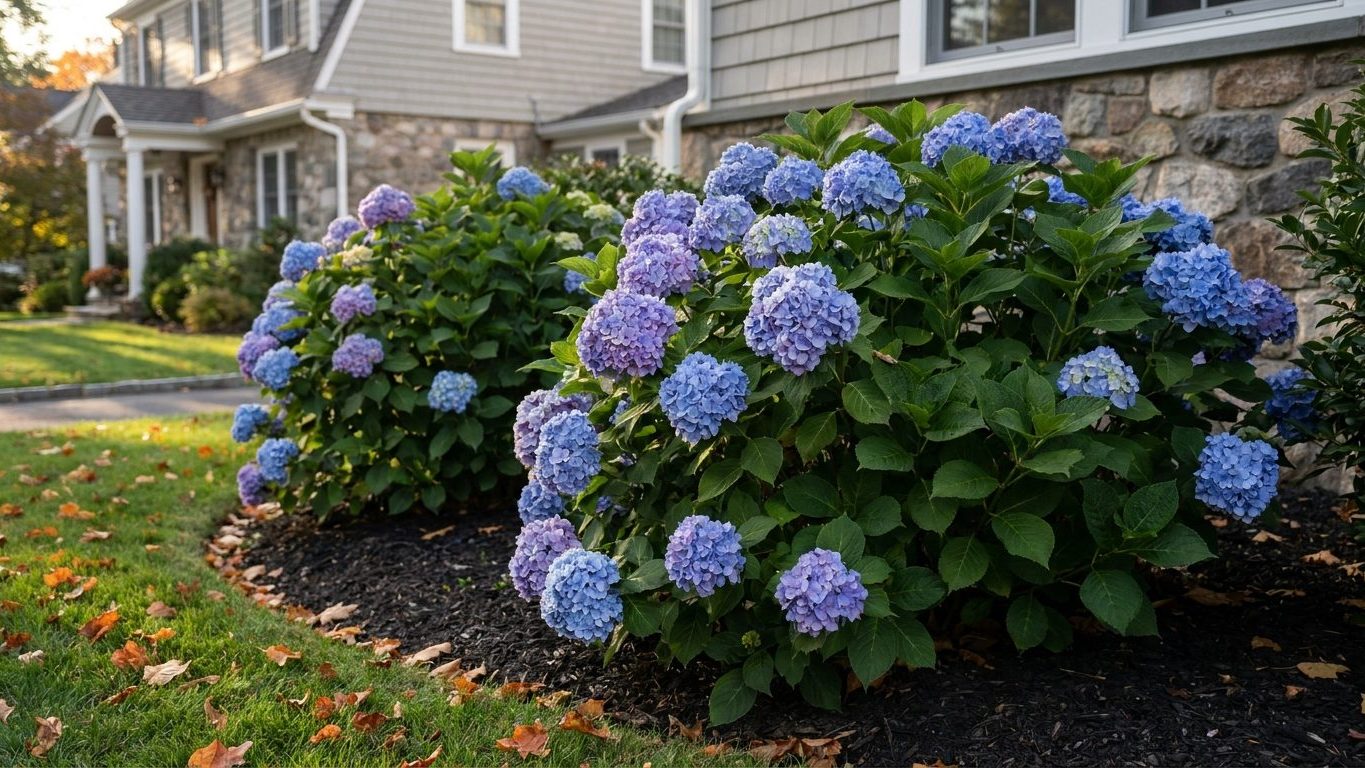
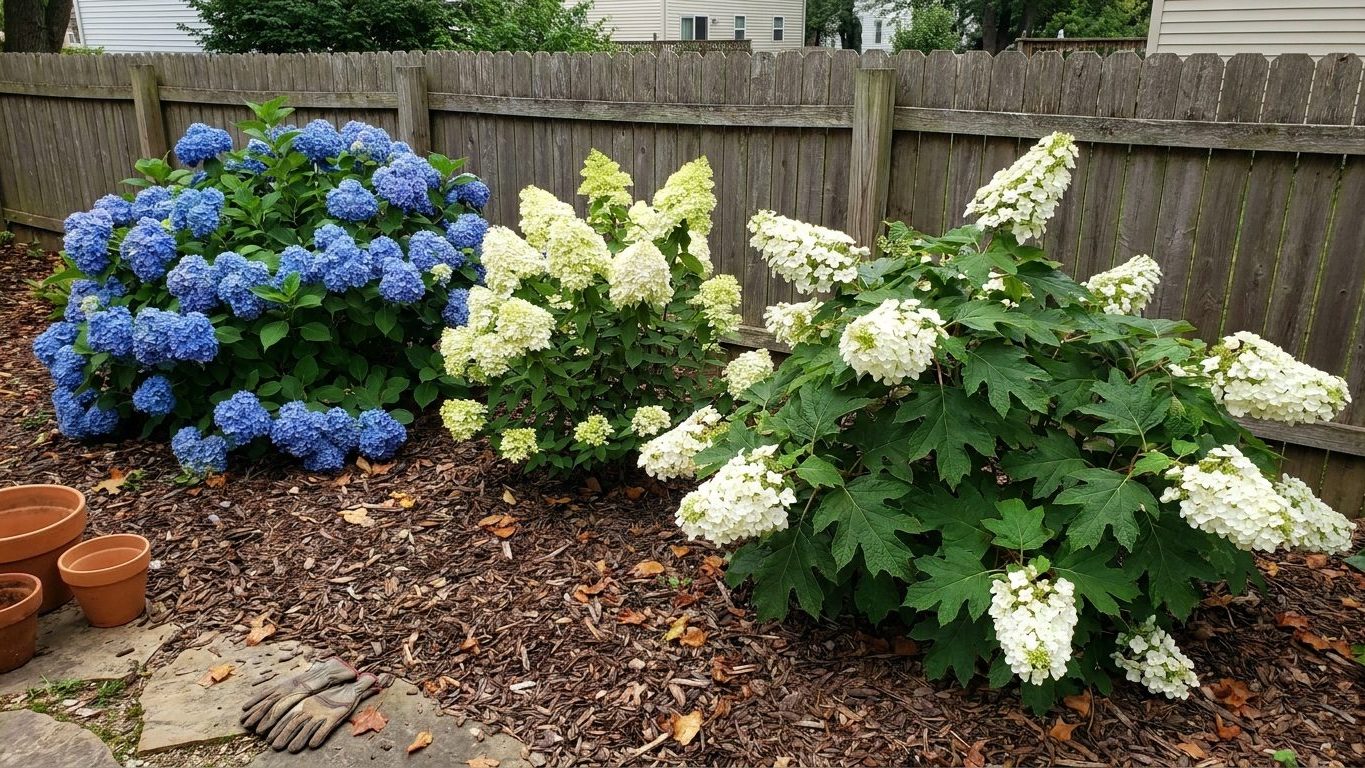
When to Prune Hydrangeas in Connecticut

When to Prune Hydrangeas in Connecticut

Connecticut homeowners get two safe windows for planting hydrangeas: spring, once the last frost has passed, and late summer running into early fall, well before the ground cools for good. Near Bridgeport, that translates to April through May or August into September, with bigleaf varieties needing their old-wood pruning finished by early July, not later in the season.

When to prune hydrangeas in Connecticut: The Short Answer

Near Bridgeport, the state’s mildest station, NOAA NCEI 1991-2020 Climate Normals put the last spring freeze between April 2 and April 12, the earliest safe date to move hydrangeas into the ground. The first fall freeze follows between October 28 and November 10, closing the second planting window before new roots can settle in.

  • January: The ground stays frozen or nearly so this deep in winter, so there’s no digging and no pruning. Check that mulch over the root zone hasn’t blown away, since bare crowns take the brunt of any freeze-thaw cycle.
  • February: Buds are still tight and the last frost is two months off, so hold off on any cuts. Order new plants now so they arrive once the April window opens.
  • March: This is the first fertilize month of the year, feeding roots as they wake up ahead of the April freeze cutoff. Skip pruning bigleaf stems now, their flower buds are already set from last summer.
  • April: Planting opens once frost risk clears between April 2 and April 12 near the coast, later inland. Set new hydrangeas in the ground as soon as the soil has dried enough to work.
  • May: A second fertilize month and still a planting month, with the shrub in full leaf and frost risk essentially gone. New plantings from April should show fresh growth by now.
  • June: The pruning window opens for bigleaf hydrangea, right as the season’s first blooms start to fade. Cut spent flower heads back to a healthy bud, never into old wood below it.
  • July: The last month to prune bigleaf hydrangea and the third fertilize month, since next year’s buds form on the stems shortly after. Finish any pruning early in the month rather than late.
  • August: The fall planting window opens, giving roots time to establish before the October frost returns. Water new plantings deeply through any late-summer dry spell.
  • September: The last safe month to plant, since roots need roughly six to eight weeks in the ground before the first fall freeze. Get anything new into the soil early in the month.
  • October: The first fall freeze arrives between October 28 and November 10, so stop planting and stop fertilizing by now. Apply a fresh layer of mulch before the ground hardens.
  • November: By the later dates in this window, frost has likely already hit inland yards even where the coast is still clear. Finish winter mulch over the crown of bigleaf varieties before the ground freezes solid.
  • December: The shrub is fully dormant now, so there’s nothing to prune and nothing to plant. Check that winter mulch and any windbreak stakes are still holding after the first real storms.

That’s the shape of a Connecticut year for hydrangeas, but every date shifts earlier or later depending on how close you sit to Long Island Sound.

How to Work Out the Dates for Your Own Yard

Your own yard rarely matches the coastal gauge in Bridgeport, so treat the state figures as a starting point and adjust for what you actually see outside your door.

  1. Start with the coastal frost range: NOAA NCEI 1991-2020 Climate Normals set Bridgeport’s last spring freeze at April 2 to April 12, a fair floor for anyone near the shoreline.
  2. Add time for elevation and distance from the Sound: inland and northwest towns often trail that coastal date by two to three weeks, pushing safe planting into late April or early May.
  3. Check the soil before the calendar: dig down a few inches, if it crumbles instead of holding together in a cold clump, the ground has warmed enough to plant.
  4. Count backward from the fall freeze too: the first freeze runs October 28 to November 10 at the coast, so work back roughly eight weeks to find the last safe date for new roots.
  5. Let the variety adjust your buffer: a panicle hydrangea shrugs off a frost that would blacken young bigleaf growth, so build in less margin for the tougher species.
  6. Keep your own log: write down the date buds broke and the date the first hard freeze hit your yard, then use that instead of the station average next year.

Panicle hydrangea rides out this entire hardiness range without protection, while bigleaf varieties pushed past zone 7a can lose their flower buds to a February thaw and freeze cycle. If leaves scorch by August, check soil moisture before blaming a pest, since heat and drought cause most of the state’s problems.

Connecticut North to South: How the Dates Shift

Move away from the Long Island Sound coastline and every date in this guide gets tighter, since elevation and distance from open water are what actually set local frost timing.

  • The Long Island Sound coast (Fairfield, New Haven, and New London counties): the mildest ground in the state, with the latest fall freeze and the earliest spring one, stretching both ends of the planting window.
  • The Central Valley (Hartford, Middletown, and the Connecticut River lowlands): a few degrees cooler than the shoreline, so treat coastal dates as a floor rather than a fixed target here.
  • The Northwest Hills (Litchfield County’s higher elevation towns): the coldest ground in Connecticut, where frost lingers into May and returns well before Halloween, shrinking every planting window.
  • The Northeast Corner (Windham County): exposure similar to the hills, with cold air pooling in low valleys overnight even on days that feel mild.

None of this collapses into one statewide date, so use the state guide as a baseline and shift it toward the hills or the shoreline depending on where your yard actually sits.

Mistakes Connecticut Punishes

No flowers despite a healthy shrub

Pruning bigleaf hydrangea any time after July removes buds already set for next summer, since this species blooms on old wood. Hold pruning to the June and July window and skip the fall cleanup on this one variety.

Blackened new growth in April

Setting plants out before the last frost clears leaves new growth exposed to a freeze that can strike as late as April 12 near the coast, later inland. Wait for the soil to warm and hold off feeding until March at the earliest.

Flower buds gone after a mild winter

A warm stretch in January or February can trick bigleaf hydrangea into breaking dormancy early, then a hard freeze afterward kills the buds before summer arrives. Leave mulch over the crown in place through winter instead of clearing it at the first thaw.

Connecticut Extension Offices and County Contacts

The Bridgeport figures above are a starting point, not a forecast for one specific yard. County offices under UConn Extension track local frost dates, soil tests, and pest reports that a statewide average can’t capture.

  • Your state page: the frost dates and the pruning window where you live.
  • Which ones hold up here: the varieties worth planting in Connecticut, ranked from safest to riskiest.
  • What goes wrong here: the pests and problems that actually show up on Connecticut hydrangeas, in season order.

Start with your county’s extension office before you buy anything this season.

Common questions

Can I plant hydrangeas in Connecticut in the fall?

Yes, late summer into early fall is the second planting window, running through September, timed to give roots six to eight weeks in the ground before the first fall freeze arrives.

When should I prune bigleaf hydrangeas in Connecticut?

Prune bigleaf hydrangea in June or July, right after the blooms fade, since this species sets next year’s flower buds on the stems shortly after, and any later cut removes them.

What USDA zone is Connecticut for hydrangeas?

The USDA Plant Hardiness Zone Map places Connecticut between 6a and 7b, a range wide enough that a variety rated hardy at the coast can still struggle in the northwest hills.

Hydrangeas That Grow Well in Alaska

Hydrangeas That Grow Well in Alaska

Smooth hydrangea and panicle hydrangea are the two types that actually bloom reliably in Anchorage yards, because both set their flower buds on new wood each spring rather than on stems that have to survive an Alaska winter. Bigleaf and oakleaf types, the ones filling mail-order catalogs, mostly fail here. The difference comes down to where the flower bud forms, not how pretty the tag photo looks.

Hydrangeas that grow well in Alaska: The Short Answer

Anchorage sits at the mild edge of Alaska’s growing conditions, but the USDA Plant Hardiness Zone Map 2023 still places the whole state, including its most populated city, within a 1a to 8a range that rules out most nursery hydrangeas.

Two genera handle that cold reliably in local yards: smooth hydrangea and panicle hydrangea, both of which set their flower buds on stems grown fresh each spring rather than on wood that must survive an Alaska winter intact.

Hydrangea arborescens ‘Annabelle’ (smooth hydrangea)

Hydrangea arborescens 'Annabelle' (smooth hydrangea) — Hydrangeas That Grow Well in Alaska

This is the safest bet in Anchorage yards. It blooms on new wood, so even a hard winter that kills the top growth back to the ground still leaves a shrub full of white mophead flowers by August. Full sun and steady moisture through the short summer matter more here than any winter wrapping.

Hydrangea arborescens ‘Invincibelle Spirit’ (pink smooth hydrangea)

Hydrangea arborescens 'Invincibelle Spirit' (pink smooth hydrangea) — Hydrangeas That Grow Well in Alaska

A pink-flowered sibling of Annabelle with the same new-wood habit and the same forgiving nature after a hard freeze. It tolerates the dieback-and-regrow cycle without losing a season of bloom. Site it where afternoon shade softens the long daylight of an Anchorage July and August.

Hydrangea paniculata ‘Limelight’ (panicle hydrangea)

Hydrangea paniculata 'Limelight' (panicle hydrangea) — Hydrangeas That Grow Well in Alaska

Panicle hydrangea is the other dependable choice for this climate. It flowers on new wood too, handles a cool, short summer better than bigleaf types ever will, and its cone-shaped blooms fade from green to soft pink as nights cool in late September. It wants full sun to bloom heavily.

Hydrangea paniculata ‘Little Lime’ (dwarf panicle hydrangea)

Hydrangea paniculata 'Little Lime' (dwarf panicle hydrangea) — Hydrangeas That Grow Well in Alaska

A compact version of Limelight that fits smaller Anchorage lots or large patio containers. Its size makes it easy to wheel a pot into an unheated garage for the coldest months, something some gardeners still do even though the straight species usually survives outdoors without help.

Hydrangea anomala subsp. petiolaris (climbing hydrangea)

Hydrangea anomala subsp. petiolaris (climbing hydrangea) — Hydrangeas That Grow Well in Alaska

This one is riskier here than the others. It can survive against a sheltered, south-facing wall where reflected heat stretches its short growing season, but an open bed rarely gives it enough warmth to set flower buds reliably year after year. Treat it as an experiment, not a foundation planting.

Hydrangea macrophylla (bigleaf or mophead hydrangea)

Hydrangea macrophylla (bigleaf or mophead hydrangea) — Hydrangeas That Grow Well in Alaska

This is the one to skip. Alaska’s 1a to 8a range runs cold enough that Anchorage, even as one of the state’s milder pockets, falls short of the warmth this old-wood bloomer needs to keep its flower buds alive over winter. Expect a green shrub with no blooms most years.

How to Work Out the Dates for Your Own Yard

Your own planting and pruning dates start from Anchorage’s frost window, not from a date printed on a seed packet.

  1. Mark your last spring frost window: NOAA NCEI 1991-2020 Climate Normals puts it at May 3 to May 12 for the Anchorage station, so treat the earlier date as your safety line if your yard sits in a low spot that holds cold air.
  2. Count forward to the site’s plant months: the calendar for this state lists May, June, July, and August as safe planting months, which lines up with soil that has finally warmed past that frost window.
  3. Give new smooth hydrangea growth until June: Annabelle-type plants that froze back to the ground over winter need until early summer to leaf out fully, so don’t judge a shrub dead before late June.
  4. Fertilize on the site’s two windows: May and July give roots and new stems a boost right when the plant is actively building the wood that will carry this year’s flowers.
  5. Prune bigleaf types only in June or July: the site’s calendar limits that cut to those two months, after the risk of a late freeze has passed and before next year’s buds start forming.
  6. Work back from the first fall frost: that window falls between September 22 and October 1, leaving roughly 143 frost-free days total, so stop heavy fertilizing by mid-August to let new growth harden off.

Annabelle survives this cycle every year, dying back hard some winters and still flowering by August. Bigleaf hydrangea doesn’t: its flower buds form on old wood the previous fall, and an Anchorage winter kills them long before summer, which is why the shrub might live but rarely blooms.

Alaska North to South: How the Dates Shift

Alaska’s frost dates and growing conditions shift dramatically depending on where you garden, even though this guide uses Anchorage as its reference point.

  • Southeast panhandle (Juneau, Sitka, Ketchikan): coastal moisture and milder winters push the frost dates later into fall and earlier into spring than most of the state, giving smooth and panicle hydrangeas a longer season.
  • Southcentral coast (Anchorage, Kenai, Homer): the reference conditions, with some of the mildest inhabited winters outside the panhandle and a frost-free season long enough for reliable panicle hydrangea bloom.
  • Interior (Fairbanks, the Denali area): colder winter extremes and a shorter frost-free season push both hydrangea types toward containers or a sheltered south wall rather than an open bed.
  • North Slope and far north (Utqiagvik and Arctic villages): the frost-free season shrinks to almost nothing, and outdoor hydrangeas of any kind aren’t a realistic yard plant there.

Check the state calendar page for the frost window that actually matches your part of Alaska before you commit to a planting date.

Mistakes Alaska Punishes

Buying a mophead for the flower color

Bigleaf hydrangeas fill garden center displays because they ship well in bloom, but their flower buds form on wood grown the previous year, and an Anchorage winter kills that wood before spring arrives. Choose Annabelle or a panicle type instead, since both flower on new wood and shrug off our winters.

Pruning outside the June to July window

Cutting back stems in fall or early spring removes wood that was about to push new growth, delaying bloom by weeks in a season that’s already short. The site’s calendar limits bigleaf pruning to June and July for exactly this reason, after frost risk drops and before next year’s buds begin forming.

Skipping fall mulch over the crown

Top growth is expected to die back most winters here, but an unmulched crown can freeze deep enough to kill the roots too, and a dead crown means no shrub at all next spring. Pile several inches of shredded bark or leaf mulch over the base before the ground freezes solid.

Alaska Extension Offices and County Contacts

USDA NIFA’s Land-Grant University Extension directory names the University of Alaska Fairbanks Cooperative Extension Service as the state’s contact point, and its county and district offices know local frost pockets a statewide range can’t capture.

  • Your state calendar page: the exact frost dates and month-by-month pruning and fertilizing windows for Alaska.
  • UAF Cooperative Extension Service: county offices that can confirm your local microclimate before you plant.
  • What goes wrong here: the pests and problems specific to hydrangeas in Alaska yards.

Call the district office nearest you before you dig, since one conversation can tell you whether your yard runs colder or milder than the citywide average.

Common questions

Can I grow bigleaf hydrangea in Anchorage at all?

Only with heavy protection, and even then bloom is unreliable. Its flower buds form on old wood, and Anchorage winters routinely kill that wood before spring, which is why smooth and panicle types are the safer starting point for most yards.

When is the best month to plant a new hydrangea in Alaska?

The site’s calendar lists May through August as safe planting months here, once soil has warmed past the last spring frost window. Planting earlier in that range gives roots more time to establish before the first fall frost arrives.

Do hydrangeas need winter protection in Alaska?

Smooth and panicle types don’t need wrapping, since they’re expected to die back and regrow from the base each year. A layer of mulch over the crown before the ground freezes matters more than protecting the top growth.

Hydrangea Pests and Diseases in British Columbia

Hydrangea Pests and Diseases in British Columbia

In Vancouver’s cool, wet coastal climate, the hydrangea problems that show up most are slug damage on new spring shoots, aphids on tender growth, and powdery mildew or Botrytis blight once summer humidity settles in. Bigleaf hydrangeas, the province’s most common variety, sit in Canadian hardiness zone 9a here and stay leafy long enough into fall for these fungal problems to matter each year.

Hydrangea pests and diseases British Columbia: The Short Answer

Slugs and snails on new shoots

Environment and Climate Change Canada’s Canadian Climate Normals put Vancouver’s average last spring frost at March 18, and slugs reach tender new hydrangea shoots within weeks of that thaw. Look for ragged holes and silvery trails on the lowest leaves. Handpick after dusk or ring the crown with grit, then recheck after rain.

Aphids on new growth

Aphids cluster on soft new tips soon after leaves unfurl, curling foliage and leaving a sticky residue that draws ants. A strong water spray most mornings knocks the colony down before it builds. Ladybugs and lacewings usually arrive on their own within a week or two if no broad insecticide has been used.

Botrytis blight in cool, damp spells

Botrytis blight in cool, damp spells — Hydrangea Pests and Diseases in British Columbia

Cool, damp stretches in spring and again in fall turn flower buds and stem tips mushy and gray-brown, especially after a run of overcast days. Prune out affected tissue as soon as it appears and dispose of it away from the bed. Space plants for airflow and avoid wetting foliage late in the day.

Powdery mildew in summer humidity

Powdery mildew in summer humidity — Hydrangea Pests and Diseases in British Columbia

A white, flour-like coating spreads across older leaves once summer humidity settles in along the coast, usually worse on plants crowded against a fence or wall. Thin nearby growth to let air move and water the soil rather than the leaves. A weekly baking-soda or milk spray can slow a mild case.

Cercospora leaf spot late in the season

Cercospora leaf spot late in the season — Hydrangea Pests and Diseases in British Columbia

By late summer, small purple-brown spots with yellow halos show up on lower leaves and the plant may drop them early. It rarely kills a hydrangea but it weakens next year’s buds if it repeats. Rake up and bin fallen leaves each fall rather than composting them at home.

Spider mites during a dry summer spell

Spider mites during a dry summer spell — Hydrangea Pests and Diseases in British Columbia

Fine stippling and a dusty, pale look on leaves during a dry August stretch usually points to spider mites, worse on plants stressed for water near a hot wall. A hard spray of water on the underside of leaves every few days breaks up the colonies. Consistent watering through the dry stretch keeps pressure low.

How to Work Out the Dates for Your Own Yard

Vancouver’s average frost dates are only a starting point, but a short countdown from them tells you which pressure matters most where you actually garden.

  1. Mark your last frost: Environment and Climate Change Canada’s Canadian Climate Normals put Vancouver’s average last spring frost at March 18, so count back three to four weeks from there to know when slugs and aphids typically start.
  2. Mark your first fall frost: the same normals put it at November 10 here, which sets the outer edge for late-season Botrytis and leaf spot before growth shuts down.
  3. Watch what’s already on the leaf: holes and slime mean slugs, a white coating means mildew, gray fuzz on buds means Botrytis, match what you see to the order above rather than guessing.
  4. Check the calendar windows for your yard: fertilize in March, May, or July, plant in March, April, September, or October, and prune bigleaf types in June or July, using the calendar page for your street.
  5. Pick a variety that matches your problem history: if mildew or Botrytis keeps returning, the varieties page lists which types shrug off damp, crowded coastal beds.

None of this replaces a look at your own shrub, since a south-facing wall or a shaded corner can shift every one of these dates by two or three weeks either way.

British Columbia North to South: How the Dates Shift

A single province still covers a wide range of coastal, valley, and mountain conditions, and each one nudges these dates a different way.

  • South Coast and Lower Mainland (Vancouver, Burnaby, Surrey): mildest and wettest, closest to the reference dates above, fungal pressure runs highest.
  • Vancouver Island (Victoria, Nanaimo, Tofino): a similar mild pattern, but exposed west-coast sites see even more rain, so slugs and Botrytis linger longer into summer.
  • Fraser Valley and inland pockets (Chilliwack, Abbotsford, Hope): summers run hotter and drier than the coast, favoring mildew flare-ups and spider mites over slugs.
  • Southern Interior and Okanagan (Kelowna, Penticton, Vernon): drier air and a harder winter push the whole calendar later in spring and earlier in fall.
  • Northern BC (Prince George, Terrace, Smithers): a much shorter, cooler season narrows every window above and limits how many pest generations show up at all.

Check the state hub for the exact frost dates and pruning window that apply to your own part of the province before you act on any of this.

Mistakes British Columbia Punishes

Watering the foliage at night

Evening overhead watering leaves hydrangea leaves wet through the cool, humid coastal night, which is exactly what Botrytis and powdery mildew need to take hold. Switch to a soaker hose or water at soil level in the morning instead, and the fungal pressure common on the coast drops fast.

Planting outside the fall window

Environment and Climate Change Canada’s Canadian Climate Normals put Vancouver’s average first fall frost at November 10, and planting after that leaves roots sitting in cold, saturated soil before they can settle in. Stick to the plant window of March, April, September, or October instead, and check the calendar page before digging in late fall.

Skipping the fall leaf clean-up

Fallen leaves and spent flower heads left on the ground through a mild coastal winter carry Botrytis and leaf-spot spores straight into next spring, since a hard freeze rarely visits Vancouver’s yards. Rake and bag diseased leaves each fall rather than composting them at home.

British Columbia Extension Offices and County Contacts

Vancouver’s zone and frost numbers are a starting point only, the Government of British Columbia’s Agriculture and Seafood office and your local garden center fill in what’s specific to your street.

Start with whichever page matches the problem already showing on your shrub.

Common questions

Do I need to spray my hydrangea every year in BC?

Not automatically. Most coastal yards only need action once a symptom actually shows, since a shrub with good spacing and morning watering often gets through a season with nothing more than a leaf rake in fall.

Can I compost blighted or spotted hydrangea leaves?

Home compost piles rarely get hot enough to kill Botrytis or leaf-spot spores, especially in a mild zone 9a winter with no hard freeze. Bag diseased leaves for yard waste pickup instead of adding them to the bin.

Why does my hydrangea get mildew even in part shade?

Shade keeps leaves damp longer after rain or watering, and still air under a fence or wall traps that moisture against the foliage. Thinning nearby growth and watering the soil rather than the leaves usually matters more than the amount of sun the plant gets.

When to Prune Hydrangeas in California

When to Prune Hydrangeas in California

In Los Angeles and most of coastal and Southern California, hydrangeas can go into the ground in nearly any month, because a hard freeze almost never arrives. Across the rest of the state, the safest planting window sits in January, February, October and November, when roots can settle before summer heat or a Sierra frost takes over.

When to prune hydrangeas in California: The Short Answer

California breaks the usual frost-counting rule that works almost everywhere else on this list.

  • January: inside the state’s plant window, cool soil and winter rain help new roots settle with little stress.
  • February: still inside the plant window, the last easy month before spring growth and rising temperatures speed everything up.
  • March: the first fertilize month, feed as new leaves push out after winter dormancy.
  • April: no dated task on the calendar, so watch new growth and keep soil evenly moist as the dry season begins.
  • May: the second fertilize month, a feeding checkpoint before the heat of summer arrives.
  • June: the first month of the bigleaf pruning window, cut back right after the first flush of bloom fades.
  • July: both a fertilize month and the second pruning month, feed and finish any bigleaf pruning before next year’s buds set.
  • August: no dated task, deep watering matters more here than feeding, especially inland where valley heat peaks.
  • September: no dated task, shift to deadheading rather than pushing fresh growth that won’t harden off in time.
  • October: back in the plant window, cooler days make this one of the two best months to set new shrubs.
  • November: the last plant month, get roots in before short days slow growth to a crawl.
  • December: no dated task, a dormant month for minimal water and no pruning, since flower buds for next season are already set.

NOAA NCEI 1991-2020 Climate Normals record zero days at or below 32°F in Los Angeles across three decades, with a frost-free season listed as 365 days. That number explains why the state’s plant window is built around heat and rain, not frost, in most of California, while the Sierra, the Central Valley and Northern California still freeze and follow a different rhythm entirely.

How to Work Out the Dates for Your Own Yard

Without a frost date to count backward from in most of the state, the method here starts with zone instead.

  1. Find your zone first: USDA Plant Hardiness Zone Map places California from 5a in the high Sierra to 11a along the far south coast, and that range tells you whether frost is even a real factor where you live.
  2. Check whether frost applies to you at all: if your yard sits near the coast or in the Los Angeles basin, plan around heat and drought, not cold.
  3. Treat the plant window as protection either way: January, February, October and November give roots time to settle before either summer heat or, inland, a winter freeze arrives.
  4. Use the fertilize months as checkpoints: March, May and July are natural moments to check soil moisture at the same time you feed.
  5. Reserve the pruning window: schedule any bigleaf cutback for June or July, right after bloom, so you never remove next year’s buds by accident.

The core idea is simple. Match your yard’s actual zone number to the state’s plant window, then let that combination, not a generic frost date, decide your calendar.

California North to South: How the Dates Shift

A single state map hides enormous variation once you move from the coast to the mountains.

  • The Sierra Nevada and high inland valleys (Truckee, Mammoth Lakes, South Lake Tahoe): winters here sit at the coldest end of the state’s range, closer to true frost-season gardening than anywhere else in California.
  • The Central Valley (Sacramento, Fresno, Bakersfield): summer heat, not frost, is the main constraint, with occasional winter cold snaps that still matter for new plantings.
  • The coast and Southern California (San Diego, Los Angeles, Santa Barbara): frost essentially never happens, so drought and water restrictions do the work a frost date would elsewhere.
  • The Bay Area and North Coast (San Francisco, Eureka, Mendocino): coastal fog moderates both heat and cold, giving hydrangeas one of the gentlest ranges in the state.

USDA Plant Hardiness Zone Map spans 5a to 11a across these areas, a spread wide enough that a shrub thriving in Eureka can struggle in Bakersfield. For the exact reading where you garden, the state guide breaks the zone down further.

Mistakes California Punishes

Watering on an East Coast schedule

Regular summer rain never arrives here, so a watering habit built for a wetter climate drowns roots instead of feeding them. Switch to deep, infrequent watering timed to the dry season, and let the soil dry slightly between sessions.

Planting outside the window in July heat

New roots set during peak summer heat struggle before they can establish, since the calendar’s plant months sit in January, February, October and November for a reason. Wait for one of those months instead of planting on impulse.

Assuming frost protection is needed everywhere

Coastal and Southern California gardeners sometimes cover shrubs against a freeze that statistically never comes, while Sierra and Central Valley gardeners skip protection they actually need. Match the precaution to your zone, not to habits from somewhere colder.

California Extension Offices and County Contacts

The statewide window above is a starting point, not the final word for your particular yard. University of California Cooperative Extension keeps county-level detail the state figures can’t capture.

  • Your county’s UC Cooperative Extension office: local frost history, soil results, and fog patterns specific to your address.
  • The state guide: the zone range and coastal-to-Sierra breakdown for California in one place.
  • Master Gardener helplines: free, yard-specific answers run through the same UC ANR network.

Call before you buy, and bring your yard’s zone number with you.

Common questions

Can I plant hydrangeas in California in summer?

It’s possible, but the calendar’s plant window skips summer entirely, running instead in January, February, October and November, since new roots set during peak heat struggle to establish before stress sets in.

Do hydrangeas need frost protection in Los Angeles?

No. NOAA NCEI 1991-2020 Climate Normals list a 365-day frost-free season for Los Angeles, so protection efforts there are better spent on shade and deep watering during heat waves.

Why does the same state have such different planting advice?

USDA Plant Hardiness Zone Map spans 5a in the high Sierra to 11a on the far south coast, a range wide enough that frost matters in one part of California and never at all in another.

Hydrangea Pests and Diseases in Colorado

Hydrangea Pests and Diseases in Colorado

Around Denver, hydrangea trouble in Colorado is less about six-legged pests and more about the ground and the air underneath them. Alkaline soil, thin humidity, and a last spring frost that can land anywhere between May 1 and May 11 cause iron chlorosis, scorched leaves, and frost-nipped buds far more often than aphids or fungus. Check the soil and the frost calendar first.

Hydrangea pests and diseases Colorado: The Short Answer

Here’s what actually shows up on hydrangeas in the Denver area, roughly in the order it appears across a growing season, worth checking against before treating for the wrong thing.

Iron chlorosis (yellow leaves, green veins)

Colorado’s soil runs alkaline almost everywhere the USDA Plant Hardiness Zone Map counts from 3b to 7b, and hydrangeas planted in it can’t pull iron from that chemistry. New leaves turn pale yellow while the veins stay dark green. Feed with chelated iron in spring, work sulfur into the soil, and recheck by midsummer.

Winter dieback on stem tips

Winter dieback on stem tips — Hydrangea Pests and Diseases in Colorado

Denver’s last spring frost can land as late as May 11, long after buds have started swelling, and a cold snap that week kills flower buds outright. Stems survive but stay bare. Delay pruning until new growth confirms which wood is alive.

Aphids on new growth

Aphids show up on tender spring shoots once nights warm, clustering under leaves and along stem tips. They leave a sticky residue and curled foliage behind. A strong water spray knocks most colonies off, and insecticidal soap handles the rest before ants start farming them for honeydew.

Powdery mildew on leaves

Powdery mildew appears by midsummer as a white, flour-like coating across leaf surfaces, thriving in the humid spells between Colorado’s dry stretches. It rarely kills the shrub but weakens it. Space plants for airflow, water at the soil line instead of overhead, and remove badly coated leaves.

Spider mites in hot, dry weather

Spider mites in hot, dry weather — Hydrangea Pests and Diseases in Colorado

Spider mites multiply fast once summer heat and low humidity settle in, leaving leaves stippled and dusty with fine webbing on the undersides. They favor stressed, drought-thirsty shrubs. Hose down foliage regularly, keep the root zone consistently moist, and reserve miticide for infestations that persist past a week.

Botrytis blight on flowers

Botrytis blight on flowers — Hydrangea Pests and Diseases in Colorado

Botrytis blight settles into flower clusters during cool, wet fall weather, turning petals brown and fuzzy gray at the base. Overcrowded plantings with poor air movement invite it fastest. Deadhead spent blooms promptly, clear fallen debris each fall, and avoid watering late in the day.

Leaf scorch from wind and sun

Front Range wind and intense high-altitude sun scorch leaf edges brown and papery, especially on shrubs facing west without afternoon shade. It’s a moisture problem, not a disease. Water deeply twice a week during hot spells, and site new plants where afternoon light is filtered.

How to Work Out the Dates for Your Own Yard

Start from Denver’s frost window and count backward or forward depending on the task, since every treatment date hangs off that same range.

  1. Mark your last spring frost: NOAA NCEI 1991-2020 Climate Normals puts it between May 1 and May 11 for the Denver station, so treat early May as a buffer zone, not planting day.
  2. Check for iron chlorosis before you fertilize: if new leaves are already yellowing, skip the May feeding until soil pH is corrected, since fertilizer won’t fix a nutrient lockout.
  3. Watch for aphids once shoots reach two inches: that’s usually a few weeks past the frost window, when tender growth attracts them most.
  4. Scout for powdery mildew through July: humidity spikes during muggy stretches are the trigger, so check leaf undersides after any run of sticky days.
  5. Prune bigleaf types only in June or July: cutting earlier risks removing wood that survived the frost window and would have bloomed.
  6. Count back from October: the first fall frost lands between September 30 and October 12, so stop fertilizing well before then to avoid pushing tender growth into the cold.

Your own yard might run earlier or later than the Denver reference station, especially at higher elevation or in a low frost pocket, so treat these dates as a starting range, not a guarantee.

Colorado North to South: How the Dates Shift

Denver’s frost window sits at one elevation and one climate pattern, but Colorado’s terrain scrambles those dates fast within a few hours’ drive.

  • Front Range and Denver metro (5,280 feet on the plains): the closest match to the reference station, so the May 1 to May 11 window applies most directly here.
  • Western Slope valleys (Grand Junction and similar low basins): milder overall, but cold air still pools overnight, so don’t assume an earlier planting date without checking your own low spots.
  • High mountain towns (Leadville, Breckenridge, and similar elevations): frost can arrive even in July, shrinking the safe window far below what Denver sees.
  • Eastern Plains: wind exposure without the foothills as a buffer scorches hydrangea leaves earlier and harder than in sheltered Denver yards.

Mistakes Colorado Punishes

Planting before the frost window closes

Setting out hydrangeas in April, before Denver’s last frost clears between May 1 and May 11, invites bud kill on the first cold snap. Wait until the planting months open in May, and check a week of forecasts first.

Fertilizing on the wrong schedule

Feeding hydrangeas outside Colorado’s May and July fertilizing window pushes soft new growth into a cold snap or a dry August stretch. Stick to those two months only, and skip fertilizer entirely in a drought year until soil moisture recovers.

Pruning bigleaf too early

Cutting back bigleaf hydrangeas before June or July removes wood that survived winter and was about to bloom. Wait for new leaves to confirm which stems are alive, then prune only in the window the calendar allows.

Colorado Extension Offices and County Contacts

Denver’s frost window is a solid starting point, but county offices and the state extension service fill in what your specific soil, elevation, and microclimate actually need.

  • Colorado State University Extension: extension.colostate.edu lists county offices, soil testing, and plant clinics across the state.
  • Your county extension office: local agents know the frost pockets and soil pH quirks a statewide map can’t capture.
  • Your state page: the frost dates and the calendar months for fertilizing, planting, and pruning where you live.

Call before treating anything for a suspected disease, a quick soil test often changes the diagnosis entirely.

Common Questions

Are hydrangeas prone to disease in Colorado’s dry climate?

Less than in humid states, but not immune. Powdery mildew and botrytis blight still appear during Colorado’s occasional wet or humid stretches, especially on crowded plantings with poor airflow.

Why do my hydrangea leaves turn yellow every summer?

That pattern almost always points to iron chlorosis from alkaline soil, not a pest or a virus. Chelated iron and a lower soil pH usually clear it within one growing season.

Do I need to spray for pests every year?

Most Colorado yards don’t. Aphids and spider mites show up in uneven years tied to weather, so scout first and treat only when you find an actual infestation rather than spraying on a fixed schedule.

When to Prune Hydrangeas in Colorado

When to Prune Hydrangeas in Colorado

Plant hydrangeas in Denver once the last spring frost has passed, in the window of May 1 to May 11, or hold off until late summer and get them in before the first fall frost arrives between September 30 and October 12. Pruning depends on the shrub, not the calendar, since old-wood and new-wood bloomers respond to cuts in opposite ways.

When to prune hydrangeas in Colorado: The Short Answer

In Denver, the safest planting dates sit right after the last spring frost window of May 1 to May 11, or in the cooler weeks before the first fall frost, September 30 to October 12, so roots have time to grip the soil before either heat or cold takes over.

Neither window is a single date. NOAA NCEI 1991-2020 Climate Normals, 32F freeze probabilities (30-70% band), station USW00003017, treats spring and fall frost as a spread of possible mornings, not one fixed day, which is why a shrub planted on May 3 in one year can still catch a cold snap that a May 10 planting avoids the next. The same logic runs in reverse each fall.

  • March and early April: soil is still cold, so hold off on planting. This is the window for dormant pruning on shrubs that bloom on new wood.
  • Through May 11: treat this as the closing bell on frost risk. Container plants can go in once this window has passed.
  • Late May through June: the main spring planting stretch, with steady watering as roots establish.
  • July and August: skip new planting in the heat. Deadhead spent blooms instead.
  • Late August into September: a second planting window opens, giving roots six to eight weeks before the fall frost range arrives.
  • After October 12: stop pruning old-wood bloomers. Mulch heavily and let the shrub go dormant.

Species survival and the problems that strike them are covered elsewhere. This one stays on timing.

How to Work Out the Dates for Your Own Yard

The statewide window is a starting point, not a guarantee, so work backward from it using your own address and elevation.

  1. Start from the reference window: NOAA NCEI 1991-2020 Climate Normals puts Denver’s last spring frost between May 1 and May 11, so treat mid-May as your safe target.
  2. Count back two to three weeks for hardening off: nursery hydrangeas need that transition period outdoors before they go into the ground for good.
  3. Check the ten-day forecast before you dig: a single night near 28°F after the window closes can still take out flower buds on old wood.
  4. Work the fall window backward too: count six weeks before the September 30 to October 12 range so roots settle before that frost arrives.
  5. Adjust for elevation: Denver sits at 5,280 feet on the plains, while mountain towns run far shorter seasons and can see frost into July.
  6. Match the shrub to your zone: Colorado’s range runs from 3b to 7b under the USDA Plant Hardiness Zone Map, based on 1991-2020 normals, and a lot two zones colder changes which shrub survives at all.

None of this replaces a look at your own yard. A north-facing bed against a fence behaves nothing like an open south-facing slope, even a mile apart.

Colorado North to South: How the Dates Shift

Colorado’s frost dates and hardiness zones move by elevation and terrain more than by latitude, which makes this state harder to generalize than most.

  • The Front Range and Denver metro (roughly 5,000 to 5,500 feet): frost dates track closest to the reference window, May 1 to May 11 in spring and September 30 to October 12 in fall.
  • The high mountains (resort valleys and higher elevations): frost can show up in July some years, compressing the whole growing season well below the statewide range.
  • The Western Slope (Grand Junction and the river valleys): different air drainage and lower elevation can push both frost windows later in spring and later in fall than the Front Range sees.
  • The Eastern Plains (open country east of the Front Range): wind exposure and lack of tree cover add stress that the frost date alone doesn’t capture.

The state guide page breaks these regional differences down further for anyone planting outside the Denver metro area.

Mistakes Colorado Punishes

Planting Before the Frost Window Closes

A warm stretch in late April tempts a lot of gardeners into planting early, then a hard freeze during the May 1 to May 11 window kills tender new growth. Wait for the window to fully pass before digging.

No Winter Protection on Old Wood

Old-wood bloomers set next year’s flowers by fall, and an unprotected shrub loses those buds to Colorado’s temperature swings over winter. A thick mulch layer and a loose wrap around the base carry buds through to spring.

Full Afternoon Sun at Altitude

Intense high-elevation sun and dry wind scorch leaves fast, even on shrubs rated for more sun elsewhere. Morning sun with afternoon shade keeps the same variety alive through a Colorado summer.

Colorado Extension Offices and County Contacts

The Denver frost dates are a starting point. Soil, exposure, and microclimate shift by county, and that’s where local extension offices fill in the gaps a statewide number can’t.

  • Your state page: the frost dates and pruning window for Colorado gathered in one place.
  • Colorado State University Extension: county offices, soil testing, and local planting calendars by region.
  • Which ones hold up here: the species and cultivars suited to Colorado’s zone range, broken down county by county.

Common Questions

Can I plant hydrangeas in Colorado in the fall?

Yes, as long as they go in before the first fall frost window of September 30 to October 12, giving roots several weeks to settle before the ground cools for winter.

Do I need to protect hydrangeas over a Colorado winter?

Most old-wood bloomers benefit from mulch and a base wrap, since Colorado’s swings between mild days and hard freezes can damage the buds that were set the previous fall.

Why does elevation matter more than the calendar month here?

A date that works in Denver at 5,280 feet can be weeks off in a mountain valley, where frost risk lingers longer and the growing season is shorter to begin with.

Hydrangeas That Grow Well in British Columbia

Hydrangeas That Grow Well in British Columbia

Bigleaf hydrangea is the shrub that made coastal gardens here famous, and around Vancouver it thrives without much fuss. Panicle and smooth hydrangeas back it up on colder ground, while oakleaf pushes the limit of what this coast can ripen most summers. The reference point for all of it sits at Canadian zone 9a, mild enough that old wood usually rides out winter intact.

The Short Answer

Some names on this list barely notice a British Columbia winter, others need a warm wall and a little luck. Here they are ordered from the safest bet to the riskiest.

Bigleaf hydrangea (Hydrangea macrophylla)

Bigleaf hydrangea (Hydrangea macrophylla) — Hydrangeas That Grow Well in British Columbia

This is the shrub that lines older streets from Victoria to North Vancouver, and it’s the safest bet in the province. The Plant Hardiness Site from Natural Resources Canada puts Vancouver at 9a in the Canadian system, mild enough that this species keeps its old wood, and its flower buds, through most winters. The risk is narrow: a late cold snap after an early spring can still nip buds set the previous fall.

Panicle hydrangea (Hydrangea paniculata)

Panicle hydrangea (Hydrangea paniculata) — Hydrangeas That Grow Well in British Columbia

Panicle types bloom on new wood, so winter cold barely touches next year’s flowers. They tolerate more sun and heavier soil than bigleaf, which makes them the forgiving choice for a first-time BC gardener. Cultivars sold locally shrug off winters colder than anything the coast delivers.

Smooth hydrangea (Hydrangea arborescens)

Smooth hydrangea (Hydrangea arborescens) — Hydrangeas That Grow Well in British Columbia

Also a new-wood bloomer, smooth hydrangea sails through a hard frost that would ruin a bigleaf’s buds. It prefers steady moisture and part shade, which coastal BC supplies without irrigation most summers. Interior gardeners lean on it precisely because it doesn’t depend on a mild winter to flower.

Mountain hydrangea (Hydrangea serrata)

Mountain hydrangea (Hydrangea serrata) — Hydrangeas That Grow Well in British Columbia

A smaller cousin of bigleaf, mountain hydrangea carries slightly hardier flower buds and a more compact habit. It suits the same coastal gardens as macrophylla but forgives a pruning mistake without losing an entire season’s bloom. It’s still an old-wood bloomer, so the same late-frost caution applies.

Climbing hydrangea (Hydrangea anomala subsp. petiolaris)

Climbing hydrangea (Hydrangea anomala subsp. petiolaris) — Hydrangeas That Grow Well in British Columbia

This one needs a wall or a mature tree and two or three years before it commits to flowering. Once established it’s nearly indestructible on the coast, but the slow start means a lot of gardeners give up before the first bloom. Patience matters more than climate here.

Oakleaf hydrangea (Hydrangea quercifolia)

Oakleaf hydrangea (Hydrangea quercifolia) — Hydrangeas That Grow Well in British Columbia

Oakleaf wants a hotter, longer summer than most of coastal BC delivers, so both its fall color and bloom can fall short. In the Fraser Valley’s warmer pockets it does better than on the immediate coast or in the Interior’s short season. It’s the riskiest name on this list outside a warm microclimate.

How to Work Out the Dates for Your Own Yard

Picking a variety isn’t a guess if you work through the numbers in order, starting from the average frost dates and moving to what the shrub itself tolerates.

  1. Start from the average last frost: Environment and Climate Change Canada’s Canadian Climate Normals put it at March 18 for Vancouver International Airport, but that’s a midpoint, not a guarantee, so treat late March and even early April as still in play.
  2. Check the average first fall frost: November 10 marks the other end of the growing season, which gives new-wood bloomers like panicle and smooth hydrangea a long stretch to set and open flowers.
  3. Confirm your zone: Vancouver sits at 9a in the Canadian system, mild enough for bigleaf and mountain hydrangea to carry old wood through winter most years.
  4. Match bloom type to that window: old-wood bloomers depend on the mild winter holding, new-wood bloomers don’t care what winter does at all.
  5. Test the riskiest name close to the house: a south or west wall adds shelter, which is where oakleaf or a marginal climbing hydrangea earns its keep.
  6. Give a new planting two winters before judging it: one mild year proves nothing, since frost lands later than that March average about half the time.

Bigleaf passes this test on the coast because the zone and the frost window both run in its favor. Oakleaf fails the same test in most of the Interior, where summer heat is fine but the winter side of the ledger runs short.

British Columbia North to South: How the Dates Shift

Coastal BC and the Interior are different growing worlds, and where you fall between them shifts which hydrangea makes sense before it shifts the calendar at all.

  • South Coast and Vancouver Island (Victoria, the Sunshine Coast, the Fraser Valley): the mildest ground in the province, where bigleaf and mountain hydrangea hold old wood through winter with the least fuss.
  • Interior valleys (the Okanagan, the Thompson): hotter, drier summers and colder winters favor panicle and smooth hydrangea over anything that depends on a gentle winter to flower.
  • Northern BC and higher elevations (the Cariboo, the Peace region): a short season narrows the safe list to the toughest new-wood bloomers, and even those need a sheltered spot.
  • Kootenay valleys (Nelson, Creston): warm pockets along the lakes can push bigleaf further than the surrounding mountains would suggest, but frost still settles in the low ground first.

The state page for British Columbia carries the province-wide frost window this list leans on, worth a look before planting anything old-wood dependent outside the coast.

Mistakes British Columbia Punishes

Fall pruning that cuts off next year’s blooms

Bigleaf and mountain hydrangea set flower buds on old wood by late summer, so a tidy fall cutback removes next year’s flowers entirely. Prune spent heads only right after bloom, never in fall or winter.

Clay soil that stays soggy all winter

Coastal BC’s wet season sits heavy in clay and rots roots before spring arrives. Dig the hole wider, not deeper, mix in coarse material, and raise the bed on the wettest lots.

Trusting the average frost date

Since March 18 is a mean and not a guarantee, tender new growth pushed early by a warm February gets caught by a later frost. Hold off removing frost cloth until closer to April.

British Columbia Extension Offices and County Contacts

British Columbia doesn’t run a county extension network the way many US states do, so the province-wide figures above are the starting point, and provincial staff fill in what’s local to your soil and elevation.

  • British Columbia’s month-by-month page: the frost dates and pruning window laid out across the year in order.
  • What goes wrong here: the pests and problems that actually show up on BC hydrangeas, in the order they appear.
  • BC Ministry of Agriculture and Food: provincial staff who can confirm what holds up in your specific district.

Common questions

Do hydrangeas need full sun in British Columbia?

Most don’t want it here. Bigleaf and mountain hydrangea prefer morning sun and afternoon shade, since coastal humidity plus a hot west wall can scorch leaves even under cloud cover most days.

Can I grow hydrangeas in pots on the coast?

Yes, and it’s a common way to try oakleaf or a climbing type before committing garden space. Winter drainage matters most, since a pot that sits full of rainwater rots roots faster than open ground.

Why didn’t my hydrangea bloom this year?

The two usual causes are a fall or winter pruning that removed old wood, or a late frost that nipped buds already swelling after a mild stretch. Check the pruning timing before assuming the plant is unhealthy.

Hydrangeas That Grow Well in Arkansas

Hydrangeas That Grow Well in Arkansas

Smooth and panicle hydrangeas grow reliably across Arkansas, from the Ozarks down to the Delta, because they bloom on new wood and shrug off a late freeze. Oakleaf does nearly as well, since it’s native to the state’s woodlands. Bigleaf hydrangea, the classic mophead, is the gamble: its flower buds form the previous fall, and a hard freeze near Little Rock can wipe out a season’s blooms before they open.

The Short Answer

The USDA Plant Hardiness Zone Map puts Arkansas at 6b to 8a, with Little Rock sitting in the milder middle of that range, and that spread explains why new-wood bloomers outperform old-wood types here. I sort the common varieties below from the one that almost never disappoints to the one that needs the most babying.

Smooth Hydrangea (Hydrangea arborescens)

Smooth Hydrangea (Hydrangea arborescens) — Hydrangeas That Grow Well in Arkansas

Native to the Ozark and Ouachita woodlands, this is the workhorse for Arkansas yards. It blooms on new wood, so a late spring freeze just delays flowering instead of erasing it, and it tolerates the heavy clay soil common statewide.

Panicle Hydrangea (Hydrangea paniculata)

Panicle Hydrangea (Hydrangea paniculata) — Hydrangeas That Grow Well in Arkansas

Also a new-wood bloomer, panicle handles Arkansas’s humid summer heat better than any other type on this list. It takes more sun than the others, which makes it the safest pick for a Delta yard without much afternoon shade.

Oakleaf Hydrangea (Hydrangea quercifolia)

Oakleaf Hydrangea (Hydrangea quercifolia) — Hydrangeas That Grow Well in Arkansas

Native to river bottoms across the southeastern United States, oakleaf tolerates drought once established and adds fall color the others don’t. It blooms mostly on old wood, so it loses a little reliability in years with a late freeze, but it’s still a strong statewide choice.

Mountain Hydrangea (Hydrangea serrata)

Mountain Hydrangea (Hydrangea serrata) — Hydrangeas That Grow Well in Arkansas

A smaller-leaved relative of bigleaf, mountain hydrangea sets sturdier flower buds and some cultivars rebloom on new growth after a rough spring. It still isn’t bulletproof against a hard late frost, but it beats straight bigleaf for consistency.

Bigleaf Hydrangea (Hydrangea macrophylla)

Bigleaf Hydrangea (Hydrangea macrophylla) — Hydrangeas That Grow Well in Arkansas

The classic mophead blooms almost entirely on old wood, meaning the flower buds set the previous September sit exposed through winter. A freeze inside Little Rock’s spring window can knock out that year’s flowers even though the shrub itself survives fine.

Climbing Hydrangea (Hydrangea anomala subsp. petiolaris)

Climbing Hydrangea (Hydrangea anomala subsp. petiolaris) — Hydrangeas That Grow Well in Arkansas

This one takes three to five years just to settle in and bloom, and it wants steady moisture and part shade to do it. Between the slow start and Arkansas’s swings between drought and downpour, it’s the riskiest of the six unless it’s tucked against a shaded north wall.

How to Work Out the Dates for Your Own Yard

Picking the right hydrangea for a specific lot means checking bloom wood against frost risk before checking the tag at the nursery.

  1. Find your frost window: NOAA NCEI 1991-2020 Climate Normals put Little Rock’s last spring frost between March 12 and March 28, and the first fall frost between November 7 and November 20.
  2. Identify the bloom wood: check the tag or ask, since new-wood bloomers like panicle and smooth shrug off a late freeze while old-wood bloomers like bigleaf don’t.
  3. Match the hardiness zone: USDA places most of the state at 6b to 8a, and a plant rated hardy to zone 6 handles a cold snap that a zone 7-only variety can’t.
  4. Walk the site in late winter: a low spot that collects cold air runs colder than the official average, and a spot against a south-facing wall runs warmer.
  5. Watch bud swell in spring: if flower buds are already swelling before the frost window closes, an old-wood bloomer is at risk that year.
  6. Hold off on fall pruning: cutting an old-wood variety back before November strips next year’s flowers before they ever form.

Panicle hydrangea passes this test easily in Little Rock, since its buds form on the current season’s growth and a March freeze just resets the clock. Bigleaf often fails it, because buds set the previous September sit through the whole winter waiting for a spring that doesn’t always cooperate.

Arkansas North to South: How the Dates Shift

Elevation, the big rivers and plain latitude nudge these dates from one end of Arkansas to the other, and a yard in the hills doesn’t run on the same calendar as one near the state line.

  • The Ozark Highlands and Northwest (Fayetteville, Bentonville, Harrison): higher elevation cools spring nights, pushing the safe planting date a little later than the rest of the state.
  • The Arkansas River Valley and Central Arkansas (Little Rock, Conway, Hot Springs): with the mildest swings between the two ranges.
  • The Delta and South Arkansas (Pine Bluff, Jonesboro, El Dorado): lower elevation and river humidity soften winter lows, letting heat-loving panicle and oakleaf settle in a bit earlier.

For the exact county-level frost dates, the Arkansas state guide breaks the picture down further than a regional list can.

Mistakes Arkansas Punishes

Pruning bigleaf too late in fall

Cutting an old-wood bloomer back in October or November removes flower buds already set for next year, since bigleaf and mountain hydrangea bloom on the previous season’s growth. Prune right after summer blooms fade instead.

Full afternoon sun in the Delta

South Arkansas’s added summer heat scorches hydrangea leaves fast when a shrub sits in unbroken afternoon sun, especially bigleaf and mountain varieties with thinner leaves. Give afternoon shade, or lean on panicle where full sun can’t be avoided.

Planting right at the average last frost date

Setting a young hydrangea out during the week of Little Rock’s average last frost, March 12 to March 28, ignores that the window is an average, not a guarantee. Wait until soil has warmed and new growth has hardened a little before planting.

Arkansas Extension Offices and County Contacts

The state’s USDA zone and Little Rock’s frost dates are a starting point, not the final word, since soil, drainage and county microclimate shift the picture. The University of Arkansas Division of Agriculture extension office for a home county fills in the rest.

  • Your state page: the frost dates and the pruning window for the whole state, region by region.
  • What goes wrong here: the pests and problems local to Arkansas hydrangeas, and how to spot them early.

A call to the county office confirms which of these varieties the neighbors down the road have actually had luck with.

Common questions

Do hydrangeas need full sun or shade in Arkansas?
Most do best with morning sun and afternoon shade given the state’s summer heat, except panicle hydrangea, which tolerates full sun even in the Delta.

Can bigleaf hydrangea reliably bloom in Arkansas?
It can, but a late frost landing inside Little Rock’s March 12 to March 28 window can kill the previous year’s flower buds, so bloom is inconsistent in some years.

What is the easiest hydrangea to grow in Arkansas?
Smooth hydrangea, native to the Ozarks, is the most forgiving statewide since it blooms on new wood and rebounds from a late freeze on its own.

Hydrangea Pests and Diseases in Arkansas

Hydrangea Pests and Diseases in Arkansas

In Little Rock, the reference city for the state, USDA’s Plant Hardiness Zone Map puts the metro at 6b to 8a, and that same humid, warm stretch between frost dates drives most of what actually goes wrong on a hydrangea here. Six problems account for nearly everything a homeowner runs into, and each one shows up on its own predictable point in the season.

The Short Answer

NOAA NCEI’s 1991-2020 Climate Normals set Little Rock’s frost-free window at roughly March 12 to March 28 in spring and November 7 to November 20 in fall, and every problem below tends to land at a particular point inside that stretch.

Aphids

Aphids show first, usually as new growth pushes out after the last frost. Look for clusters of small green or black insects on tender stem tips and the undersides of young leaves, plus a sticky residue that draws ants. A strong spray of water every few days, repeated through the flush, knocks populations down without reaching for a spray bottle.

Four-lined plant bug

This one shows up a few weeks later, once nights stay consistently warm. It leaves round, sunken, dark spots scattered across the leaf, sometimes mistaken for disease. The insect itself moves fast and is hard to catch, so the damage pattern, evenly spaced round lesions rather than irregular blotches, is the real tell. It stays cosmetic on an otherwise healthy shrub.

Powdery mildew

By midsummer, humid air turns leaf surfaces chalky white, starting on the top side of older leaves near the base of the plant. It rarely kills a hydrangea outright but weakens it season after season. Spacing plants for airflow and watering the soil rather than the foliage does more than any product applied after the fact.

Cercospora leaf spot

Small purple-brown spots with tan centers appear on lower, older leaves through late summer, then climb upward and drop the leaf early. It thrives in the same humidity that feeds powdery mildew, and the two often show up on the same plant together. Raking and removing fallen leaves at season’s end starves next year’s spores.

Botrytis blight

Cool, damp stretches in fall or early spring bring a gray, fuzzy mold onto flower buds and soft stem tissue. It moves fast on crowded plants after several overcast, wet days in a row. Pruning out affected buds as soon as they turn mushy keeps it from spreading into healthy wood.

Root rot

Root rot — Hydrangea Pests and Diseases in Arkansas

Not a season so much as a soil condition. Wherever clay holds water for more than a day after rain, roots suffocate and the whole shrub wilts despite moist soil. Wilting that doesn’t recover after watering, on a plant sitting in heavy, slow-draining ground, is the giveaway. Raised planting and amended soil at planting time prevent it far more reliably than any treatment after the fact.

How to Work Out the Dates for Your Own Yard

Matching a symptom to a cause starts with the calendar, not the plant.

  1. Mark the last frost: NOAA NCEI’s 1991-2020 Climate Normals set Little Rock’s spring frost-free start between March 12 and March 28, so anything chewing on new growth before that window closes is almost always aphids.
  2. Watch the six weeks after: round, sunken leaf spots that appear through April and May point to four-lined plant bug rather than disease.
  3. Track the humidity, not the thermometer: a chalky white coating on top leaf surfaces in July and August is powdery mildew, and it needs still air more than heat to take hold.
  4. Check the lower leaves first: purple-brown spots that start near the base of the plant and climb upward late in summer are Cercospora leaf spot.
  5. Note the weather before symptoms appear: gray mold on buds after several overcast, rainy days in a row is botrytis, and it rarely shows up during a dry spell.
  6. Dig a little before the first frost: a shrub that wilts even in wet soil, checked against the November 7 to November 20 fall frost window, usually has root rot rather than seasonal dieback.

None of this replaces a look at the actual plant, but the calendar narrows the guesswork fast. A problem that shows up out of season, say, powdery mildew symptoms in March, is worth a second look before treating it as textbook.

Arkansas North to South: How the Dates Shift

Arkansas’s own geography moves these dates around more than a single state figure suggests.

  • The Ozark highlands (northwest Arkansas, higher elevation): cooler nights slow every one of these problems down, aphids and mildew included.
  • The River Valley (central Arkansas, around Little Rock): this is the reference point the rest of the state gets compared against.
  • The Delta (eastern Arkansas, Mississippi lowlands): heavier, slower-draining soil and thicker summer humidity push root rot and leaf spot ahead of schedule.
  • The Gulf Coastal Plain (southern Arkansas): a longer warm season gives aphids and four-lined plant bugs time for an extra generation before frost.

Whichever part of the state you garden in, check the state page for the frost window that actually applies to your yard before assuming Little Rock’s dates are yours.

Mistakes Arkansas Punishes

Watering the leaves at night

Overhead watering after work hours leaves foliage wet through the warm, humid night, exactly the condition powdery mildew and Cercospora leaf spot need to spread. Water the soil directly, early in the day, so leaves dry before evening. See the pruning and care calendar for the state’s watering rhythm through the growing season.

Skipping the fall cleanup

Leaving fallen, spotted leaves under the shrub through winter hands next year’s leaf spot and botrytis spores a place to overwinter close to fresh growth. Rake and remove them once leaves drop, rather than leaving debris as mulch. This single habit does more than most treatments applied the following summer.

Planting straight into heavy clay

Arkansas clay holds water long after rain stops draining, and a root ball set straight into it without amendment sits wet for days. Work in compost and raise the bed a few inches before planting. That step prevents most of the root rot cases that follow.

Arkansas Extension Offices and County Contacts

The state’s hardiness zone and frost windows are a starting point, not a diagnosis. Your county extension office, through the University of Arkansas System Division of Agriculture, identifies a specific leaf spot or insect for free, usually from a photo or a sample dropped off at the office.

  • Your state page: the frost dates and pruning window for wherever you live in Arkansas.
  • Which ones hold up here: the varieties that tolerate Little Rock’s summers and the state’s winter lows without a fight.
  • uaex.uada.edu: county office contacts and the extension service behind all of it.

Call before you spray. A ten-minute conversation saves a season of guessing.

Common questions

Do I need to spray hydrangeas every year in Arkansas?

Not as routine. Most of what shows up, aphids, four-lined plant bug damage, mild powdery mildew, stays cosmetic on an otherwise healthy shrub and clears on its own once the weather shifts. Reach for a spray only after you’ve confirmed what you’re looking at.

Can root rot be fixed once it starts?

Rarely, once wilting shows up despite wet soil. The better move is prevention at planting, raised beds and amended clay, since a hydrangea already sitting in saturated ground for a full season has usually lost too much root mass to recover fully.

Why do my hydrangeas get leaf spot every August?

Because Arkansas’s summer humidity and warm nights give Cercospora exactly what it needs, and the problem builds on itself if fallen leaves stay under the plant through winter. Cleaning up debris each fall breaks that cycle more reliably than treating leaves once spots appear.

The almanac, state by state. Every date on this site comes from a state’s own frost facts and its extension service’s calendar — and says where it comes from.