Skip to content

Hydrangea Pests and Diseases in Hawaii

Hydrangea Pests and Diseases in Hawaii

Hydrangeas in Hawaii rarely die from cold. The trouble here is moisture: constant humidity on windward coasts feeds fungal disease, while a handful of insects, most the Chinese rose beetle, chew fresh growth after dark. Knowing which one you’re looking at saves the plant.

Hydrangea pests and diseases Hawaii: The Short Answer

The USDA Plant Hardiness Zone Map places the islands across a 9a-13a range, with Honolulu as the low-elevation reference point most gardeners compare against. Most of what damages hydrangeas here is fungal, tied to rainfall and shade, rather than the insect pressure mainland gardeners describe.

Slugs and snails on new leaves

Slugs and snails on new leaves — Hydrangea Pests and Diseases in Hawaii

Wet soil left over from the January and February planting window draws slugs to tender seedlings at night. Ragged holes with a silvery trail are the tell. Handpick after dark or set a shallow beer trap, and check the state calendar page for the full planting window.

Chinese rose beetle at dusk

Chinese rose beetle at dusk — Hydrangea Pests and Diseases in Hawaii

This beetle skeletonizes leaf edges into a lacy pattern and feeds almost exclusively after sunset, vanishing by morning. It favors soft new growth pushed by the March, May and July fertilize schedule. Row cover over young plants at dusk blocks it without spraying.

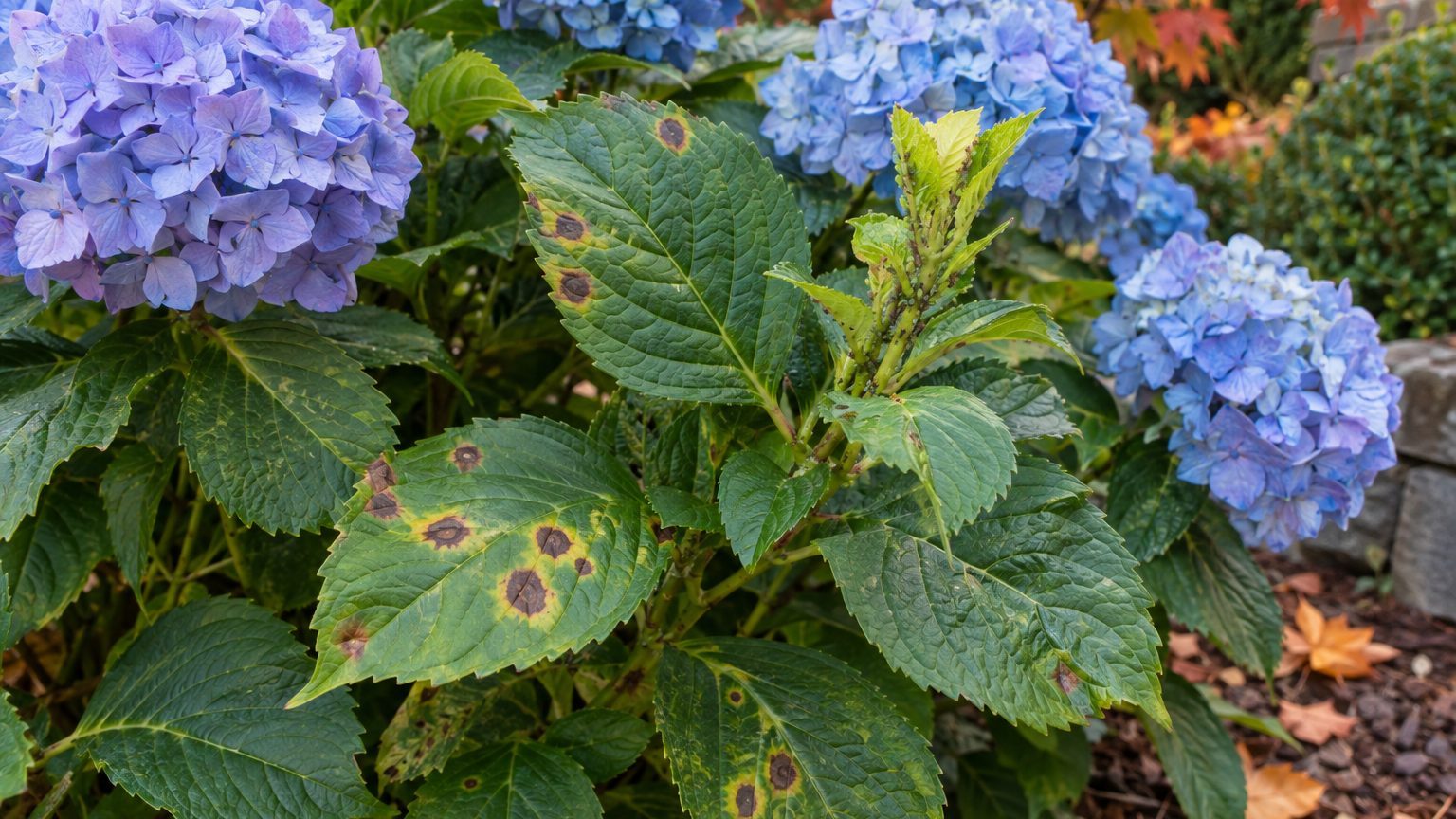
Aphids clustered on buds

Small, soft-bodied clusters gather on flower buds right when fertilizer pushes new growth. Sticky residue and curled leaf tips follow. A strong water spray every few days knocks populations down before buds open, cheaper than any treatment.

Powdery mildew in humid shade

Powdery mildew in humid shade — Hydrangea Pests and Diseases in Hawaii

A gray-white dusting spreads across leaves wherever airflow is poor, worse on the humid windward side of an island. It rarely kills the shrub but weakens bloom. Space plants wider and prune out crowded interior stems during the June or July bigleaf pruning window.

Botrytis blight on wet blooms

Botrytis blight on wet blooms — Hydrangea Pests and Diseases in Hawaii

Brown, mushy spots appear on petals and buds right after a heavy rain event, spreading fast in still air. Remove and discard affected blooms rather than composting them. Better spacing and morning watering, not evening, keep this from returning.

Root rot after standing water

Root rot after standing water — Hydrangea Pests and Diseases in Hawaii

Yellowing lower leaves and a soft, blackened base signal Phytophthora root rot, almost always from soil that never drains between rains. Raised beds or amended, gritty soil fix this faster than any fungicide. See the state guide page for a full site-prep checklist.

How to Work Out the Dates for Your Own Yard

NOAA NCEI’s 1991-2020 Climate Normals record zero days at or below 32°F at station USW00022521, so there’s no frost countdown to run here. The method instead starts from the calendar windows and works backward through rainfall and airflow at your own site.

  1. Check the month against the planting window: wilting in a shrub set out during January or February usually points to transplant stress, not pest damage.
  2. Walk the yard after dark: chewed leaf edges with no insect visible by morning almost always mean Chinese rose beetle, active at night only.
  3. Match new growth to the fertilize schedule: aphid clusters and mildew both spike around the March, May and July feeding, since both feed on soft tissue.
  4. Check drainage after the next heavy rain: yellowing that starts low on the plant after standing water points to root rot, not a leaf disease.
  5. Note what happens after the bigleaf pruning window: buds that fail to open following June or July pruning suggest disease carried over on old wood, not a new pest.

Run through these five checks in order before treating anything. Most misdiagnoses in Hawaii come from spraying for insects when the real problem is standing water.

Hawaii North to South: How the Dates Shift

Hawaii doesn’t run north to south so much as windward to leeward, and elevation matters as much as either.

  • Windward coasts (Hilo, Hamakua, Puna): humidity stays high year-round, so fungal pressure from mildew and botrytis runs higher than anywhere else in the state.
  • Leeward and dry coasts (Kona, Waianae, Kihei): drier air cuts fungal risk sharply, but spider mites become the more likely complaint on stressed foliage.
  • Upcountry and high elevation (Waimea, Volcano, Kula): cooler nights slow both insects and fungal spread, the closest match to a mainland-style growing season.
  • Outer islands and exposed shores (Kauai’s north shore, Molokai): wind and salt spray add stress that opens the door to root and stem disease.

Check the state guide page for the planting and pruning windows that apply to your part of the island chain.

Mistakes Hawaii Punishes

Watering on top of standing rain

Adding irrigation right after a downpour keeps roots sitting wet and invites Phytophthora root rot within weeks. Let soil drain and dry slightly at the surface before watering again, and confirm the bed drains at all before replanting there.

Pruning outside the bigleaf window

Cutting bigleaf hydrangeas outside June or July removes the buds that were already set for next season’s bloom. Wait for that window, and mark it on next year’s calendar so it doesn’t get skipped again.

Ignoring airflow in windward shade

Crowding shrubs together on the humid windward side traps moisture against the leaves and feeds both mildew and botrytis. Space plants wider than feels necessary and prune the interior open during the bigleaf window to let air move through.

Hawaii Extension Offices and County Contacts

The zone range and calendar windows above are a starting point. The CTAHR Extension office for your county carries the rest, from soil testing to confirming a pest identification in person.

  • Your state page: the planting, fertilizing and pruning windows for where you live.
  • Which ones hold up here: the varieties that tolerate Hawaii’s humidity and elevation spread.
  • County extension office: soil testing, pest samples and a local answer when a diagnosis isn’t clear.

Common questions

Do hydrangeas need winter protection in Hawaii?
No. NOAA records zero freeze days for the islands, so cold protection isn’t part of the calendar here.

Why do my hydrangea leaves have holes but no bugs in sight?
Check after dark. Chinese rose beetle feeds at night and disappears well before daylight, leaving damage but no visible insect.

Is powdery mildew dangerous to the plant?
It weakens bloom but rarely kills the shrub. Wider spacing and pruning during the June or July window control it better than repeated spraying.
When to Prune Hydrangeas in Hawaii

When to Prune Hydrangeas in Hawaii

In Hawaii, the safe planting windows fall in January, February, October, and November, with bigleaf hydrangeas pruned in June and July after bloom fade. There’s no frost date to count from here. Elevation and rainfall set the rhythm instead, and a yard in Honolulu runs on a different clock than one on Kula’s slopes or Hilo’s wet coast.

When to prune hydrangeas in Hawaii: The Short Answer

Honolulu anchors the state’s growing calendar, and USDA Plant Hardiness Zone Map puts Hawaii at zone 9a to 13a, a spread wide enough that a hydrangea planted near the coast behaves nothing like one set into cooler upcountry soil.

  • January: the plant window opens, and new hydrangeas go into the ground while air stays cool and moist. Give the root ball a full month before the driest weeks arrive.
  • February: this is the second month of the same plant window, still a safe bet island-wide. Water deeply at planting since roots haven’t spread far yet.
  • March: the first fertilize date lands here, feeding shrubs as they push new leaves. Skip fertilizer on anything planted within the last six weeks.
  • April: no plant, fertilize, or prune date falls this month, so this is a watch-and-mulch stretch. Check that drainage still runs clear after any heavy rain.
  • May: the second fertilize date arrives, right as buds start forming on older wood. Keep the feeding light on shrubs still building their first-year roots.
  • June: pruning bigleaf hydrangeas begins, the only stretch of the year set aside for it. Cut spent flower heads back to the first strong pair of leaf buds.
  • July: the prune window closes here, and the third fertilize date lands in the same month. Finish any cutting before mid-month so new buds have time to set.
  • August: no scheduled task falls here, and this is usually the driest stretch of the year. Watch leaf edges for the curl that signals a shrub needs deeper watering.
  • September: still an off-calendar month, good for scouting a planting site ahead of fall. Clear weeds from the spot so roots meet no competition in October.
  • October: the plant window reopens, the first of two fall months for setting new hydrangeas. Cooler nights let roots establish before winter’s calmer growth.
  • November: the plant window closes at month’s end, the last safe stretch until January. Mulch new plantings well since this closes out the fall push.
  • December: no task is scheduled, and shrubs mostly rest through this slower month. Use the quiet stretch to plan where January’s new plantings will go.

These dates hold for lowland Hawaii, where the frost that shapes mainland calendars never arrives. Rainfall and elevation do that work instead, and the next section walks through adjusting them for your own yard.

How to Work Out the Dates for Your Own Yard

Working out your own dates means starting from the state’s zone range and narrowing it down to your yard’s elevation and exposure.

  1. Pick your plant window first: the state calendar sets planting at January, February, October, and November, so choose the window closest to now.
  2. Place your yard on the zone range: USDA Plant Hardiness Zone Map lists Hawaii from 9a to 13a, so a garden near sea level in Honolulu behaves differently than one on a cooler upcountry slope.
  3. Match elevation to expectation: the higher the yard sits, the closer it behaves to the 9a end, meaning slower growth and a shorter bloom push.
  4. Set your feeding dates: fertilize in March, May, and July, spacing the three feedings evenly through the growing stretch.
  5. Reserve pruning for June and July: cut spent bigleaf blooms only inside that window, never earlier.
  6. Confirm with your island’s extension office: local staff can tell you where your yard actually falls inside that broad zone range.

None of these steps replace a look at your own soil, but together they turn a wide zone range into a date that fits your particular yard.

Hawaii North to South: How the Dates Shift

Hawaii’s islands don’t share one calendar, and elevation shifts these dates more than any coastline does.

  • Windward and wet coasts (Hilo, Hana, Kaneohe): rain stays frequent enough that plantings often root faster here than anywhere else in the state.
  • Leeward and dry coasts (Kona, Waikiki, Lahaina): heat and dry air mean afternoon shade and steady watering matter more than the calendar date itself.
  • Upcountry and high elevation (Kula, Volcano, Waimea): cooler air lets bloom color hold longer and pushes the whole season slightly later.

Check the Hawaii hydrangea guide for the numbers that apply to your specific island and elevation.

Mistakes Hawaii Punishes

No bloom despite lush green growth

No bloom despite lush green growth — When to Plant and Prune Hydrangeas in Hawaii

Bigleaf hydrangeas set their flower buds on old wood, and cutting them at any time outside the June and July window strips away next year’s blooms before they even form. Prune only inside that window, and otherwise leave the shrub alone through the rest of the year.

Leaves crisped along the sunny edge

Full lowland sun near the dry, leeward coast scorches leaf margins fast, turning edges brown within days during the hottest stretch of the year. Plant in afternoon shade instead, especially below the cooler upcountry elevations, and check which named varieties actually tolerate this heat before choosing a spot.

Soft, leggy growth and no flowers

Feeding outside the March, May, and July fertilize dates pushes soft, leggy new growth that never has time to harden into flower buds before the season moves on. Stick to those three feeding months, and skip fertilizer entirely on anything planted within the past six weeks.

Hawaii Extension Offices and County Contacts

The state’s zone range is a starting point, not a final answer, and the county extension office fills in what the map can’t show.

  • CTAHR Extension: the University of Hawaii’s extension service, with island-specific staff who know your slope and soil.
  • Which ones hold up here: the variety guide names the hydrangeas suited to Hawaii’s zone range, from most reliable to most fragile.
  • What goes wrong here: the trouble guide covers the pests and stress signs particular to this state’s climate.

Common questions

Can I plant hydrangeas in Hawaii during summer?

The state calendar reserves planting for January, February, October, and November, so summer planting works only with heavy shade and constant water, and even then roots may not establish before the driest weeks of the year arrive.

Do hydrangeas need chill hours in Hawaii?

No. Lowland Hawaii never sees freezing temperatures, so hydrangeas here rely on rainfall and elevation rather than a winter chill period to set their bloom.

Should I prune hydrangeas right after planting?

No. Wait until the shrub is established, and reserve any bigleaf pruning for the June and July window regardless of when it first went into the ground.

Hydrangeas That Grow Well in Georgia

Hydrangeas That Grow Well in Georgia

Six hydrangea species handle Georgia’s clay, heat, and humidity well enough to bloom reliably, though not equally. Oakleaf and panicle lead the pack, while the classic mophead bigleaf hydrangea needs a specific pruning calendar to flower here at all. The right pick depends less on looks than on how each species handles Georgia’s frost timing and long summer heat, covered variety by variety below.

Hydrangeas that grow well in Georgia: The Short Answer

Oakleaf and panicle hydrangeas hold up best from the Georgia mountains down to the coastal plain, while bigleaf hydrangea only blooms reliably if its pruning matches the state calendar.

Atlanta’s growing season sits inside Georgia’s 6a to 9b span on the USDA Plant Hardiness Zone Map, and a spring frost window of March 11 to March 29 decides whether an old-wood bloomer opens its flowers or not.

Oakleaf Hydrangea

Oakleaf Hydrangea — Hydrangeas That Grow Well in Georgia

This one is native to the woods of Georgia and the wider Southeast, so it already knows the heat, the clay, and the humidity. It tolerates part sun better than any other hydrangea on this list and rarely loses flower buds to a late frost. It’s the safest pick for a first Georgia planting.

Panicle Hydrangea

Panicle Hydrangea — Hydrangeas That Grow Well in Georgia

Panicle types bloom on new wood, so a cold snap after the frost window doesn’t wipe out the season’s flowers the way it can with older-wood bloomers. It handles full sun and Georgia’s July heat better than most hydrangeas on this list. Plant it in the spring planting window and it settles in fast.

Smooth Hydrangea

Smooth Hydrangea — Hydrangeas That Grow Well in Georgia

Another Southeast native, smooth hydrangea (the type behind ‘Annabelle’) dies back hard in winter but rebuilds and flowers the same year, which sidesteps bud damage from a late frost entirely. It wants part shade and steady moisture, both easy to give in a shaded Georgia yard.

Bigleaf Hydrangea

Bigleaf Hydrangea — Hydrangeas That Grow Well in Georgia

This is the classic mophead or lacecap look, but it blooms on old wood, so buds set the previous summer can get nipped by a late frost. Prune it only in the state’s June or July window, right after bloom, never in fall.

Mountain Hydrangea

Mountain Hydrangea — Hydrangeas That Grow Well in Georgia

Closely related to bigleaf and sometimes sold beside it, mountain hydrangea sets slightly hardier flower buds but still leans on old wood for its show. It does better in the cooler pockets of north Georgia than in the deep heat of the coastal plain.

Climbing Hydrangea

Climbing Hydrangea — Hydrangeas That Grow Well in Georgia

This is the riskiest of the six here, since it prefers cooler summers than Georgia usually delivers and can take a couple of years to establish before it flowers at all. Reserve it for a shaded, north-facing wall with steady moisture.

How to Work Out the Dates for Your Own Yard

Matching a hydrangea to your yard is less about a single date and more about counting backward from the frost window that actually applies where you live.

  1. Check your last frost window first: NOAA NCEI 1991-2020 Climate Normals puts Georgia’s spring freeze risk at March 11 to March 29 near Atlanta, and any old-wood bloomer needs its buds to survive past that stretch.
  2. Match the species to your sun exposure: oakleaf and panicle hydrangea take full sun through a Georgia summer, while smooth and climbing hydrangea need afternoon shade to avoid scorch by July.
  3. Plant inside the real planting months: set new hydrangeas out in March, April, September, or October, never in the thick of summer heat.
  4. Give a first bloom cycle before judging: a bigleaf hydrangea that skips flowers its first spring may just need one more season to build old wood, not a replacement.
  5. Track how it handles the fall window: first frost arrives November 13 to December 1, and a plant still holding healthy leaves into that stretch is well suited to your particular spot.

Oakleaf hydrangea survives both ends of that window without help, since it evolved in these same woods and sets next year’s buds early.

Climbing hydrangea struggles at both ends, leafing out late in spring and often losing steam well before the fall window closes.

Georgia North to South: How the Dates Shift

Georgia’s frost dates and hardiness numbers hold true at the Atlanta station, but the state runs from mountain ridges to tidal marsh, and that distance shifts both ends of the growing season.

  • North Georgia and the mountains (the Blue Ridge and Chattahoochee National Forest area): frost arrives here well before it reaches Atlanta, which favors oakleaf and mountain hydrangea over species that need a long hot stretch to set buds.
  • The Piedmont and Atlanta metro: the state’s 6a to 9b range and the frost windows named above apply most directly here.
  • The coastal plain and the coast (Savannah and the barrier islands): winters run milder and the season stretches longer, giving bigleaf and climbing hydrangea their best shot at holding onto old-wood buds through winter.

Check the Georgia state guide for the frost dates and pruning window that apply closest to where you actually garden.

Mistakes Georgia Punishes

Pruning bigleaf in fall or winter

Bigleaf hydrangea sets its flower buds on old wood well before summer ends, so a fall cleanup or a winter shape-up removes next year’s blooms before they open. The state’s pruning window for bigleaf sits in June and July, right after the flowers fade, never later.

Planting during peak summer heat

Setting a new hydrangea into Georgia clay during the hottest stretch of summer asks the roots to establish while the plant also fights heat stress, and many don’t make it. Plant in March, April, September, or October instead, when the ground is workable and the heat has eased.

Treating full sun the same everywhere

A nursery tag reading full sun assumes a cooler climate than south Georgia delivers, and bigleaf or climbing hydrangea scorch fast under an unbroken coastal plain afternoon. Give them morning sun and afternoon shade, and lean on oakleaf or panicle where shade isn’t an option.

Georgia Extension Offices and County Contacts

The numbers above are a starting point, but a county extension agent knows your soil test and your particular microclimate better than any state map. The University of Georgia Cooperative Extension, at extension.uga.edu, is the place to start.

  • Your state page: the frost dates and the pruning window where you live.
  • What goes wrong here: the sibling page covering pests and problems specific to Georgia hydrangeas.

Call the county office before the next planting window opens in September or October, and bring a soil sample.

Common Questions

Do hydrangeas bloom the first year in Georgia?

Most new hydrangeas, especially bigleaf and mountain types, spend their first season building roots rather than flowers. Planted in the March or April window, expect a fuller bloom the following spring once old wood has had a season to set buds.

Can hydrangeas survive a Georgia winter without protection?

Oakleaf, panicle, and smooth hydrangea handle the state’s fall frost window of November 13 to December 1 without any covering. Bigleaf and mountain hydrangea benefit from a layer of mulch over the root zone in the colder stretch of north Georgia.

Why didn’t my hydrangea flower this year?

A skipped bloom season usually traces back to a fall or winter pruning cut that removed the old wood carrying next year’s buds, or a late frost inside the March window that damaged buds already forming. Check the pruning calendar before assuming the plant is unhealthy.

Hydrangea Pests and Diseases in Georgia

Hydrangea Pests and Diseases in Georgia

In and around Atlanta, Georgia’s mild winters and thick summer humidity mean hydrangea problems rarely disappear for good, they just rotate through the calendar. Leaf spot, powdery mildew, aphids, and root rot account for most of the damage local yards see, and each one tends to show up on cue with the season’s heat and moisture.

Hydrangea pests and diseases Georgia: The Short Answer

USDA Plant Hardiness Zone Map puts Atlanta at 6a to 9b, and that narrow band of mild winters is why gardeners here fight nearly the same lineup of hydrangea troubles every year, just on a rolling schedule tied to the state’s calendar of fertilizing, planting, and pruning windows.

Aphids

Small green or black clusters crowd new stem tips right as hydrangeas go into the ground during the March and April planting window, curling leaves and leaving a sticky residue behind. A strong water spray or insecticidal soap knocks them back before they call in ants and sooty mold.

Cercospora leaf spot

Purple-rimmed brown spots spread up from the lower leaves once humidity settles in, and by the May fertilizing round a shrub can look half-defoliated from the ground up. Clearing fallen leaves and watering the soil instead of the foliage slows the spread most reliably.

Powdery mildew

A gray-white dusting coats top leaf surfaces during July’s sticky heat, more of a cosmetic problem than a killer but ugly enough to notice from the porch. Spacing plants for airflow and skipping overhead watering keeps it from building year over year.

Japanese beetles

Japanese beetles — Hydrangea Pests and Diseases in Georgia

Metallic green beetles skeletonize leaves down to lace during the same June and July stretch set aside for pruning bigleaf types, often stripping a shrub in days. Hand-picking into soapy water each morning works better here than most sprays, since beetles keep flying in from neighboring yards.

Spider mites

Spider mites — Hydrangea Pests and Diseases in Georgia

Fine stippling and faint webbing show up on leaf undersides during hot, dry spells later in summer, worse on shrubs already stressed by too much sun. A hard hose-down every few days breaks up colonies without reaching for a miticide.

Botrytis blight

Gray, fuzzy mold settles on flower heads and soft new growth during cool, damp stretches heading toward the November to December frost window. Deadheading spent blooms and cutting back overcrowded stems opens the airflow that keeps this fungus from taking hold.

Root rot

Wilting leaves on a well-watered shrub usually trace back to soggy soil, a problem that surfaces most often at the September and October planting window when new roots meet heavy clay. Raised beds or amended, well-drained soil at planting time prevent most cases outright.

Deer browsing

Ragged, torn leaf edges and stripped buds appear as cooler weather sends deer looking for tender greens through fall and into dormancy. Fencing or a repellent rotation protects the shrub better than any single spray, since deer adapt to scent alone within a season.

How to Work Out the Dates for Your Own Yard

Matching a symptom to its actual cause takes a walk around the shrub and a look at the calendar, since most of these problems announce themselves on a schedule tied to Georgia’s frost dates.

  1. Check the calendar first: NOAA NCEI 1991-2020 Climate Normals put Atlanta’s last spring freeze between March 11 and March 29, so aphids and early leaf spot showing up before that window closes are simply arriving on schedule, not a sign of a bigger problem.
  2. Look at where the damage sits on the plant: spotting on lower, older leaves points to Cercospora, while a dusty film on top leaves in July heat is powdery mildew instead.
  3. Time it against the prune window: chewed, skeletonized leaves during the June and July bigleaf pruning stretch are almost always Japanese beetles, not a fungus.
  4. Test the soil before blaming a bug: a wilting shrub in soil that stays wet days after rain points to root rot, especially near the September and October planting window.
  5. Watch the weather, not just the date: a run of cool, damp days pushing toward the November 13 to December 1 first frost window favors Botrytis over any insect.
  6. Rule out deer last: torn, ragged edges rather than clean holes or skeletonized veins usually mean deer, not an insect at all.

None of these six checks needs a lab test. A shrub failing more than one at once usually has a weaker problem riding along on a stronger one, most often root rot inviting in a leaf fungus.

Georgia North to South: How the Dates Shift

Georgia’s frost numbers above come from an Atlanta airport station sitting inside an urban heat island, so pest and disease timing shifts once a yard sits farther north in the mountains or south near the coast.

  • North Georgia mountains (Blue Ridge, Dahlonega, Blairsville): cooler nights slow fungal problems like Cercospora and Botrytis but also push the growing season later, so beetle and aphid pressure lags a few weeks behind the rest of the state.
  • The Piedmont and Atlanta metro (Atlanta, Athens, Macon): this is the reference zone for the frost windows above, with the fullest overlap of every pest and disease on this list.
  • The coastal plain and coast (Savannah, Brunswick, Valdosta): milder winters mean pests barely slow down, so aphids, mites, and root rot in heavy, poorly drained soil show up earlier and linger longer into fall.

Whichever part of the state a yard sits in, the frost dates above are the starting point, adjusted a few weeks earlier or later for elevation and distance from the coast.

Mistakes Georgia Punishes

Watering the foliage after dark

Georgia’s humid nights already keep leaves wet for hours, so an evening sprinkler pass adds the extra moisture that Cercospora leaf spot and Botrytis blight need to spread through a bed. Watering the soil directly in the morning, timed to the March, May, or July fertilizing rounds, keeps foliage dry by nightfall instead.

Planting shrubs too close together

Tight spacing traps the same humid air that spreads powdery mildew and leaf spot from one shrub to the next within a single season. Leaving real air gaps at the March, April, September, or October planting windows costs a little visual fullness now but saves the whole bed later.

Leaving fallen leaves under the shrub all winter

Leaf litter left in place over winter carries Cercospora and Botrytis spores straight into next spring’s new growth. Raking and disposing of dropped leaves before the November to December frost window closes breaks that cycle at the cheapest point in the whole calendar.

Georgia Extension Offices and County Contacts

Georgia’s zone and frost numbers above are a state-level start, and county Extension staff can narrow things down with a plant clinic that identifies a leaf sample on the spot.

  • Your state page: the frost dates and pruning window for bigleaf types where you live.
  • Which hydrangeas hold up here: the varieties worth planting given Georgia’s humidity and heat.
  • UGA Extension: county offices that can confirm a pest or disease from an actual leaf or stem sample.

Bringing a sample to the county office beats guessing from a photo, every time.

Common Questions

What’s the most common hydrangea disease in Georgia?

Cercospora leaf spot turns up more often than anything else here, favored by Georgia’s humid summers and appearing on lower leaves first before working upward through the plant.

Do I need to spray hydrangeas every year in Georgia?

Most Georgia yards get by with better watering habits and airflow rather than a regular spray schedule, saving fungicide and insecticide for a shrub that’s already showing clear symptoms.

Can root rot be fixed once it starts?

A shrub with advanced root rot rarely recovers in place, but improving drainage and cutting back watering can save a mildly affected plant before symptoms spread to the whole root system.

When to Prune Hydrangeas in Georgia

When to Prune Hydrangeas in Georgia

The safe window in Georgia runs March through April, then again September through October, once the state’s spring and fall frost dates clear. In the Atlanta area, that means holding off until past mid-March and starting fresh once September heat breaks. Pruning bigleaf types is a separate task, locked to June and July rather than the planting months.

When to prune hydrangeas in Georgia: The Short Answer

NOAA NCEI 1991-2020 Climate Normals puts Atlanta’s last spring frost between March 11 and March 29, which lines up with the state’s official plant window of March, April, September, and October. The safest planting days sit just past that spring date or well before the first fall frost lands between November 13 and December 1.

  • January: The shrub sits fully dormant, weeks before the March 11 frost window even begins to close. Skip any pruning on bigleaf types, since next year’s flower buds already formed inside last summer’s wood.
  • February: Frost risk still runs high this far from the March window. Use the quiet stretch to test soil pH and work compost into beds meant for spring shrubs.
  • March: The plant window opens as spring frost risk tapers toward March 29. Set new hydrangeas in the ground and start the first of the year’s three fertilize rounds.
  • April: Planting continues through this second spring month. Water new roots deeply, since a young shrub can’t yet pull moisture from deeper soil on its own.
  • May: The second fertilize round lands as new growth pushes hard. Mulch two to three inches deep to hold moisture through early heat.
  • June: Pruning bigleaf varieties opens right after their spring bloom fades. Cut spent flower heads back to the first strong bud pair, never lower.
  • July: The bigleaf pruning window closes alongside the year’s third fertilize round. Finish shaping cuts before this month ends, since buds start setting for next year soon after.
  • August: No planting or pruning is scheduled, so this becomes a watching month. Deep water twice a week during dry spells, since wilting afternoon leaves usually mean heat stress rather than disease.
  • September: The fall plant window opens as afternoon heat starts to break. Roots often set faster now than in spring, with weeks of warm soil still ahead.
  • October: Planting continues through this second fall month, well ahead of the frost arriving between November 13 and December 1. That gap gives new roots real time to settle before winter.
  • November: The first fall frost lands somewhere in this window, closing the growing season. Stop feeding and let the shrub harden off into dormancy on its own.
  • December: Frost has settled in across the state by now. Leave dried flower heads on the plant, since they offer a bit of bud protection through winter.

Those twelve months repeat every year in the same order, so the real work is matching your own yard’s microclimate to this calendar rather than memorizing new dates each season.

How to Work Out the Dates for Your Own Yard

Working out your own dates starts with finding your closest weather station rather than borrowing Atlanta’s range outright.

  1. Locate your closest station: NOAA NCEI 1991-2020 Climate Normals ties its Atlanta figures to station USW00013874, so a yard in the mountains or near the coast needs its own local reading.
  2. Read the frost window as a range: treat March 11 to March 29 as a spread of risk rather than one deadline, and lean toward the later end if a cold snap is in the forecast.
  3. Check your hardiness zone: Georgia spans zone 6a to 9b, so a shrub rated for the middle of that range may struggle in the mountains even as it thrives near the coast.
  4. Match the gesture to the state’s window: line up planting with March, April, September, or October, whichever sits closest to your own frost-free stretch.
  5. Confirm bloom type before you prune: bigleaf hydrangeas set next year’s buds on old wood, so June and July stay the only safe pruning months for that type specifically.
  6. Call before you commit: a county office can confirm whether a late frost is still a real risk in your specific pocket of the state.

None of this replaces a local check. A shrub bought at a big-box store in Savannah and one bought in Blairsville are working from two different calendars, even under the same state name.

Georgia North to South: How the Dates Shift

Elevation and distance from the coast pull these dates in opposite directions, even though Atlanta anchors the only figures cited here.

  • North Georgia and the mountains: frost arrives here weeks before it reaches Atlanta in fall, and lingers weeks longer in spring, so both ends of the state’s planting windows should shift inward for safety.
  • The Atlanta metro and Piedmont: this is the reference zone itself, where NOAA NCEI 1991-2020 Climate Normals’ March 11 to March 29 and November 13 to December 1 ranges apply most directly.
  • South Georgia and the coastal plain: milder winters push fall frost later and end spring frost earlier, stretching the safe planting season on both sides of summer.

None of this changes the state’s official plant months, it just shifts where inside each month a given yard sits safest.

Mistakes Georgia Punishes

No blooms the following spring

This happens when bigleaf hydrangeas get pruned outside June and July, cutting off buds already set for next year’s flowers. Keep every cut inside that two-month window and confirm bloom type before picking up shears.

Roots that never take hold before frost

Planting past October pushes root establishment too close to the November 13 to December 1 frost arrival, leaving a young shrub exposed before it has settled in. Stick to the state’s four scheduled planting months.

Leaves scorched by midsummer

Full afternoon sun during Georgia’s hottest stretch scorches leaf edges brown, especially across the Piedmont and coastal plain. Site new shrubs for morning sun and afternoon shade, then keep the fertilize schedule steady through July.

Georgia Extension Offices and County Contacts

The state’s numbers get you started, but a county office fine-tunes them for your exact yard. UGA Cooperative Extension keeps those local contacts.

  • Your state page: the frost dates and the pruning window where you live.
  • Which ones hold up here: the hydrangea varieties best suited to Georgia’s zone range.
  • What goes wrong here: the pests and problems specific to Georgia’s climate.

Common questions

Can I plant hydrangeas in Georgia in the middle of summer?

It’s not part of the state’s scheduled window. July heat stresses new roots before they can spread, so stick to the March, April, September, or October months instead.

Do all hydrangea types follow the same pruning schedule?

No. The June and July window applies to bigleaf types that bloom on old wood. Other types tolerate a wider pruning season, so confirming the type first matters more than the calendar alone.

Is Atlanta’s frost date the same for the whole state?

No. It’s a reference point tied to one station. North Georgia and the mountains freeze earlier in fall and later in spring, while the coastal plain runs milder on both ends.

Hydrangeas That Grow Well in Florida

Hydrangeas That Grow Well in Florida

Panicle and oakleaf hydrangeas hold up best across Florida, tolerating full sun and long summers with little fuss. Bigleaf hydrangea, the blue or pink pom-pom type most people picture, works too, but only with afternoon shade, steady water, and a spot outside the state’s harder freeze pockets.

Hydrangeas that grow well in Florida: The Short Answer

The USDA Plant Hardiness Zone Map puts the whole state at 8b-11b, a spread that runs from cool nights near Jacksonville, the reference city for this state’s climate data, down to frost-free Miami. Jacksonville’s last spring frost falls February 16 to March 7, and its first fall frost lands November 26 to December 13.

That swing decides which hydrangea species can handle both ends of the state, since a plant that shrugs off a Panhandle freeze can still scorch in a Miami August, and the reverse holds too.

Panicle hydrangea (Hydrangea paniculata)

Panicle hydrangea (Hydrangea paniculata) — Hydrangeas That Grow Well in Florida

This is the safest choice statewide because it blooms on new wood, so a late freeze near Jacksonville cannot wipe out the coming season’s flowers. It also shrugs off long, humid summers that stress other types, and it tolerates full sun even where oakleaf and bigleaf need afternoon shade to survive.

Oakleaf hydrangea (Hydrangea quercifolia)

Oakleaf hydrangea (Hydrangea quercifolia) — Hydrangeas That Grow Well in Florida

Native to the Southeast, this species already grows wild in parts of north Florida, so it arrived pre-adapted to the region’s heat and humidity. Its thick, textured leaves handle a few hours of direct sun without scorching, and it delivers fall color that few other hydrangeas offer this far south.

Smooth hydrangea (Hydrangea arborescens)

Smooth hydrangea (Hydrangea arborescens) — Hydrangeas That Grow Well in Florida

‘Annabelle’ and its relatives handle Florida’s rebound freezes reasonably well because, like paniculata, they flower on new wood each year. They prefer more shade and moisture than panicle types, though, and gardeners in the southern half of the state often see smaller blooms once midsummer heat peaks.

Reblooming bigleaf hydrangea (‘Endless Summer’ types)

Reblooming bigleaf hydrangea ('Endless Summer' types) — Hydrangeas That Grow Well in Florida

These cultivars flower on both old and new wood, which buys some insurance against a Jacksonville-area freeze that damages buds before they open. They still need afternoon shade and steady moisture from the spring planting window through summer, or their leaves wilt by early afternoon most days.

Bigleaf hydrangea (Hydrangea macrophylla)

Bigleaf hydrangea (Hydrangea macrophylla) — Hydrangeas That Grow Well in Florida

The classic blue or pink pom-pom shrub blooms mostly on old wood, so a hard freeze during Jacksonville’s frost window can strip an entire season’s flowers before they open. It also fades fastest in full Florida sun, which makes it a plant for morning light and afternoon shade only.

Mountain hydrangea (Hydrangea serrata)

Mountain hydrangea (Hydrangea serrata) — Hydrangeas That Grow Well in Florida

This is the riskiest pick south of the Panhandle, since it is bred for cooler summers than most of Florida delivers. Prolonged heat tends to stall growth and bloom production even with shade and irrigation, and it rarely rewards the extra care it demands here.

Whichever of these six you choose, match it to the microclimate on your own lot, since afternoon shade or a coastal breeze can move a variety from the risky end of this list to the safe end.

How to Work Out the Dates for Your Own Yard

Work out your own planting and pruning dates by counting backward from Jacksonville’s frost window instead of a fixed date, since NOAA NCEI 1991-2020 Climate Normals puts the last spring frost there between February 16 and March 7.

The same math works whether you are counting toward spring planting or backward from the first fall frost, since both edges of the growing season chase the same set of dates.

  1. Start counting from the last frost date: with the window at February 16 to March 7, treat early February plantings as needing frost cloth on standby.
  2. Match planting to the state’s plant months: this state’s calendar lists February, March, September, and October as the times to plant, which gives new roots weeks to establish before summer heat or a winter cold snap arrives.
  3. Hold bigleaf pruning to early summer: prune only in June or July, after spring bloom finishes and before next year’s buds start forming on old wood.
  4. Feed on the three scheduled months: fertilize in March, May, and July only, and skip any fall feeding that would push soft new growth toward the November 26 to December 13 frost window, since that growth freezes first.
  5. Check whether your pick blooms on new wood: panicle and smooth hydrangeas recover from a late frost near the February window and still flower through summer without stalling.
  6. Watch bigleaf for the opposite risk: because its buds form on old wood the year before, a freeze inside that same window can erase a season’s flowers even though the shrub survives.

Once you know which window applies to your address, the arithmetic is simple: count back from the frost date, not forward from a nursery tag, and you stop pruning off flowers before they even show up.

A gardener near the coast might push the plant date slightly later, since a marine breeze delays the ground’s last cold snap, but the order of the six steps above still holds.

Florida North to South: How the Dates Shift

Florida’s frost math changes fast between the Panhandle and the Keys, and that shift decides which hydrangea species even make sense in a given yard. Latitude is not the only variable, since coastal breezes and inland heat pockets nudge these dates too, even within a single county.

  • The Panhandle and North Florida (Jacksonville, Tallahassee, Gainesville): frost still arrives most winters, so panicle, oakleaf, and smooth hydrangeas that bloom on new wood recover faster than bigleaf types that lose next year’s buds to a hard freeze.
  • Central Florida (Orlando, Tampa, the Lakeland ridge): freezes turn rare and shallow here, so summer heat becomes the bigger threat and afternoon shade matters more than any frost cloth.
  • South Florida and the coasts (Miami, the Keys, the barrier islands): the growing calendar effectively inverts, with cooler months carrying the main bloom and summer heat and humidity doing the damage cold does further north.

Whichever part of the state you garden in, check your own region’s frost history and hardiness zone before you plant a hydrangea suited to a different part of the state, since a Panhandle recommendation and a Miami one rarely match.

Mistakes Florida Punishes

Three habits imported from cooler states get punished fastest in a Florida yard, and each one has a simple fix.

Planting bigleaf hydrangea in full afternoon sun

Florida’s summer sun scorches bigleaf leaves fast, even with regular watering, because the plant evolved for cooler, shadier native ranges than this state offers. Give it morning sun and afternoon shade instead, ideally on the east or north side of the house, and check the planting window before you dig.

Pruning after July

Cutting back bigleaf hydrangea past the June to July window removes the very buds it already set for next year, since those buds form on old wood months in advance. Prune only inside that window, and save any later trimming for panicle or smooth types instead.

Feeding on a fall schedule

Fertilizing outside the state’s scheduled months pushes tender new growth right into the November 26 to December 13 frost window, and that soft growth is what freezes first. Stick to the March, May, and July feedings, and let the plant harden off before fall arrives.

Florida Extension Offices and County Contacts

The state-level hardiness zone and frost window here are a starting point, not a final answer. Your county extension office adjusts for local soil, salt spray, and microclimate that no statewide number can capture.

  • Your state page: the Jacksonville frost dates and the June to July pruning window in one place.
  • Which ones hold up here: the six varieties above, ranked from safest to riskiest for Florida yards.
  • UF/IFAS Solutions for Your Life: find your county’s extension office for soil tests and salt-tolerant variety advice.

Call before you plant if you’re within a few miles of the coast, since salt spray changes which hydrangea survives faster than frost does.

Common questions

Can hydrangeas survive Florida summers without heavy shade?

Panicle and oakleaf types manage in full sun statewide, but bigleaf hydrangea needs afternoon shade south of the Jacksonville reference zone, or its leaves wilt by midafternoon most summer days.

Do hydrangeas need winter protection in Florida?

North Florida sees an actual frost window, November 26 to December 13 into February 16 to March 7, so a young shrub benefits from mulch and frost cloth during those weeks. Central and south Florida rarely need it.

Which hydrangea blooms the most reliably in a Florida yard?

Panicle hydrangea blooms on new wood every year regardless of what winter does, which makes it the most consistent bloomer from the Panhandle to the coast.

Hydrangea Pests and Diseases in Florida

Hydrangea Pests and Diseases in Florida

Florida hydrangeas face a shorter list of true threats than northern gardens, but humidity turns small problems into big ones fast. In Jacksonville, the reference city for the state’s climate data, the main risks are fungal, not insect, and they track the rainy season more than the calendar. Here is what actually shows up, in the order it shows up, and what stops it before it spreads.

Hydrangea pests and diseases Florida: The Short Answer

Most hydrangea trouble in Florida comes from heat and moisture, not from any single insect. In Jacksonville, the state’s reference station, the USDA Plant Hardiness Zone Map puts north Florida at 8b while the rest of the state runs warmer, up to 11b.

That extra warmth keeps fungal spores active for more months than a northern garden ever sees. Humidity, not cold, is what breaks a Florida hydrangea.

Aphids on new spring growth

Clusters of small green or black insects crowd tender stem tips as the plant leafs out, curling leaves and leaving a sticky residue behind. A strong water spray knocks most off, and insecticidal soap handles the rest. Check new growth weekly once you’re past the last spring frost window described on the Florida hydrangea calendar.

Powdery mildew on shaded leaves

A gray-white film settles over leaves that stay damp under thick canopy or crowded siding, and it spreads fastest during warm, wet stretches. Thin the surrounding shrubs for airflow, water at the base instead of overhead, and remove the worst leaves. It rarely kills the plant but it cuts bloom size.

Cercospora leaf spot in the rainy season

Round purple-brown spots appear on lower leaves first, then work upward as summer rains keep foliage wet for hours at a stretch. Pull off spotted leaves as soon as you see them and avoid watering in the evening. Left alone it can defoliate a shrub by late summer.

Spider mites during dry heat spells

Spider mites during dry heat spells — Hydrangea Pests and Diseases in Florida

Fine webbing and a dusty, stippled look on leaves shows up when a hot, dry week follows a wet one, favoring mites over fungus for once. A hard hose-down every few days breaks their life cycle better than most sprays. This often overlaps the state’s March, May, or July fertilizing months.

Scale insects on older wood

Scale insects on older wood — Hydrangea Pests and Diseases in Florida

Small brown bumps cling to woody stems by late summer, hard to notice until stems look dusty or sooty mold grows on their sticky excretion. Scrape off light infestations by hand or treat with horticultural oil in cooler weather. Heavy infestations weaken the whole shrub over a season.

Botrytis blight after a cool, damp spell

Botrytis blight after a cool, damp spell — Hydrangea Pests and Diseases in Florida

Brown, mushy patches show up on flower clusters and soft new growth after a stretch of cool, wet weather, usually as temperatures start to drop. Cut out affected blooms and improve air movement around the base. It fades on its own once drier weather returns.

Root rot in poorly drained soil

Wilting leaves on a plant still getting watered on schedule usually mean roots sitting in soggy soil, common in Florida’s flat, poorly drained yards. Raise the bed or work in coarse material before replanting, covered on the Florida hydrangea varieties page. Rot rarely reverses once it sets in.

How to Work Out the Dates for Your Own Yard

Matching a symptom to the right cause takes a few minutes of comparison, not a lab test.

  1. Check the calendar first: NOAA NCEI puts Jacksonville’s last spring frost between February 16 and March 7, so a spring symptom before that window is more likely cold stress than disease.
  2. Look at the leaf pattern: spots that start low and climb point to a fungus splashing up from wet soil, not an insect working down from the tips.
  3. Feel the residue: a sticky film means aphids or scale, a dry powder means mildew, and neither shows up the same way.
  4. Note the weather of the past week: a hot dry spell favors mites, a cool damp one favors botrytis, and a long wet stretch favors leaf spot.
  5. Check the planting zone: the USDA system lists 8b through 11b for the state, and a plant pushed a full zone warmer than its label struggles more with every problem.
  6. Compare against the pruning window: damage that shows up outside June or July, the state’s bigleaf pruning months, is unlikely to be pruning shock and worth a second look.

Five minutes with this list usually narrows six possible problems down to one or two, which is enough to know what to cut, spray, or simply wait out.

Florida North to South: How the Dates Shift

Frost dates and pest pressure both shift hard across a state this long, and north Florida behaves nothing like the rest of it.

  • North Florida (Jacksonville, Tallahassee, Gainesville): the only part of the state that sees a real frost window, so cold stress and fungal disease both track the same fall-to-spring calendar.
  • Central Florida (Orlando, Tampa, Ocala): frost is rare enough that the growing calendar flips, with the main season running through winter and summer heat becoming the harder stretch to manage.
  • South Florida (Miami, Naples, the Keys): effectively frost-free year round, where fungal pressure from constant humidity replaces cold as the shrub’s biggest threat, all season long.

Whichever part of the state you’re in, the Florida hydrangea guide lines up the frost and pruning windows for your exact spot.

Mistakes Florida Punishes

Watering overhead in the evening

Wetting leaves right before nightfall keeps them damp for hours, exactly what powdery mildew and leaf spot need to take hold in Florida’s humidity. Switch to a soaker hose at the base, ideally in the morning, and most fungal pressure drops within a couple of weeks.

Planting a zone too warm for the label

A tag written for cooler climates often can’t handle the extra heat once it’s a full zone warmer, and stressed plants draw pests faster than healthy ones. The state’s 8b to 11b range means a shrub that thrives in Jacksonville may struggle in Miami. Check the Florida hydrangea varieties page before buying.

Skipping the summer prune window

Cutting bigleaf hydrangeas outside June or July, the state’s set pruning months, removes next year’s flower buds and leaves fresh wounds open during the wettest part of the year. Wait for that window and disease pressure on the cuts drops with it.

Florida Extension Offices and County Contacts

The state-level numbers here are a starting point, and the county office fills in what’s different about your yard.

For a problem specific to your county, the UF/IFAS Extension network at sfyl.ifas.ufl.edu connects to a local office that can look at a leaf in person.

Common questions

Do I need to spray hydrangeas in Florida on a schedule?

No, most Florida problems trace back to watering habits and airflow rather than a pest calendar, so fixing those first usually cuts spraying down to occasional spot treatment.

Are Florida hydrangea diseases worse in south Florida than north Florida?

Fungal pressure runs higher in south Florida because the growing season never breaks for winter, while north Florida gets a cold stretch that slows spores down for a few months.

Can a hydrangea recover from root rot?

Rarely, once roots have gone soft and brown the shrub is usually done, which is why raised beds and good drainage matter more than any treatment after the fact.

Hydrangeas That Grow Well in Delaware

Hydrangeas That Grow Well in Delaware

Panicle and smooth hydrangeas grow reliably almost anywhere in Delaware, from Wilmington’s clay soil to the sandy loam near Rehoboth Beach. Bigleaf and mountain hydrangeas can thrive too, but they gamble on a mild spring, since a late freeze can wipe out the flower buds they set the previous fall. Which one earns a spot in your yard depends less on the species name and more on how your particular county handles frost.

Hydrangeas that grow well in Delaware: The Short Answer

USDA Plant Hardiness Zone Map puts Wilmington at zone 7a, while the sandy pocket around Lewes and Rehoboth Beach edges into 8a, and that spread across the state decides which hydrangea blooms on schedule and which one skips a year. The safest bets tolerate the whole range without flinching, the riskiest ones need the mild end of it to set a full head of blooms.

Panicle hydrangea

Panicle hydrangea — Hydrangeas That Grow Well in Delaware

Hydrangea paniculata blooms on new wood, so a late frost never touches the flower buds, it simply resprouts and blooms anyway. It handles both Wilmington’s heavier soil and the sandier ground further south, and it tolerates more direct sun than most other types here.

Smooth hydrangea

Smooth hydrangea — Hydrangeas That Grow Well in Delaware

Hydrangea arborescens, the native behind cultivars like ‘Annabelle’, is built for the mid-Atlantic woodland edge and shrugs off Delaware winters without protection. It also blooms on new wood, so a hard freeze in April costs you nothing but a slightly later bloom, never a lost season.

Oakleaf hydrangea

Oakleaf hydrangea — Hydrangeas That Grow Well in Delaware

Hydrangea quercifolia is native to the Southeast and settles into Delaware’s zone range without much complaint, tolerating both the clay around New Castle County and drier soil further inland. Its flower buds form in late summer rather than deep winter, which keeps it mostly clear of the state’s spring frost swings.

Bigleaf hydrangea

Bigleaf hydrangea — Hydrangeas That Grow Well in Delaware

Hydrangea macrophylla is the mophead most people picture, and it grows here, but it sets its flower buds on old wood the previous fall, leaving them exposed through winter. A frost that lingers into the second week of April can blank out a whole season of color on an otherwise healthy shrub.

Mountain hydrangea

Mountain hydrangea — Hydrangeas That Grow Well in Delaware

Hydrangea serrata behaves like a smaller, slightly tougher cousin of bigleaf, with buds that tolerate a bit more cold before failing. It still blooms mostly on old wood, so a shrub planted in a low, frost-pocket corner of a Kent County yard carries a similar risk, just with a wider margin.

Climbing hydrangea

Climbing hydrangea — Hydrangeas That Grow Well in Delaware

Hydrangea anomala subsp. petiolaris survives Delaware winters without trouble once established, but establishment is the catch, it can sit for two or three seasons before putting out real growth or flowers. In a state where gardeners want quicker results, that slow start makes it the riskiest name on this list, not because of cold, but because of patience.

How to Work Out the Dates for Your Own Yard

The zone map gets you in the right neighborhood, but the real answer to whether a hydrangea blooms next spring sits in your own county’s frost dates.

  1. Find your last spring frost window: NOAA NCEI 1991-2020 Climate Normals puts Wilmington’s window between April 3 and April 14, and yards away from that airport station often run a week or two later, so treat the date as an early estimate.
  2. Push that window back for old-wood bloomers: a bigleaf or mountain hydrangea already has swollen buds by early April, so if your actual last frost lands anywhere in that window, or later, expect some bud damage most years.
  3. Check your first fall frost too: the same station puts it between October 26 and November 7, which sets the outer edge of the plant window and tells you when new growth needs to have hardened off already.
  4. Match the shrub to the timing you found: a panicle or smooth hydrangea sets buds on new wood after that spring frost risk has already passed, so it never has to gamble on the date at all.
  5. Confirm with a second source: your own yard’s frost record, or a neighbor’s garden journal, usually beats the airport number for accuracy where you actually garden.

Run those steps on two names and the difference is obvious. Panicle hydrangea clears every step because its buds form after the last frost risk has passed, while bigleaf carries its buds through the entire window and loses the gamble in any year the frost lingers past the first week of April.

Delaware North to South: How the Dates Shift

Delaware is a small state, but its three counties see different enough conditions to shift how much you can trust an old-wood hydrangea.

  • New Castle County (Wilmington and the Piedmont edge): the coolest part of the state, with heavier clay soil that holds cold longer into spring, so old-wood bloomers here carry the most risk of the three regions.
  • Kent County (Dover and the central flatlands): milder than the north but still inland enough to sit in frost pockets on calm, clear nights, especially in low-lying yards near creeks and ditches.
  • Sussex County (Lewes, Rehoboth Beach, and the coastal south): the mildest ground in the state, warmed by the bay and the ocean, which nudges the safe window earlier and gives bigleaf and mountain hydrangeas their best odds of a full bloom.

None of that changes what the shrub is, only how forgiving the calendar is where you garden, so weigh your own county against the state’s frost and pruning windows before you commit to an old-wood type.

Mistakes Delaware Punishes

Pruning bigleaf outside its window

Bigleaf sets next year’s buds soon after this year’s bloom fades, so cutting it back outside the June and July window removes flowers before they even form. Stick to that window, and if unsure, wait until this year’s bloom finishes before reaching for shears.

Fertilizing too late into fall

Feeding a hydrangea in late summer pushes soft new growth right as the first fall frost approaches between October 26 and November 7, and that tender growth freezes before it hardens off. Keep to the March, May, and July feeding stops and let the plant slow down on its own.

Ignoring the last frost window

Planting a bigleaf or mountain hydrangea in a low corner of the yard before the last spring frost window has cleared leaves swollen buds exposed to a freeze a panicle hydrangea would never notice. Check the planting months, and give old-wood types the warmest, most sheltered spot you have.

Delaware Extension Offices and County Contacts

The state’s zone range is a starting point, not a soil test, and University of Delaware Cooperative Extension covers the rest, from disease diagnosis to a hydrangea that simply refuses to bloom.

  • Your county extension office: reach University of Delaware Cooperative Extension for a soil test and a local recommendation before you plant.
  • The Delaware hydrangea calendar: month by month fertilizing, planting, and pruning dates for this state.
  • What goes wrong with Delaware hydrangeas: the pests and problems this climate actually produces, and how to fix them.

Common questions

Do hydrangeas need full sun in Delaware?

Most types do better with morning sun and afternoon shade here, especially bigleaf and mountain hydrangeas, since Delaware’s summer humidity plus full afternoon sun scorches leaf edges fast. Panicle hydrangea tolerates more direct sun than the rest.

Can I grow bigleaf hydrangea in Delaware at all?

Yes, but expect an off year whenever the last spring frost lingers into the second week of April, since the flower buds are already exposed by then. Planting it against a south or east-facing wall softens that risk.

When is the best time to plant a new hydrangea in Delaware?

Stick to April, May, August, or September, which gives roots time to settle before summer heat or winter cold arrives. Avoid planting at the peak of summer if you can’t keep up with watering.

Hydrangeas That Grow Well in Illinois

Hydrangeas That Grow Well in Illinois

Panicle and smooth hydrangeas grow most reliably across Illinois, from Chicago’s lakefront yards down to the farm country near Springfield. Both bloom on new wood, so a rough winter never erases the flower show the way it does with other types. Bigleaf hydrangea struggles through most of the state and needs a sheltered, protected spot to set buds that actually survive to spring.

Hydrangeas that grow well in Illinois: The Short Answer

Six species cover nearly every yard in the state, and the order below runs from the one that almost never disappoints to the one that breaks the most hearts near Chicago.

Smooth hydrangea

Smooth hydrangea — Hydrangeas That Grow Well in Illinois

Hydrangea arborescens is native to the eastern United States and shrugs off an Illinois winter without any wrapping or mulch. It flowers on new wood, so even a stem that dies back to the ground still produces a full round of blooms that same summer. This is the safest starting point for a first-time grower anywhere in the state.

Panicle hydrangea

Panicle hydrangea — Hydrangeas That Grow Well in Illinois

Hydrangea paniculata handles the cold near the lake and the humid summers farther south with the same ease. Like the smooth type, it sets flowers on new growth, so a late frost or a hard prune rarely costs a season of color. Full sun brings the largest flower heads and the sturdiest stems that hold up in wind.

Oakleaf hydrangea

Oakleaf hydrangea — Hydrangeas That Grow Well in Illinois

Hydrangea quercifolia adds fall color and peeling bark that neither smooth nor panicle types offer. It performs well through the southern half of the state but can lose its flower buds to a harsh late freeze in the counties closest to Chicago. A spot against a wall or fence on the north side of the house buys it a little extra protection.

Climbing hydrangea

Climbing hydrangea — Hydrangeas That Grow Well in Illinois

Hydrangea anomala subsp. petiolaris is slow to settle in and can take a few seasons before it flowers at all. Once it roots, it climbs brick or a sturdy trellis and tolerates the state’s cold with little complaint. Patience matters more than skill with this one.

Mountain hydrangea

Mountain hydrangea — Hydrangeas That Grow Well in Illinois

Hydrangea serrata flowers on both old and new wood, which gives it a second chance after a rough winter wipes out the first round of buds. It stays smaller than bigleaf hydrangea and fits a tighter city lot better. A ring of mulch around the base still helps in the coldest corners of Illinois.

Bigleaf hydrangea

Bigleaf hydrangea — Hydrangeas That Grow Well in Illinois

Hydrangea macrophylla is the riskiest pick here. The USDA Plant Hardiness Zone Map puts Illinois at 5a to 7b, and its flower buds form the previous fall, rarely surviving an open winter this far north. Growers who insist on it wrap the shrub in burlap or grow it in a container that comes indoors.

How to Work Out the Dates for Your Own Yard

Working out your own planting and pruning dates starts with the frost window for your county, not the calendar page taped to the shed.

  1. Find your local frost window: NOAA NCEI 1991-2020 Climate Normals puts the last spring frost near Chicago between April 11 and April 22, and county lines farther from the lake often push that later by a week or two.
  2. Plant only inside the state’s window: Illinois planting runs April, May, August, and September, so hold off setting a new hydrangea until spring frost risk has passed near that April date.
  3. Feed on the three-month schedule: fertilize in March, May, and July, timing the first round to new growth rather than to a fixed calendar date.
  4. Prune bigleaf hydrangeas in early summer only: June and July are the only safe months, since cutting earlier removes the buds the shrub already set the year before.
  5. Watch the fall date to protect what you planted: the first fall frost lands between October 24 and November 3 near Chicago, and mulch should go down before that date arrives.

A panicle hydrangea planted in that April window sails through both ends of this schedule, since its buds form after the last frost and never face the winter cold at all. A bigleaf hydrangea planted the same week spends the whole season racing the October frost date to harden its wood, and most years it loses that race.

Illinois North to South: How the Dates Shift

Illinois stretches a long way from the Wisconsin line to the Ohio River, and that distance alone shifts every date on the schedule above.

  • Northern Illinois near Lake Michigan (Cook, Lake, DuPage counties): the lake holds spring back a little and pushes fall later along the immediate shoreline, which can help bigleaf hydrangea just enough to matter.
  • Central Illinois (Springfield, Bloomington, the flat prairie counties): frost arrives close to the reference-city numbers above, with little buffer from wind or open water either way.
  • Southern Illinois (Cairo, Carbondale, the Shawnee Hills): frost eases off earliest in spring and holds off longest in fall, giving bigleaf hydrangea its best shot anywhere in the state.

Whichever part of the state you garden in, the Illinois hydrangea calendar is the starting point, not the final word for your particular yard.

Mistakes Illinois Punishes

Pruning bigleaf hydrangea in fall

Cutting stems back in September or October removes the flower buds already formed for next summer, since bigleaf sets its buds the year before it blooms. Prune only in June or July, the window the state calendar allows, and skip the fall cleanup on this one shrub.

Planting too close to the first fall frost

NOAA NCEI 1991-2020 Climate Normals puts the first fall frost near Chicago between October 24 and November 3, and a hydrangea set out in late September has only a few weeks to root in before then. Move fall planting earlier in that window or wait for spring instead.

Leaving bigleaf hydrangea unwrapped over winter

An open winter with no snow cover or burlap kills the buds on bigleaf hydrangea across most of the state’s 5a to 7b range, leaving a shrub that leafs out but never flowers. Wrap the base in burlap or plant panicle or smooth hydrangea instead.

Illinois Extension Offices and County Contacts

The frost dates and zone range above come from one weather station and one statewide map. Your county office and the pages below fill in what actually changes on your block.

  • Illinois hydrangea guide: the state page with the full-year overview and hardiness range for the whole territory.
  • Illinois hydrangea calendar: month-by-month planting, fertilizing, and pruning dates measured against the frost windows above.
  • University of Illinois Extension: county-by-county contacts for soil tests and site-specific advice.

Common questions

Do hydrangeas bloom every year in Illinois?

Panicle and smooth hydrangeas bloom on new wood, so they flower reliably every summer regardless of how hard the previous winter hit. Bigleaf hydrangea sets its buds the fall before, so a cold, open winter near Chicago can mean a shrub full of leaves and no flowers at all.

What is the best hydrangea for Chicago-area yards?

Panicle hydrangea handles the cold closest to the lake with the least fuss, and smooth hydrangea runs a close second for anyone who wants a native option. Both tolerate the reference city’s frost window without any wrapping or special siting.

Can bigleaf hydrangea grow in Illinois at all?

It can, mostly in the southern counties where the growing season runs a little longer and winters open up a bit less harshly. Farther north, it needs a sheltered spot, a burlap wrap, or a container that comes indoors for winter to have a real shot at blooming.

When to Prune Hydrangeas in Illinois

When to Prune Hydrangeas in Illinois

Plant hydrangeas in Illinois in spring, from April into May, or again in early fall, through August and September, working around Chicago’s frost dates. The reference station there sees a last spring frost between April 11 and April 22 and a first fall frost between October 24 and November 3, inside a state that spans USDA zone 5a to 7b. Prune bigleaf varieties only in June and July.

When to prune hydrangeas in Illinois: The Short Answer

Chicago’s airport station anchors these dates, but what actually moves your shovel is the state’s own calendar of fertilize, plant, and prune windows, layered over twelve months of dormancy, growth, and bloom.

  • January: hydrangeas sit fully dormant. Check that mulch over the root zone hasn’t blown away or washed thin during winter storms.
  • February: still dormant. Order bareroot or container stock now so it arrives close to the April planting window.
  • March: the fertilize window opens this month. Feed established shrubs once new leaf buds start to swell.
  • April: the plant window opens, and NOAA NCEI 1991-2020 Climate Normals puts Chicago’s last spring frost between April 11 and April 22, so hold new plantings until that range clears.
  • May: the plant window continues and the fertilize window reopens. Water new shrubs deeply through their first spring in the ground.
  • June: the bigleaf pruning window opens. Remove only stems that failed to leaf out at all.
  • July: the bigleaf pruning window and the fertilize window both close. Deadhead spent panicle blooms as they fade.
  • August: the plant window reopens for fall planting. Warm summer soil speeds root establishment before cooler nights arrive.
  • September: the plant window closes for the year. Get fall shrubs settled before the first real chill.
  • October: Chicago’s first fall frost arrives between October 24 and November 3. Mulch roots before that range begins.
  • November: the frost window closes out. Finish any winter wrap on exposed bigleaf stems and buds.
  • December: fully dormant, with no planting or pruning to do. Use this month to plan next year’s spot.

Those windows repeat every year, but frost is the date that actually moves season to season, and your own yard may lag the airport figure by a week in either direction.

How to Work Out the Dates for Your Own Yard

Your own yard rarely matches the airport station exactly, so work through these steps in order before you commit a shrub to the ground.

  1. Check your county’s frost record: NOAA NCEI 1991-2020 Climate Normals puts Chicago’s last spring frost between April 11 and April 22, and suburban or rural yards often run a week or two behind that airport figure, so confirm with your local extension office.
  2. Match the state plant window: planting opens in April and May, then again in August and September, so choose the season that fits the size of shrub you’re buying.
  3. Confirm your zone: the USDA Plant Hardiness Zone Map places the state between zone 5a and 7b, and a shrub rated only for warmer zones will struggle through a typical Illinois winter.
  4. Reserve June and July for bigleaf pruning: cut outside that window and you risk removing the very buds that carry next year’s bloom.
  5. Mark the fall cutoff: the first fall frost arrives between October 24 and November 3, so treat September as the last safe month to plant before the ground cools.

Run through those five checks in order and you’ll land on a date that fits your actual yard, not the state average, since a shaded north-facing bed and a sunny south wall can differ by real margins on the same street.

Illinois North to South: How the Dates Shift

Illinois stretches a long way between the Great Lakes shoreline and the southern tip near the Ohio River, and that distance shifts every date in the same direction, earlier in the south and later toward Chicago.

  • Northern Illinois (Chicago, Rockford, Waukegan): sits at the cooler end of the state’s zone 5a to 7b range, so the last spring frost lingers into late April and the first fall frost can arrive early.
  • Central Illinois (Springfield, Peoria, Bloomington): falls in the middle of that range and tracks closest to the Chicago figures.
  • Southern Illinois (Carbondale, Cairo, the Shawnee Hills): warms into the higher end of the zone range, clearing frost noticeably earlier in spring and holding it off longer into fall.

Check the Illinois hydrangea guide for the range closest to your own county before you settle on a date.

Mistakes Illinois Punishes

Planting Before the Soil Warms

The urge to plant on the first mild day in early April is strong, but Chicago’s last frost can run as late as April 22, and a late freeze on fresh roots sets growth back a full season. Hold new shrubs until the state’s April and May window is fully underway.

Pruning Bigleaf Too Early or Too Late

Bigleaf hydrangeas set next year’s flower buds on old wood soon after they finish blooming, so a fall or early spring cut removes the very growth you’re waiting on. Keep pruning inside the June and July window and skip it entirely in other months.

Skipping Winter Mulch on Exposed Buds

The state’s zone range runs from 5a to 7b, and a shrub planted in the colder northern half without winter protection can lose its flower buds to a hard freeze. Mulch roots and wrap exposed bigleaf stems before the first fall frost settles in around late October.

Illinois Extension Offices and County Contacts

The state’s zone range and Chicago’s frost dates are a starting point, not a final answer for your address. Your county’s contact fills in the local detail.

  • Your state page: the frost dates and pruning window laid out above, in one place.
  • Which ones hold up here: the hydrangea varieties suited to the state’s zone range.
  • What goes wrong here: the pests and problems this climate creates for hydrangeas.

Reach University of Illinois Extension for your county’s office and current local advisories before you dig.

Common questions

Can I plant hydrangeas in Illinois in the fall?

Yes. The state’s plant window includes August and September, giving roots time to establish well ahead of Chicago’s first fall frost between October 24 and November 3.

What hardiness zone is Illinois for hydrangeas?

Illinois spans USDA zone 5a to 7b on the USDA Plant Hardiness Zone Map, so a shrub’s cold rating matters more in the northern part of the state than in the south.

When should I prune bigleaf hydrangeas in Illinois?

Prune bigleaf varieties only in June and July, right after they finish blooming and before next year’s flower buds form on old wood.

The almanac, state by state. Every date on this site comes from a state’s own frost facts and its extension service’s calendar — and says where it comes from.