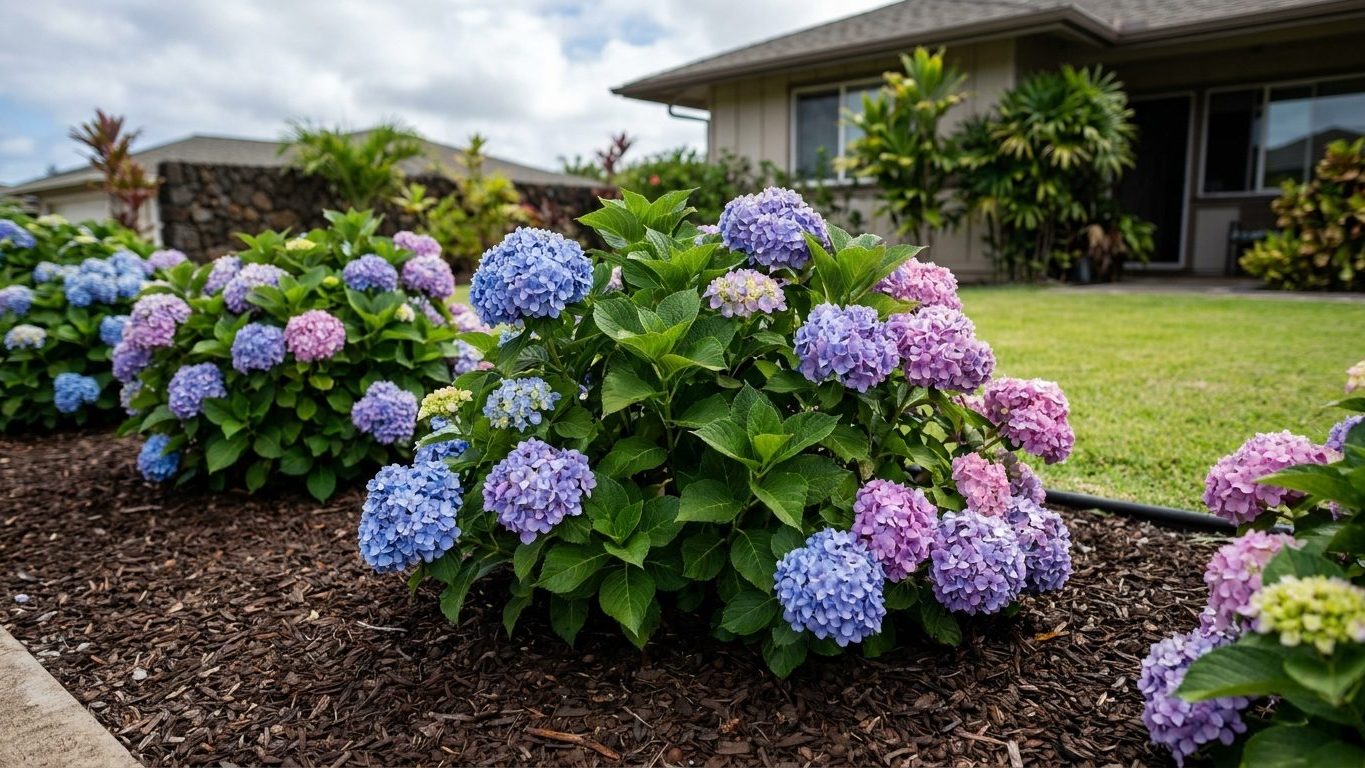
In Hawaii, the safe planting windows fall in January, February, October, and November, with bigleaf hydrangeas pruned in June and July after bloom fade. There’s no frost date to count from here. Elevation and rainfall set the rhythm instead, and a yard in Honolulu runs on a different clock than one on Kula’s slopes or Hilo’s wet coast.
When to prune hydrangeas in Hawaii: The Short Answer
Honolulu anchors the state’s growing calendar, and USDA Plant Hardiness Zone Map puts Hawaii at zone 9a to 13a, a spread wide enough that a hydrangea planted near the coast behaves nothing like one set into cooler upcountry soil.
- January: the plant window opens, and new hydrangeas go into the ground while air stays cool and moist. Give the root ball a full month before the driest weeks arrive.
- February: this is the second month of the same plant window, still a safe bet island-wide. Water deeply at planting since roots haven’t spread far yet.
- March: the first fertilize date lands here, feeding shrubs as they push new leaves. Skip fertilizer on anything planted within the last six weeks.
- April: no plant, fertilize, or prune date falls this month, so this is a watch-and-mulch stretch. Check that drainage still runs clear after any heavy rain.
- May: the second fertilize date arrives, right as buds start forming on older wood. Keep the feeding light on shrubs still building their first-year roots.
- June: pruning bigleaf hydrangeas begins, the only stretch of the year set aside for it. Cut spent flower heads back to the first strong pair of leaf buds.
- July: the prune window closes here, and the third fertilize date lands in the same month. Finish any cutting before mid-month so new buds have time to set.
- August: no scheduled task falls here, and this is usually the driest stretch of the year. Watch leaf edges for the curl that signals a shrub needs deeper watering.
- September: still an off-calendar month, good for scouting a planting site ahead of fall. Clear weeds from the spot so roots meet no competition in October.
- October: the plant window reopens, the first of two fall months for setting new hydrangeas. Cooler nights let roots establish before winter’s calmer growth.
- November: the plant window closes at month’s end, the last safe stretch until January. Mulch new plantings well since this closes out the fall push.
- December: no task is scheduled, and shrubs mostly rest through this slower month. Use the quiet stretch to plan where January’s new plantings will go.
These dates hold for lowland Hawaii, where the frost that shapes mainland calendars never arrives. Rainfall and elevation do that work instead, and the next section walks through adjusting them for your own yard.
Hawaii — the year and the numbers
- State
- Hawaii
- USDA zones
- 9a-13a
- Frost
- none in an average year
- Annual rain
- 16 in
- Lawn zone
- warm-season
- Source
- NOAA NCEI 1991-2020 Climate Normals: not-computable flag for every freeze percentile at 32F and 36F, zero days per year at or below 32F, station USW00022521 — https://www.ncei.noaa.gov/access/services/data/v1?dataset=normals-annualseasonal&stations=USW00022521 · Honolulu
How to Work Out the Dates for Your Own Yard
Working out your own dates means starting from the state’s zone range and narrowing it down to your yard’s elevation and exposure.
- Pick your plant window first: the state calendar sets planting at January, February, October, and November, so choose the window closest to now.
- Place your yard on the zone range: USDA Plant Hardiness Zone Map lists Hawaii from 9a to 13a, so a garden near sea level in Honolulu behaves differently than one on a cooler upcountry slope.
- Match elevation to expectation: the higher the yard sits, the closer it behaves to the 9a end, meaning slower growth and a shorter bloom push.
- Set your feeding dates: fertilize in March, May, and July, spacing the three feedings evenly through the growing stretch.
- Reserve pruning for June and July: cut spent bigleaf blooms only inside that window, never earlier.
- Confirm with your island’s extension office: local staff can tell you where your yard actually falls inside that broad zone range.
None of these steps replace a look at your own soil, but together they turn a wide zone range into a date that fits your particular yard.
Hawaii North to South: How the Dates Shift
Hawaii’s islands don’t share one calendar, and elevation shifts these dates more than any coastline does.
- Windward and wet coasts (Hilo, Hana, Kaneohe): rain stays frequent enough that plantings often root faster here than anywhere else in the state.
- Leeward and dry coasts (Kona, Waikiki, Lahaina): heat and dry air mean afternoon shade and steady watering matter more than the calendar date itself.
- Upcountry and high elevation (Kula, Volcano, Waimea): cooler air lets bloom color hold longer and pushes the whole season slightly later.
Check the Hawaii hydrangea guide for the numbers that apply to your specific island and elevation.
Mistakes Hawaii Punishes
No bloom despite lush green growth

Bigleaf hydrangeas set their flower buds on old wood, and cutting them at any time outside the June and July window strips away next year’s blooms before they even form. Prune only inside that window, and otherwise leave the shrub alone through the rest of the year.
Leaves crisped along the sunny edge
Full lowland sun near the dry, leeward coast scorches leaf margins fast, turning edges brown within days during the hottest stretch of the year. Plant in afternoon shade instead, especially below the cooler upcountry elevations, and check which named varieties actually tolerate this heat before choosing a spot.
Soft, leggy growth and no flowers
Feeding outside the March, May, and July fertilize dates pushes soft, leggy new growth that never has time to harden into flower buds before the season moves on. Stick to those three feeding months, and skip fertilizer entirely on anything planted within the past six weeks.
Hawaii Extension Offices and County Contacts
The state’s zone range is a starting point, not a final answer, and the county extension office fills in what the map can’t show.
- CTAHR Extension: the University of Hawaii’s extension service, with island-specific staff who know your slope and soil.
- Which ones hold up here: the variety guide names the hydrangeas suited to Hawaii’s zone range, from most reliable to most fragile.
- What goes wrong here: the trouble guide covers the pests and stress signs particular to this state’s climate.
Common questions
Can I plant hydrangeas in Hawaii during summer?
The state calendar reserves planting for January, February, October, and November, so summer planting works only with heavy shade and constant water, and even then roots may not establish before the driest weeks of the year arrive.
Do hydrangeas need chill hours in Hawaii?
No. Lowland Hawaii never sees freezing temperatures, so hydrangeas here rely on rainfall and elevation rather than a winter chill period to set their bloom.
Should I prune hydrangeas right after planting?
No. Wait until the shrub is established, and reserve any bigleaf pruning for the June and July window regardless of when it first went into the ground.