Skip to content

When to Prune Hydrangeas in New Jersey

When to Prune Hydrangeas in New Jersey

Plant hydrangeas in New Jersey in spring, from March into April, or again in fall, from September into October, once the soil has cooled but before the ground locks up. Newark’s frost dates and the state’s split hardiness zone decide which of those windows fits your yard, and bigleaf hydrangea pruning waits until June or July.

When to prune hydrangeas in New Jersey: The Short Answer

Newark’s last spring frost, according to NOAA NCEI U.S. Climate Normals 1991-2020, falls between March 29 and April 6, and that single window decides most of what follows below, month by month.

  • January: The shrub sits dormant and needs nothing but a look for winter dieback. Skip pruning now, since cutting into wood this early only invites more cold damage.
  • February: This is order-and-prep season, not planting season, with the ground in Newark still too cold to dig. Pick out bare-root stock or container plants so they’re ready once frost risk drops.
  • March: Planting opens this month, but only after the frost risk has mostly passed. Fertilizing also starts in March, once new growth shows at the base of the shrub.
  • April: The planting window stays open through April, right as the spring frost risk finally clears for good. Water new shrubs deeply twice a week until roots settle in.
  • May: A second fertilizer application goes down in May, timed to feed the shrub as flower buds start forming. Mulch two to three inches deep to hold moisture through the coming heat.
  • June: Pruning of bigleaf hydrangea belongs here, right after the first flush of blooms fades. Cut spent flower stems back to the first healthy set of buds, never lower.
  • July: July carries both the last fertilizer round and the tail end of the bigleaf pruning window. Water during dry stretches, since summer heat pulls moisture out of the soil fast.
  • August: No fertilizing or pruning this month, since late feeding pushes soft growth frost will punish. Deadhead spent blooms and keep watering steady instead.
  • September: Planting reopens in September, and many Jersey gardeners prefer this window since the soil holds warmth while the air cools. Give new plants six to eight weeks before the ground freezes.
  • October: October closes the fall planting window, with roots needing time to establish before the first frost arrives. Hold off on pruning here, since fresh cuts don’t heal well this late.
  • November: Newark’s first fall frost lands between November 4 and November 16, and that’s the cue to mulch roots heavily for winter. Stop watering once the ground starts to freeze.
  • December: The shrub is fully dormant again, and pruning or fertilizing both wait until the calendar says otherwise. Check mulch depth after heavy wind or snow.

New Jersey’s USDA Plant Hardiness Zone spans 6a to 7b, wide enough that a shrub thriving in Newark’s suburbs might struggle sixty miles inland. Check your own county before trusting this list outright.

How to Work Out the Dates for Your Own Yard

Finding your own dates starts with your county’s frost window, not the state’s, since the calendar above uses Newark as its reference point and your yard may run cooler or warmer.

  1. Find your local frost dates: NOAA NCEI Climate Normals lists Newark’s last spring frost at March 29 to April 6, but a county extension office or a personal weather log can adjust that window for your own soil and elevation.
  2. Count backward from the fall frost for planting: with first fall frost landing November 4 to November 16, a September or October planting date leaves several weeks of root growth before the ground locks up.
  3. Count forward from the spring frost for pruning: bigleaf hydrangea pruning waits until June or July, well clear of any lingering cold that could damage fresh cuts.
  4. Check your hardiness zone on the map: USDA places New Jersey between zone 6a and 7b, and a shrub rated for zone 7 alone is gambling in a 6a yard.
  5. Watch the shrub, not just the calendar: new growth at the base signals it’s safe to fertilize, regardless of what the date on the wall says.

None of this replaces a look at your own yard. A north-facing slope or a low spot that collects cold air can run behind the reference dates above.

New Jersey North to South: How the Dates Shift

New Jersey stretches from the Highlands in the north to the shore in the south, and that distance shows up in the calendar more than most homeowners expect.

  • The Skylands and Highlands (Sussex, Warren, Morris counties): higher elevation and colder pockets push both frost dates later in spring and earlier in fall than the Newark numbers above suggest.
  • The Piedmont and central corridor (Essex, Union, Middlesex counties): this band tracks closest to Newark’s own numbers, since the reference station sits inside this corridor.
  • The Pine Barrens and inland south (Burlington, Ocean, Atlantic counties): sandy soil drains fast and warms early, often letting the safe planting date arrive ahead of the north.
  • The shore and bay counties (Cape May, Monmouth, Cumberland): coastal water moderates temperature swings, softening both the spring cold snaps and the first hard frost of fall.

Check the state guide for New Jersey to see where your county lines up against these regional shifts.

Mistakes New Jersey Punishes

Pruning bigleaf hydrangea after summer

Bigleaf hydrangea sets its flower buds on the previous year’s wood, so a fall cut removes next summer’s blooms entirely. Keep pruning inside the June to July window and skip the urge to tidy shrubs in September or October.

Planting before the soil actually warms

A calendar page that says March feels safe, but NOAA NCEI Climate Normals puts Newark’s last spring frost as late as April 6, and cold wet soil rots new roots before they take hold. Wait until the ground has dried out, even into April.

Fertilizing into late summer

A feeding in August or later forces soft new growth that the first fall frost, arriving as early as November 4 in Newark, kills outright. Stop fertilizing after July and let the shrub harden off on its own.

New Jersey Extension Offices and County Contacts

The zone and frost numbers above are a starting point, not a final answer, and Rutgers New Jersey Agricultural Experiment Station keeps county-level guidance for exactly the gaps a statewide range leaves open.

  • Your state page: the frost dates and the pruning window where you live, gathered in one place.
  • Which ones hold up here: a variety-by-variety look at what actually survives a New Jersey winter.
  • What goes wrong here: the pests and problems specific to hydrangeas in this state, month by month.

Call your county extension office before the next planting window opens.

Common Questions

Can I plant hydrangeas in New Jersey in the summer?

Summer heat stresses new roots before they’ve had a chance to establish, so the spring window of March through April and the fall window of September through October both work better than a July planting.

Do hydrangeas need winter protection in New Jersey?

In colder pockets of the state, a heavy mulch layer over the root zone before the first fall frost protects the shrub through winter, especially for bigleaf varieties that set buds on old wood.

What happens if I miss the June to July pruning window for bigleaf hydrangea?

Pruning outside that window risks cutting off next year’s flower buds, since bigleaf hydrangea blooms on the previous season’s growth. Wait for the next window rather than pruning off schedule.
Hydrangea Pests and Diseases in New Hampshire

Hydrangea Pests and Diseases in New Hampshire

New Hampshire hydrangeas fight cold more than insects. In Concord, USDA hardiness zone 3b to 6a and a frost window that closes in late April decide whether bigleaf types even flower, while aphids, four-lined plant bug, powdery mildew, and two leaf diseases fill out the rest of the season’s trouble list, each one landing at its own point in the year rather than all at once.

Hydrangea pests and diseases New Hampshire: The Short Answer

NOAA NCEI’s climate normals put Concord’s last spring frost between April 16 and April 27, close enough to bud swell that cold, not insects, causes most flowerless bigleaf hydrangeas in New Hampshire. The state’s zone range, 3b to 6a, then decides which winter problems turn into summer ones for the rest of the season.

Bud blast after a late frost

Bud blast after a late frost — Hydrangea Pests and Diseases in New Hampshire

A frost that lands inside that window blackens swelling flower buds and can erase the whole season’s bloom. Wait until the window closes before pulling off winter protection, and check the state calendar page for the exact week where you garden.

Sticky curled new growth

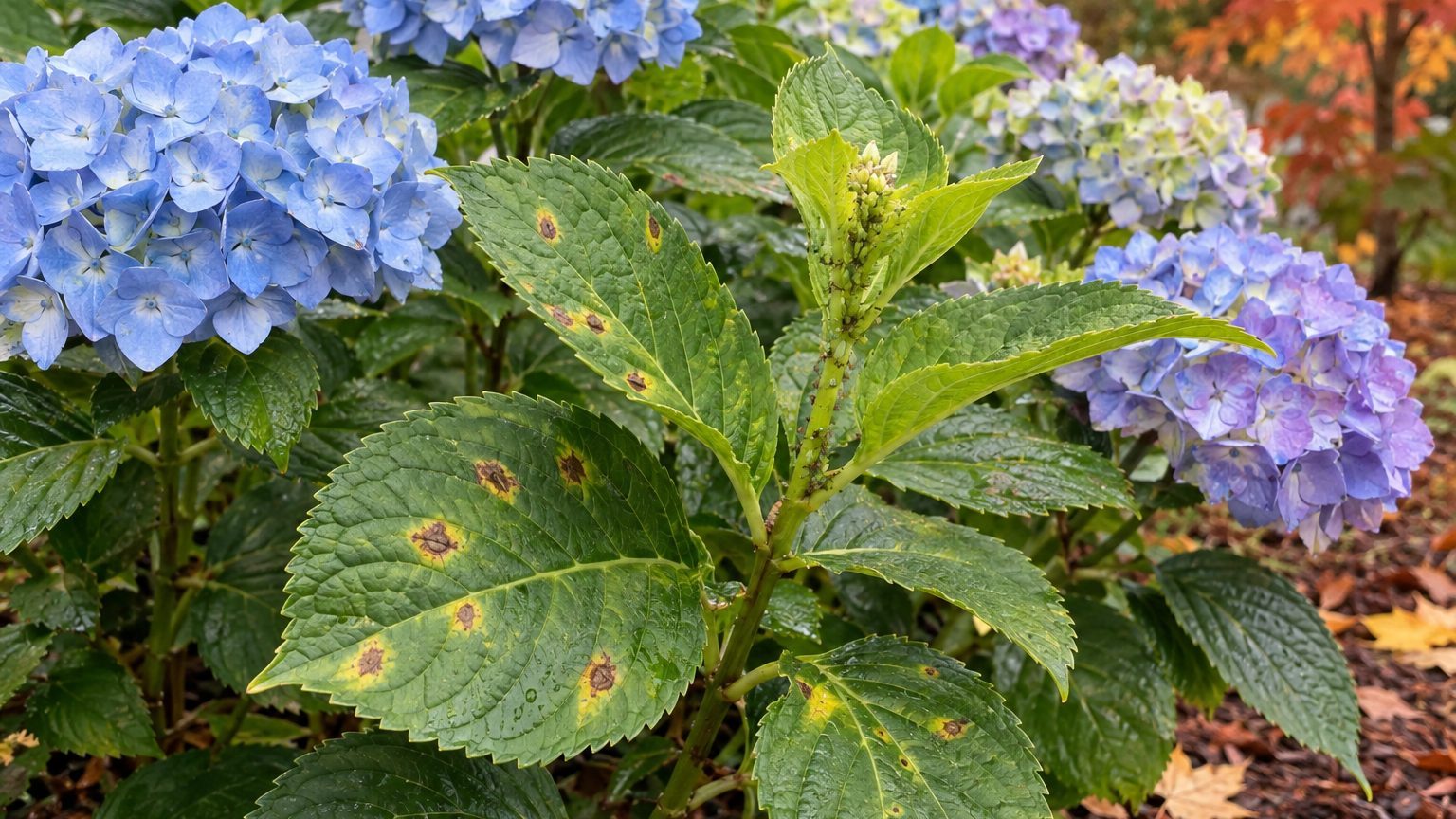
Aphids cluster on tender shoots as soon as new growth pushes out, right in the April and May planting window. Leaves curl, stems get tacky with honeydew, and sooty mold follows. A strong hose spray every few days knocks the colony down without reaching for a spray bottle.

Pinholes and stippled young leaves

Four-lined plant bug punches small round holes in young leaves in early summer, usually before the June and July pruning window opens on bigleaf types. The damage looks worse than it is and rarely needs treatment. Pruning during that window cleans the shrub up anyway.

White dust across the leaf surface

Powdery mildew shows as a gray-white film on leaf tops during humid July stretches, especially where shrubs sit close together. Airflow matters more than any fungicide: space plants, skip evening overhead watering, and let the July fertilizing round feed roots instead of wet foliage.

Brown spots ringed in purple

Brown spots ringed in purple — Hydrangea Pests and Diseases in New Hampshire

Cercospora leaf spot follows the same humid weeks as mildew, marking lower leaves with small brown spots edged in purple before they yellow and drop. It rarely kills a healthy shrub. Rake and remove fallen leaves each fall so spores do not overwinter in the bed.

Fuzzy gray mold on spent blooms

Fuzzy gray mold on spent blooms — Hydrangea Pests and Diseases in New Hampshire

Botrytis blight coats faded flower clusters with a fuzzy gray mold during extended wet spells in mid-summer, sometimes spreading onto stems. Cutting spent blooms promptly and improving airflow between shrubs stops it from traveling into next year’s buds.

Blackened canes after a hard winter

New Hampshire’s zone 3b to 6a range means some winters kill canes back to the snow line, especially on bigleaf types that bloom on old wood. Scratch the bark in spring, cut back to living tissue, and lean on panicle or smooth types if this happens most years.

How to Work Out the Dates for Your Own Yard

Concord’s numbers are a starting point, not a rule for your own yard, so work backward from the frost window instead of a fixed calendar date.

  1. Find your last spring frost: NOAA NCEI’s climate normals put Concord’s window between April 16 and April 27, and gardens off the valley floor should add a week or two to that.
  2. Hold winter protection through that window: pulling burlap or mulch off before the window closes exposes swelling flower buds to the exact frost that kills them.
  3. Watch new growth for aphids: they show up within two to three weeks of the first flush, overlapping the April and May planting window on the calendar.
  4. Pair pest checks with the June and July pruning window: that is when bigleaf gets cut back anyway, so a look for four-lined plant bug damage costs nothing extra.
  5. Count back from first fall frost: Concord’s range runs October 13 to October 26, and fallen, spotted leaves need raking before that window closes the season.
  6. Check where your yard sits on the zone map: the state runs anywhere from 3b to 6a, and a shrub that survives winter in the south may not near the notches.

None of this replaces watching your own shrub. A warm pocket against a south-facing wall runs a week or two ahead of an open yard, and a low spot that collects cold air runs behind it.

New Hampshire North to South: How the Dates Shift

Concord sits in the middle of the state’s range, and the same pest and disease timeline shifts by a couple of weeks in either direction depending on where you garden.

  • The Seacoast (Portsmouth, Dover, Exeter): the mildest ground in the state, with the shortest frost season and the longest stretch of humid air that favors powdery mildew and leaf spot.
  • The Merrimack Valley (Concord, Manchester, Nashua): the reference climate, tracking the frost window and zone range described above.
  • The Lakes Region and hill towns (Laconia, New London, Peterborough): cold air pools in the valleys overnight, pushing bud blast risk later into spring and cane dieback further into the growing season.
  • The North Country and White Mountains (Berlin, Lancaster, Franconia): the shortest growing season in the state, where winter dieback is the default outcome for bigleaf types rather than an exception.

Whichever pocket of the state you garden in, the state hydrangea page sets the frost and zone figures your county starts from.

Mistakes New Hampshire Punishes

Pruning bigleaf too early

Cutting bigleaf hydrangea back in April or May removes the same old wood that survived winter and would have flowered. Wait for the June and July pruning window on the calendar, cut just above the first live bud, and check the by-variety page before planting the next one.

Skipping winter protection on exposed sites

Leaving bigleaf hydrangea bare through a New Hampshire winter in an open, windy spot invites full cane dieback, not just bud loss. Mound mulch over the crown before the ground freezes, and hold the wrap until Concord’s frost window closes in late April.

Watering leaves late in the day

Sprinkling leaves late in the day keeps them damp overnight through humid summer stretches, which is exactly what powdery mildew and leaf spot need to spread. Water at the base in the morning instead, and pair it with the July fertilizing round already on the calendar.

New Hampshire Extension Offices and County Contacts

Concord’s frost window and zone range are only a starting point. USDA NIFA’s Land-Grant University Extension directory lists UNH Extension as the county-by-county contact for the pest pressure, soil, and exposure specific to your address.

  • UNH Extension: extension.unh.edu connects to county offices and current advisories for common hydrangea problems.
  • Your state page: the frost dates and zone range for New Hampshire in one place.
  • Which ones hold up here: the variety-by-variety page for choosing a hydrangea built for this climate.

Common questions

Do I need to spray hydrangeas in New Hampshire every year?

No. Most New Hampshire yards see aphids and an occasional leaf spot outbreak, and both clear up with a hose spray and better airflow rather than a scheduled fungicide program.

Why did my hydrangea leaf out fine but never flower?

Bigleaf hydrangea blooms on old wood, and a late frost inside Concord’s April 16 to April 27 window, or a hard winter within the state’s 3b to 6a range, kills those buds before summer even starts.

Is winter dieback the same as a disease?

No. It is cold injury, not an infection, though a shrub weakened by dieback is more likely to pick up powdery mildew or leaf spot once the wound tissue is exposed to a humid summer.

When to Prune Hydrangeas in New Hampshire

When to Prune Hydrangeas in New Hampshire

Hydrangeas in New Hampshire go in the ground during April, May, August, or September, and the safe pruning stretch for bigleaf varieties is limited to June and July. Near Manchester, the state’s reference city for frost data, the last spring frost falls between April 16 and April 27, and the first fall frost arrives between October 13 and October 26.

When to prune hydrangeas in New Hampshire: The Short Answer

New Hampshire hydrangea care follows a short growing season bounded by two frost windows, and each month asks for a different job.

  • January: The shrub is fully dormant and needs no attention beyond checking that mulch hasn’t blown off the root zone. Skip pruning until the coldest stretch of winter passes.
  • February: Buds stay tucked against the wood through this month, so it remains a hands-off period. Look for split bark from freeze-thaw cycles, but wait to act.
  • March: This opens the first fertilize window listed for the state, so a balanced feed now gets nutrients into the soil before leaf-out. Hold off on planting since the ground is often still cold.
  • April: NOAA NCEI U.S. Climate Normals 1991-2020 puts Manchester’s last spring frost window at April 16 to April 27, and April is also the earliest month on the state’s plant list. Set new shrubs in the ground only once that window has passed in your yard.
  • May: May carries both a plant window and a second fertilize window, making it the busiest month for hydrangeas here. Newly planted shrubs need steady watering as they settle into the soil.
  • June: June opens the prune-bigleaf window, the only safe stretch to shape bigleaf varieties without cutting off next year’s buds. Wait until stems fully leaf out before cutting anything back.
  • July: Pruning bigleaf hydrangeas continues through July, and it’s also the third fertilize month on the calendar. Deep watering matters most now as summer heat peaks.
  • August: August reopens the plant window, a good stretch for adding shrubs once the worst heat has eased. Keep new roots moist through any dry spell.
  • September: September closes out the plant window, giving roots several weeks to settle before the ground cools. Avoid heavy pruning now since new growth won’t harden off in time.
  • October: The first fall frost window runs October 13 to October 26 at the reference station, marking the shift toward dormancy. Stop fertilizing and let the plant wind down naturally.
  • November: Once leaves drop, a layer of mulch over the root zone helps buffer the hardest freezes ahead. This is not a month for pruning or feeding.
  • December: The shrub sits fully dormant and needs nothing beyond an occasional check that snow load isn’t bending branches. Save any structural work for the coming prune window.

New Hampshire’s frost swings by roughly two weeks in either direction across the state, and the USDA Plant Hardiness Zone Map spans zone 3b to 6a, so a shrub that thrives near Manchester may need extra protection in the White Mountains.

How to Work Out the Dates for Your Own Yard

Your yard’s actual dates depend on how far your address sits from the reference weather station, and a few checks close that gap.

  1. Check your last frost against Manchester’s window: NOAA NCEI U.S. Climate Normals 1991-2020 puts Manchester’s last spring frost window at April 16 to April 27, and inland or elevated yards often run one to two weeks later.
  2. Push your fall frost earlier if you’re rural: The first fall frost window sits at October 13 to October 26 at the airport station, and suburban or wooded lots typically see frost arrive earlier than that.
  3. Match your zone to the state range: The state spans hardiness zone 3b to 6a, so a shrub rated for the warmer end may struggle in a colder pocket.
  4. Count backward from your plant window: The state’s plant windows fall in April, May, August, and September, so choose the slot that lands safely after your local last frost.
  5. Watch the wood, not the calendar, for pruning: The prune window for bigleaf varieties runs June and July, timed to when new leaves reveal which stems actually survived winter.

Manchester’s frost swings, this state’s zone range, and the plant windows above give you three checks. Line them up and you’ll land on dates that fit your own yard instead of the airport’s.

New Hampshire North to South: How the Dates Shift

Manchester’s numbers are a starting point, but the state’s terrain pulls those windows in different directions depending on where you garden.

  • The North Country (high elevation, near the White Mountains): frost lingers latest here, often pushing safe planting toward the back half of the spring window.
  • The Lakes Region (shoreline towns around the state’s larger lakes): open water moderates swings, buffering both the last spring frost and the first fall frost by a few days compared with inland yards.
  • The Seacoast (coastal towns near the ocean): the mildest corner of the state, where the growing season stretches longest and frost arrives latest in fall.
  • The Merrimack Valley and South (nearest the reference city): dates track closest to the Manchester figures used above, since this is where the weather station sits.

For the full zone breakdown and a wider look at frost timing across the state, the New Hampshire hydrangea guide covers the territory-wide picture.

Mistakes New Hampshire Punishes

Pruning bigleaf on the wrong schedule

Cutting back bigleaf hydrangeas in fall or early spring removes the buds that already formed for next year, since bigleaf blooms on old wood. Wait for the June to July prune window listed for this state, once new leaves show which stems survived winter, before removing anything.

Planting before the last frost clears

NOAA NCEI U.S. Climate Normals 1991-2020 puts Manchester’s last spring frost window at April 16 to April 27, and garden centers often stock hydrangeas before that window closes. Hold new shrubs in a sheltered spot until your yard clears frost, then plant during April or May.

Skipping mulch before the ground freezes

Skipping mulch before the first fall frost window of October 13 to October 26 leaves shallow roots exposed to sudden hard freezes, especially in the colder pockets of the state. Pile mulch over the root zone in November, once leaves drop, rather than waiting for the ground to freeze solid.

New Hampshire Extension Offices and County Contacts

Manchester’s frost dates and the state’s zone range are a starting point, not a guarantee for your county.

  • Your state page: the frost dates and the pruning window for New Hampshire in one place.
  • Which ones hold up here: hydrangea varieties matched to this state’s zone range.
  • UNH Extension: county offices for soil tests and local planting advice.

Common questions

Can I plant hydrangeas in New Hampshire in fall?

Yes, September falls inside the state’s plant window, though roots need several weeks of mild soil before the first fall frost window of October 13 to October 26 arrives at the reference station.

Do I need to cover hydrangeas for winter in New Hampshire?

A layer of mulch over the root zone helps across most of the state, and it matters most for bigleaf varieties, which set next year’s buds on wood that has to survive winter intact.

Why didn’t my hydrangea bloom this year?

A late spring frost inside the April 16 to April 27 window, or a prune done outside the June to July window, are the two most common reasons bigleaf hydrangeas skip a bloom season here.

Hydrangeas That Grow Well in New Brunswick

Hydrangeas That Grow Well in New Brunswick

Panicle and smooth hydrangeas are the two safe bets for a New Brunswick yard: both tolerate the winters that put Moncton, the province’s reference city, at Canadian hardiness zone 5a, and both flower on new wood, so an early frost or a hard prune never erases the bloom. Bigleaf types remain the gamble here, not the standard choice.

Hydrangeas that grow well in New Brunswick: The Short Answer

Natural Resources Canada’s Plant Hardiness Site puts Moncton, the province’s reference city, at Canadian zone 5a, with an average last frost near May 23 and first fall frost by October 2.

That short, cool season rules out most bigleaf hydrangeas and puts the panicle and smooth species at the top of any real New Brunswick planting list.

A full month-by-month calendar and a rundown of the pests and problems that show up here live on their own pages. This one stays on the six names worth planting.

Hydrangea paniculata (Panicle Hydrangea)

Hydrangea paniculata (Panicle Hydrangea) — Hydrangeas That Grow Well in New Brunswick

This is the shrub to plant first here. It flowers on new wood, so a hard freeze that kills the buds each winter costs nothing, since the bush rebuilds and blooms by late summer regardless. Cold has never been the limiting factor for this species in a zone 5a garden.

Hydrangea arborescens ‘Annabelle’ (Smooth Hydrangea)

Hydrangea arborescens 'Annabelle' (Smooth Hydrangea) — Hydrangeas That Grow Well in New Brunswick

Native to eastern North America and about as tough as hydrangeas get, ‘Annabelle’ dies back to the ground most winters here and simply regrows from the roots. New wood blooming means the frost date barely matters, only the length of summer left to flower.

Hydrangea paniculata ‘Limelight’ (Panicle Hydrangea)

Hydrangea paniculata 'Limelight' (Panicle Hydrangea) — Hydrangeas That Grow Well in New Brunswick

A named panicle cultivar prized for its sturdier stems and denser cone-shaped blooms, ‘Limelight’ carries the same new-wood habit as the species and the same tolerance for a short, cool season. It is a safe substitution wherever straight paniculata is sold out.

Hydrangea quercifolia (Oakleaf Hydrangea)

Hydrangea quercifolia (Oakleaf Hydrangea) — Hydrangeas That Grow Well in New Brunswick

Oakleaf blooms on old wood, which puts it a step behind the first three here. A hard winter can strip the flower buds even when the plant itself survives, so treat any bloom in a New Brunswick yard as a bonus rather than a guarantee.

Hydrangea anomala subsp. petiolaris (Climbing Hydrangea)

Hydrangea anomala subsp. petiolaris (Climbing Hydrangea) — Hydrangeas That Grow Well in New Brunswick

This vine survives the cold well enough once established, but establishment is the catch: it can take several seasons of a short growing window just to attach and cover a wall, let alone flower. Patience matters more than winter protection with this one.

Hydrangea macrophylla (Bigleaf Hydrangea)

Hydrangea macrophylla (Bigleaf Hydrangea) — Hydrangeas That Grow Well in New Brunswick

The riskiest name on this list and the one most beginners bring home from a big-box store. Its flower buds form on old wood the previous fall, and a normal New Brunswick winter kills them outright, leaving healthy green leaves and no blooms most years.

How to Work Out the Dates for Your Own Yard

Working out a safe day for your own yard means counting from the two average frost dates for Moncton, not from a fixed date printed on a plant tag.

  1. Start from the average last frost: Environment and Climate Change Canada lists it for Moncton as May 23, which is a midpoint, not a guarantee, so treat the two weeks after it as the safe window before setting a panicle or smooth hydrangea in the ground.
  2. Match the month to the planting window: it runs across May, June, August, and September here, so a shrub bought in early spring should wait for that first slot instead of going in during a late-May cold snap.
  3. Push bigleaf types later, not earlier: since Hydrangea macrophylla buds often die back over winter, setting it out in the June slot instead of May gives roots an extra month to establish before the first fall frost near October 2.
  4. Fertilize only in the two open months: feed in May or again in July, never later, so new growth has time to harden off before the season closes.
  5. Prune bigleaf in June or July only: cutting outside that pair of months risks removing next year’s flower buds on a shrub that already struggles to carry them through winter.

A panicle hydrangea planted in the May slot blooms reliably because it flowers on new wood grown after that date. A bigleaf hydrangea planted the same week can look healthy for a full year and then skip flowering entirely, since the buds it formed the previous fall never survived winter.

New Brunswick North to South: How the Dates Shift

  • The Fundy coast (Saint John, St. Andrews, the Fundy shore): the bay’s cold water keeps spring air cool and delays planting, though the same fog moderates the first fall frost and can stretch the season on the back end.
  • The Saint John River valley (Fredericton, Oromocto, Woodstock): inland valley air warms faster once the sun is up, so the ground here is often workable a little sooner than along the coast.
  • The northern highlands and Acadian Peninsula (Bathurst, Miramichi, Campbellton): higher ground and the province’s coldest pockets push the frost-free window shorter from both ends, squeezing an already tight season for bigleaf hydrangeas.

None of these shifts changes which species survive, only how much margin each one gets, so treat the Moncton dates as a starting point to adjust by feel, not as a fixed rule for every yard.

Mistakes New Brunswick Punishes

Pruning bigleaf hydrangeas in fall

Cutting back Hydrangea macrophylla in September or October removes the very buds meant to open next summer. This shrub already loses many buds to winter cold, so the real pruning window here is June and July, before the shrub sets next year’s growth.

Planting after the fall window closes

A hydrangea set in the ground after September has only weeks before the average first frost on October 2, not enough time to root in before cold arrives. The planting months that work here are May, June, August, and September, nothing later.

Treating every hydrangea like a bigleaf

Gardeners who mulch a panicle or smooth hydrangea for winter, then leave a bigleaf bare, have the protection backward. The old-wood bloomers need the extra cover most, and the six names above show which ones actually need it.

New Brunswick Extension Offices and County Contacts

Canada’s federal extension arm, Agriculture and Agri-Food Canada, backs the provincial hardiness numbers. Two other pages here carry the details this one leaves out.

  • Your province page: the frost dates and the pruning window for wherever you garden in New Brunswick.
  • Which ones hold up here: the six names above, ranked from safest to riskiest for this zone.
  • What goes wrong here: the pests and problems this climate actually produces, in the order they show up each season.

Common questions

Do hydrangeas need winter protection in New Brunswick?

Panicle and smooth types need none, since they regrow from the base each spring. Bigleaf hydrangeas benefit from a mound of mulch over the crown, though even that rarely saves the flower buds through a Canadian zone 5a winter.

Can I grow bigleaf hydrangea in Moncton at all?

The plant itself usually survives, leafing out fine each spring. Reliable flowers are the problem, since old-wood buds rarely make it through winter here, so most gardeners grow it for foliage or in a pot brought indoors for the cold months.

When is the best month to plant hydrangeas in New Brunswick?

May and June give the longest run before fall, while August and September work for shrubs that need less time to establish. Avoid the very end of September, since the average first frost lands close behind it.

Hydrangea Pests and Diseases in New Brunswick

Hydrangea Pests and Diseases in New Brunswick

In New Brunswick, hydrangeas mostly struggle with powdery mildew, leaf spot, aphids, and bud loss from late frost, not an exotic pest list. Around Moncton, the season runs roughly from May 23 to October 2, and cool, damp summers push fungal disease ahead of insects. Bigleaf varieties carry the most risk, since the province sits in Canadian zone 5a.

Hydrangea pests and diseases New Brunswick: The Short Answer

Bud blast after a late frost

Bud blast after a late frost — Hydrangea Pests and Diseases in New Brunswick

New growth that browns and drops in spring usually traces to a frost after leaf-out. Environment and Climate Change Canada’s Canadian Climate Normals put Moncton’s average last frost at May 23, but half of all years run later. Cut back watering, cover shrubs on cold nights, and check the calendar page before pruning.

Aphids clustering on new growth

Small green or black insects crowd tender stem tips and curl the newest leaves, usually once the last frost has passed near Moncton. Sticky honeydew and sooty mold often follow within days. Knock them off with a strong jet of water or bring in ladybugs, and recheck weekly through the June pruning window.

Leaf scorch in full afternoon sun

Leaf scorch in full afternoon sun — Hydrangea Pests and Diseases in New Brunswick

Brown, crispy edges on leaves facing full afternoon sun usually mean heat and wind stress rather than disease, more common on exposed sites than in shaded yards. Move new plantings to morning sun with afternoon shade, and water deeply twice a week during dry spells rather than a light daily sprinkle.

Powdery mildew on the leaf surface

Powdery mildew on the leaf surface — Hydrangea Pests and Diseases in New Brunswick

A gray-white dusty coating spreads across leaves during warm, humid stretches once summer settles in, rarely killing the shrub outright but weakening the next season’s flower buds. Space plants for airflow, water the soil rather than the foliage, and strip off badly coated leaves before the fall cleanup.

Cercospora leaf spot climbing the plant

Cercospora leaf spot climbing the plant — Hydrangea Pests and Diseases in New Brunswick

Small purple-brown circles appear on the lowest leaves first and climb the plant through late summer, then those leaves yellow and drop early, thinning the shrub from the bottom up. Rake and discard fallen leaves each fall instead of composting them, since the fungus overwinters in that debris.

Botrytis blight after a cool, wet spell

Botrytis blight after a cool, wet spell — Hydrangea Pests and Diseases in New Brunswick

Gray, fuzzy patches form on flower clusters and soft new growth after an extended damp spell, common during a cool coastal New Brunswick fall. Improve drainage around the roots, avoid watering late in the day, and cut out any infected blooms the moment they appear.

Root rot in soggy soil

Wilting leaves on a shrub sitting in wet, heavy soil usually point to root rot rather than drought, especially after a rainy stretch. Pull back mulch from the base, improve drainage before replanting, and avoid daily watering, since soggy roots invite the fungus faster than dry ones stress the plant.

Deer browsing over winter

Stems get chewed back to bare wood when snow cover is thin and forage is scarce, especially on shrubs left unprotected near woodland edges. Fence young plants or apply repellent before the ground freezes, and expect thinner flowering the following June as the shrub recovers.

How to Work Out the Dates for Your Own Yard

Working out which hydrangea problem is actually on your shrub takes a short walk around the plant and a glance at the calendar, more than any spray-first approach.

  1. Note the month before anything else: bud blast and deer damage only show up outside the May through October growing window, while leaf spot and mildew need weeks of summer humidity to take hold, so a June problem and a September problem are rarely the same one.
  2. Check which leaves carry the marks: lower, older leaves with spreading spots point to Cercospora leaf spot working its way up the plant, while curled or sticky newest growth points to aphids instead.
  3. Press the soil at the base with a finger: ground that stays soggy for days after rain signals root rot risk, while dry, crumbly soil around a wilting shrub usually points to drought stress or a different culprit entirely.
  4. Match winter symptoms to the zone: Natural Resources Canada’s Plant Hardiness Site puts the Moncton area at Canadian zone 5a, so bare stem tips after a hard winter are close to normal here and not automatically a disease to treat.
  5. Track the last two weeks of weather: a cool, wet stretch tips the balance toward botrytis blight on the flowers, while a hot, dry run points back to leaf scorch or aphid stress instead.
  6. Call the county office when two problems overlap: mixed symptoms on one shrub are common enough that a photo sent to extension settles the question faster than another round of guessing.

None of this replaces an actual look at the shrub, but running through these checks before reaching for a spray keeps most New Brunswick yards from treating the wrong problem.

New Brunswick North to South: How the Dates Shift

New Brunswick’s frost dates and disease pressure don’t sit still across the province, even though the Moncton figures anchor this whole page.

  • The Fundy coast (Saint John, St. Andrews): persistent fog and cooler summer nights slow both bud break in spring and fungal pressure in summer, so mildew and leaf spot often show up later than they do further inland.
  • The north and the Acadian Peninsula (Bathurst, Edmundston, Campbellton): a shorter growing season and harder winters push bud blast and deer damage higher on the list of yard problems, well ahead of the summer fungal disease that dominates further south.

Whichever part of the province you garden in, start from the New Brunswick page for your own frost window, then use the checks above to sort out which problem actually matches what you’re seeing.

Mistakes New Brunswick Punishes

New Brunswick’s climate is unforgiving of a few habits more than others.

Pruning bigleaf hydrangea outside June and July

Cutting stems back in spring or fall removes the flower buds already set for next year, since bigleaf varieties bloom on last season’s wood. The calendar sets pruning at June and July for that reason. Wait for that window, and only remove wood earlier if it’s clearly dead or broken.

Watering the leaves instead of the roots

Overhead watering in the evening leaves foliage wet overnight, which is exactly the setup powdery mildew and botrytis blight need to spread across a shrub. Switch to a soaker hose or drip line at the base, water in the morning, and save the overhead spray for knocking aphids off new growth.

Skipping winter protection because the zone sounds mild

Canadian zone 5a still brings hard freezes and thin snow cover in some winters, and unprotected stems take the brunt of both bud blast and deer browsing. Mound mulch over the crown before the ground freezes, wrap exposed shrubs in burlap, and check them again after the season’s first heavy snow.

New Brunswick Extension Offices and County Contacts

The Canadian zone 5a figure above is a starting point, not the full picture. New Brunswick’s county offices and the federal agriculture department fill in the specifics for one particular yard.

  • Federal extension resources: Agriculture and Agri-Food Canada publishes growing guides and pest alerts that apply across the province, since the provincial department’s own site isn’t reliably reachable for automated checks.
  • Your county office: local horticulturists confirm whether a symptom on your shrub matches what other yards nearby are seeing this season.
  • Master gardener clinics: bring a photo of the affected leaves or stems to the next volunteer clinic in your county before deciding on a treatment.

Common questions

Do I need to spray hydrangeas every year in New Brunswick?

No. Most New Brunswick yards only see one or two of the problems above in a given season, and many years pass with nothing more than aphids to hose off. Save spraying for a confirmed fungal outbreak rather than a routine schedule.

Is Canadian zone 5a too cold for hydrangeas?

Not for the hardier types. Zone 5a around Moncton supports panicle and smooth hydrangeas without much trouble, while bigleaf varieties need the winter protection and correct pruning window described above to bloom reliably.

What should I do if I can’t identify the problem?

Photograph the affected leaves, stems, or flowers in daylight and bring them to the county extension office or a master gardener clinic rather than guessing with a store-bought spray.

When to Prune Hydrangeas in New Brunswick

When to Prune Hydrangeas in New Brunswick

Plant hydrangeas in New Brunswick after the average last spring frost, around May 23 in Moncton, or in late summer once nights cool, through September. Prune bigleaf varieties only in June or July, right after bloom, since this province’s Canadian hardiness zone 5a winters can kill wood cut too early or too late. The window is narrow: work around it, not against it.

When to prune hydrangeas in New Brunswick: The Short Answer

New Brunswick’s growing season runs on a short leash, and each month asks for a different move around the frost dates that bracket it.

  • January: The shrub sits fully dormant under this province’s Canadian zone 5a winters, so there is nothing to plant or cut. Check that mulch still covers the root zone after any thaw.
  • February: Cold still holds, and pruning cuts made now would open the stem to more damage before spring arrives. Look for swollen buds low on the stem as the only sign of life.
  • March: Environment and Climate Change Canada’s Canadian Climate Normals put Moncton’s average last spring frost at May 23, so frost is still two months off and the ground is often too wet to dig. Hold containers indoors or in a sheltered spot.
  • April: Frost risk stays high this close to the May 23 average, so planting still waits. Start easing any potted hydrangea toward outdoor light for a week or two.
  • May: This month opens the plant window, but the frost mean falls mid-month, so waiting until late May is the safer bet than trusting the calendar page alone. Fertilizing also starts now, once new growth shows.
  • June: Planting continues, and this is the first of two months set aside for pruning bigleaf hydrangeas, right after the spring flush fades. Cut spent blooms back to the first strong bud, no further.
  • July: The second pruning month for bigleaf types, and the second fertilizing month too. A cut made now still leaves time for the plant to set next year’s buds before fall.
  • August: The plant window reopens for late-summer additions, since cooler nights ease transplant stress. Roots get a full two months to settle before the first frost.
  • September: The last month in the plant window, and often the safest for anyone who missed spring. First fall frost averages October 2, so plants set now still have roughly a month of open ground.
  • October: The first fall frost mean lands around October 2, so this is not a planting month, and digging now risks fresh roots meeting a hard freeze. Add a fresh mulch layer instead.
  • November: Dormancy sets in, and the plant needs no attention beyond a check on mulch depth over the root crown. No cutting, no digging.
  • December: The shrub sits fully dormant through the coldest stretch of the year. This is a good month to plan next year’s spot rather than touch the plant itself.

Two windows matter more than the rest: the late-May start once frost risk fades, and the June-through-July stretch for cutting back bigleaf wood without losing next year’s blooms.

How to Work Out the Dates for Your Own Yard

Working out your own dates starts with the zone this province sits in, since every other figure below works around that one number.

  1. Weigh the zone against the shrub: Natural Resources Canada’s Plant Hardiness Zone by Municipality places Moncton at Canadian zone 5a, cold enough that anything bred for milder zones needs a sheltered wall or heavy winter mulch to survive here at all.
  2. Start from the average last frost: Moncton’s mean date lands May 23, so count back three to four weeks for hardening off pots and count forward the same span before trusting open ground.
  3. Match the calendar window: the month list opens planting only in May, June, August, and September, so line up the closest of those four with your actual frost-free stretch.
  4. Watch the ground, not just the calendar: New Brunswick soil often stays cold and wet well into May, and digging into saturated ground does more harm than waiting another week.
  5. Count back from the first fall frost for late planting: with the mean landing October 2, an August or September planting still needs four to six weeks of root growth before that date arrives.

None of this replaces a walk around your own yard. A slope that drains fast or a wall that holds heat can shift these dates by a week in either direction, and I’d trust that over a printed chart.

New Brunswick North to South: How the Dates Shift

Moncton anchors the figures above, but the coast, the river valley, and the northern uplands each pull the dates a different way.

  • The Fundy Coast (Saint John, St. Andrews, the Sussex corridor): the bay keeps spring cooler and fall milder than inland Moncton, so both frost dates tend to slide later.
  • The Saint John River Valley (Fredericton, Woodstock, the Upper Valley): cold air pools at night in the low ground, and frost can settle here after it has already lifted around Moncton.
  • The Northeast and the Highlands (Bathurst, Campbellton, the Miramichi headwaters): higher ground and a longer reach into winter push both frost dates against the shrub, cutting the safe planting stretch shorter than the provincial figures suggest.

Whichever corner of the province you garden in, treat the Moncton-based window as a starting point, not a guarantee, and check the New Brunswick guide for the fuller picture.

Mistakes New Brunswick Punishes

Cutting back in fall

Bigleaf hydrangeas set next year’s flower buds on the wood grown this year, so a fall cleanup that trims stems removes blooms before they even form. Save the cuts for June or July, right after the flowers fade, and let fall growth stand through winter.

Planting the week the snow melts

New Brunswick soil often stays cold and waterlogged well past the thaw, and a shrub planted before frost risk has actually passed sits in ground too wet to grow real roots. Wait until the plant window opens in May, and lean toward its later half.

No winter mulch on the crown

Natural Resources Canada’s Plant Hardiness Zone by Municipality places Moncton in Canadian zone 5a, cold enough to kill an unprotected root crown even when top growth looks fine come spring. Pile mulch over the base once the first fall frost mean of October 2 has passed, and pull it back only after new growth shows.

New Brunswick Extension Offices and County Contacts

The Moncton figures above are a starting point, and county soil can shift them by a week either way. Agriculture and Agri-Food Canada is the next stop for anyone who wants a local check before digging.

  • Your New Brunswick guide: the frost dates and pruning window for wherever you live in the province.
  • Which ones hold up here: the varieties suited to Canadian zone 5a winters, ranked from safest to riskiest.
  • What goes wrong here: the pests and problems this province’s growers actually report, season by season.

Common questions

Can I plant hydrangeas in New Brunswick in fall?

Yes. August and September both sit inside the plant window, and roots set then still get four to six weeks of growth before the first fall frost mean of October 2 arrives.

Is New Brunswick too cold for hydrangeas?

Not for every type. Moncton’s Canadian zone 5a rules out the least hardy varieties without protection, but several hold up well here, covered on the varieties page for this province.

When should I prune hydrangeas in New Brunswick?

Stick to June or July for bigleaf types, right after the blooms fade. Cutting in fall or early spring removes next year’s flower buds before they ever open.

When to Prune Hydrangeas in Nevada

When to Prune Hydrangeas in Nevada

Nevada’s own calendar puts planting in January, February, October and November, with bigleaf pruning reserved for June and July. That’s the short answer, but this high, dry state runs from desert floor to mountain pass, and the right week for your yard depends on how far you sit above the Las Vegas valley or how close you live to a cold mountain bottom.

When to prune hydrangeas in Nevada: The Short Answer

NOAA NCEI U.S. Climate Normals 1991-2020 puts the Las Vegas area’s last spring frost between January 7 and February 1, with the first fall freeze arriving December 8 to December 23, but the statewide planting window falls in January, February, October and November, with bigleaf pruning reserved for June and July.

  • January: This opens the statewide planting window, so a container-grown shrub can go in the ground if your local soil has thawed. Check with your county extension office before digging, since Nevada’s frost calendar swings hard by elevation.
  • February: Still inside the planting window, and often the calmer month in the valleys before spring growth pushes hard. Water deeply right after planting instead of relying on rain.
  • March: This is the first fertilizing month of the year, feeding a shrub that’s already established as new leaves emerge. Skip the feed on anything planted in the past few weeks.
  • April: No task is scheduled this month, but mulch deserves a top-up as days warm and wind picks up. New growth is where wind scorch shows first on exposed sites.
  • May: The second fertilizing month, applied again as buds set for summer bloom. Watering frequency needs to climb as desert heat builds through the month.
  • June: Pruning season opens for bigleaf hydrangeas, cutting spent flower heads back to the first strong bud below the bloom. Leave any stem that hasn’t flowered alone.
  • July: The last month for both fertilizing and bigleaf pruning, so finish shaping before peak summer stress sets in. Afternoon shade matters more than feeding from here forward.
  • August: Nothing is scheduled here, so hold off on pruning or feeding and focus on steady water through the hottest stretch. Leaf scorch tends to show up now.
  • September: Still a quiet month on the calendar, useful for planning where fall planting will go. Cooling nights start easing heat stress on established shrubs.
  • October: The planting window reopens, and cooler soil makes this one of the two best months of the year to set new shrubs. Roots get weeks to settle before winter dormancy.
  • November: The last planting month before the calendar closes for winter, so get any remaining shrubs in early. Mulch heavily right after planting.
  • December: Dormancy sets in as the first fall freeze moves through, arriving December 8 to December 23 near Las Vegas and earlier at elevation. No planting or pruning this month, just protect the root zone.

Every one of these gestures shifts by weeks depending on how high above the valley floor you garden, which is exactly what the next section walks through.

How to Work Out the Dates for Your Own Yard

Your own last frost date does the real math, not the state average.

  1. Call your county extension office: ask for the frost dates specific to your address, since a foothill lot can run weeks behind the valley floor.
  2. Weigh your elevation against the state’s hardiness range: the USDA Plant Hardiness Zone Map puts Nevada’s span at 4a to 10a, so a lot near the low end needs a hardier hydrangea and a later spring planting date than one near the top.
  3. Check the soil, not the calendar: cold, wet ground around the root ball slows a new hydrangea more than a light frost in the air ever will.
  4. Pick a variety rated for your end of the range: a shrub bred to survive zone 4a conditions holds up where one rated only to 7a would not.
  5. Recheck before the fall window: the same office that confirmed your spring numbers can tell you whether October or November suits your ground better.

None of this replaces a phone call to whoever tracks frost in your own valley, since the state’s range is simply too wide for one date to cover it.

Nevada North to South: How the Dates Shift

Elevation does more to move these dates around than latitude does in a state this vertical.

  • Southern desert lowlands (Las Vegas Valley, Laughlin): the warmest ground in the state, with the earliest safe planting and the latest fall frost anywhere in Nevada.
  • Western slope and Sierra foothills (Reno, Carson City): frost lingers weeks longer than the desert floor, pushing spring planting later and tightening the pruning window.
  • Northern high desert and rural counties (Elko, Ely): the coldest ground on the calendar, sitting near the bottom of the state’s hardiness range and calling for the hardiest varieties available.
  • Lake Tahoe basin: cold air pools around the lake shore, so a short walk downhill from a ridge can change the safe planting week entirely.

Your own state guide breaks these differences down county by county, worth a look before you commit to a date.

Mistakes Nevada Punishes

No flowers on a healthy shrub

No flowers on a healthy shrub — When to Plant and Prune Hydrangeas in Nevada

Bigleaf varieties set next year’s buds on this year’s wood, so cutting outside the June to July window removes the flowers before they ever show. Prune right after bloom, inside that window, and leave unbloomed stems alone through fall and winter.

Leaves scorched on the sunny side

Desert sun and low humidity burn hydrangea leaves fast, especially where afternoon light lands directly on the west side of the plant. Site new shrubs for morning sun and afternoon shade, and keep the root zone mulched through the hottest stretch of summer.

Roots sitting in alkaline caliche

Much of Nevada’s soil runs shallow over caliche or straight desert clay, both of which trap water and push pH too high for a hydrangea’s taste. Dig a wider hole than seems necessary, work in organic matter, and check drainage before committing a shrub to that spot.

Nevada Extension Offices and County Contacts

The state’s own range is a starting point, and University of Nevada, Reno Extension carries the county-level detail that decides your actual date.

  • Your state page: the frost dates and the pruning window where you live.
  • University of Nevada, Reno Extension: county office contacts and local frost guidance for your address.
  • Your county office: the fastest way to confirm whether this month is safe to plant.

Common questions

Can I plant hydrangeas in Nevada in summer?

Summer sits outside the state’s planting window, which runs January, February, October and November. Desert heat stresses new roots before they’ve had time to spread, so fall planting is the safer bet in most parts of the state.

Do all Nevada hydrangeas need the same hardiness zone?

No. The state spans USDA zones 4a to 10a, so a variety that thrives near Las Vegas may not survive a winter in Elko or the Sierra foothills. Match the plant to your own zone rather than to the state average.

When should I prune bigleaf hydrangeas in Nevada?

June and July, right after the blooms fade and before next year’s buds set on the new wood. Pruning outside that window is the most common reason a healthy bigleaf hydrangea stops flowering.

Hydrangeas That Grow Well in Nebraska

Hydrangeas That Grow Well in Nebraska

Panicle and smooth hydrangeas handle Nebraska’s winters without special care, based on the reference city of Omaha, while bigleaf types need a sheltered spot and still gamble on flowers most years. Six species and cultivars actually make sense for this state, and knowing which one you’re planting matters more than the label on the pot.

Hydrangeas that grow well in Nebraska: The Short Answer

USDA Plant Hardiness Zone Map puts Nebraska at zone 4a to 5b, with Omaha standing in as the reference city for winter lows. That range decides which hydrangea species shrug off a normal winter here and which ones need a warm wall, heavy mulch, or plain luck to bloom at all.

Panicle hydrangea

Panicle hydrangea — Hydrangeas That Grow Well in Nebraska

This one treats a Nebraska winter as background noise. It blooms on new wood, so a hard freeze that kills the top only delays flowering by a few weeks, not a whole season. Full sun and average soil are all it asks for.

Smooth hydrangea

Smooth hydrangea — Hydrangeas That Grow Well in Nebraska

Native to the eastern half of the country, this species shrugs off subzero lows the same way panicle does. New wood carries the bloom, so late frost damage grows back into flowers within the same summer. It also tolerates part shade better than most on this list.

Climbing hydrangea

Climbing hydrangea — Hydrangeas That Grow Well in Nebraska

Rated hardy into zone 4, this vine survives the cold fine, the trouble is patience. It can take several seasons to establish before it flowers at all, and a rough first winter on a young plant sets it back further. Give it a sheltered wall to start.

Oakleaf hydrangea

Oakleaf hydrangea — Hydrangeas That Grow Well in Nebraska

Most sources rate this one for zone 5 and up, which puts the colder pockets of the state right at its edge. Flower buds set in fall can die back in a harsh 4a winter even when the shrub itself survives. Plant it against a house wall for extra warmth.

Mountain hydrangea

Mountain hydrangea — Hydrangeas That Grow Well in Nebraska

Closely related to bigleaf and rated for similar zones, this species is a touch hardier but still borderline west of Omaha. Winter dieback of the flower buds is common in an open, windy yard. A protected courtyard spot improves the odds considerably.

Bigleaf hydrangea

Bigleaf hydrangea — Hydrangeas That Grow Well in Nebraska

This is the one nursery photos always show, and the one that struggles most here. Rated for zone 6 and warmer, it blooms mostly on old wood that a Nebraska winter routinely kills back to the ground. Treat it as a gamble unless it gets serious winter protection.

How to Work Out the Dates for Your Own Yard

I start every calendar for a new yard the same way, by pulling the reference-city frost window and then adjusting it for what’s actually growing in the ground.

  1. Start from Omaha’s frost window: NOAA NCEI U.S. Climate Normals puts the last spring frost at April 12 to April 23 and the first fall frost at October 15 to October 26 for the reference station.
  2. Add a buffer for your own county: suburban and rural yards typically see the last frost land later and the first fall frost arrive earlier than the airport figures, sometimes by one to two weeks.
  3. Match the shrub to the zone: panicle and smooth hydrangeas tolerate the full 4a to 5b range without protection, so they can go in as soon as the soil is workable in spring.
  4. Hold back on old-wood bloomers: bigleaf and mountain hydrangea set next year’s flower buds in fall, so they go in after the last frost date has cleared for your county, not before.
  5. Watch the calendar for pruning: bigleaf types get their major cuts in June or July, right after bloom, never in fall when a cut removes next year’s buds along with the wood.

Panicle hydrangea planted in an Omaha-area yard blooms the same summer and returns reliably because it flowers on new wood. Bigleaf hydrangea, planted the same week, can lose every flower bud over a normal winter here and skip a season, which is why it belongs against a sheltered wall rather than an open bed.

Nebraska North to South: How the Dates Shift

The 4a to 5b range for Nebraska is not one flat number, and moving across the state changes which end of it applies to a given yard.

  • Eastern Nebraska (Omaha, Lincoln, the Missouri River valley): the mildest corner of the state, sitting toward the warmer 5b end, with a longer stretch between frosts than anywhere else here.
  • The Panhandle and western high plains (Scottsbluff, Chadron, Alliance): elevation pushes this area toward the colder 4a end, and a hydrangea that survives fine near Omaha can struggle here without a sheltered spot.
  • The Sandhills and north-central counties (Valentine, Ainsworth, O’Neill): wide-open, wind-exposed ground that dries out flower buds over winter faster than a fenced-in suburban yard.
  • The southern tier near the Kansas line (Beatrice, Hastings, McCook): closer to the milder end of the range, with a spring that tends to arrive a little sooner than in the Panhandle.

Check your own county’s line on the USDA map before assuming the Omaha figures apply to your yard.

Mistakes Nebraska Punishes

No blooms after a normal winter

This is almost always a bigleaf or mountain hydrangea that set its flower buds in fall, then lost them to a routine Nebraska freeze. Switch to a panicle or smooth variety, or move the shrub against a heated wall for real protection.

Pruning cut off next year’s flowers

Cutting bigleaf hydrangea back in fall or early spring removes the wood that was already holding next year’s buds. The pruning window for bigleaf runs June and July, right after bloom, and any cut outside that stretch costs a season of flowers.

Bare roots left exposed to open wind

Nebraska’s open plains dry out unmulched roots and buds faster than a sheltered yard would, especially in the Panhandle and Sandhills. A few inches of mulch over the root zone before the ground freezes cuts that damage down considerably.

Nebraska Extension Offices and County Contacts

The Omaha figures only take you so far, and Nebraska’s land-grant extension service fills in the rest for your specific county.

  • Your state page: the frost dates and the pruning window where you live.
  • Which ones hold up here: the variety list ordered from safest to riskiest for this state.
  • Nebraska Extension: county offices for soil tests, pest identification, and planting advice specific to your address.

Common questions

Can bigleaf hydrangea ever reliably bloom in Nebraska?

It can, but only with deliberate winter protection such as a mound of mulch over the crown or a spot tight against a heated wall. Left exposed in an open bed, it loses its flower buds to a normal winter more often than not.

Do panicle and smooth hydrangeas need any winter protection at all?

No, both tolerate the full 4a to 5b range without mulch or wrapping. A hard freeze may kill the top growth, but new wood carries the bloom the following summer regardless.

Is the Omaha frost window accurate for my whole county?

Treat it as a starting point, not a guarantee. Suburban and rural yards away from the airport station often see frost arrive earlier in fall and linger later in spring, sometimes by a week or two.

When to Prune Hydrangeas in Nebraska

When to Prune Hydrangeas in Nebraska

In Omaha, the safest windows for planting hydrangeas run April through May and again in August through September, once the region’s last spring frost (April 12 to April 23) has passed or well before the first fall frost (October 15 to October 26) arrives. Prune bigleaf varieties in June or July, right after the blooms fade, never before flowering ends.

When to prune hydrangeas in Nebraska: The Short Answer

NOAA NCEI U.S. Climate Normals 1991-2020 sets Omaha’s last spring frost between April 12 and April 23 and its first fall frost between October 15 and October 26, and every gesture below is timed against those two windows.

  • January: Hydrangeas sit dormant under whatever mulch you left in fall. Skip pruning now, since bigleaf buds for next summer are already set along the stems.
  • February: Still too early to prune or fertilize. Use this month to plan new varieties, since nothing above ground needs attention yet.
  • March: A fertilize month opens. Feed as new growth stirs, roughly a month ahead of the last frost window, but leave old mulch in place until the ground fully thaws.
  • April: The first planting window opens. Hold off until frost risk fades toward the back half of the month, and water new transplants well if a late cold snap threatens.
  • May: Both a fertilize and a planting window run this month. It’s the safest stretch to get bigleaf, panicle or smooth hydrangeas into ground that has warmed enough for fast root growth.
  • June: Bigleaf pruning opens right after the first flush of blooms fades. Cut spent flower heads back to the first healthy bud, no farther.
  • July: A second fertilize pass runs alongside the tail end of the bigleaf pruning window. Finish any cuts early in the month so new buds harden before fall.
  • August: Planting reopens as the summer heat breaks. Roots set into cooler soil faster than in a July planting, with months to go before the first fall frost.
  • September: The planting calendar closes out. Get shrubs in by mid-month so they have roughly a month of root growth before the first fall frost window.
  • October: Frost risk climbs through the month. Stop fertilizing, add a fresh layer of mulch at the base, and ease off heavy watering once nights turn cold.
  • November: Most of the state has seen its first freeze by now. Mound extra mulch over the crown, especially for bigleaf varieties in the colder end of the state’s zone 4a to 5b range.
  • December: Fully dormant. Check that winter wind hasn’t stripped mulch from the base, and leave pruning tools put away until June.

These dates come from Omaha’s airport station, and your own yard, especially in the Panhandle or a low frost pocket, can run a week or two later in spring and earlier in fall. Confirm your local window before committing a new shrub to the ground.

How to Work Out the Dates for Your Own Yard

NOAA NCEI U.S. Climate Normals 1991-2020 sets Omaha’s last spring frost between April 12 and April 23 and its first fall frost between October 15 and October 26, and your own yard’s dates start from there.

  1. Find your local frost dates: call your county extension office or check a station closer than the Omaha airport, since a rural yard or a low spot often runs a week or two behind the city’s numbers.
  2. Count backward from bloom: if you want flowers on old wood, plan bigleaf pruning for June or July, right after bloom fades, not before.
  3. Match your planting month to the calendar: stick to April, May, August or September, the only months the state’s planting window covers.
  4. Check where you fall in the hardiness range: USDA Plant Hardiness Zone Map puts Nebraska across zone 4a to 5b, and a yard on the colder end needs heavier winter mulch than one near Omaha.
  5. Weigh which hydrangea you’re planting: a panicle hydrangea shrugs off a late frost that would blacken a bigleaf’s flower buds outright.

None of this replaces a look at your own soil and site. A south-facing wall or a low spot that collects cold air can shift these dates by more than a week in either direction.

Nebraska North to South: How the Dates Shift

Nebraska spans a long stretch of latitude and a real elevation gain heading west, and that changes the calendar more than a single state-wide figure suggests.

  • The Panhandle and the west (zone 4a): higher elevation and drier air push the last frost later and the first fall frost earlier, so shrink both planting windows from the edges.
  • The southeast corner near Omaha and Lincoln (zone 5b): this is the milder end of the range and the closest match to the reference-city dates above.
  • The Sandhills and north-central counties: sandy, fast-draining soil dries out between waterings, so shrubs set in April or May need more frequent watering through their first summer.

Check the Nebraska state guide for your county’s exact frost window before locking in a date, since the state-wide range covers a real spread.

Mistakes Nebraska Punishes

No blooms on an otherwise healthy shrub

This usually means pruning happened outside the June to July window, cutting off buds that were about to flower. Prune bigleaf hydrangeas only right after bloom fades, never in fall or early spring, and next year’s flowers stay intact.

A shrub planted in October that never leafs out

Planting outside the April, May, August or September window leaves roots too little time to establish before the first fall frost arrives. Stick to the four planting months and skip a fall planting once frost risk climbs.

Stems dead to the ground every spring

This points to a colder microclimate, often in the state’s zone 4a stretch, where winter cold reaches the crown without enough mulch. Pile extra mulch over the base going into November and favor panicle or smooth varieties where winters run hardest.

Nebraska Extension Offices and County Contacts

Omaha’s frost windows are a starting point, not a county-by-county guarantee, and the office nearest your address can confirm what actually happens in your yard.

  • Your state page: the frost dates and the pruning window for wherever you live in Nebraska.
  • Which ones hold up here: the hydrangea varieties that get through a Nebraska winter and the ones that struggle.
  • Nebraska Extension: University of Nebraska-Lincoln Extension connects you to the county office that can check your local frost dates.

Common questions

Can I plant hydrangeas in Nebraska in fall?

Yes, within the state’s August and September window, but get them in the ground early enough to root before Omaha’s October 15 to October 26 first frost.

Do hydrangeas need winter protection in Nebraska?

In the colder end of the state’s zone 4a to 5b range, a heavy mulch layer over the crown protects bigleaf hydrangeas better than any winter wrap.

What happens if I prune bigleaf hydrangeas too early?

Pruning before June risks cutting off flower buds already set on old wood, which is why the state’s prune window sits in June and July, right after bloom.

Hydrangeas That Grow Well in Montana

Hydrangeas That Grow Well in Montana

Panicle and smooth hydrangeas are the safe bets across Montana, built for winters that stay brutally cold and summers that arrive late. Bigleaf hydrangea, the type most people picture with its giant mophead blooms, struggles here because its flower buds rarely survive the state’s coldest nights, which is why it sits at the bottom of the list below.

Hydrangeas that grow well in Montana: The Short Answer

In Billings, the USDA Plant Hardiness Zone Map puts the state at 3a to 6a, and Billings itself sits toward the milder end of that range. That single fact decides almost everything below: hydrangeas that bloom on new wood shrug off Montana winters, while those that bloom on old wood mostly don’t.

Hydrangea paniculata ‘Limelight’

Hydrangea paniculata 'Limelight' — Hydrangeas That Grow Well in Montana

Panicle hydrangea is the safest name on this list. It blooms on new wood, so a hard winter that kills stems to the ground still leaves a full bloom by August. Zone 3 hardiness means it shrugs off winters most other hydrangeas can’t survive.

Hydrangea paniculata ‘Little Lime’

Hydrangea paniculata 'Little Lime' — Hydrangeas That Grow Well in Montana

A compact paniculata that behaves the same way as ‘Limelight’ in a Montana yard. It stays shorter, which matters where open wind can shred taller stems, and it still blooms reliably on new wood every summer.

Hydrangea arborescens ‘Annabelle’

Hydrangea arborescens 'Annabelle' — Hydrangeas That Grow Well in Montana

Smooth hydrangea is native to a wide swath of the country and hardy enough for Montana’s coldest counties. It blooms on new wood too, so winterkill only delays the show, it never cancels it. Afternoon shade helps the big white heads hold up in dry summer wind.

Hydrangea arborescens ‘Incrediball’

Hydrangea arborescens 'Incrediball' — Hydrangeas That Grow Well in Montana

Bred for stronger stems than older Annabelle types, which matters where wind is a bigger threat than cold. It carries the same new-wood blooming habit and the same cold tolerance, making it a solid second choice for exposed yards.

Climbing hydrangea (Hydrangea anomala subsp. petiolaris)

Climbing hydrangea (Hydrangea anomala subsp. petiolaris) — Hydrangeas That Grow Well in Montana

A step riskier than the shrubs above. It tolerates cold reasonably well but needs years to establish before it flowers, and a rough winter early in its life can set it back to nothing. It wants a sheltered wall, not an open yard.

Bigleaf hydrangea (Hydrangea macrophylla)

Bigleaf hydrangea (Hydrangea macrophylla) — Hydrangeas That Grow Well in Montana

The riskiest name here. Bigleaf sets its flower buds on old wood the fall before, and Montana’s winter lows routinely kill those buds even when the plant itself survives. Expect a green shrub with few or no blooms most years without heavy winter protection.

How to Work Out the Dates for Your Own Yard

The frost window decides almost every planting date, so work from it instead of a generic calendar.

  1. Find your last spring frost window: NOAA NCEI 1991-2020 Climate Normals puts Billings’ last spring freeze between April 29 and May 10, a range that shifts later the higher you climb into the mountains.
  2. Hold new plantings until that window closes: a hydrangea set into cold soil before May 10 often sits stalled for weeks, and a late freeze can burn new leaves back to bare wood.
  3. Line up with the site’s plant months: Montana’s plant window covers April, May, August, and September, so an early fall planting avoids both the late frost risk and the driest weeks of midsummer.
  4. Work out the fall cutoff: the first fall frost lands October 1 to October 14, leaving an August planting roughly two months to root before the ground locks up.
  5. Weigh your zone against the variety’s needs: paniculata and arborescens types hold their own at zone 3a, while bigleaf wants conditions closer to zone 6a, the mild edge of the state’s range.
  6. Watch your own yard’s microclimate: a spot against a south-facing wall can run warmer than the official window, while a low pocket that collects cold air can run colder.

Take ‘Limelight’ as the test case: it blooms on new wood, so a winter that kills every stem to the ground still leaves a full show by late summer.

Bigleaf hydrangea fails the same test. Its flower buds form on old wood the fall before, and Montana’s winter lows erase them most years no matter when it was planted.

Montana North to South: How the Dates Shift

Montana’s frost dates aren’t one line on a map, they shift with elevation, water, and how exposed a valley is to wind.

  • Western valleys (Missoula, Kalispell, the Bitterroot): lake and river moisture softens the swings, letting the plant window open a little earlier than the rest of the state.
  • South-central valleys (Bozeman, Livingston, the Yellowstone corridor): higher elevation cold pockets can push both frost dates later in spring and earlier in fall than the Billings reference numbers suggest.
  • Eastern high plains (Miles City, Glendive, Sidney): open, treeless exposure means wind does more damage than cold alone, so shelter matters as much as the calendar date.
  • Southern river valleys (Billings, the lower Yellowstone): this is the mildest ground in the state.

Wherever you garden, treat the state-wide dates as a starting point and adjust with what your own yard tells you.

Mistakes Montana Punishes

Montana’s cold and short season punish three specific habits harder than a milder climate would.

Planting bigleaf for old-wood blooms

Bigleaf hydrangea sets next year’s flowers on wood grown this year, and Montana’s winter lows kill those buds most years even when the shrub itself survives fine. Plant a paniculata or arborescens type instead, both bloom on new wood and shrug off the same cold.

Pruning bigleaf outside its window

The safe prune window for bigleaf hydrangea here is June and July. Cutting earlier removes wood that would have carried this year’s buds, and cutting later leaves fresh wounds exposed just as the first fall frost approaches in early October.

Skipping mulch before the ground freezes

Bare soil around the crown loses heat fast once the first fall frost lands, somewhere between October 1 and October 14 here. A few inches of mulch over the root zone before that window closes protects the crown more than wrapping the top growth ever will.

Montana Extension Offices and County Contacts

Montana’s zone range is a starting point, not a final answer, and county-level help fills in the rest.

  • Your state page: the frost dates and prune window for where you actually live, not just the Billings reference numbers.
  • What’s going wrong with your hydrangea: symptom-by-symptom fixes for the pests and problems Montana’s climate brings.
  • Montana State University Extension: call your county office before you plant if your yard sits outside Billings’ milder valley.

Common questions

Can bigleaf hydrangea ever bloom reliably in Montana?

Only with heavy winter protection, since its flower buds form on old wood that Montana’s cold routinely kills. Gardeners who wrap the whole shrub in burlap and mulch heavily sometimes get blooms, but paniculata and arborescens types skip that work entirely.

Do hydrangeas need full sun in Montana?

Most do best with morning sun and afternoon shade here, since the state’s dry summer air and strong sun can scorch leaves faster than in a humid climate. A spot with a few hours of shade past midday holds moisture longer.

How long does a newly planted hydrangea need before winter?

Aim for at least six to eight weeks of root growth before the first fall frost, which lands October 1 to October 14 in Billings. That points toward the April, May, August, and September plant window rather than a midsummer planting.

The almanac, state by state. Every date on this site comes from a state’s own frost facts and its extension service’s calendar — and says where it comes from.