Skip to content

When to Prune Hydrangeas in New York

When to Prune Hydrangeas in New York

In New York City, the safe window to plant hydrangeas runs March through April and again in September through October, set between the last spring frost (March 23 to April 3) and the first fall frost (November 14 to November 27). Upstate and in the Adirondacks, push both ends of that window out by weeks, not days.

When to prune hydrangeas in New York: The Short Answer

New York’s hydrangea calendar runs on three overlapping windows, plant, fertilize, and prune bigleaf, each one tied to how close the season sits to a frost date.

  • March: NOAA NCEI U.S. Climate Normals 1991-2020 puts New York City’s last spring frost at March 23 to April 3, so early fertilizing is fine but planting still carries risk this early.
  • April: Once the frost window has fully passed, the plant window is open. This is the safer of the two spring months for setting a hydrangea into the ground.
  • May: A second fertilizing round supports the flush of new growth. No planting or pruning is due this month.
  • June: The prune bigleaf window opens. Cut only spent blooms, since bigleaf sets next year’s flower buds on this year’s old wood.
  • July: Pruning bigleaf continues alongside a third and final fertilizing round for the year.
  • August: No task is due. Water deeply through heat instead of fertilizing or cutting anything back.
  • September: The second plant window opens. Roots need time to settle before the ground cools for winter.
  • October: The last month on the plant calendar. Mulch heavily around anything set in now.
  • November: The first fall frost arrives, November 14 to November 27 in New York City. Protect any recent planting with a thick mulch layer before that date.
  • December: Dormant season. Leave the roots undisturbed under their mulch.
  • January: Still dormant. Check for winter dieback on exposed stems after a hard freeze.
  • February: Order new plants and plan bed changes before the March window opens again.

One date decides most of this calendar: the last spring frost. Wait until that window has fully closed before setting roots in the ground, and count backward from the November frost before making the last fall planting.

How to Work Out the Dates for Your Own Yard

Working out your own dates starts with the frost window for your area, then bends around whatever your particular yard adds to it.

  1. Find your closest frost reference: compare your address to New York City’s range of March 23 to April 3, and push both ends out by two to four weeks if you’re upstate or near the Adirondacks.
  2. Check the pot before the ground: a hydrangea can go into loosened soil once the top few inches have thawed, roughly a week ahead of the last frost date on paper.
  3. Hold for the full window: don’t transplant until the entire frost range has passed, since a late freeze on new roots does more damage than a delayed planting date ever will.
  4. Work backward from fall frost: the September and October plant window needs six to eight weeks of root growth before the first fall frost, November 14 to November 27 in the city, earlier upstate.
  5. Match pruning to bloom type: the June and July prune bigleaf window only works right after flowering, since bigleaf hydrangea sets next year’s buds on old wood by late summer.

Every step above bends around one number, the day the ground can be trusted not to freeze again. Get that date right for your address, and the rest of the calendar falls into place.

New York North to South: How the Dates Shift

USDA Plant Hardiness Zone Map 2023 places New York across zones 3b to 7b, the widest spread of any of the regions below, and that spread is what pushes these dates around.

  • New York City and Long Island (the coast, the boroughs, the Island’s south shore): mild ocean air keeps this corner closest to the frost dates named above, and the fall plant window often runs a little longer here than anywhere else in the state.
  • The Hudson Valley and the Catskills (Dutchess, Ulster, Greene counties): elevation nudges the last spring frost later and the first fall frost earlier, squeezing the plant window from both ends.
  • Western New York and the Great Lakes shore (Buffalo, Rochester, the Niagara frontier): lake effect keeps air milder into fall right along Erie and Ontario, but turns colder just a few miles inland.
  • The Adirondacks and the North Country (Lake Placid, the St. Lawrence Valley, the high peaks): the shortest frost-free stretch in the state, where bigleaf hydrangea struggles to survive most winters.

None of these regional shifts replace the actual frost dates for your own county, which is what the state page above tracks region by region.

Mistakes New York Punishes

No blooms after a hard prune

No blooms after a hard prune — When to Plant and Prune Hydrangeas in New York

Cutting bigleaf hydrangea back in fall or early spring removes the old wood carrying next year’s buds. Keep pruning inside the June and July window, right after flowering, so new buds have a full season to set.

Frost-bitten new growth in spring

Planting before the last frost window has closed leaves tender roots exposed to a freeze they can’t yet handle. Wait until the full range, March 23 to April 3 in New York City, has passed before digging.

Roots heaved out of the ground

Freeze-thaw cycles common across upstate New York push shallow roots upward over winter. A heavy mulch layer laid down before the November frost keeps soil temperature steady enough to prevent it.

New York Extension Offices and County Contacts

The statewide zone range is only a starting point. Cornell Cooperative Extension keeps county-level advice that adjusts for local soil, snow load, and lake effect closer than any statewide figure can.

  • Cornell Cooperative Extension: county-by-county offices that can confirm frost dates and soil conditions for your address.
  • Which ones hold up here: a rundown of hydrangea varieties matched to New York’s frost and soil conditions.
  • What goes wrong here: the pests and problems that show up most often on New York hydrangeas, season by season.

Check with your county office before the ground freezes, and the calendar above will do the rest.

Common questions

Can I plant hydrangeas in New York in the fall?

Yes, the September and October window works well, as long as there’s enough time for roots to settle before the first fall frost, which lands November 14 to November 27 in New York City and earlier upstate.

Do hydrangeas survive New York winters?

Panicle and smooth hydrangeas handle the state’s 3b to 7b range without much trouble, but bigleaf varieties struggle outside the mildest pockets near the coast and often lose their flower buds to a hard freeze.

When should I stop fertilizing hydrangeas in New York?

July is the last round on the calendar. Fertilizing later pushes soft new growth that won’t harden off before the first fall frost arrives.
Hydrangea Pests and Diseases in New Mexico

Hydrangea Pests and Diseases in New Mexico

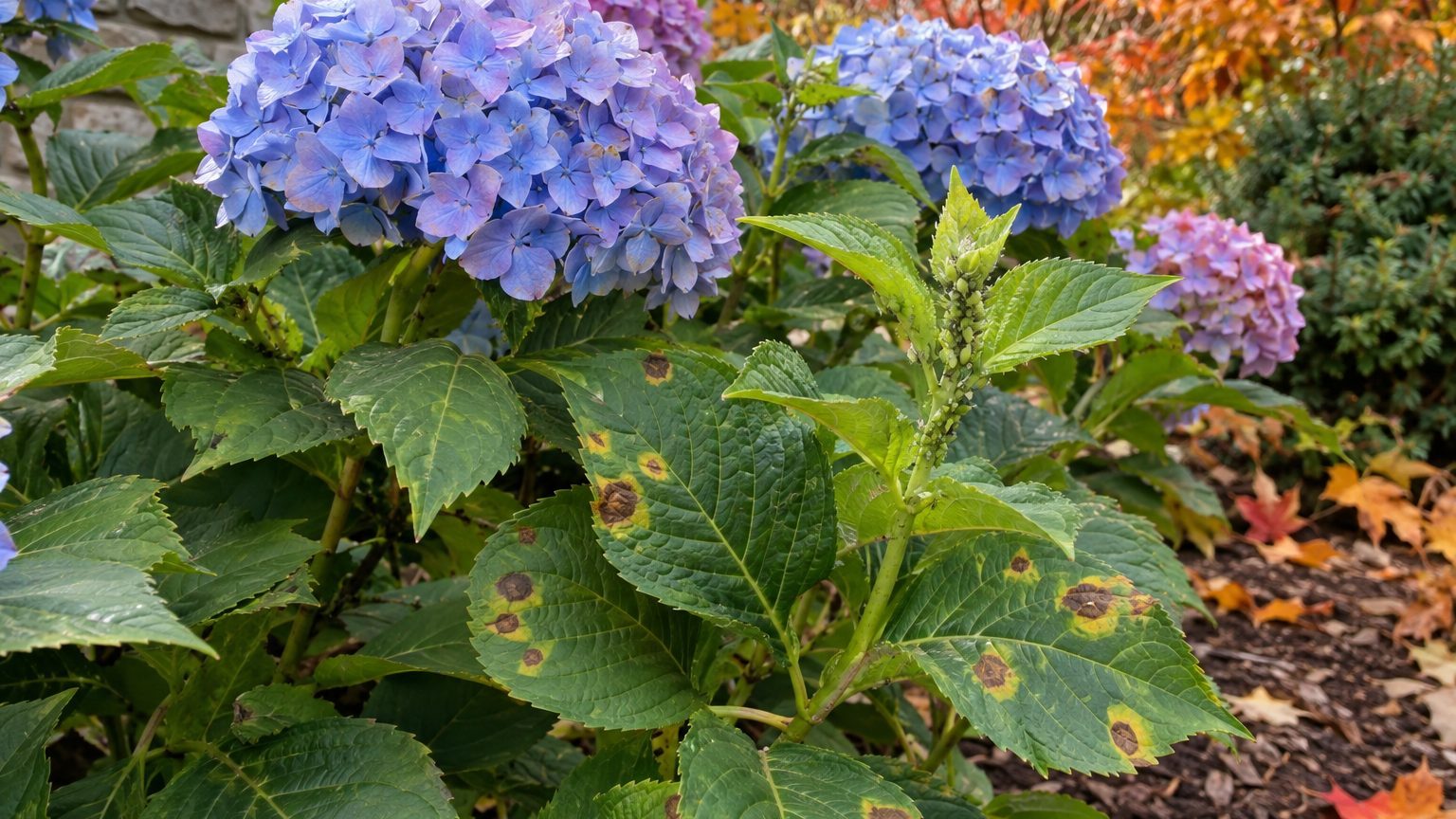
In Albuquerque, hydrangea trouble follows the dry air and alkaline soil more than any single insect. Aphids and spider mites show up on new growth, but chlorotic leaves and sun scorch cause more losses across the state’s USDA zones 4b to 9a. Powdery mildew stays rare here. Watch these six problems in the order they appear each season, from spring aphids to fall root rot in wet clay.

Hydrangea pests and diseases New Mexico: The Short Answer

Aphids

Aphids cluster on tender new shoots once night temperatures climb into the fifties, curling leaves and leaving a sticky residue that draws ants. USDA Plant Hardiness Zone Map puts the state at 4b to 9a, so this start date drifts by elevation. A strong morning hose spray knocks the colony back fast.

Chlorotic leaves

Yellow leaves with dark green veins point to iron chlorosis, not a bug or fungus, because most of the state sits on alkaline soil that locks iron out of reach. It appears as new growth hardens in late spring. A chelated iron drench timed to the March or May fertilize window brings the green back.

Spider mites

Spider mites — Hydrangea Pests and Diseases in New Mexico

Spider mites thrive in the dry heat that defines most New Mexico summers, stippling leaves with tiny pale dots and spinning fine webbing along the stems. They build up fastest during long dry spells between waterings. A hard water spray on the undersides every few days breaks the cycle better than most sprays.

Leaf scorch

Leaf scorch — Hydrangea Pests and Diseases in New Mexico

Leaf scorch shows up as brown, crisp edges on the sunniest side of the shrub, usually by midsummer, and it comes from wind and low humidity, not disease. It gets worse on plants facing west without afternoon shade. Moving mulch out to the drip line and watering deeply twice a week cuts the damage fast.

Powdery mildew

Powdery mildew stays rare in New Mexico’s dry air, but a white, dusty film can appear on leaves right after the short summer monsoon pushes humidity up for a week or two. It fades once the air dries back out. Extra spacing between shrubs keeps this one from ever taking hold.

Root rot

Root rot — Hydrangea Pests and Diseases in New Mexico

Root rot follows overwatering in the clay and caliche soils common across the state, turning stems soft at the base and leaves limp even after rain. It tends to show up in fall as growth slows down. Raised beds or amended planting holes with better drainage are the real fix, not fungicide.

How to Work Out the Dates for Your Own Yard

Working out which of these six problems you actually have starts with the calendar, not with the bug or the leaf.

  1. Mark the frost window first: NOAA NCEI U.S. Climate Normals lists Albuquerque’s last spring frost between March 31 and April 12, so bronzed leaves that show up before that range are freeze damage, not disease.
  2. Check it against the fertilize months: March, May, and July are the state’s fertilize windows, and pale, thin leaves that appear right before those dates usually mean chlorosis, not a pest.
  3. Watch the stretch after planting: plant windows fall in March, April, August, and September, and wilting inside that stretch is almost always root stress, not aphids.
  4. Inspect new growth through the prune window: bigleaf pruning runs June and July, and sticky, curled tips found then point straight to aphids or mites, not fungus.
  5. Re-check after any monsoon week: humidity spikes are the only time this state sees powdery mildew, so a white film after rain confirms it, while dry heat still points back to mites.

None of these six problems looks the same on paper as it does on your own patio, especially at elevation, so treat the calendar as a first pass and confirm by eye before treating anything twice.

New Mexico North to South: How the Dates Shift

Elevation changes pest and disease timing across New Mexico more than any single calendar date, and it moves in the same direction as the land, colder and later toward the mountains, hotter and earlier toward the low desert.

  • Northern high country (Santa Fe, Taos, Raton): the growing season opens later at elevation, so aphids and chlorotic leaves show up weeks behind the rest of the state, and a late freeze can still nip new growth well into spring.
  • Central river valley (Albuquerque, Los Lunas, Belen): this is the reference climate for the whole page, dry heat brings spider mites on early and alkaline river-bottom soil keeps chlorosis a running problem all summer.
  • Southern low desert (Las Cruces, Deming, Carlsbad): the longest frost-free stretch in the state pushes mite pressure and leaf scorch earlier and harder, while the short monsoon window offers the only real risk of powdery mildew.

Wherever you garden in the state, the New Mexico hydrangea guide has the frost window and pruning dates sized to your county.

Mistakes New Mexico Punishes

Skipping the pH test

Alkaline soil across most of the state locks up iron before a hydrangea can use it, and gardeners often spray for disease when the real problem is mineral. A simple soil test before planting catches this, and the calendar’s March, May, and July fertilize windows are the right time to correct it.

Watering by the calendar, not the soil

Caliche and clay hold water far longer than the surface looks, so a fixed weekly schedule drowns roots long before wilting shows. Root rot follows within weeks in low spots. Check soil moisture with a finger or probe before every watering instead of running on autopilot.

No afternoon shade on the west side

Full western sun paired with New Mexico’s low humidity scorches hydrangea leaves faster than almost anywhere else in the country. Plant against an east or north wall, or under high tree cover, and save west exposures for the toughest panicle varieties.

New Mexico Extension Offices and County Contacts

USDA Plant Hardiness Zone Map lists New Mexico at 4b to 9a, but that range covers desert floor to mountain forest, and your county office knows which pests and soils actually show up on your street.

  • New Mexico State University Extension: aces.nmsu.edu links every county office to a local horticulture agent.
  • Your county extension office: free or low-cost soil tests and pest identification.
  • The New Mexico hydrangea guide: frost dates and pruning windows sized to your part of the state.

Start there before you plant anything new this fall.

Common questions

Do hydrangeas get powdery mildew in New Mexico?

Rarely, and only for a short stretch. The dry climate keeps this fungus mostly at bay, but a brief monsoon humidity spike can bring a dusty white film to leaves for a week or two before it dries out again.

Why do hydrangea leaves turn yellow with green veins in New Mexico?

That pattern is iron chlorosis, not a disease. Alkaline soil across most of the state locks iron out of reach of the roots, and a chelated iron treatment during the March or May fertilize window usually corrects it.

When should I treat aphids on hydrangeas in New Mexico?

Check new growth as soon as nights warm in spring, ahead of the June and July pruning window. A hard spray of water most mornings usually clears a light infestation before it spreads.

When to Prune Hydrangeas in New Mexico

When to Prune Hydrangeas in New Mexico

In Albuquerque, the safest stretch to plant hydrangeas falls in April, once spring frost clears, and again in August into September once summer heat eases, while bigleaf types get pruned in June or July after their first bloom fades. Elsewhere in New Mexico, especially higher up, push those dates back a week or two and check with your county extension office first.

When to prune hydrangeas in New Mexico: The Short Answer

NOAA NCEI U.S. Climate Normals 1991-2020 puts Albuquerque’s last spring frost at March 31 to April 12 and the first fall frost at October 29 to November 9, and every month below is set against that stretch.

  • January: Hydrangeas sit fully dormant and the ground is usually too cold to dig, so this stays a planning month, not a planting one. Check that fall mulch is still in place over the root zone.
  • February: Frost is still weeks from breaking, so keep new plants in their nursery pots on a bright porch rather than in the ground. Order bareroot stock now if you want it in the yard by April.
  • March: This opens the calendar’s plant window, but with the last frost not clearing until March 31 to April 12, hold off on the earliest days. It’s also the first of the year’s three fertilize months, so feed established shrubs once new growth shows.
  • April: Once the frost window closes, mid to late April is the safest stretch to get container-grown hydrangeas into the ground. Water deeply right after planting and keep the root ball from drying out for two weeks.
  • May: This is the second fertilize month, timed to push leafy growth before summer heat arrives. Skip planting this month and let spring transplants settle in instead.
  • June: Bigleaf varieties that finished their first bloom get pruned now, cutting spent flower heads back to the first strong bud below them. Afternoon shade matters more as temperatures climb.
  • July: Pruning continues for any bigleaf shrub still carrying faded blooms, and this is the year’s third and final fertilize month. Water more often, since dry heat pulls moisture out of beds fast.
  • August: The calendar’s second plant window opens once the sharpest summer heat eases. Choose a cloudy stretch or plant in early morning to spare new roots from transplant stress.
  • September: Planting continues, giving roots the longest run to establish before the first fall frost lands October 29 to November 9. Hold off on any pruning this late.
  • October: With frost approaching, this is the month to lay down mulch over the root zone rather than start anything new. Stop fertilizing so growth doesn’t get caught out by cold.
  • November: Frost typically arrives somewhere in this stretch, and leaves blacken fast once it does. Leave dead foliage on the plant through winter, since it helps insulate the buds beneath it.
  • December: Shrubs are fully dormant and need nothing beyond an eye on mulch after wind or a hard freeze. This is a good month to plan replacements for spring.

Those Albuquerque dates are a starting point, not a promise. Gardens outside the city, especially at higher elevation, often see frost linger later in spring and arrive earlier in fall, so confirm timing with your own county before you dig.

How to Work Out the Dates for Your Own Yard

Your own frost window decides everything else, and a five-step check gets you there even without a soil thermometer.

  1. Find your zone first: The USDA Plant Hardiness Zone Map 2023 places New Mexico anywhere from 4b to 9a, and a shrub rated for zone 6 will struggle at 4b in the mountains north of Santa Fe but thrive in Las Cruces.
  2. Count back from your last frost: Take Albuquerque’s March 31 to April 12 window as your reference point, then add a week or two if you’re higher up or further from the city center.
  3. Match the plant window to your soil: Even inside the state’s plant months, wait until soil crumbles in your hand rather than clumps, since cold wet clay around new roots is worse than a slightly later start.
  4. Test one shrub before committing a bed: A panicle hydrangea against a west wall in Albuquerque often survives both winter cold and summer sun, while a bigleaf hydrangea in the same spot usually scorches by July.
  5. Recheck before pruning: Bigleaf types get their cut in June or July only after you’ve confirmed which buds are old wood and which are new, since pruning the wrong ones removes next year’s flowers entirely.

None of this replaces a look at your own yard. Wind exposure, wall reflection and soil type shift these numbers as much as elevation does, so treat the calendar as a start and adjust after the first year.

New Mexico North to South: How the Dates Shift

Elevation does more to shift these dates in New Mexico than latitude does, since the state runs from around 3,000 feet along the Rio Grande in the south to over 7,000 feet in the northern mountains.

  • Northern mountains (Santa Fe, Taos, Los Alamos): frost lingers later into spring and returns earlier in fall than Albuquerque’s numbers suggest, so push both windows back and lean toward panicle or smooth hydrangeas over bigleaf.
  • Central river valley (Albuquerque, Rio Rancho, Belen): this is the reference zone the calendar above is built on, with the most moderate swing between spring and fall frost anywhere in the state.
  • Southern desert (Las Cruces, Deming, the Mesilla Valley): frost clears earlier and returns later, stretching the planting season on either end, though summer heat becomes the bigger limit on which varieties hold up.
  • Eastern plains (Clovis, Roswell, Portales): open exposure brings harder wind and sharper swings than the river valley sees, so windbreak placement matters as much as the calendar date.

Check the state guide for New Mexico for the zone breakdown by county before you settle on a date.

Mistakes New Mexico Punishes

Planting in full afternoon sun

New Mexico’s sun intensity at altitude scorches hydrangea leaves fast, especially on a west-facing wall with no afternoon shade. Choose a spot with morning sun and afternoon shade instead, or plant against an east-facing wall where the shrub gets light before the heat peaks.

Pruning bigleaf hydrangeas outside the window

Cutting back bigleaf types outside June or July removes flower buds already set for next year, leaving a healthy shrub with no blooms. Stick to the calendar’s June to July window, and only cut spent flower heads, not healthy stems.

Skipping mulch before the first fall frost

NOAA NCEI U.S. Climate Normals 1991-2020 puts Albuquerque’s first fall frost at October 29 to November 9, and bare soil around the root zone loses heat fast as temperatures drop toward that window. Lay mulch three to four inches deep by mid-October instead, and leave it through winter.

New Mexico Extension Offices and County Contacts

Albuquerque’s numbers are a starting point, and New Mexico State University Extension keeps county-level detail that adjusts them for your elevation and soil.

  • New Mexico State University Extension: county offices that can confirm your local frost window and soil results before you plant.
  • Which hydrangeas hold up here: the variety-by-variety breakdown for New Mexico’s dry heat and alkaline soil.
  • What goes wrong here: the pests and problems specific to hydrangeas grown in this state, in the order they show up.

Call your county office before the first frost either way, since local advice beats any calendar.

Common questions

Can I plant hydrangeas in New Mexico in the fall?

Yes, the calendar’s second plant window opens in August and runs into September, giving roots time to establish before the first fall frost arrives October 29 to November 9 in Albuquerque.

Do hydrangeas need full shade in New Mexico?

Not full shade, but afternoon shade matters far more here than in wetter states, and morning sun with protection after midday keeps leaves from scorching through summer.

Why didn’t my bigleaf hydrangea bloom this year?

The most common cause is pruning outside the June to July window, which cuts off buds already set for the following year’s flowers.

Hydrangeas That Grow Well in New Jersey

Hydrangeas That Grow Well in New Jersey

Panicle and smooth hydrangeas are the safest bets across New Jersey, hardy through the state’s 6a to 7b range, while bigleaf types can work near the coast but risk losing flower buds during colder inland winters.

Hydrangeas that grow well in New Jersey: The Short Answer

The USDA Plant Hardiness Zone Map puts New Jersey at 6a to 7b, with Newark sitting near the milder edge of that range. That single number decides which hydrangea species shrug off a Garden State winter and which ones gamble their flower buds on a mild December.

Panicle hydrangea

Panicle hydrangea — Hydrangeas That Grow Well in New Jersey

Hydrangea paniculata is the safest choice anywhere in New Jersey, from the Highlands to Cape May. It blooms on new wood, so a hard freeze never touches the flower buds, and it tolerates both 6a winters and 7b summers without complaint.

Smooth hydrangea

Smooth hydrangea — Hydrangeas That Grow Well in New Jersey

Hydrangea arborescens, the native species behind ‘Annabelle’, handles the state’s full hardiness range without protection. It also blooms on new wood, so a late frost that nips the stems still leaves a full flush of blooms by midsummer.

Oakleaf hydrangea

Oakleaf hydrangea — Hydrangeas That Grow Well in New Jersey

Hydrangea quercifolia brings fall color that panicle and smooth types skip entirely. It holds up fine through New Jersey winters, though a site with reliable afternoon shade keeps the leaf edges from scorching in a hot South Jersey August.

Climbing hydrangea

Climbing hydrangea — Hydrangeas That Grow Well in New Jersey

Hydrangea petiolaris survives the cold without trouble but takes its time. Expect three or four seasons before it climbs and flowers, so it suits patient gardeners more than the coldest pockets of the state.

Mountain hydrangea

Mountain hydrangea — Hydrangeas That Grow Well in New Jersey

Hydrangea serrata sits between smooth and bigleaf types in toughness. Its flower buds handle a typical New Jersey winter better than bigleaf, but a late cold snap after a warm February can still erase a season of blooms.

Bigleaf hydrangea

Bigleaf hydrangea — Hydrangeas That Grow Well in New Jersey

Hydrangea macrophylla is the riskiest name on this list. It blooms on old wood, so the state’s 6a stretch can freeze out next year’s flowers even when the shrub itself survives, leaving healthy green leaves and no blooms at all.

How to Work Out the Dates for Your Own Yard

Working out your own planting window starts with the same frost data used for the state figure, then adjusts for what sits around your yard. NOAA NCEI U.S. Climate Normals puts the Newark station’s last spring frost between March 29 and April 6, and gardens away from the airport’s pavement typically see frost linger a week or two longer.

  1. Find your last spring frost: start from the March 29 to April 6 window and add a week if you garden inland or at elevation.
  2. Note your first fall frost: the November 4 to November 16 window marks when new growth needs to have already hardened off.
  3. Match the planting months to your site: New Jersey’s plant window runs March, April, September, and October, so pick the half of that window furthest from your local frost date.
  4. Time pruning to bloom type: bigleaf and mountain hydrangeas get pruned in June or July, right after their old-wood buds finish flowering, never in spring.
  5. Fertilize on the March, May, July schedule: skip a fall feeding, since new growth pushed late won’t harden before frost.

Panicle hydrangea passes this test in almost any county because its new-wood blooms don’t care when the last frost lands. Bigleaf hydrangea fails it more often, since a bud set in October can be gone by March, no matter how carefully the calendar was followed.

New Jersey North to South: How the Dates Shift

Altitude and distance from the ocean shift these dates more than latitude does inside a state this narrow.

  • The Skylands and Northwest (Sussex, Warren, Morris counties): frost arrives earliest and lingers latest here, so bigleaf and mountain hydrangeas lose more flower buds than the state average suggests.
  • Central New Jersey (Middlesex, Somerset, Mercer counties): closer to the Newark reference figures, with the frost window holding up reasonably well away from river valleys.
  • The Shore (Monmouth, Ocean, Atlantic counties): the Atlantic keeps both frost dates milder, which is why bigleaf hydrangeas do best in yards within a few miles of the coast.
  • South Jersey and the Pine Barrens (Cumberland, Cape May, Burlington counties): sandy soil warms fast in spring but drains hydrangea beds dry by August, so watering matters more than the frost date itself.

Check the state guide’s frost map for the county closest to your own before trusting any single date.

Mistakes New Jersey Punishes

Pruning bigleaf hydrangea in spring

Cutting back old wood in March removes the buds that were about to bloom. New Jersey’s bigleaf and mountain types set flowers the previous summer, so the only safe pruning window is June or July, right after the shrub finishes flowering.

Planting bigleaf in an exposed spot

An open yard in the Skylands or Northwest lets winter wind strip moisture from flower buds that a coastal yard never loses. Choosing panicle or smooth hydrangea for exposed sites, and saving bigleaf for a sheltered corner, avoids the blank spring most homeowners blame on the weather.

Fertilizing after July

A late feeding pushes soft new growth that has no time to harden before the fall frost window arrives. Sticking to the March, May, July schedule keeps growth timed to the season instead of racing the first freeze.

New Jersey Extension Offices and County Contacts

The state’s 6a to 7b range is a starting point, not a guarantee for your yard. Rutgers Cooperative Extension and your county office narrow that down to what actually survives your soil and slope.

  • Your state page: the frost dates and the pruning window for where you live in New Jersey.
  • Which ones hold up here: the full ranking of hydrangea varieties by how they handle a Garden State winter.
  • Rutgers New Jersey Agricultural Experiment Station: njaes.rutgers.edu connects to the county office nearest your zip code for a soil test before you plant.

Common questions

Do hydrangeas need full sun or shade in New Jersey?

Most varieties do best with morning sun and afternoon shade across the state, since summer heat in the 7b pockets of South Jersey can scorch leaves by early afternoon. Panicle hydrangea tolerates more sun than the others, while oakleaf and bigleaf prefer the shadier end of that range.

Why did my hydrangea not bloom this year?

A bigleaf or mountain hydrangea that stays green but skips flowers almost always lost its buds to a winter cold snap or a spring pruning cut. Switching to a new-wood bloomer like panicle or smooth hydrangea removes that risk entirely.

Can I grow bigleaf hydrangea near the Jersey Shore?

Coastal yards in Monmouth, Ocean, and Atlantic counties see milder winter lows than inland New Jersey, which is exactly where bigleaf hydrangea has the best odds of blooming reliably. Move even a few miles inland and the same variety becomes a gamble.

Hydrangeas That Grow Well in Nevada

Hydrangeas That Grow Well in Nevada

Panicle and smooth hydrangeas hold up best across Nevada. Las Vegas marks the warm end of the state’s USDA range, but its numbers are a desert extreme, not a statewide guide. Bigleaf mopheads, the kind most gardeners picture, struggle here with alkaline soil, low humidity, and old-wood buds that a late frost or a hard Reno winter can wipe out before they ever open.

Hydrangeas that grow well in Nevada: The Short Answer

Panicle and smooth hydrangeas handle Nevada’s swings best, from the high desert around Reno to the low desert around Las Vegas. The USDA Plant Hardiness Zone Map puts the state at a wide 4a to 10a, with Las Vegas anchoring the warm end and the mountains dragging the cold end down, so the right hydrangea depends on which end of that range you actually garden in.

Panicle Hydrangea

Panicle Hydrangea — Hydrangeas That Grow Well in Nevada

Hydrangea paniculata blooms on new wood, so a late frost or a hard prune never costs it a season. It shrugs off Nevada’s dry heat and alkaline soil better than any other type, which makes it the safest planting for both Reno and Las Vegas yards.

Smooth Hydrangea

Smooth Hydrangea — Hydrangeas That Grow Well in Nevada

Hydrangea arborescens, the type behind old-fashioned round-headed blooms, also flowers on new wood and tolerates cold winters at elevation. It wilts hard under afternoon sun in the low desert, so it wants some shade once summer temperatures climb.

Oakleaf Hydrangea

Oakleaf Hydrangea — Hydrangeas That Grow Well in Nevada

Hydrangea quercifolia brings drought tolerance and fall color once it’s established, and it handles cold stretches around Carson City without much fuss. Low desert heat around Las Vegas pushes it harder, so it needs steady water and afternoon shade there.

Mountain Hydrangea

Mountain Hydrangea — Hydrangeas That Grow Well in Nevada

Hydrangea serrata is a smaller-scale cousin of the classic mophead, with slightly better cold tolerance. It still wants humidity Nevada rarely offers, so its blooms tend to be smaller and less reliable than panicle or smooth types.

Bigleaf Hydrangea

Bigleaf Hydrangea — Hydrangeas That Grow Well in Nevada

Hydrangea macrophylla, the mophead most people picture, sets its buds on old wood, so a freeze anywhere in the state’s frost window can erase a season of blooms. Nevada’s alkaline soil also pushes its flowers toward pink and lavender no matter what the tag promises.

Climbing Hydrangea

Climbing Hydrangea — Hydrangeas That Grow Well in Nevada

Hydrangea anomala subsp. petiolaris needs years of shade and steady moisture to establish, both in short supply across most Nevada yards. It’s the riskiest pick on this list, and it rarely rewards the wait in the low desert.

How to Work Out the Dates for Your Own Yard

Figuring out whether your yard can support a panicle hydrangea or a bigleaf hydrangea comes down to six checks, not the single zone number stamped on a nursery tag.

  1. Look up your zone, not the state’s: the USDA Plant Hardiness Zone Map spreads Nevada across a wide 4a to 10a, and a yard in Carson City sits nowhere near a yard in Las Vegas on that same scale.
  2. Ask your county office for your true frost date: Las Vegas’s last spring frost falls between January 7 and February 1, but that’s a desert extreme, not a statewide guide.
  3. Check when the variety actually sets its flower buds: panicle hydrangea builds fresh buds every spring on new wood, so a hard freeze the winter before never costs it a single bloom.
  4. Weigh old-wood bloomers against your frost risk: bigleaf hydrangea sets buds the fall before, so a freeze between the first fall frost, December 8 to December 23, and a late spring cold snap can wipe out the whole show.
  5. Test your soil pH before you commit: alkaline soil across most of Nevada shifts bigleaf blooms toward pink even when the plant tag promises blue.
  6. Plant inside the state’s cool windows: January, February, October, and November give roots time to settle before summer heat or a hard freeze arrives.

Run through those six checks and the pattern holds up: panicle hydrangea passes the winter and summer test almost anywhere in Nevada, while bigleaf hydrangea only clears the bar in a handful of sheltered, well-amended yards.

Nevada North to South: How the Dates Shift

Elevation, latitude, and a desert climate pull Nevada’s planting and frost dates in different directions, sometimes within the same county.

  • The high desert and mountains (Reno, Carson City, Elko): frost lingers weeks longer than the state’s warm-end numbers suggest, so plant later in spring and expect an earlier fall freeze.
  • The Lake Tahoe basin (Incline Village, the South Shore): elevation keeps nights cold well into the planting season, which favors panicle and smooth hydrangeas over anything blooming on old wood.
  • The low desert south (Las Vegas, Henderson, Laughlin): the mildest winters in the state, but also the harshest summer sun, so afternoon shade matters more here than the frost date does.
  • The rural Great Basin (Eureka, Ely, Battle Mountain): some of the widest temperature swings in the state, with hot afternoons and cold nights even in mid-summer, so hydrangeas need afternoon shade and wind protection regardless of the calendar.

None of these regional shifts show up in a single statewide hardiness number, so the Nevada growing guide and your county extension office fill in the rest.

Mistakes Nevada Punishes

Planting bigleaf for blue blooms

Most Nevada soil runs alkaline, and alkaline soil pushes bigleaf hydrangea blooms toward pink and lavender no matter what the plant tag promises. Test your soil before you buy, and plant panicle or smooth hydrangea instead if you want a color you can actually count on.

Digging in during peak summer heat

A new hydrangea planted in July fights transplant shock and Nevada’s dry heat at the same time, and most don’t recover. Stick to the state’s cool planting windows, January, February, October, and November, so roots can settle before summer sun or a hard freeze tests them.

Trusting a single statewide frost date

NOAA NCEI U.S. Climate Normals 1991-2020 puts Las Vegas’s last spring frost between January 7 and February 1, but that number comes from an extreme desert heat island and says nothing about Reno or the mountains, where frost arrives weeks or months differently. Call your county extension office for the date that actually applies to your yard.

Nevada Extension Offices and County Contacts

The state’s 4a to 10a range only gets you started. University of Nevada, Reno Extension and your county office turn that into a real planting date, a soil test, and a pruning window that fits your yard.

  • University of Nevada, Reno Extension: extension.unr.edu lists county offices, soil testing, and hydrangea guidance suited to the high desert.
  • Your county extension office: the contact for your actual frost date, since Las Vegas airport numbers don’t apply statewide.
  • A local soil test: worth running before you plant bigleaf hydrangea, since alkaline soil decides bloom color more than the tag on the pot.

Call before you dig this fall.

Common questions

Can bigleaf hydrangeas turn blue in Nevada soil?

Rarely without heavy amending. Most Nevada soil runs alkaline, which pushes bigleaf hydrangea blooms toward pink and lavender no matter what color the plant promised at the nursery. A soil test tells you how far off you are before you buy.

When should I prune hydrangeas in Nevada?

For bigleaf hydrangea, the window falls in June and July, right after the old-wood blooms fade and before next year’s buds start forming. Panicle and smooth types are more forgiving, since they bloom on new wood and can be cut back earlier without losing next season’s flowers.

Do hydrangeas need afternoon shade in Nevada?

In the low desert around Las Vegas, yes. Direct afternoon sun scorches leaves on almost every hydrangea type, so an eastern exposure or dappled shade under a taller tree keeps plants healthier through the summer than a full-sun bed ever will.

Hydrangeas That Grow Well in New Hampshire

Hydrangeas That Grow Well in New Hampshire

Panicle and smooth hydrangeas grow well across New Hampshire, including around Concord, where winters test the state’s USDA zone 3b to 6a range. Both bloom on new wood, so a hard freeze that kills the buds doesn’t erase the season. Bigleaf and mountain hydrangeas struggle here unless the yard sits in a sheltered pocket near the coast or a large lake.

Hydrangeas that grow well in New Hampshire: The Short Answer

The USDA Plant Hardiness Zone Map puts New Hampshire between zone 3b and 6a, with Concord itself sitting in the milder end of that range. That spread decides which hydrangea species make sense here more than soil type or sun exposure ever will. The six below run from safest bet to genuine gamble for a typical New Hampshire yard.

Panicle hydrangea

Panicle hydrangea — Hydrangeas That Grow Well in New Hampshire

This is the one nearly every New Hampshire nursery pushes toward first-time buyers, and for good reason. It blooms on new wood each summer, so winter dieback never costs you the flowers. It tolerates more sun and colder ground than any other hydrangea sold in the state.

Smooth hydrangea

Smooth hydrangea — Hydrangeas That Grow Well in New Hampshire

Native to the eastern woodlands and often sold as ‘Annabelle’ types, this species dies back hard some winters and simply regrows from the base each spring. It blooms on new wood too, which makes it nearly foolproof through a Concord winter. It prefers a bit more shade than panicle types.

Climbing hydrangea

Climbing hydrangea — Hydrangeas That Grow Well in New Hampshire

Slow to establish, sometimes taking three or four seasons before it flowers at all, but once rooted it handles New Hampshire cold without much complaint. It clings to brick, stone, or a sturdy trellis and rewards patience with lacy white blooms in early summer. Not a shrub for anyone in a hurry.

Oakleaf hydrangea

Oakleaf hydrangea — Hydrangeas That Grow Well in New Hampshire

This one holds up fine in the warmer pockets of southern New Hampshire but gets iffy farther north or at elevation. Its flower buds form on old wood, so a severe winter can wipe out the coming season’s show even while the plant itself survives. Site it against a wall for extra warmth.

Mountain hydrangea

Mountain hydrangea — Hydrangeas That Grow Well in New Hampshire

A close cousin of bigleaf that’s marketed as slightly hardier, mountain hydrangea still sets most of its buds on old wood. In a typical New Hampshire winter those buds often don’t make it, leaving a healthy plant with few or no blooms. Some newer rebloomers hedge that bet a little.

Bigleaf hydrangea

Bigleaf hydrangea — Hydrangeas That Grow Well in New Hampshire

This is the classic mophead sold in every big-box garden center each spring, and it’s the riskiest choice on this list for New Hampshire. Its buds form on old wood the previous fall, and this state’s winters kill them often enough that many gardeners get leaves but no flowers most years.

How to Work Out the Dates for Your Own Yard

Your own yard rarely matches the airport weather station exactly, so treat the numbers below as a starting point you adjust after a season of watching your own ground.

NOAA NCEI U.S. Climate Normals puts Concord’s last spring frost between April 16 and April 27, and its first fall frost between October 13 and October 26. Everything else works backward or forward from that window.

  1. Mark your last spring frost window: count on soil staying cold into late April here, so don’t rush new-wood hydrangeas into the ground before that window closes.
  2. Mark your first fall frost window: October 13 to October 26 is when you stop feeding and start thinking about winter protection for old-wood types.
  3. Fertilize on the state’s rhythm: feed in March, May, and July, then stop, so soft new growth isn’t still forming when the fall frost window opens.
  4. Plant inside the safe windows: April, May, August, and September give roots enough warm soil to settle before either frost date arrives.
  5. Prune bigleaf only in June or July: prune earlier or later and you risk cutting off next year’s flower buds before they’ve even set.
  6. Walk your own yard for a week: a low spot or a north wall can run a full zone colder than your neighbor’s yard even inside the same 3b to 6a range.

A smooth hydrangea shrugs off a late frost because it blooms on new wood that hasn’t even emerged yet. A bigleaf planted in that same spot can lose an entire season’s buds to the same night, which is the whole case for choosing new-wood types first in this state.

New Hampshire North to South: How the Dates Shift

Elevation and distance from water move these dates around more than latitude does in a state this size.

  • The North Country (Coos County, the White Mountains): frost can linger into late spring and return early in fall, pushing every date earlier in fall and later in spring.
  • The Lakes Region (Belknap and Carroll counties): large bodies of water hold heat into fall, which buys old-wood bloomers a few extra weeks before the first hard freeze.
  • The Seacoast (Rockingham County, coastal towns): the Atlantic moderates both ends of the season, giving bigleaf and oakleaf their best odds anywhere in the state.
  • The Merrimack Valley and South (Hillsborough and Merrimack counties, near Concord): this is the reference zone for the dates, and the mildest ground the state has to offer inland.

Check the state guide for the frost and pruning windows that match the county you actually garden in, since a single statewide number never fits a place with mountains, lakes, and coastline this close together.

Mistakes New Hampshire Punishes

Pruning bigleaf in fall

Cutting back a mophead after the leaves drop feels tidy, but it removes the old wood carrying next year’s flower buds. Prune bigleaf only in June or July, right after it finishes its first flush, and check the calendar page before you reach for shears in October.

Planting outside the safe windows

A hydrangea set into the ground in late June or October rarely builds enough root before extreme heat or hard frost arrives. Stick to April, May, August, or September so roots have real time to establish before either stress hits.

Skipping winter protection on old-wood types

Leaving a bigleaf or mountain hydrangea bare through a Concord winter all but guarantees a bud-free summer. Mound mulch over the crown before the ground freezes, or skip the gamble entirely and plant a panicle or smooth hydrangea instead, covered on the which-ones-hold-up page.

New Hampshire Extension Offices and County Contacts

The state’s 3b to 6a range is only a starting point. Your county extension office knows the frost pockets, soil types, and local pest pressure that no statewide map can capture.

  • Your state page: the frost dates and the pruning window where you live.
  • UNH Extension: county contacts and soil test kits for the ground you’re actually planting into.
  • What goes wrong here: the pests and problems New Hampshire growers report most often.

Call before you plant if you’re within a season of your first hard frost, since a county agent can tell you in a five-minute conversation whether your particular yard runs closer to zone 3b or zone 6a.

Common questions

Can bigleaf hydrangeas survive winter in New Hampshire?

Some do, especially in sheltered spots near the Seacoast or a large lake, but most New Hampshire winters kill the old-wood flower buds even when the plant itself lives. Panicle and smooth hydrangeas are the safer bet for reliable blooms.

What is the best hydrangea for New Hampshire’s cold winters?

Panicle hydrangea handles the state’s 3b to 6a range with the least fuss, since it blooms on new wood that grows fresh each spring regardless of how hard the previous winter hit.

When should I plant hydrangeas in New Hampshire?

Plant in April, May, August, or September, giving roots time to settle into warm soil before the last spring frost or the first fall frost arrives.

Hydrangea Pests and Diseases in Nevada

Hydrangea Pests and Diseases in Nevada

Nevada hydrangeas struggle more from dry heat and hard water than from any single bug crawling the yard. Spider mites, aphids, and the occasional patch of powdery mildew do show up, but sunscorch, chlorosis, and root rot tied to irrigation habits do the most damage statewide. Which problem you’re actually looking at depends on the season, your elevation, and how you water, not just the plant itself.

Hydrangea pests and diseases Nevada: The Short Answer

The USDA Plant Hardiness Zone Map puts Nevada across zones 4a to 10a, a spread wide enough that a hydrangea overwintering fine in Las Vegas can die outright in the high desert near Elko.

Frost data pinned to the Las Vegas airport shows a last spring frost of January 7 to February 1 and a first fall frost of December 8 to December 23.

That reading is a heat-island extreme, not a statewide guide. Elevation pushes frost months earlier in fall and later in spring almost everywhere else in Nevada, so check with your county extension office before setting dates.

Freeze-nipped flower buds

Bigleaf hydrangeas set next year’s flower buds by late summer, and a late cold snap in the mountains kills them before bloom even though the shrub looks green and healthy. Skip the spring hard prune and remove only dead wood after leaves emerge, since flowering depends on which buds survive winter, not on how hard you cut back.

Aphids on new growth

Clusters of small green or black insects gather on tender stem tips and the undersides of new leaves as hydrangeas leaf out, leaving curled growth and a sticky residue called honeydew behind. A strong water spray every few days knocks most colonies off before you need anything stronger, and ladybugs usually finish the job outdoors.

Spider mites in the heat

Fine webbing on leaf undersides and a stippled, dusty look across the foliage signal spider mites, which multiply fastest during the hottest, driest stretch of a Nevada summer. Hosing down the foliage weekly raises humidity enough to slow them, and mulch that keeps roots cool reduces the stress that draws mites in the first place.

Leaf scorch on the sunny side

Leaf scorch on the sunny side — Hydrangea Pests and Diseases in Nevada

Brown, crispy edges on leaves facing west or south point to sunscorch, not disease, and it worsens in reflected heat off stucco walls or gravel beds common in Nevada landscaping. Afternoon shade or a spot on the east side of the house prevents most of it, since no spray fixes a hydrangea planted in the wrong light.

Powdery mildew after overhead watering

Powdery mildew after overhead watering — Hydrangea Pests and Diseases in Nevada

A gray-white dusty coating on leaf tops, usually starting low on the plant, shows up when overhead sprinklers wet the foliage in the evening and it stays damp overnight. Switching to drip irrigation at the base and watering in the morning clears most cases without a fungicide, since dry leaves by nightfall stop the spores from spreading.

Root rot and yellow leaves

Root rot and yellow leaves — Hydrangea Pests and Diseases in Nevada

Wilting despite wet soil and leaves that yellow between the veins usually mean either root rot from Nevada’s heavy clay pockets holding water, or chlorosis from alkaline tap water blocking iron uptake. Raised beds with fast-draining soil solve the first problem, and an acidifying soil drench addresses the second.

How to Work Out the Dates for Your Own Yard

Matching a symptom to the right fix starts with ruling out the obvious, in this order.

  1. Check the calendar first: if it’s June or July and lower leaves look scorched brown, that’s heat and sun, not disease, since Nevada’s prune window for bigleaf hydrangea falls in June and July, right when scorch peaks too.
  2. Look at the watering method: overhead sprinklers running at night point to powdery mildew, while soggy soil under a drip system running daily points to root rot instead.
  3. Turn a leaf over: fine webbing or a gritty feel means spider mites, sticky residue and curled tips mean aphids, and a clean, dry underside with brown edges up top means sunscorch.
  4. Test the soil, not just the leaf: yellow leaves with green veins on a well-watered plant usually trace back to Nevada’s alkaline tap water, not a pest at all.
  5. Time it against planting season: a new hydrangea set out in January or February that struggles by March is adjusting to transplant shock, not fighting a pathogen.

Run through that order before reaching for any spray, since most common Nevada hydrangea complaints trace back to water and light, not to a living pest at all.

Nevada North to South: How the Dates Shift

Nevada’s timing shifts more with elevation than with straight-line distance, and pests follow the same pattern.

  • The high desert and mountains (Elko, Ely, the Tahoe basin): frost arrives months earlier in fall and lingers later in spring, so freeze damage to flower buds matters more here than any insect.
  • The Reno-Carson City corridor (Reno, Carson City, Minden): milder than the high desert but still cold enough some winters that bud loss, not mites or mildew, is the main complaint.
  • The Las Vegas valley (Las Vegas, Henderson, Boulder City): the mildest ground in the state and the driest air, which favors sunscorch, spider mites, and alkaline chlorosis over any cold-weather problem.

Check the state guide for your own frost window before assuming a Las Vegas timeline applies anywhere north of Reno.

Mistakes Nevada Punishes

Watering on a schedule, not by soil

Automatic sprinklers set to run daily regardless of temperature keep clay soil waterlogged one week and bone-dry the next, and that swing invites both root rot and spider mites in the same season. Check soil moisture with a finger before each watering instead of trusting a timer, since Nevada’s aridity punishes fixed schedules more than it punishes any single pest.

Planting outside the calendar window

Setting a new hydrangea into the ground during a July heat wave instead of Nevada’s January, February, October, or November planting window stresses roots before they establish, and stress draws aphids and mites in the first place. Wait for one of those cooler months and the same shrub settles in with far fewer pest calls.

Treating every yellow leaf as disease

Reaching for a fungicide the moment leaves yellow skips the real Nevada culprit most of the time, which is alkaline irrigation water blocking iron uptake, not a pathogen at all. A soil test and an iron chelate drench solve chlorosis directly, and spraying a healthy leaf for a disease it doesn’t have wastes time and money.

Nevada Extension Offices and County Contacts

The zone and frost numbers above set a starting point, but soil, wind, and local water chemistry finish the picture, and that’s where the county office comes in. University of Nevada, Reno Extension keeps the local calls current for your yard specifically.

  • Your state page: the frost dates and the pruning window where you live.
  • Which ones hold up here: varieties that take Nevada’s heat and alkaline soil without a fight.
  • The planting calendar: the January, February, October, and November windows month by month.

Call your county office before you spray anything, since a five-minute description over the phone usually settles which of these problems you’re actually looking at.

Common questions

Do hydrangeas get powdery mildew in Nevada’s dry climate?

Yes, though less often than in humid states, and it almost always follows overhead watering in the evening rather than showing up on its own. Switching to morning drip irrigation clears most cases without any fungicide.

What causes yellow hydrangea leaves in Nevada gardens?

Alkaline tap water is the most common cause, blocking iron uptake and leaving leaves yellow between green veins even on a well-watered plant. Overwatered clay soil causing root rot is the second most likely cause.

Is it safe to prune away pest-damaged wood in summer?

Removing damaged stems during June or July, Nevada’s bigleaf pruning window, is fine, but cutting back healthy wood at the same time risks removing next year’s flower buds along with the damage.

Hydrangeas That Grow Well in Mississippi

Hydrangeas That Grow Well in Mississippi

Oakleaf and panicle hydrangeas top the list for Mississippi yards, tolerant of both the humidity and the mild winters that define the state’s climate. Bigleaf hydrangea can work too, especially with some afternoon shade, while climbing and mountain hydrangea struggle against the heat that settles over Jackson and the rest of the state from June through September.

Hydrangeas that grow well in Mississippi: The Short Answer

USDA Plant Hardiness Zone Map puts Mississippi at 7b to 9a, with Jackson sitting near the middle of that range. Given the state’s heat and humidity, oakleaf and panicle hydrangea are the varieties that grow well nearly everywhere here, while bigleaf hydrangea needs a site chosen with more care and climbing hydrangea rarely thrives at all.

The order below runs from the safest choice for a typical Mississippi yard to the one that asks the most of a gardener, based on how each type handles summer heat, humidity, and the timing of the last spring freeze.

Oakleaf hydrangea

Oakleaf hydrangea — Hydrangeas That Grow Well in Mississippi

Native to the Southeast, oakleaf hydrangea shrugs off Mississippi’s heat and humidity once its roots settle in. It blooms on old wood, but sets buds early enough that a late frost near Jackson’s window rarely costs a season of flowers, and its peeling bark and fall color keep the shrub worth looking at long after bloom time.

Panicle hydrangea

Panicle hydrangea — Hydrangeas That Grow Well in Mississippi

Panicle hydrangea blooms on new wood, so a late cold snap around Jackson’s frost window never costs it a season of color. It also tolerates full sun better than anything else on this list, which matters on a yard without much shade to offer.

Smooth hydrangea

Smooth hydrangea — Hydrangeas That Grow Well in Mississippi

Varieties in the Annabelle line handle Mississippi’s clay soil and winter cold without much fuss, and they bloom on new wood the same as panicle types. The trouble comes in August, when Gulf Coast heat can wilt the stems by afternoon unless the plant gets some shade or steady water.

Bigleaf hydrangea

Bigleaf hydrangea — Hydrangeas That Grow Well in Mississippi

This is the mophead most people picture, and it grows well across much of Mississippi, but it blooms mostly on old wood, so a late freeze close to the spring frost date can strip a whole season of flowers. Morning sun with afternoon shade makes the difference between a full shrub and a bare one.

Mountain hydrangea

Mountain hydrangea — Hydrangeas That Grow Well in Mississippi

Closely related to bigleaf hydrangea, mountain hydrangea tends to handle cold better but heat worse, wilting sooner through the Gulf Coast’s long summers than it does in the state’s northern hill country. It fits the upper end of the 7b to 9a range more comfortably than the lower end.

Climbing hydrangea

Climbing hydrangea — Hydrangeas That Grow Well in Mississippi

Climbing hydrangea prefers the shorter, cooler summers found farther north, and it tends to sulk through Mississippi’s heat and humidity, growing slowly if it grows at all. Gardeners who want height and coverage on a wall usually get better results from a shrub suited to the climate instead.

How to Work Out the Dates for Your Own Yard

Work out your own planting and pruning dates by counting from the frost window instead of a fixed calendar date, since Jackson’s average freeze rarely lines up with a neighboring county’s.

  1. Mark the last spring frost: NOAA NCEI 1991-2020 Climate Normals puts Jackson’s window at March 6 to March 22, and gardens outside the city often see frost linger a week or two past that, so treat the later date as a floor rather than a guarantee.
  2. Hold new hydrangeas until the freeze risk passes: wait until the back end of that window before setting out a young oakleaf or panicle hydrangea whose roots haven’t spread far yet.
  3. Watch the plant calendar for the real planting months: March and April open the spring window, and September and October give a second chance once summer heat breaks.
  4. Prune bigleaf hydrangea only in June or July: pruning outside this window risks cutting off buds already formed on last year’s wood, the reason bigleaf sometimes skips a season of bloom.
  5. Fertilize on the March, May, and July schedule: this spaces feeding around the plant’s growth spurts without pushing tender new growth into a late frost.
  6. Mark the first fall frost: the same data sets Jackson’s window at November 7 to November 22, and that date signals when to stop feeding and let new growth harden off.

A panicle hydrangea passes both ends of this test easily, since it blooms on new wood and tolerates the heat that builds between the two frost windows. Climbing hydrangea fails the summer half of the same test, wilting through months a panicle barely notices.

Mississippi North to South: How the Dates Shift

Mississippi stretches from the Tennessee state line to the Gulf Coast, and that distance shifts both the frost window and the summer heat load enough to change which hydrangea variety does best in a given yard.

  • The Hill Country and North Mississippi (near the Tennessee line): frost lingers later into spring here than it does around Jackson, and cooler nights favor bigleaf and mountain hydrangea over types that need a long, hot stretch to bloom well.
  • The Central Belt (around Jackson and the capital region): this is the reference climate for the state’s frost windows, sitting in the middle of both the temperature swings and the growing season length.
  • The Gulf Coast and Piney Woods (Gulfport, Hattiesburg, and the coastal counties): frost arrives later in fall and leaves earlier in spring, extending the season enough that heat-loving panicle and oakleaf hydrangea outperform bigleaf types that struggle with the added humidity.

Check your own county’s microclimate against the state guide before locking in a planting date, since a shaded hillside or a low spot that collects cold air can shift the picture in either direction.

Mistakes Mississippi Punishes

Mississippi’s heat, humidity, and clay soil punish a few specific habits harder than cooler states do.

Planting in full afternoon sun

Mississippi’s summer sun scorches hydrangea leaves by early afternoon, especially on bigleaf and smooth varieties, and the plant wilts within hours even with regular watering. Choose a spot with morning sun and afternoon shade instead, the same siting rule that keeps the varieties above blooming through August rather than collapsing.

Pruning bigleaf hydrangea outside June or July

Cutting bigleaf hydrangea back in fall or early spring removes the buds it already set on last year’s wood, the reason a shrub sometimes skips flowering completely the following summer. Stick to the June and July window from the calendar above, and limit cutting to spent blooms rather than healthy stems.

Watering on a fixed schedule instead of the soil

Mississippi’s clay soil holds water far longer than sandy soil does, so a fixed watering schedule drowns roots during a wet spell and starves them during a dry one. Check the soil about an inch down before watering, a habit that matters more here than any calendar date.

Mississippi Extension Offices and County Contacts

The zone and frost figures above come from a single Jackson weather station, so a broader network fills in the rest for your own soil and microclimate.

  • Mississippi State University Extension: county-level advice, soil testing, and plant recommendations tailored past the state-wide averages.
  • Your county extension office: the closest source for a soil test and a planting date that accounts for your yard’s own frost pocket.
  • The Mississippi hydrangea calendar page: the month-by-month version of the fertilize, plant, and prune windows referenced throughout this guide.

Common questions

Can bigleaf hydrangea survive a Mississippi winter?

It survives the cold without trouble across the whole 7b to 9a range, but its flower buds are the vulnerable part, not the roots. A late freeze close to the spring frost window is what actually costs a season of bloom, not winter itself.

Do hydrangeas need full shade in Mississippi?

Not full shade, but afternoon shade matters a great deal south of Jackson. Morning sun with shade after midday keeps bigleaf and smooth hydrangea from wilting, while panicle and oakleaf tolerate more direct sun through the day.

Which hydrangea blooms most reliably in Mississippi’s climate?

Panicle hydrangea blooms most reliably because it sets flowers on new wood each year, so it isn’t at the mercy of a late frost the way bigleaf hydrangea’s old-wood buds are.

Hydrangea Pests and Diseases in Nebraska

Hydrangea Pests and Diseases in Nebraska

Hydrangeas in Nebraska run into five recurring problems across a season: aphids on spring growth, powdery mildew and Cercospora leaf spot through humid summer weeks, botrytis blight around bloom time, and spider mites once August turns dry. None of these are unique to the state, but Nebraska’s swing from a late, cold spring to a hot, dry late summer decides which one shows up first and how hard it hits.

Hydrangea pests and diseases Nebraska: The Short Answer

Lincoln’s frost-free stretch, which NOAA NCEI U.S. Climate Normals places at April 12 to April 23 for the last spring freeze and October 15 to October 26 for the first fall freeze, is the same calendar every problem below has to work inside.

Five distinct issues turn up on hydrangeas grown across Nebraska yards, each tied to a specific stretch of that window rather than to the plant itself, and none of them are unique to this state.

The swing between a cold, late spring and a hot, dry August decides which one shows up first and how hard it hits a given shrub, and catching each by its own signs, instead of guessing from a bag on a store shelf, is what actually saves the flush.

Aphids

Small green or black insects cluster on the soft tips of new growth right as leaves push out inside the spring frost window, curling foliage and leaving a sticky film behind. A strong water spray or insecticidal soap knocks them back within days, and checking new growth weekly through May catches them before flower buds even form.

Powdery mildew

A gray-white, dusty coating spreads across leaf tops during humid stretches of early summer, thriving wherever air sits still between crowded shrubs. Spacing plants for airflow and watering the soil instead of the leaves keeps spores from settling in the first place, and a sulfur-based fungicide applied early stops it before it climbs the whole plant.

Cercospora leaf spot

Small purple-brown circles with tan centers dot older, lower leaves first, usually showing by midsummer as heat and humidity both peak. The fungus survives in fallen leaf litter over winter, so raking and discarding dropped foliage each fall breaks the cycle far better than any spray applied once symptoms appear.

Botrytis blight

Flower clusters and young stems turn brown and mushy after cool, wet stretches, often right around bloom time in early summer. Pruning out the damaged tissue and improving airflow around the base of the shrub matters more here than any fungicide, since the fungus feeds mainly on dead plant material left sitting in place.

Spider mites

Spider mites — Hydrangea Pests and Diseases in Nebraska

Fine webbing and stippled, bronze-toned leaves show up during the dry heat that often follows Lincoln’s hottest weeks, well before the fall frost closes the season in October. Mites hate a strong hose-down, so rinsing leaf undersides twice a week during dry spells usually ends the problem without reaching for a chemical at all.

How to Work Out the Dates for Your Own Yard

Matching a symptom to the right fix starts with the calendar, not the leaf itself, since narrowing down the timing eliminates most of the list before you even look closely at the plant.

  1. Place the date on the calendar: NOAA NCEI U.S. Climate Normals puts Lincoln’s last spring frost at April 12 to April 23, and any damage showing up before that window closes usually means cold stress or aphids on tender new growth, not fungus.
  2. Check what the air did last week: powdery mildew and botrytis blight both follow humid, still stretches, while spider mites and scorch follow the driest week of summer instead.
  3. Flip a leaf over: fine webbing or tiny moving specks under close look mean spider mites, not disease, and no fungicide in the shed will touch them.
  4. Note which leaves are hit first: older, lower leaves usually mean Cercospora leaf spot working up from fallen debris, while damage starting on new tips points to aphids instead.
  5. Match it to the pruning window: damage that shows up right after cutting bigleaf hydrangea back in June or July is often a stress reaction to the cut, not a new pest.
  6. Rule out simple sunburn: leaf edges browning only on the side facing full afternoon sun point to scorch from heat and wind, not to any pest or fungus at all.

Running through these six checks before reaching for any spray usually narrows six possible problems down to one, and it saves buying a fungicide or insecticide that would have done nothing for the actual cause sitting in a particular Nebraska yard this week.

Nebraska North to South: How the Dates Shift

Nebraska stretches far enough east to west that the same pest can behave differently depending on elevation, humidity, and how close a yard sits to the Missouri River.

  • The Panhandle and higher elevations (Scottsbluff, Chadron, Alliance): colder air pools longer into spring here, and pest and disease pressure typically trails a week or two behind Lincoln’s calendar.
  • The Missouri River valley in the east (Omaha, Nebraska City, Bellevue): extra humidity off the river keeps powdery mildew and leaf spot active later into fall than farther west.
  • The Sandhills and north-central plains (Valentine, Ainsworth, Broken Bow): wind and dry air favor spider mites and leaf scorch over any fungal problem most seasons.
  • Southeast Nebraska (Lincoln, Beatrice, Falls City): sits closest to the reference-city dates, with the least lag of any region.

Whichever part of the state a yard sits in, the state guide’s frost dates are a starting point, and the local pattern still decides which of these five problems shows up first.

Mistakes Nebraska Punishes

Fertilizing outside the March, May, July window

A feeding applied in late summer pushes soft new growth right before Lincoln’s first fall frost, October 15 to October 26, and that tender growth is what cold damage and botrytis hit first. Stick to the three-month feeding schedule and skip any bag labeled for fall use on hydrangeas here.

Pruning bigleaf hydrangea outside June or July

Cutting bigleaf types earlier or later than the June to July window removes the very wood that carries next year’s blooms, since this species sets buds on old growth. A shrub pruned in April or September often looks diseased the following spring when it’s really just bare of flower buds.

Planting too late in fall

A hydrangea set into the ground after the August or September planting window has little time to root before the October frost arrives, and thin roots going into winter show up as dieback that gets blamed on disease. Stick to the spring or late-summer planting months instead.

Choosing bigleaf for the coldest yards

Nebraska’s zone 4a-5b range, per the USDA Plant Hardiness Zone Map, sits at the cold edge for bigleaf hydrangea, and a hard winter kills flower buds even when the plant survives. Panicle and smooth hydrangea tolerate that range far better and skip most of the dieback that gets mistaken for pest damage.

Nebraska Extension Offices and County Contacts

Lincoln’s frost dates and the zone 4a-5b range are a starting point, not a full diagnosis for a specific yard, and Nebraska Extension keeps the county-level detail a single state figure can’t cover.

  • Frost dates and hardiness zone: the anchors for every date in this list.
  • Which ones hold up here: the varieties that tolerate Nebraska’s zone 4a-5b range without yearly dieback.
  • The month-by-month calendar: fertilizing, planting, and pruning windows lined up against Lincoln’s frost dates.

Call the county office before spraying anything, since a quick photo sent in usually settles which of these problems is actually on the shrub this week.

Common questions

What is the most common hydrangea disease in Nebraska?

Powdery mildew and Cercospora leaf spot show up most often in Nebraska yards, both tied to humid stretches of summer rather than to any one variety of hydrangea.

Do Nebraska’s cold winters kill hydrangea pests along with the plant?

A hard freeze inside the zone 4a-5b range knocks back overwintering aphids and mites, but it rarely reaches fungal spores sitting in fallen leaf litter, which is why fall cleanup matters more than winter cold for disease control.

When should I treat for spider mites in Nebraska?

Watch for stippled, bronze leaves during the driest weeks of summer, typically after Lincoln’s hottest stretch and before the October 15 to October 26 fall frost closes the season, and start with a strong water rinse twice a week before reaching for any chemical.

Hydrangea Pests and Diseases in New Jersey

Hydrangea Pests and Diseases in New Jersey

Hydrangeas in New Jersey run into a predictable lineup of pests and diseases tied to Newark’s humid summers and its March 29 to April 6 last-frost window: aphids and bud blight show up first, powdery mildew and leaf spot follow through summer heat, and deer pressure builds as the November frost window closes in. Catching each one by its timing, not just its symptom, is what keeps a shrub blooming.

Hydrangea pests and diseases New Jersey: The Short Answer

In Newark, the reference city for New Jersey’s climate data, hydrangea trouble follows the season rather than the calendar page. NOAA NCEI’s 1991-2020 climate normals put the last spring frost between March 29 and April 6 and the first fall frost between November 4 and November 16, and nearly every problem below lines up with one end of that stretch or the other.

Aphids

Small green or black insects cluster on tender spring shoots right after the frost-free window opens, curling leaves and leaving sticky residue behind. A strong hose blast knocks most colonies loose, and a soap spray handles stragglers before ants and sooty mold move in behind them.

Botrytis blight on buds

Cool, wet stretches right after the spring planting window turn unopened flower buds brown and mushy, with a gray fuzzy coating showing on humid mornings. Pull infected buds immediately and skip overhead watering, since wet petals are what let the fungus spread from one cluster to the next.

Powdery mildew

A white, flour-like film coats leaf tops during the humid stretch that overlaps the June and July pruning window for bigleaf types, worst where air stays still. Space plants for airflow, thin crowded interior stems during that same window, and treat early spots with a sulfur fungicide.

Cercospora leaf spot

Circular purple-brown spots with tan centers appear on lower, older leaves through mid to late summer, eventually causing early leaf drop on stressed plants. Rake and discard fallen leaves rather than composting them, and water at the base in the morning so foliage dries by afternoon.

Japanese beetles

Japanese beetles — Hydrangea Pests and Diseases in New Jersey

Metallic green beetles chew ragged holes through leaves and flowers during peak summer heat, sometimes skeletonizing whole clusters within days. Hand-pick into soapy water in early morning when beetles move slowly, and skip pheromone traps, which tend to draw in more beetles than they catch.

Deer browsing on buds

Deer browsing on buds — Hydrangea Pests and Diseases in New Jersey

As the November 4 to November 16 frost window approaches, deer strip tender stems and next year’s flower buds, especially on unfenced properties near woods. A physical barrier or repellent applied before the first hard freeze protects the buds that would otherwise open the following June.

How to Work Out the Dates for Your Own Yard

Working out which problem is actually on your hydrangea starts with the calendar, not the leaf.

  1. Check the date against the frost windows: NOAA NCEI’s climate normals put Newark’s last spring frost between March 29 and April 6, so bud damage showing up before that window closes usually points to winter injury, not disease.
  2. Look at what’s affected first: spotting that starts on lower, older leaves in July points toward Cercospora rather than a fungus that attacks new growth at the top.
  3. Note the weather of the past week: a stretch of rain right before symptoms appear favors botrytis and powdery mildew over insect feeding damage.
  4. Inspect at two different times of day: Japanese beetles and aphids are easiest to catch feeding in early morning, while fungal spots stay visible all day long.
  5. Match the timing to the pruning window: mildew that appears just as the June to July bigleaf pruning window opens often traces back to stems left crowded too long.
  6. Rule out deer last: browsing near the November 4 to November 16 frost window leaves torn, ragged stem edges rather than the clean cuts insects leave.

Once the timing matches, the identifying details in the section above confirm it, since each entry there lists what the problem leaves behind and what actually works against it.

New Jersey North to South: How the Dates Shift

Elevation, the shore, and distance from the coast all nudge these timelines in different directions across the state.

  • North Jersey and the Highlands (Sussex, Warren, Morris counties): higher ground delays the frost-free start, which pushes back aphid and botrytis pressure but also shortens the humid stretch that favors mildew.
  • Central Jersey (Middlesex, Mercer, Somerset counties): conditions track closest to Newark’s own numbers, so the timing in the short answer above applies with little adjustment.
  • The Shore (Monmouth, Ocean, Cape May counties): marine air keeps humidity elevated later into fall, stretching the powdery mildew and leaf spot risk beyond what inland yards see.
  • South Jersey and the Pine Barrens (Camden, Gloucester, Atlantic counties): sandy soil drains fast, cutting root rot risk but leaving plants more drought-stressed and open to spider mites in dry stretches.

None of that changes the state’s hardiness zone of 6a to 7b, but it does shift when each problem below shows up in your own yard rather than at the reference station.

Mistakes New Jersey Punishes

Watering the leaves, not the roots

Overhead sprinklers keep foliage wet through the humid stretch that already favors powdery mildew and leaf spot, giving fungal spores exactly the moisture they need to spread. Switch to a soaker hose at the base, run it in the morning, and let leaves dry by afternoon.

Pruning outside the June-July window

Cutting bigleaf hydrangeas outside the June and July pruning window removes next year’s flower buds and leaves fresh wounds that heal slowly as cooler weather sets in. Stick to that window, and treat any cut made outside it as a bud sacrifice, not a shaping choice.

Leaving fallen leaves in place

Skipping fall cleanup lets Cercospora spores and aphid eggs overwinter in leaf litter, ready to reinfect new growth as soon as the last spring frost passes. Rake and discard fallen leaves before the first fall frost window closes, rather than letting them sit through winter.

New Jersey Extension Offices and County Contacts

The reference-city figures above are a starting point, not the final word for every county, and Rutgers Cooperative Extension fills in the rest.

  • Your state page: the frost dates and the pruning window where you live.
  • Which ones hold up here: the varieties that tolerate New Jersey’s winters and summers without extra fuss.
  • Rutgers NJAES: county-level diagnostics for confirming which pest or disease is actually on your plant.

Common questions

Do I need to spray my hydrangeas every year to prevent disease?

Not on a healthy shrub with good airflow and morning watering at the base. Routine spraying makes more sense as a response to a confirmed problem than as a yearly habit.

Can one sick hydrangea infect the others nearby?

Fungal spores from leaf spot and botrytis can spread to neighboring plants through wind-blown rain and shared soil moisture, so removing infected leaves and buds promptly limits how far a problem travels.

Is deer damage more common in one part of New Jersey than another?

Properties near wooded edges in the Highlands and the Pine Barrens tend to see more browsing pressure than yards in denser, central suburban areas, simply because deer traffic is heavier there.

The almanac, state by state. Every date on this site comes from a state’s own frost facts and its extension service’s calendar — and says where it comes from.