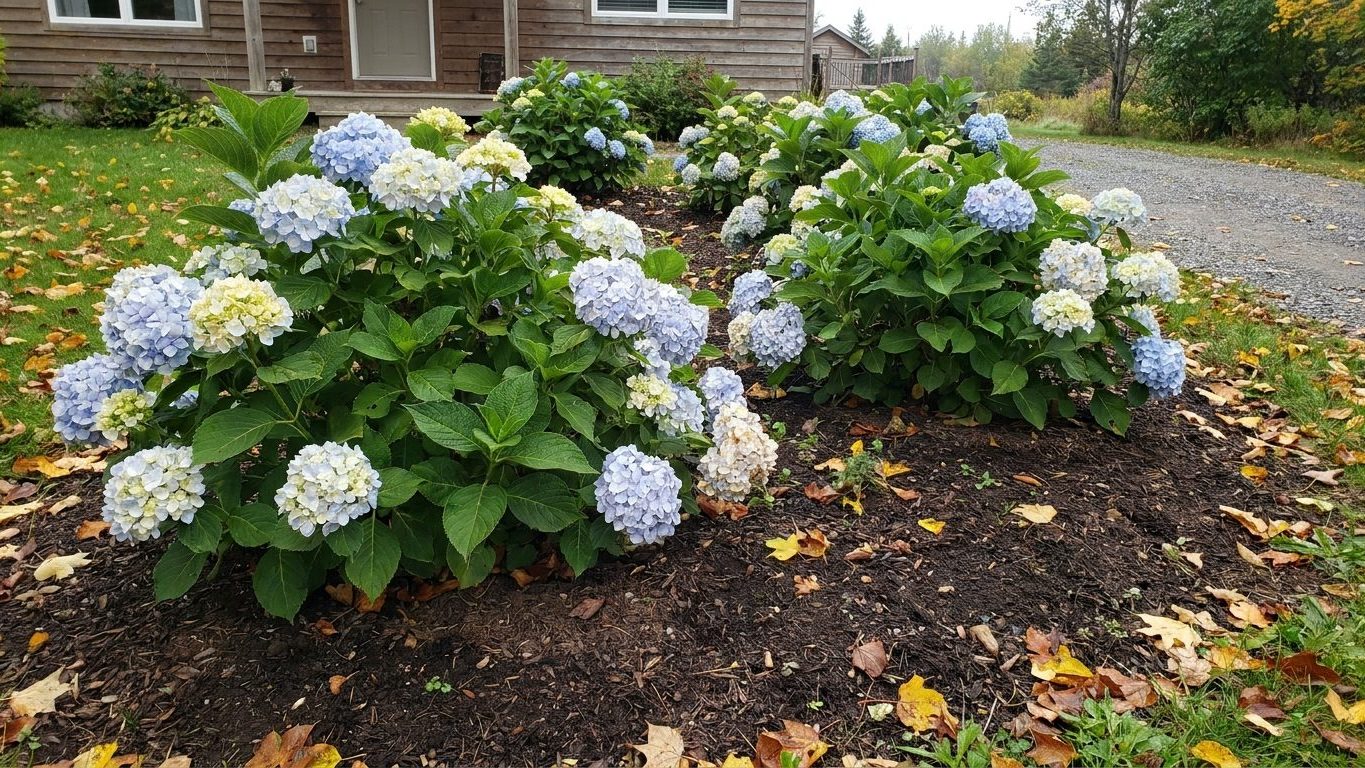
Hydrangeas in Yukon face a short, uncertain season. The average last spring frost falls June 5 and the first fall frost lands August 25, leaving roughly eleven frost-free weeks. Whitehorse sits in Canadian hardiness zone 1b, cold enough that every hydrangea here lives in a container, not the ground. Panicle and smooth types tolerate that routine best.
Hydrangeas Care Calendar for Yukon

Environment and Climate Change Canada’s Canadian Climate Normals for station WHITEHORSE A put the average last frost at June 5, a mean that frost actually beats in roughly half of all years, which makes it a midpoint to plan around rather than a safe cutoff to plant by.
- Dormancy: the safest stretch to repot, divide, or shift a hydrangea to a new container falls while it stands leafless and every root sits undisturbed by active growth.
- Planting: hold off setting a young plant into its permanent pot until well past June 5, since frost still arrives after that average date in roughly half of all years on record.
- Establishment: two to three weeks past the average last frost, check the newest leaves for cold burn before trusting that the season has actually turned toward summer.
- Bloom window: with only about eleven frost-free weeks on the calendar, flower buds set and open in a hurry, so steady watering through July matters more here than any fertilizer schedule.
- Pre-frost prep: in the weeks running up to the August 25 average first frost, start moving containers toward a south-facing wall, covered porch, or sheltered entry to buy a little extra warmth.
- Winter shelter: once frost actually settles in, bring every container indoors or into an unheated garage right away, since Yukon winters kill anything left rooted outside through the cold months.
Nothing on this list assumes a textbook year, and up here the whole calendar bends around the container rather than the ground it sits on.
Yukon — the year and the numbers
- State
- Yukon
- Hardiness zones
- 1b
- Last spring frost
- June 5
- First fall frost
- August 25
- Annual rain
- 10 in
- Lawn zone
- cool-season
- Source
- Environment and Climate Change Canada — Canadian Climate Normals 1981-2010, station WHITEHORSE A · Whitehorse
Best Hydrangeas for Yukon
Natural Resources Canada’s Plant Hardiness Zone map places Whitehorse in Canadian zone 1b, a rating built from seven climate variables rather than the single-variable USDA scale, and colder than any commonly sold hydrangea species is rated to survive while planted directly in open ground.
That reality turns every type into a container plant here, and the real differences between them show up less in cold tolerance and more in how each one handles a summer spent outdoors followed by a winter spent in a shed or a spare room.
| Kind | Flowers on | Winter here | Sun |
|---|---|---|---|
| Panicle | New wood | Container only, most forgiving of rough handling | Full sun |
| Smooth | New wood | Container only, cut back hard each spring anyway | Full sun to part shade |
| Bigleaf | Mostly old wood | Container only, rarely reblooms after an indoor winter | Part shade |
| Oakleaf | Old wood | Container only, slow to recover from indoor storage | Part shade |
Climbing hydrangea and mountain hydrangea barely register at this latitude and don’t appear in the table above, the other kinds each get their own page, along with the fuller reasoning behind every verdict here.
When to Plant, Prune and Feed Hydrangeas in Yukon
Environment and Climate Change Canada’s Whitehorse normals put the average last frost at June 5 and the average first frost at August 25, a gap of roughly eleven weeks that every window listed below counts forward or backward from.
That gap is tight enough that planting, pruning, and feeding nearly overlap on the calendar, unlike in longer-season states where gardeners have whole months of daylight to spread the same three tasks across.
| Task | Window here | Counted from |
|---|---|---|
| Planting into containers | Early to mid June | 0 to 10 days after the June 5 average last frost |
| Pruning after bloom | Late July into early August | Roughly 8 weeks after last frost, ahead of the August 25 average first frost |
| Feeding, once | Mid to late June | 2 to 3 weeks after last frost, once new leaves harden off |
There is no fall feeding window worth naming in this territory. With first frost landing by late August on average, any nitrogen applied after early July only pushes soft new growth straight into the cold that follows it.
Hydrangeas Problems in Yukon and What Causes Them
No flowers most summers
Old-wood bloomers such as bigleaf set next year’s flower buds in the fall before winter, and a season spent half outdoors and half in a cold shed or garage kills those buds long before spring arrives. Switching to a type that flowers on new wood instead sidesteps the problem, and the which-ones page covers exactly that swap in more detail.
New growth killed by a late frost
Environment and Climate Change Canada’s Whitehorse normals put the average last frost at June 5, but a plant set outside right on that date can still lose its very first leaves in about half of all years. Holding containers under cover for another week or two past that average is the safer bet for tender new growth.
A shrub that never gets bigger
Roots confined to a pot, combined with a winter spent indoors that never lets the plant fully settle into dormancy, mean growth often resets each year instead of building steadily on the last. Repotting every second spring, during the dormancy window described above, gives roots room to spread without forcing new growth out too early.
Yukon North to South: How the Dates Shift
Whitehorse, the station behind Environment and Climate Change Canada’s June 5 and August 25 averages, anchors every figure here, but the territory itself runs from river valley floor to alpine tundra, and the frost calendar shifts with that terrain.
- Southern river valleys (Whitehorse, Haines Junction, Watson Lake): closest to the June 5 and August 25 averages, and about the closest thing the territory has to a genuine, if short, growing season.
- Northern and interior communities (Dawson City, Old Crow, the Dempster corridor): frost tends to linger later into spring and return earlier come fall, shrinking that already tight eleven-week window even further for anyone gardening up there.
- Higher ground and exposed ridges (any spot noticeably above the valley floor): cold air settles and drains away slowly overnight, so a pot left outside can meet frost even inside what the averages call a safe window.
None of that changes the container-only verdict reached above, it just nudges the safe dates earlier or later, and the calendar page walks through the fuller month-by-month version built around Whitehorse itself.
Yukon Extension Offices and County Contacts
Natural Resources Canada’s Canadian zone 1b rating for Whitehorse is a starting point, not a guarantee for every yard in the territory. Agriculture and Agri-Food Canada’s federal site is the reliable contact point, since the territorial department’s site blocks automated checks.
- The calendar page: the fuller month-by-month version of these same frost dates and the tasks tied to them for Yukon.
- Which ones hold up here: a longer look at the species that actually tolerate a container winter in this climate.
- What goes wrong here: the pests and problems that tend to show up in a short, cool northern summer.
This month, the one gesture worth making is checking the local forecast before anything currently under cover goes back outside.
Common questions
Can hydrangeas survive winter outdoors in Yukon?
Not reliably in most yards. Canadian hardiness zone 1b, the rating Natural Resources Canada assigns to Whitehorse, sits well below what any commonly sold hydrangea species tolerates while rooted in open ground through winter, so a container that comes indoors each year is the method that actually works here.
How short is the Yukon growing season for a hydrangea?
Roughly eleven weeks on average, running from the June 5 last frost to the August 25 first frost recorded at the Whitehorse station, and that already short gap runs even tighter farther north and on higher ground within the territory.
Which hydrangea type is easiest to grow in a Yukon container?
Panicle and smooth types tend to do best, since both flower on new wood each year and generally shrug off the rough handling that comes with being hauled indoors and back outside on a strict annual schedule.