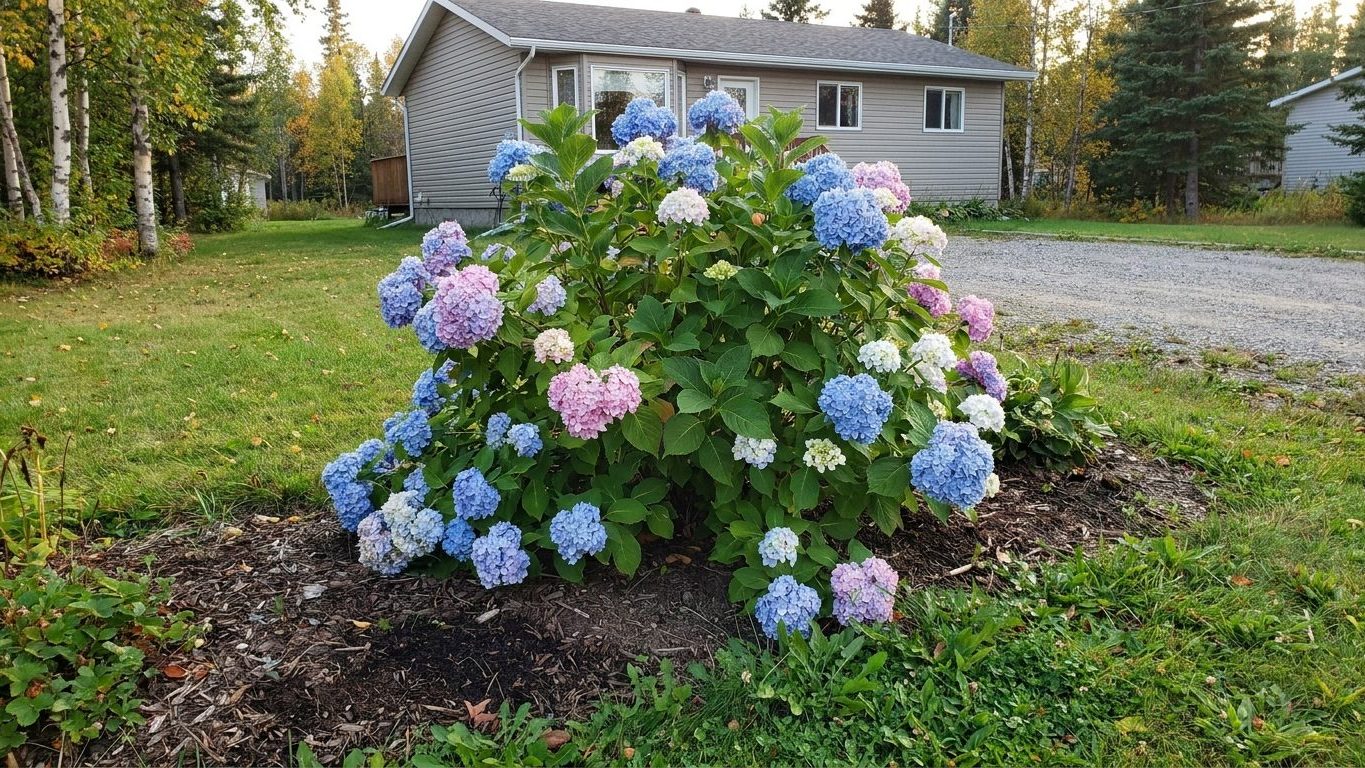
Hydrangeas in Northwest Territories face a hard truth: at Canadian hardiness zone 1b in Yellowknife, with a growing season squeezed between a May 25 average last frost and a September 18 average first frost, most garden hydrangeas will not survive outdoors unprotected. The realistic answer is container culture, heavy winter shelter, or treating the shrub as a seasonal planting brought back inside before the cold returns.
Hydrangeas Care Calendar for Northwest Territories

My planting year fits inside a short window. Environment and Climate Change Canada’s Canadian Climate Normals set the Yellowknife A average last frost at May 25 and first frost in fall at September 18, a gap near sixteen weeks. Natural Resources Canada rates the city Canadian zone 1b, and that rating decides almost everything below.
- Dormancy: from freeze-up through early spring, a potted hydrangea rests in an unheated garage or a mulch pile, roots undisturbed.
- Moving outside: wait two to three weeks past the May 25 average last frost before containers go back out, since that date is only a midpoint.
- Leaf-out: through June, new growth races under nearly twenty hours of daylight, and a late cold snap can still scorch it.
- Bud set: by mid-July, buds on new-wood bloomers swell, though many summers here run too short for a full flush.
- Frost watch: starting in late August, check the forecast nightly, since the September 18 average first frost can also arrive early.
- Bringing it in: at the first hard-freeze warning, move pots indoors or into an attached space before the cold catches the plant outside.
- Deep winter: once inside, keep the shrub cold and dark near freezing rather than warm, or it wakes too soon and drops its buds.
Skip that fall move once and a single hard freeze can end the plant for the year. The calendar here answers to the pot, not the ground.
Northwest Territories — the year and the numbers
- State
- Northwest Territories
- Hardiness zones
- 1b
- Last spring frost
- May 25
- First fall frost
- September 18
- Annual rain
- 11 in
- Lawn zone
- cool-season
- Source
- Environment and Climate Change Canada — Canadian Climate Normals 1981-2010, station YELLOWKNIFE A · Yellowknife
Best Hydrangeas for Northwest Territories
Not every hydrangea is built the same way, and in a place this cold that difference decides everything. Flower buds sit either on last year’s stems or on fresh wood grown this spring, and only the second habit has a real shot this far north.
Natural Resources Canada rates Yellowknife Canadian zone 1b, colder than almost any USDA-mapped hydrangea range on record, so none of these shrubs is reliably root-hardy in open ground here. Container growing narrows the gap, but the same wood habit still decides what a hard frost costs you.
| Kind | Verdict here | Why |
|---|---|---|
| Bigleaf hydrangea | Container only, indoors most of the year | Buds sit on old wood and rarely survive an outdoor winter this cold |
| Panicle hydrangea | Best outdoor try, still mulched heavy | Blooms on new wood, so a killed top still regrows and flowers by fall |
| Smooth hydrangea | Most likely to persist at the root | Native to cold parts of North America, regrows from the base each spring |
| Oakleaf hydrangea | Skip it outdoors | Old-wood bloomer that also wants a longer, warmer season than this one offers |
Climbing hydrangea and the reblooming mophead types are on their own pages, since neither has a realistic outdoor case in this territory. The short list above is the one worth testing in a pot on the deck.
When to Plant, Prune and Feed Hydrangeas in Northwest Territories
Three dates matter more than the rest of the calendar. Environment and Climate Change Canada’s Canadian Climate Normals put the Yellowknife A average last frost at May 25, and every window below counts from that single mark.
The average first fall frost lands September 18, which closes the growing season fast once August ends. That squeeze is why pruning and feeding happen early here, not through midsummer the way warmer states allow.
| Task | Window here | Counted from |
|---|---|---|
| Plant or move outside | 2 to 3 weeks after May 25 | Average last spring frost |
| Prune new-wood bloomers | Late April to early May, before growth starts | Just ahead of the May 25 average last frost |
| Feed | Once in early June, then stop by mid-July | 2 to 6 weeks after the average last frost |
| Bring indoors or shelter | By early to mid-September | 1 to 2 weeks before the September 18 average first frost |
Anything not finished by the second week of September is racing the calendar in this territory. There is no fall feeding window worth using once that date closes in.
Hydrangeas Problems in Northwest Territories and What Causes Them
No flowers despite a healthy plant
This is almost always winter bud kill on an old-wood bloomer like bigleaf or oakleaf hydrangea. The stems survive but the flower buds, set the previous fall, freeze before spring. Switch to a new-wood kind or keep the shrub sheltered over winter instead of open ground.
Stem dieback every winter
Natural Resources Canada’s Canadian zone 1b rating for Yellowknife means stems above the snowline rarely survive a full winter outdoors. New-wood bloomers shrug this off and regrow from the base, but the shrub never gets tall the way it does farther south.
Scorched leaves under the midnight sun
Long summer daylight this far north pushes leaves hard, and a plant moved outside too fast after storage can scorch at the edges. Harden it off over a week in filtered light before full sun, the same way you would a seedling.
Northwest Territories North to South: How the Dates Shift
Nothing about this territory is uniform, and a shrub that limps through in one valley can fail outright a few hundred miles north.
- South of Great Slave Lake (Hay River, Fort Smith, Fort Providence): closer to the Alberta border, this stretch runs a touch milder and its frost-free stretch opens a little earlier than Yellowknife’s.
- Great Slave Lake corridor (Yellowknife, Behchoko, Dettah): the reference point for the dates above, where the big lake moderates the worst spring and fall swings.
- Mackenzie Valley (Fort Simpson, Wrigley, Norman Wells): river-valley shelter helps a little, but the season still closes fast once September arrives.
- Beaufort Delta and the Arctic coast (Inuvik, Tuktoyaktuk, Aklavik): shorter and colder again, where even container hydrangeas spend most of the year under cover.
The territory’s own page holds the Yellowknife-based dates used throughout this guide, and a local check before planting anywhere else in the territory is worth the call.
Northwest Territories Extension Offices and County Contacts
Yellowknife’s numbers are a starting point, not a local guarantee, since the territory shifts hard between its southern edge and the Arctic coast. The Government of Northwest Territories runs the agriculture services listed below.
- NWT Agriculture Services: the territorial page for growers, greenhouse programs, and local contacts.
- Your regional office: the closest place to ask whether a hydrangea has ever wintered outdoors near you.
- This month’s move: call ahead before you buy, and get the pot ready to come back inside before the season turns.
Common questions
Can hydrangeas survive winter outdoors in the Northwest Territories?
Mostly no. At Canadian zone 1b, only the toughest new-wood bloomers, and even those planted in a sheltered, mulched spot, have a modest chance, and gardeners closer to the Arctic coast see even less success than Yellowknife does.
What’s the best hydrangea for a short northern growing season?
Smooth hydrangea and panicle hydrangea handle the squeeze best, since both flower on new wood and can rebuild after a hard freeze kills everything above ground.
When should I bring a potted hydrangea indoors in NWT?
Aim for one to two weeks before the September 18 average first frost, and move earlier rather than later, since that date is a midpoint and frost sometimes arrives sooner.