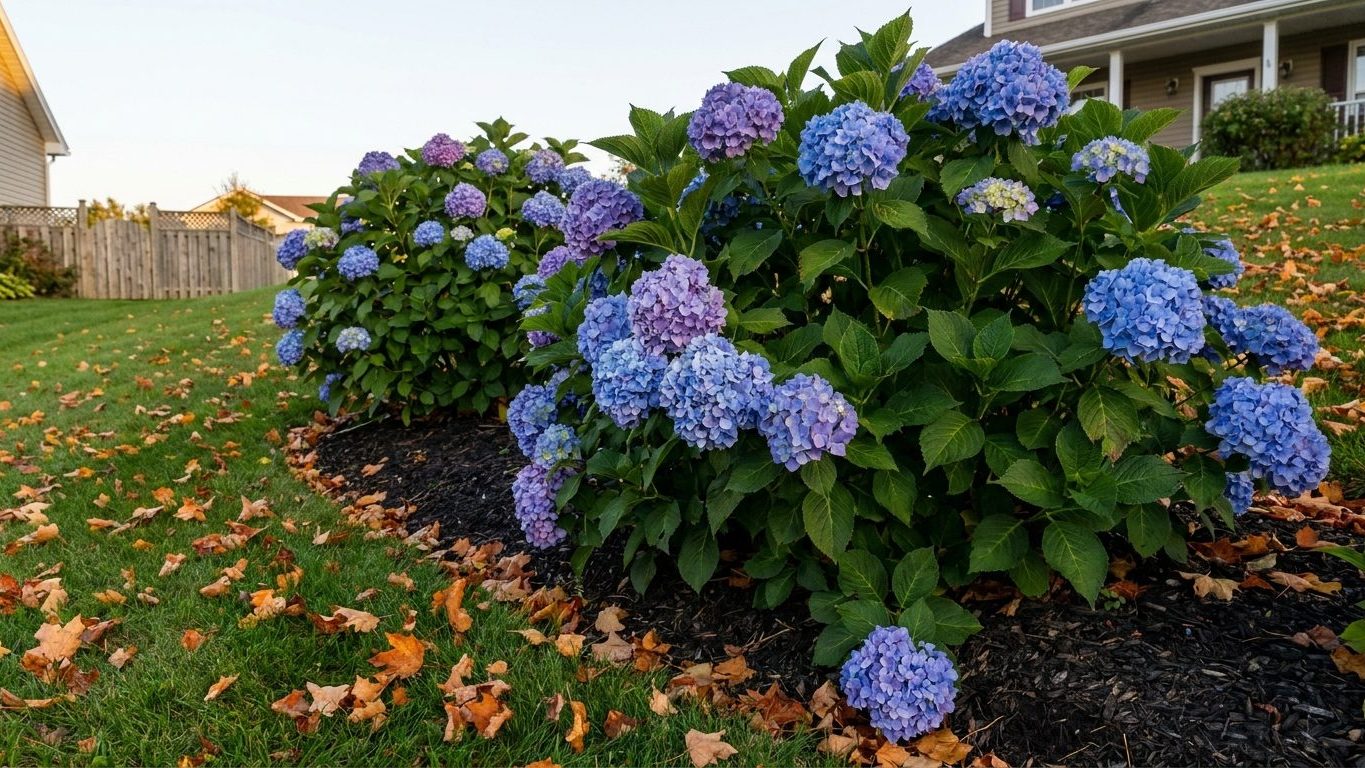
Hydrangeas can grow across New Brunswick, but the kind matters more than the yard. Panicle and smooth types bloom reliably despite the province’s short, cold season, while bigleaf varieties risk losing their flowers to winter even when the shrub itself survives. The dates below all trace back to Moncton’s average frost window and its Canadian hardiness zone rating.
Hydrangeas Care Calendar for New Brunswick

My growing year here starts and ends with two averages. Environment and Climate Change Canada’s Canadian Climate Normals put the last spring frost at Moncton around May 23 and the first fall frost around October 2, and Natural Resources Canada rates the city Canadian hardiness zone 5a, a short season that decides almost every date below.
- Dormancy: from mid fall through early spring, before growth starts, is the one stretch to move or divide a hydrangea without disturbing the roots.
- Planting: wait until two to three weeks after the May 23 average last frost, once the soil has warmed, before setting new stock in the ground.
- Leaf out: new growth pushes through the back half of spring, and a late cold snap here can still nip soft leaves.
- Bloom: flowers open through summer on panicle and smooth types, while bigleaf buds set the year before can fail if a hard winter took them.
- Deadheading: spent flower heads come off through late summer, cut just below the bloom without touching next year’s buds on old-wood kinds.
- Frost prep: heavy mulch goes on in the weeks before the October 2 average first frost, banking the crown against the short season ahead.
Zone 5a leaves little room for error, so every step above leans toward caution rather than a longer bloom.
New Brunswick — the year and the numbers
- State
- New Brunswick
- Hardiness zones
- 5a
- Last spring frost
- May 23
- First fall frost
- October 2
- Annual rain
- 47 in
- Lawn zone
- cool-season
- Source
- Environment and Climate Change Canada — Canadian Climate Normals 1981-2010, station MONCTON · Moncton
Best Hydrangeas for New Brunswick
Not every hydrangea sold at a garden center is built for a Canadian zone 5a winter. The kinds that flower on new wood shrug off a hard freeze because they regrow and bloom the same year no matter what died back over winter.
Kinds that set their buds on old wood carry more risk here, since a cold snap, or a mild spell that breaks dormancy early, can wipe out the flower show without touching the plant’s survival at all.
| Kind | Verdict here | Why |
|---|---|---|
| Panicle (H. paniculata) | Reliable | Blooms on new wood, so top growth lost to winter still flowers that summer. |
| Smooth (H. arborescens, incl. Annabelle types) | Reliable | Also blooms on new wood, dies back hard some years and comes back regardless. |
| Bigleaf (H. macrophylla) | Risky | Buds form on old wood, which a zone 5a winter can kill outright. |
| Oakleaf (H. quercifolia) | Marginal | Old-wood bloomer, best against a sheltered south-facing wall. |
| Climbing (H. petiolaris) | Slow but possible | Takes several seasons to establish before it flowers at all. |
Bigleaf hydrangeas still show up in New Brunswick yards, usually tucked against a warm wall or under eave cover, but they stay a gamble most seasons. Mountain hydrangea and other less common kinds get their own page for the finer detail that doesn’t fit here.
When to Plant, Prune and Feed Hydrangeas in New Brunswick
Three dates decide most of the hydrangea year here, and all three trace back to the same average. Environment and Climate Change Canada puts the last spring frost at May 23 near Moncton, with the first fall frost landing October 2.
Planting waits for the soil to warm, pruning splits by which wood carries the buds, and feeding follows new growth rather than a fixed date. Get the wood type wrong and a spring prune can cut off the whole year’s flowers.
| Task | Window here | Counted from |
|---|---|---|
| Planting | Two to three weeks after May 23 | Last spring frost average |
| Pruning, new-wood kinds | Late winter to very early spring, before growth starts | Ahead of the last frost average |
| Pruning, old-wood kinds | Right after bloom fades, by mid to late summer | Before next year’s buds set |
| Feeding | Once after growth starts, lightly again in early summer | After the last frost average |
The full month by month rundown, including when to stop feeding and when mulch goes on, lives on the calendar page for this province.
Hydrangeas Problems in New Brunswick and What Causes Them
No flowers on an otherwise healthy shrub
This is almost always winter injury on a bigleaf hydrangea, whose flower buds formed on old wood the previous fall. A hard stretch inside a Canadian zone 5a winter can kill those buds while the plant itself leafs out fine. Switch to a new-wood kind or mulch the crown heavily each fall.
New leaves blackened in late spring
Tender growth pushed out after a mild stretch, then a frost close to the May 23 average last frost caught it off guard. The stems usually recover, but that flush of leaves is lost. Hold off cutting back until new growth shows which stems actually survived.
Leaf spots after a wet summer
Humid, still air between crowded shrubs favors fungal leaf spot, especially on older bigleaf plants. Wider spacing and watering the soil rather than the leaves cuts the risk considerably. It reads worse than it is, mostly cosmetic and heaviest late in the season.
New Brunswick North to South: How the Dates Shift
Moncton’s numbers are one point on a map that runs from tidal coast to interior highlands, and hydrangeas feel every mile of that spread.
- The Fundy coast and the south (near the Bay of Fundy, closer to Nova Scotia’s milder shoreline): fog and tempered sea air push the season later into fall but keep hard freezes softer than inland spots.
- The Saint John River valley (around Fredericton, further from the coast): warmer summer days than the coast, but sharper spring frosts once the river fog clears each morning.
- The north and the Restigouche highlands (toward the Quebec border): a shorter season on both ends, where the safe planting window closes earlier and the mulch goes on sooner.
None of that changes the province’s zone 5a starting point, it only shifts how much slack a given yard gets on either side of it.
New Brunswick Extension Offices and County Contacts
Moncton’s zone 5a rating is a province-wide starting point, not a promise for every yard. For anything specific to your own soil and microclimate, check with federal growing resources or your local county office.
- Your province: the frost dates and hardiness zone anchoring every date.
- Which ones hold up here: the fuller rundown on which hydrangea kinds fit a zone 5a winter.
- Agriculture and Agri-Food Canada: federal growing resources for gardeners across the country.
This week, that gesture is checking mulch depth on any bigleaf before the nights turn cold.
Common questions
Can I grow bigleaf hydrangeas in New Brunswick?
Yes, but treat it as a gamble tied to winter severity rather than a sure bet. Zone 5a winters can kill the old-wood flower buds even when the plant survives, so heavy fall mulch and a sheltered spot against a wall improve the odds.
What is the coldest a hydrangea can take here?
That depends on the kind more than any single temperature. Panicle and smooth hydrangeas bloom on new wood and shrug off dieback, while bigleaf and oakleaf carry more risk because next year’s flowers ride on wood that has to survive the winter first.
When is the safest time to plant a new hydrangea?
Aim for two to three weeks after the average last spring frost, once the soil has warmed, rather than right at the frost date itself. That average falls around May 23 near Moncton, though it lands later in about half of all years.