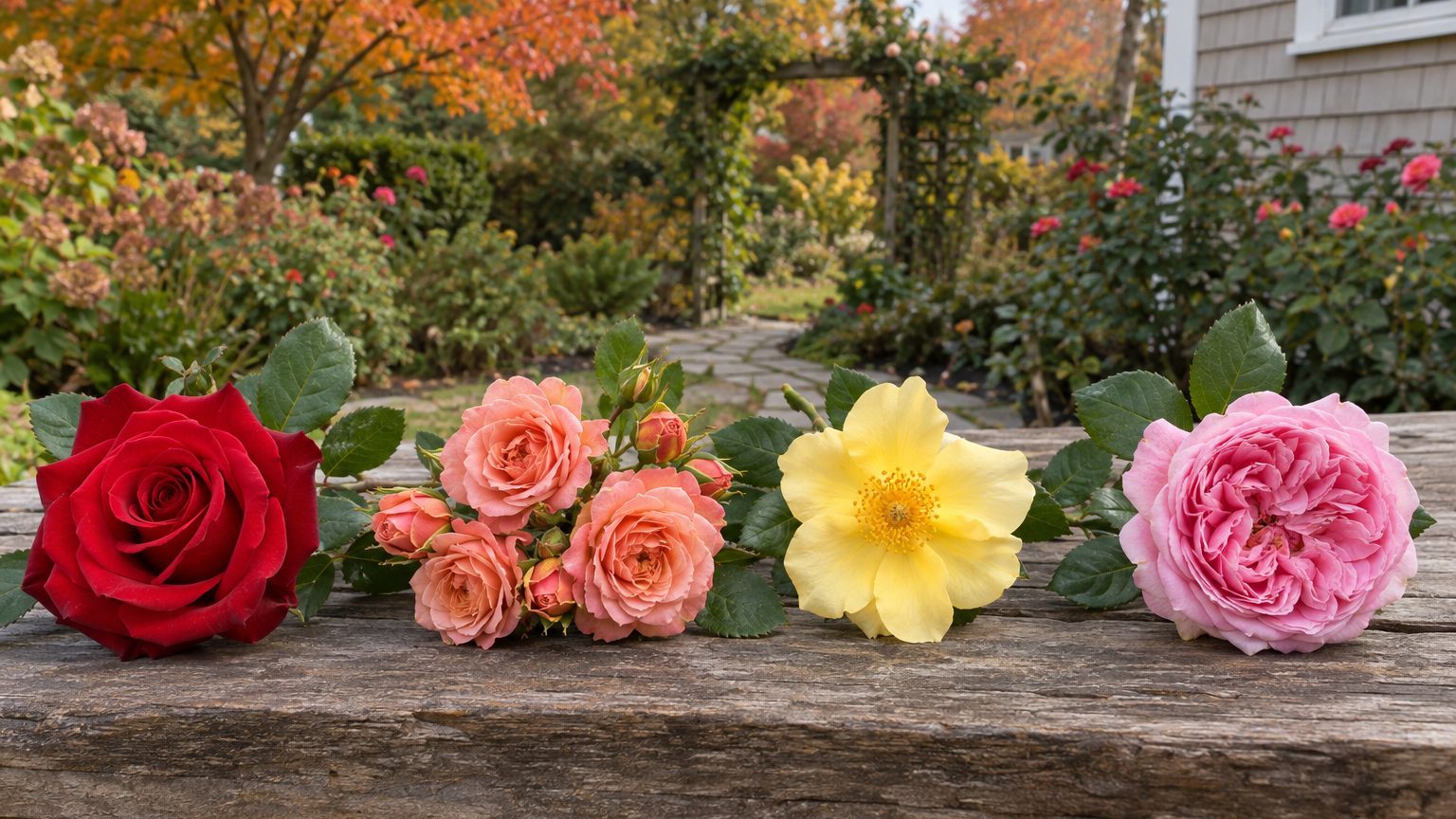
Some rose canes come through a Rhode Island winter green and ready to leaf out, while others are dead to the ground by April. The difference is mostly the type you planted.
Best Roses to Grow in Rhode Island

Hardy shrub roses, rugosas and old garden roses handle Rhode Island winters with little fuss, while hybrid teas, floribundas and most climbers need help. The state sits in USDA zones 6a-7b, so cold is the main thing that sorts roses here. A rose bred for much colder winters needs little to no added protection in the milder parts of that range.
Knock Out Roses
Knock Out is a hardy shrub rose that performs well without extra winter protection. That makes it an easy first rose for a front yard.
Prune it in March and April, just as the buds start to swell, since it repeat-blooms on new growth.
Explorer Series Roses
The Explorer series was bred for cold, and it shows. These shrub roses perform well here without a winter covering, so they suit a bed you would rather not fuss over in November.
Rugosa Roses
Rosa rugosa is hardy in most locations, which is why it is the rose to reach for when a spot is exposed or hard to reach with a mulch mound.
Species roses like it, along with most landscape and shrub roses, rarely need extensive preparation for winter.
Old Garden Roses
Many old garden roses are extremely tolerant of cold, and they are reliably hardy without a wrapped or mounded base.
Most flower once a year on last year’s wood, so prune them right after they bloom, never in early spring. Cutting them in March removes the flower buds.
Hybrid Teas, Floribundas and Grandifloras
Hybrid teas have the classic cutting-rose form, with long stems and fragrant flowers. They are not reliably winter hardy and need protection in cold winters.
Prune them in March and April, when the forsythia blooms and the winter covering is off. February can also work in an early spring.
Climbing Roses
Most climbers are not reliably winter hardy, and some miniature and polyantha roses share that weakness. A climber can still cover a trellis or arbor beautifully.
Choose a variety rated for your zone and plan to protect the canes. Tying them in loosely in fall makes that job easier.
Rhode Island — the year and the numbers
- State
- Rhode Island
- USDA zones
- 6a-7b
- Last spring frost
- April 7 to April 17
- First fall frost
- October 24 to November 3
- Annual rain
- 48 in
- Lawn zone
- cool-season
- Source
- NOAA NCEI U.S. Climate Normals 1991-2020, 32F freeze probabilities · Providence
How to Choose a Rose for a Rhode Island Garden
Start with the chillier parts of your yard, not the prettiest catalog photo. Extension advice is to choose only types hardy enough for the coldest average winter in your zone, and the extent of protection then depends on the rose and where it sits in the garden.
The table matches common situations to a type that fits.
| Your situation | What suits it in Rhode Island | Why |
|---|---|---|
| Exposed, colder inland yard | Rugosa or Explorer series roses | These roses are hardy and need no winter covering |
| Little time to spare | Knock Out or other landscape shrub roses | They perform well without extra winter protection |
| Small space | Miniature roses | Some are reliably hardy, but others need a covering, so check the label |
| Cut flowers for a vase | Hybrid teas | Long stems and fragrance, but they must be protected in winter |
| Trellis or arbor | Climbing roses rated for your zone | They can be trained to cover a support, though most are not reliably hardy |
| Cold corner you rarely visit | Species and old garden roses | They tolerate cold and need little preparation |
Groundcover roses also appear among the types suited to Rhode Island yards, handy along a slope or border edge. Whatever you pick, check the plant tag for its hardiness rating before it goes in the cart.
Which Roses Suit Different Parts of Rhode Island
The state spans USDA zones 6a-7b, so where you garden shifts how much protection a rose needs.
- Narragansett Bay and the South County shore: Gardens near the water sit toward the milder end of the range, so tender roses have a better chance with a good covering and a sheltered spot.
- The northwestern hills around Burrillville and Foster: Inland and higher ground runs colder and frosts later in spring, so rugosa, Explorer and other hardy shrub roses are the safer choice.
Suburban and rural yards usually see their last spring frost later than the airport reference, so check your own county before planting early.
Rose Buying Mistakes to Avoid in Rhode Island
Tender Roses Left Bare
A hybrid tea or climber planted without a plan for winter often loses canes to the cold, and then blooms from what is left.
Put protection on in November, after several killing freezes, once the plant is dormant. December works too if the freezes come late. Clean up fallen leaves first.
Choosing by Looks Alone
A rose picked for color or fragrance without a hardiness check is the usual reason a bush dies back. Rose hardiness varies widely by variety.
Look for a rating that matches your zone. If the plant is marginal, keep it to a sheltered corner and budget for winter protection.
Feeding Too Late
Fertilizer late in summer pushes soft, succulent growth that cannot harden off before winter. Feed from April through July, after pruning, at first bloom and in mid-July.
No fertilizer should go on after mid-August, so the canes can toughen up before the first hard freezes.
Where to Get Rose Advice in Rhode Island
University of Rhode Island Cooperative Extension answers rose questions for the state, and your county office can speak to your particular soil and microclimate.
- Extension publications and Master Gardener volunteers can help you diagnose leaf spots or dieback, best brought in with a sample cane.
- Visit your local extension office to check which varieties do well near you, and again in fall before you wrap or mound the canes.
Common Questions
Can You Plant a Rose in July?
Yes, if it is a potted rose. Container roses can go in from April through midsummer. Bare-root roses are best planted in March and April, before growth starts.
When Should You Take Winter Protection Off Roses?
Take it off in March and April, once the ground thaws. Remove the covering gradually, then prune repeat-blooming roses as the buds begin to swell.
How Much Sun Do Roses Need?
Roses grow best with plenty of direct sunlight each day. They also prefer rich, loose soil with plenty of organic matter and good drainage.