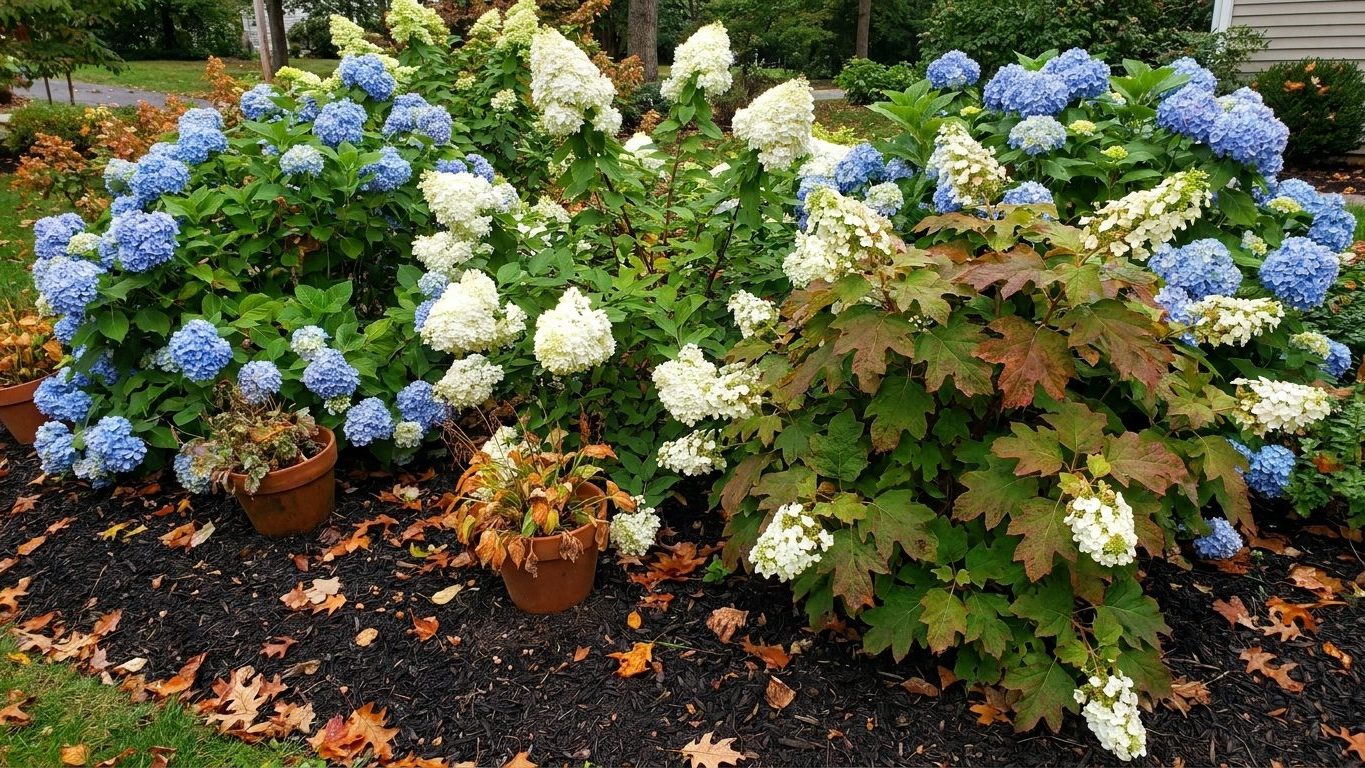
Panicle and smooth hydrangeas are the safest bets across Washington. Bigleaf and oakleaf types also do well in the mild western lowlands, while mountain and rough-leaf types need more shelter and more luck.
The catch is geography. Seattle’s maritime climate is not Spokane’s high desert, so the right shrub depends on which side of the Cascades your yard sits on.
Hydrangeas that grow well in Washington: The Short Answer
NOAA NCEI 1991-2020 Climate Normals puts the last spring freeze in Seattle between February 27 and March 18, with the first fall freeze between November 13 and November 30.
That long, mild stretch is why most hydrangeas that grow well in Washington do so on the west side. The ranking below runs from safest to riskiest for the state as a whole.
Panicle hydrangea

Hydrangea paniculata blooms on wood grown the same season, so a hard winter or a late freeze rarely costs you flowers. It takes more sun than any other type here, and Limelight is a widely grown cultivar. That reliability puts it first on the list, east side included.
Annabelle smooth hydrangea
Hydrangea arborescens ‘Annabelle’ also flowers on new growth, so even a winter that kills the stems back leaves you big white heads by summer. It likes part shade and steady moisture. Stems flop after heavy rain, which a low support ring fixes.
Bigleaf hydrangea
Hydrangea macrophylla is the classic mophead, at home in Seattle’s mild winters and cool summers. Many kinds set buds on old stems, so a hard freeze or a winter haircut costs the bloom. The pruning window is June and July, laid out in When to Plant and Prune Hydrangeas in Washington.
Oakleaf hydrangea
Hydrangea quercifolia offers lobed leaves, cone-shaped white flowers and burgundy fall color, and it tolerates dry shade better than most. It holds up in the western lowlands, but it also sets buds on old wood, so cold east of the Cascades can thin the show. Give it room to spread.
Mountain hydrangea
Hydrangea serrata is a smaller, finer cousin of bigleaf with lacecap flowers, and somewhat hardier. It blooms on old wood too, so cold that reaches the buds hurts it the same way. Plant it in a sheltered spot on the west side and treat it as a step up in risk.
Rough-leaf hydrangea
Hydrangea aspera has velvety leaves and wide lavender-and-pink flowers, and it is the riskiest name here. It wants shelter from wind and cold plus mild winters, so it belongs in protected western yards only. Buy one as a project, not as the backbone of a planting.
Washington — the year and the numbers
- State
- Washington
- USDA zones
- 4a-9a
- Last spring frost
- February 27 to March 18
- First fall frost
- November 13 to November 30
- Annual rain
- 39 in
- Lawn zone
- transition-season
- Source
- NOAA NCEI 1991-2020 Climate Normals, 32F freeze probabilities · Seattle
How to Work Out the Dates for Your Own Yard
Start from the NOAA NCEI 1991-2020 Climate Normals for Seattle, which give a last spring freeze between February 27 and March 18 and a first fall freeze between November 13 and November 30.
- Confirm you live on the west side: those windows describe western Washington, and east of the Cascades the season is far shorter, so the numbers slide toward a later spring and an earlier fall.
- Count back from the fall range: give a new shrub a month of root time and subtract four weeks, so November 13 to November 30 becomes October 16 to November 2. The calendar’s fall planting months, September and October, sit at or ahead of that range.
- Treat the spring range as a floor: February and March are planting months on the calendar, but a freeze date is not a planting date, because cold wet soil and low light hold growth back well past it.
- Test the name against the winter: a panicle hydrangea flowers on new wood, so a freeze that damages last year’s stems costs it little. Bigleaf carries next summer’s buds on old stems and can lose them in a cold snap east of the Cascades.
- Test it against the summer too: afternoon sun scorches bigleaf leaves, so give it morning sun, while panicle types shrug off far more heat.
Write the result as a range, never a single day. A range minus a few weeks is still a range, and that is the honest answer for a yard on the Sound or in the foothills.
Washington North to South: How the Dates Shift
Elevation, saltwater and the Cascade divide all move the Seattle dates around the state, each in its own direction.
- Puget Sound lowlands (Seattle, Tacoma, Olympia): water moderates the temperature, so the Seattle window is the baseline here, with the far north running a little cooler.
- Pacific coast and Olympic Peninsula (Long Beach, Aberdeen, Forks): ocean air keeps winters mild and freezes rare, but cool summers and wind slow bloom and favor tough shrubs.
- Cascade foothills and passes (North Bend, Skykomish, Snoqualmie Pass): elevation pulls the last freeze later and the first one earlier, so plant toward the late end and lean on panicle and smooth types.
- Eastern Washington (Spokane, Yakima, Wenatchee): rain shadow, high desert, colder winter lows and hot dry summers shorten the season, and bigleaf becomes a gamble.
For the full picture of the state, start with Hydrangeas in Washington.
Mistakes Washington Punishes
Planting the day frost ends
NOAA NCEI 1991-2020 Climate Normals put Seattle’s last freeze between February 27 and March 18, yet cold wet soil and low light hold growth back well past it. Plant when the ground drains and warms. Sodden roots invite trouble, covered in Hydrangea Pests and Diseases in Washington.
Pruning bigleaf in late winter
Bigleaf hydrangeas carry next summer’s flower buds on old stems, so a late-winter cut removes the bloom. Prune in June and July, right after flowering, and shape lightly. The exact months are in When to Plant and Prune Hydrangeas in Washington.
Using Seattle dates statewide
Seattle sits in mild, maritime western Washington. Beyond the Cascades the climate is high desert with a far shorter season, so the same dates would put a shrub in the ground too early or leave it exposed in fall. Work out your own range, starting from Hydrangeas in Washington.
Washington Extension Offices and County Contacts
The Seattle window is a starting point, not a verdict on your street. Washington State University Extension, at extension.wsu.edu, and your county office hold the local detail on soil, elevation and microclimate. Three pages here cover the rest.
- Hydrangeas in Washington: the state guide, with the frost dates and the climate picture for where you live.
- When to Plant and Prune Hydrangeas in Washington: the month-by-month windows for planting, feeding and pruning.
- Hydrangea Pests and Diseases in Washington: what shows up on leaves and stems through the season. Read it, then take a photo of any trouble to your county office.
Common questions
Which hydrangea is safest in Washington?
Panicle hydrangeas, followed by smooth types such as Annabelle. Both bloom on new wood, so winter damage costs them little. Bigleaf and oakleaf do well on the mild west side, but the buds they carry on old stems are at risk east of the Cascades.
When do I prune bigleaf hydrangeas in Washington?
The calendar window is June and July, right after the flowers fade. Cutting in late winter removes the buds meant for the coming summer.
When should I feed hydrangeas in Washington?
The calendar lists March, May and July as the feeding months. Use them as a rhythm, and ask your county office how the soil in your area changes the amount.