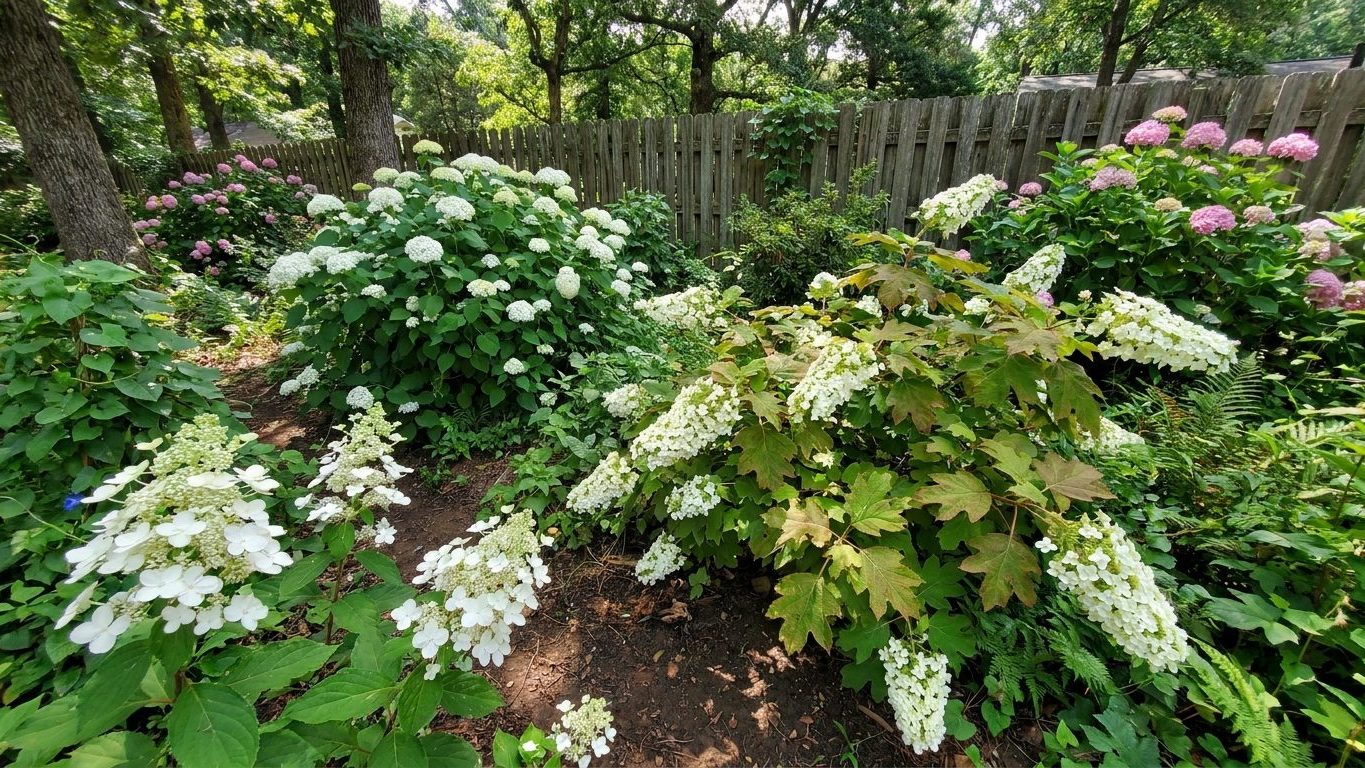
Saskatoon’s frost-free stretch runs roughly from May 18 to September 18, inside a Canadian hardiness zone of 3a, one of the coldest zones any hydrangea in this series has to survive. Panicle and smooth hydrangeas, which rebuild their flowering wood every spring, make it through a Saskatchewan winter. Bigleaf and mountain hydrangeas, which bloom on last year’s stems, mostly do not.
Hydrangeas that grow well in Saskatchewan: The Short Answer
Natural Resources Canada’s Canada’s Plant Hardiness Site puts Saskatoon at a Canadian hardiness zone of 3a, a figure built from seven climate variables rather than one, and it does not convert to a USDA zone. That single number decides almost everything on this list. Only shrubs that shrug off winter dieback and rebuild their flowers on new wood are worth the space in a Saskatchewan yard.
Annabelle

This smooth hydrangea cultivar dies to the ground most winters and simply regrows from the roots, then flowers on that same season’s new wood by late summer. It is about as close to foolproof as a hydrangea gets in a zone 3a garden, which is why local growers keep it in stock.
Incrediball

A sturdier-stemmed sibling of Annabelle, bred to hold up its heavier white blooms after a prairie downpour. It shares the same root hardiness and the same new-wood bloom habit, so a hard Saskatoon winter costs it nothing but height.
Limelight

This panicle hydrangea also blooms on new wood, opening lime-green cones from midsummer into fall, well inside the window between the May and September frost averages. Its wood is more winter-hardy than a bigleaf’s, though a young plant still benefits from a first-winter mulch collar.
Little Lime

A compact form of the same panicle species, useful where a foundation bed is too small for a full-size shrub. It carries the same cold tolerance as its taller relative, so size, not winter, is the only real limit here.
Quick Fire

This panicle cultivar sets bud and colors earlier than most, which matters when the season between frosts runs only about four months. Gardeners who want the shrub to finish its show before the September average find this the safer bet.
Oakleaf hydrangea

Its flower buds form on old wood, the same stems a zone 3a winter often kills back to the snowline, so a bloom-free year is common even on an otherwise healthy plant. A heavy mulch mound over the crown improves the odds but does not guarantee flowers.
Bigleaf hydrangea
The florist favorite grown everywhere south of the border rarely blooms here, since its buds sit on the previous year’s stems and Saskatoon’s winter reliably takes those stems down to the ground. Most gardeners who love the look grow it in a large pot they carry into an unheated garage for winter.
Saskatchewan — the year and the numbers
- State
- Saskatchewan
- Hardiness zones
- 3a
- Last spring frost
- May 18
- First fall frost
- September 18
- Annual rain
- 14 in
- Lawn zone
- cool-season
- Source
- Environment and Climate Change Canada — Canadian Climate Normals 1981-2010, station SASKATOON SRC · Saskatoon
How to Work Out the Dates for Your Own Yard
Work out your own dates by starting from the two averages Saskatoon reports and reasoning outward from there, not by copying a date off a package grown for a milder zone.
- Start from the frost averages: Environment and Climate Change Canada’s Canadian Climate Normals, drawn from an older reference period than the newer normals used for the US state pages in this series, put Saskatoon’s last spring frost at an average of May 18 and its first fall frost at an average of September 18, a season of roughly four months.
- Treat both dates as midpoints, not guarantees: in one year out of two the frost falls later than these averages, so anything planted right on May 18 is still gambling on the second half of that split.
- Match the pruning window to the bloom wood: the calendar for this state lists June and July for pruning bigleaf types, but a new-wood bloomer like a panicle hydrangea tolerates a harder cut in that same window without losing its season.
- Check what the shrub does after winter: a hydrangea that regrows thin green stems from the base by June, like Annabelle, is telling you it survived as a root, which is exactly what a zone 3a plant needs to do.
- Watch for the shrub that skips this step: a bigleaf hydrangea that still shows only bare, woody stems in June has lost its flower buds for the year, since those buds were sitting on wood the winter already killed.
Run this same reasoning for any cultivar under consideration. Find its bloom wood, hold that against Saskatoon’s roughly four-month season, and decide whether the plant can finish flowering before the September average arrives.
Saskatchewan North to South: How the Dates Shift
- The northern boreal fringe (Prince Albert and areas north): colder air pools here through spring, so the safe planting window opens later than Saskatoon’s calendar suggests and the season runs shorter on both ends.
- The Saskatoon-Regina corridor (the settled prairie core) is the zone the reference dates describe, and even inside it an exposed, wind-scoured yard can lose extra days off either end.
- The southwest and sheltered river valleys (Swift Current, the Qu’Appelle Valley): valley walls trap warmth and cut wind, so a shrub tucked against a south-facing slope there can outlast one planted in the open near Saskatoon.
Whichever part of the province a yard sits in, treat the Saskatchewan guide’s dates as the starting line, then adjust for local shelter and exposure.
Mistakes Saskatchewan Punishes
Planting exactly on the frost average
May 18 is a midpoint, not a guarantee, so a shrub set in the ground that day still faces a real chance of a later freeze. Wait until the state’s planting window is well underway, and keep frost cloth ready for the first few nights.
Leaving the crown bare going into winter
A zone 3a winter kills unprotected crowns outright, not just the top growth, which is the difference between a shrub that regrows and one that is simply gone. Mound mulch over the base once the ground starts to freeze, deep enough to insulate the roots through the coldest months.
Choosing an old-wood bloomer for the color
Bigleaf and oakleaf hydrangeas set next year’s buds on stems that rarely survive here, so a gardener who plants for the catalog photo usually gets leaves and no flowers. Choose a panicle or smooth type instead, the ones covered above that rebuild their flowering wood every spring.
Saskatchewan Extension Offices and County Contacts
The zone and frost figures describe Saskatoon’s reference station, not any single yard, so a local office fills the gap once a hydrangea type has been chosen.
- Saskatchewan Agriculture: the province’s agribusiness and industry office, a starting point before calling a local greenhouse.
- The Saskatchewan calendar page: month-by-month frost dates and the pruning window for the whole growing season.
- What goes wrong here: the pests and problems that show up on Saskatchewan hydrangeas, season by season.
Common questions
Can bigleaf hydrangea survive winter in Saskatchewan without protection?
Rarely as a flowering shrub. Its buds sit on old wood that a zone 3a winter typically kills back to the ground, so the plant may leaf out again but skip blooming most years.
What is the best hydrangea for a Saskatoon front yard?
A smooth or panicle type such as Annabelle, Incrediball, or Limelight, since all three rebuild their flowering wood from scratch each spring and do not depend on stems surviving the winter intact.
How long is the growing season for hydrangeas in Saskatchewan?
Roughly four months on average, from a last spring frost around May 18 to a first fall frost around September 18, though either date can land later in about half of all years.