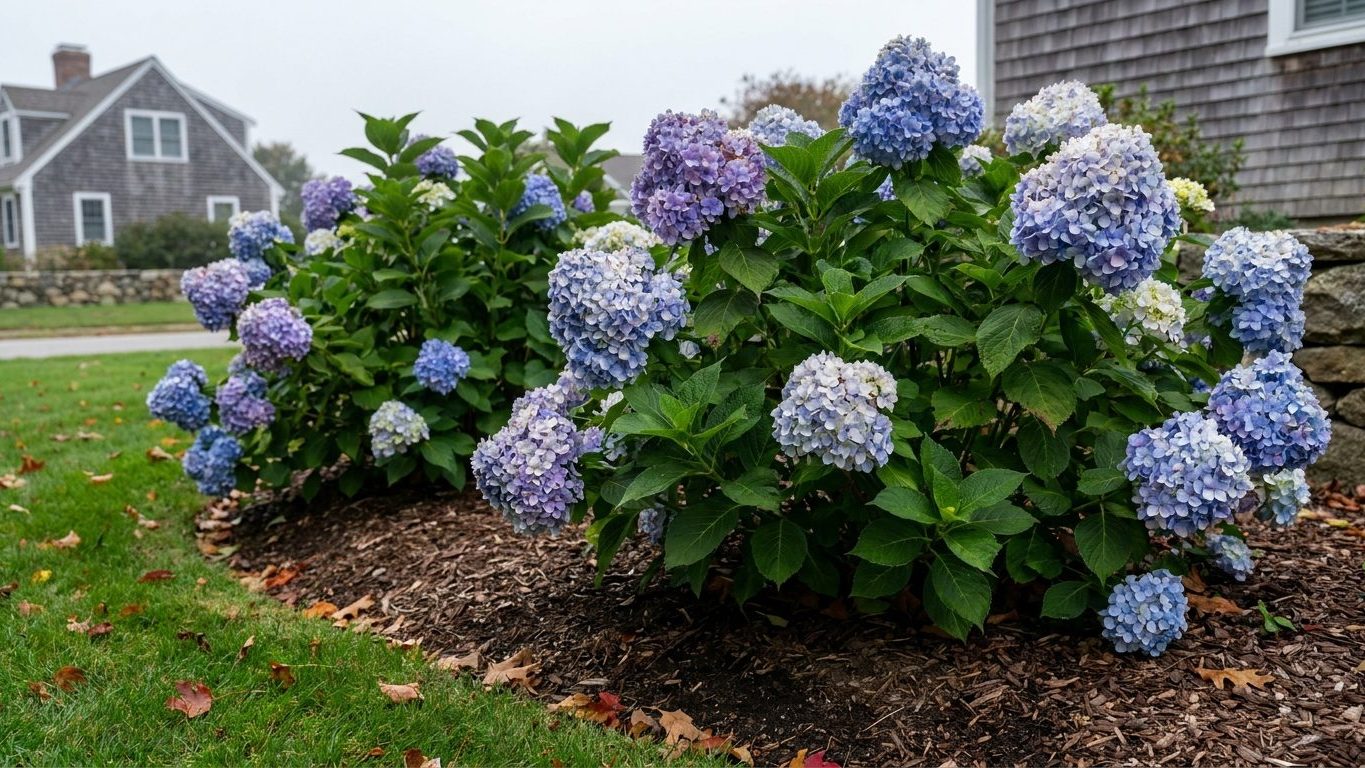
Providence is the reference point for Rhode Island’s frost dates, and that changes when a hydrangea can safely go into the ground or come under the pruning shears. Planting opens in April and May, then again in August and September. Bigleaf pruning belongs to June and July only, right after bloom, never in fall.
When to prune hydrangeas in Rhode Island: The Short Answer
Here is how the year unfolds for a Rhode Island yard, using Providence’s frost dates and the state’s own fertilize, plant, and prune windows as the anchor points.
- January: The ground stays frozen most weeks. Hydrangeas sit fully dormant, so the only task is checking that heavy snow hasn’t cracked a branch.
- February: Order bare-root stock or sketch out a bed location. Nothing goes into the soil yet, since the ground is still too cold to dig.
- March: March opens the first fertilize window on Rhode Island’s calendar. Feed established shrubs once soil turns workable, but hold off on planting new ones.
- April: Planting opens this month, though NOAA NCEI U.S. Climate Normals 1991-2020 puts Providence’s last spring frost between April 7 and April 17. Wait until that window passes before a new hydrangea touches the ground.
- May: May carries a fertilize round and one of the year’s two strongest planting months. Soil has warmed enough by now that roots settle in fast.
- June: Pruning bigleaf hydrangeas begins once the first bloom flush fades. Cut spent stems back to a strong bud pair, never touching healthy new wood.
- July: The pruning window closes here, alongside the third and final fertilize month. This is the last feeding before shrubs shift energy into next year’s buds.
- August: Planting reopens for fall, the first of two remaining months on the calendar. Warm soil and cooling air give new roots an easier start than spring offers.
- September: This is the second fall planting month, and the earlier in the month a shrub goes in, the more root time it gets before frost returns.
- October: Providence’s first fall frost lands between October 24 and November 3, so this month is for deep watering, not planting.
- November: Once frost has settled in for good, mound mulch over the root zone of bigleaf varieties to protect the flower buds already set for next year.
- December: Shrubs are fully dormant and need no feeding or cutting. Brush heavy snow off the branches before the weight snaps a stem.
Those twelve months follow Rhode Island’s actual fertilize, plant, and prune windows, not a generic national calendar. A shrub planted in June or pruned in September breaks both rules at once.
Rhode Island — the year and the numbers
- State
- Rhode Island
- USDA zones
- 6a-7b
- Last spring frost
- April 7 to April 17
- First fall frost
- October 24 to November 3
- Annual rain
- 48 in
- Lawn zone
- cool-season
- Source
- NOAA NCEI U.S. Climate Normals 1991-2020, 32F freeze probabilities · Providence
How to Work Out the Dates for Your Own Yard
Every date on that calendar starts from the same anchor, Providence’s frost window, and shifts by math a homeowner can run at home.
- Start from the airport average: NOAA NCEI U.S. Climate Normals 1991-2020 puts Providence’s last spring frost between April 7 and April 17, and that range is a floor, not a guarantee, for the rest of the state.
- Add a week or two for a rural yard: Suburban and rural gardens typically see frost linger one to two weeks longer than the airport gauge, so a yard outside the city core should treat late April as the real starting line.
- Match the state’s planting months: Rhode Island’s calendar opens planting in April and May, then again in August and September, so pick whichever window falls after your adjusted frost date.
- Count forward to the pruning months: A hydrangea planted this spring won’t need cutting back until June or July, once the first bloom cycle finishes.
- Check your zone before choosing a variety: USDA Plant Hardiness Zone Map 2023 places Rhode Island between zone 6a and 7b, and a shrub rated no hardier than 7a is gambling on the colder half of that range.
Run those five checks against your own address and the calendar above turns from a state average into a personal schedule.
Rhode Island North to South: How the Dates Shift
Rhode Island is small, but a few miles inland or up the bay can shift these windows by a week or more.
- Coastal Rhode Island (Newport, Narragansett, Block Island): the ocean holds heat longer, so both frost dates run later in fall and earlier in spring than Providence’s average, giving hydrangeas a longer season.
- The Providence area and the Bay (Providence, Warwick, East Providence): this is the reference zone the state’s frost windows are built from, so the calendar above applies most directly here.
- Inland and northern Rhode Island (Woonsocket, Chepachet, the Blackstone Valley): higher ground and distance from the bay mean frost arrives sooner in fall and lingers longer in spring, so lean toward the late end of every window.
For the state’s own frost and hardiness figures rather than these regional shifts, the Rhode Island hydrangea guide keeps the full range in one place.
Mistakes Rhode Island Punishes
Planting before the last frost clears
New hydrangeas set out before Providence’s window closes, April 7 to April 17 per NOAA NCEI U.S. Climate Normals 1991-2020, can lose their first flush of leaves to a late cold snap. Wait for the window to pass, then use April or May instead of guessing.
Pruning bigleaf hydrangeas in fall
Cutting bigleaf stems back in September or October removes flower buds already set for next year, since this species blooms on old wood. Keep pruning inside June and July, the only two months Rhode Island’s calendar allows for this cut.
Skipping winter protection on exposed buds
A bigleaf hydrangea left bare through a Rhode Island winter often blooms only from the base the following summer, because exposed buds die in the cold. Mound mulch over the root zone once the first fall frost settles in, typically by early November.
Rhode Island Extension Offices and County Contacts
Rhode Island’s hardiness range and frost windows come from statewide weather stations and USDA maps, but a local office can confirm what’s happening in a specific yard. The University of Rhode Island Cooperative Extension is the state’s land-grant contact for that kind of check.
- Your state page: the Rhode Island hardiness zones and frost dates gathered in one place.
- Which ones hold up here: the hydrangea varieties matched to Rhode Island’s zone 6a to 7b range.
- What goes wrong here: the pests and problems most common in Rhode Island yards, and the fix for each.
Common Questions
Can I plant hydrangeas in Rhode Island in the fall?
Yes. August and September are both planting months on Rhode Island’s calendar, and fall planting often outperforms spring because the soil stays warm while the air cools, letting roots establish without heat stress.
What happens if I prune bigleaf hydrangeas outside June and July?
The shrub survives, but it skips a bloom season, because pruning in fall, winter, or spring removes flower buds already set on old wood. June and July are the only months the state’s calendar sets aside for this cut.
Does Rhode Island’s coast really change the planting window?
It can. Coastal spots near Narragansett Bay tend to see a later first fall frost and an earlier last spring frost than Providence’s airport average, stretching the safe planting season by a week or more in a mild year.