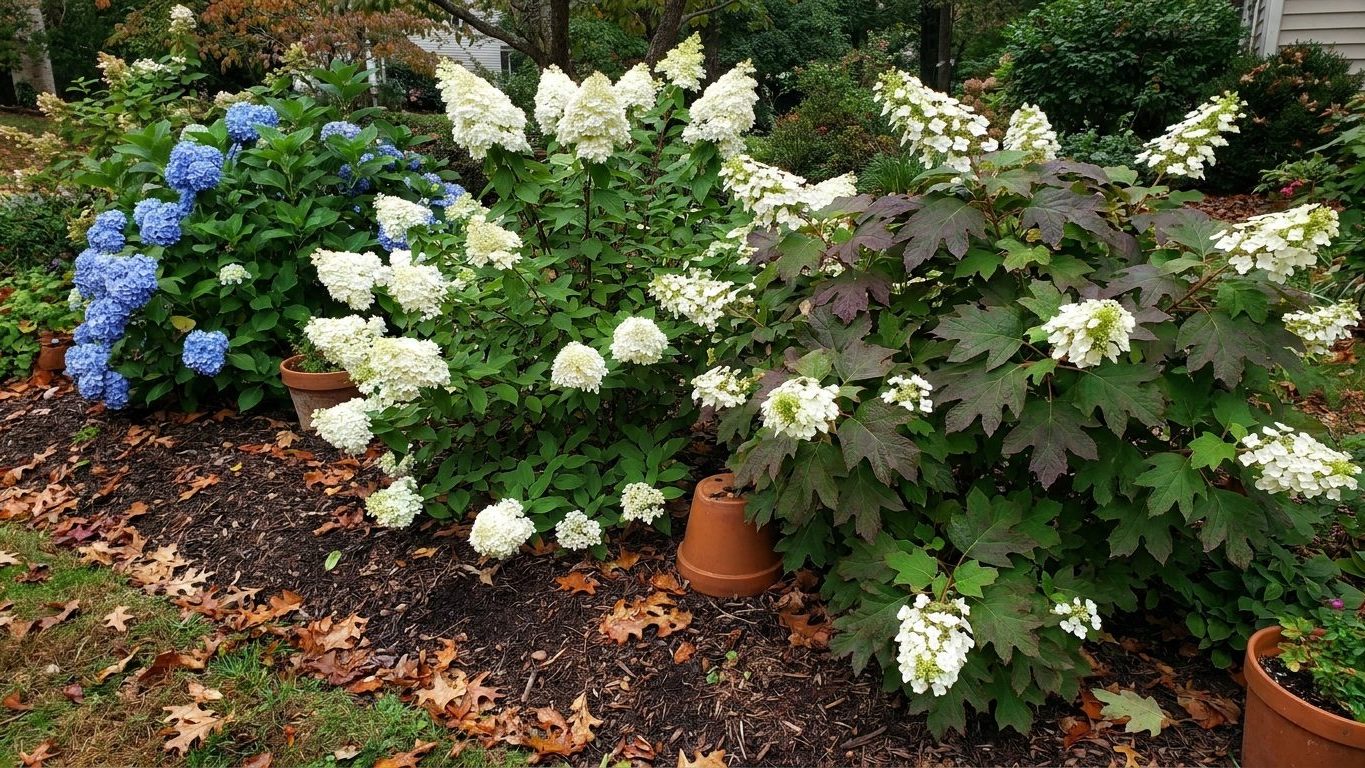
Panicle and smooth hydrangeas are the two safest choices across the province, tolerating winters that push bigleaf hydrangea to the edge of survival. Toronto sits at Canadian hardiness zone 7a, cold enough that old-wood bloomers like bigleaf lose their flower buds in most years unless heavily protected.
Hydrangeas that grow well in Ontario: The Short Answer
Panicle hydrangea

Hydrangea paniculata is the safest bet here. Natural Resources Canada’s Plant Hardiness Site puts Toronto at Canadian zone 7a, and this species blooms on new wood, so a shrub that dies back to the ground still flowers by late summer. It’s the variety most nurseries in the province lead with.
Smooth hydrangea

Hydrangea arborescens, sold widely as ‘Annabelle’, is nearly as forgiving. It also flowers on new wood and tolerates cold well below what Toronto sees in an average winter, though its heavy white blooms can flop after rain without support.
Climbing hydrangea

Hydrangea anomala subsp. petiolaris survives Ontario winters once established, clinging to brick or a sturdy trellis. The catch is patience, since it can take several years to flower, and gardeners who expect quick color often give up before it settles in.
Oakleaf hydrangea

Hydrangea quercifolia brings fall foliage color that panicle and smooth types don’t, but it sits closer to the edge of what this province’s winters allow. A sheltered spot against a south or east wall makes the difference between a shrub that returns and one that doesn’t.
Mountain hydrangea

Hydrangea serrata is a smaller relative of bigleaf hydrangea and shares its habit of setting buds the previous fall. It survives more winters than true bigleaf types but still loses flowers in a hard cold snap, making it a middle-risk choice rather than a dependable one.
Bigleaf hydrangea

Hydrangea macrophylla is the riskiest pick for this province. It sets its flower buds the summer before, and Ontario’s winter lows routinely kill those buds even when the plant itself survives, which is why so many bigleaf shrubs here produce leaves but no blooms.
Ontario — the year and the numbers
- State
- Ontario
- Hardiness zones
- 7a
- Last spring frost
- April 30
- First fall frost
- October 16
- Annual rain
- 31 in
- Lawn zone
- cool-season
- Source
- Environment and Climate Change Canada — Canadian Climate Normals 1981-2010, station TORONTO LESTER B. PEARSON INT'L A · Toronto
How to Work Out the Dates for Your Own Yard
The two mean frost dates for this province are a starting point, not a fixed calendar, and every yard needs its own version of the math.
- Start from the mean last frost: Environment and Climate Change Canada’s Canadian Climate Normals put the average last spring frost at April 30 for the Toronto Lester B. Pearson station, a midpoint that half of all years beat and half don’t.
- Add a buffer before planting anything tender: treat late April through mid-May as the real risk window rather than a single safe date, since new growth on a hydrangea can still burn in a late cold snap.
- Work forward to the fall side: the same normals set the average first fall frost at October 16, marking roughly when active growth stops for the year.
- Test a hardy name against that window: panicle hydrangea flowers on new wood grown entirely within that spring-to-fall stretch, so it fits the gap with room to spare.
- Test a risky name the same way: bigleaf hydrangea sets next year’s buds by late summer, so anything that happens between October and April, including a hard freeze well ahead of that October 16 average, can erase a season of flowers before it starts.
Whichever hydrangea is under consideration, running it through both ends of that window says more about whether it belongs in this yard than any zone number alone.
Ontario North to South: How the Dates Shift
Toronto’s frost dates describe the shoreline, not the whole province, and a few features push those dates earlier or later depending on where a yard sits.
- Northern Ontario (Thunder Bay, Sudbury, Timmins): winters run longer and colder here, so both the safe planting window and the pruning window for tender hydrangeas open weeks later than they do near Lake Ontario.
- Southwestern Ontario (Windsor, London, the Niagara Peninsula): the moderating effect of Lake Erie and Lake Ontario keeps this corner milder, often giving bigleaf hydrangea its best odds anywhere in the province.
- Eastern Ontario (Ottawa, Kingston): further from large lakes, this region sees sharper temperature swings, so a hydrangea that survives near Toronto isn’t guaranteed to survive here without extra shelter.
Anyone gardening outside that immediate shoreline should treat the Toronto dates as a starting range, then adjust using local knowledge of frost pockets and lake effect.
Mistakes Ontario Punishes
Pruning bigleaf in fall
Cutting bigleaf hydrangea back in fall removes the buds it already set for next summer, since this species blooms on old wood. Wait until new leaves appear in spring, then remove only what’s clearly dead, matching the province’s June to July pruning window for bigleaf.
Planting right at spring frost
Setting a new hydrangea in the ground the same week frost typically ends leaves no margin, since Toronto’s April 30 average is a midpoint, not a deadline. Waiting into the planting window’s later months, April, May, August, or September, gives roots time to settle before summer heat.
Leaving stems bare into winter
Cutting a tender hydrangea to the ground before Toronto’s average October 16 frost strips away the insulation last year’s stems provide. Leaving old growth standing over winter and cleaning it up in spring protects buds low on the plant, the same ones a bloom the following year depends on.
Ontario Extension Offices and County Contacts
- Your Ontario calendar page: the month-by-month planting, feeding, and pruning windows built from these same frost dates.
- What goes wrong with hydrangeas here: the pests and cold-damage symptoms specific to this province, and what actually fixes them.
- Ontario Ministry of Agriculture, Food and Rural Affairs: county-level contacts for extension advice.
Common questions
Will bigleaf hydrangea ever reliably bloom in Ontario?
Some years it will, especially in the Niagara Peninsula or right along Lake Ontario, but Toronto’s Canadian zone 7a rating means a hard winter can strip flower buds even on an established plant. Choosing panicle or smooth hydrangea removes that gamble.
What’s the earliest I should plant a new hydrangea?
The planting window for this province lists April as a starting month, but that lines up with Toronto’s average April 30 last frost, so an early April planting still risks a cold snap. Waiting toward May reduces that risk.
Does a warm fall mean I can skip winter protection?
No. The October 16 average first frost is a midpoint, and a mild October doesn’t change how cold January gets. Bigleaf and mountain hydrangea still need mulch or stem protection regardless of how fall behaves.