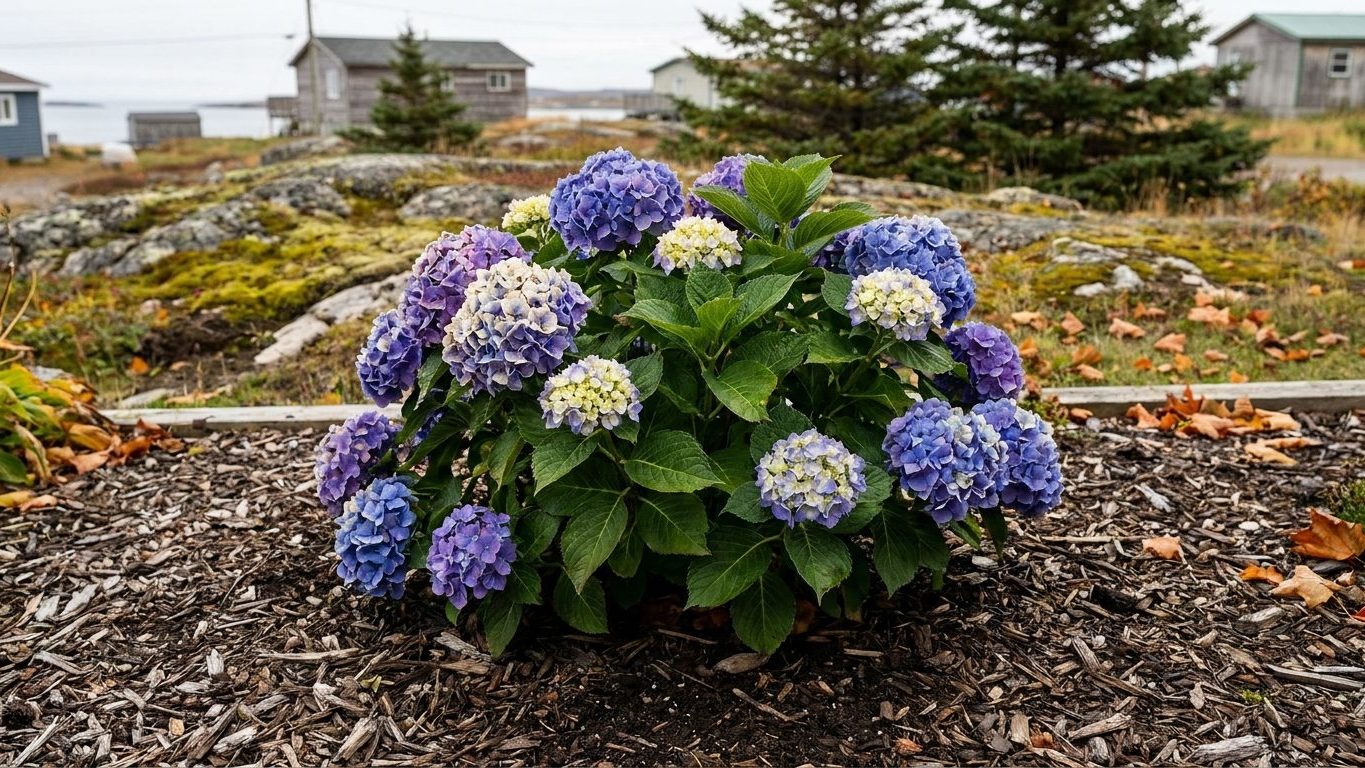
In Nunavut, the honest window to plant hydrangeas runs June through August, with Rankin Inlet as the reference point. Frost breaks around June 19 on average and returns by September 13, so the growing season for anything woody stays short and unforgiving. Pruning bigleaf types, if you attempt them at all, falls in June and July only.
When to prune hydrangeas in Nunavut: The Short Answer
Environment and Climate Change Canada’s Rankin Inlet A normals put the average spring frost at June 19 and the first fall frost at September 13, so this month-by-month list treats those two dates as the pivot for every gesture below.
- January: Ground stays frozen solid across Nunavut, so no planting or pruning gesture applies here. Order stock now if you plan to try a hardy shrub once the short summer arrives.
- February: Frost still holds tight, weeks before the June 19 average breakup. Use the quiet month to research whether any hydrangea can survive zone 0a at all.
- March: Snowpack usually still covers beds this far north. Hold off on any soil work until the ground visibly thaws around you.
- April: The average spring frost remains nearly two months out. Check containers and winter shelters for damage before the short season starts.
- May: The fertilize window opens this month, ahead of frost breaking. Feed only shrubs already established in a sheltered spot, never a new transplant.
- June: Frost breaks on average around June 19, and the plant window opens the same month. Prune bigleaf hydrangeas now too, since this is the first of only two months the calendar allows it.
- July: Planting continues, the second fertilize window opens, and bigleaf pruning finishes this month. This is the busiest stretch of the entire hydrangea year here.
- August: The plant window closes by month’s end. Anything going into the ground this late needs the rest of summer to root before frost returns.
- September: The first fall frost lands on average September 13. Wrap or bring in anything still exposed well before that date arrives.
- October: Frost has already returned across most of the territory. Mulch roots heavily now and stop watering entirely.
- November: Daylight shrinks fast and the ground refreezes for good. There is no gesture left to make outdoors this month.
- December: Dormancy is complete territory-wide. Use the quiet month to plan next year’s sheltered planting spot.
Four months out of twelve carry any real gesture at all, and that scarcity is the actual answer to when to plant hydrangeas in Nunavut, with Rankin Inlet as the benchmark.
Nunavut — the year and the numbers
- State
- Nunavut
- Hardiness zones
- 0a
- Last spring frost
- June 19
- First fall frost
- September 13
- Annual rain
- 12 in
- Lawn zone
- cool-season
- Source
- Environment and Climate Change Canada — Canadian Climate Normals 1981-2010, station RANKIN INLET A · Rankin Inlet
How to Work Out the Dates for Your Own Yard
The average dates only work as a starting point, and translating them onto your own lot takes a few extra steps beyond the calendar table above.
- Find your zone first: Natural Resources Canada rates Rankin Inlet at zone 0a, the coldest classification the country’s plant hardiness system uses, so start every decision from that number.
- Count backward from the mean spring frost: nothing goes into the ground before June 19 on average, and a colder microsite on your own lot can push that later still.
- Check your fall exposure next: work back from the September 13 mean fall frost to see how few weeks a young shrub actually has to root before cold returns.
- Match the shrub to that season length: with barely three months between the two averages, only the hardiest names are worth trying at all in this territory.
- Read your own site, not the average: a spot near open water or against a south wall can run days ahead of Rankin Inlet, while a low or shaded yard runs behind it.
None of these steps replace the calendar table. They just tell you where on that calendar your own yard actually sits, which can shift by more than a week either way.
Nunavut North to South: How the Dates Shift
Nunavut spans three vast administrative regions, and none of them soften the average dates the way lower latitudes do elsewhere.
- Kivalliq (Rankin Inlet, Arviat, Baker Lake): this is the reference region the June 19 and September 13 averages come from, and even here a rough year pushes both dates further from summer.
- Qikiqtaaluk (Iqaluit, Pond Inlet, Cape Dorset): sitting further north and closer to open Arctic water, this region tends to hold onto spring cold longer and see fall cold arrive sooner than Rankin Inlet does.
- Kitikmeot (Cambridge Bay, Gjoa Haven, Kugluktuk): the most continental of the three, with a short, intense thaw that can compress the whole growing window even tighter than the Kivalliq average suggests.
Whichever region you garden in, treat every other part of the territory as running behind, not ahead, of the Rankin Inlet dates carried on the calendar above.
Mistakes Nunavut Punishes
Planting right on the average frost date
June 19 is a mean, not a guarantee, so a shrub planted that exact week can still meet a late frost. Push planting a week or two later into the June through August window, and give it every extra day of soil warmth available.
Choosing a shrub rated for a milder zone
Natural Resources Canada already places Rankin Inlet at zone 0a, the coldest rating the system uses, so a hydrangea bred for a warmer zone has almost no chance outdoors here. Check the varieties page before buying anything for this yard.
Pruning outside June and July
The calendar allows bigleaf pruning only in June and July, and cutting into a shrub before or after that stretch removes wood the plant needs to survive the next freeze. Wait for the window, prune once, then leave the shrub alone.
Nunavut Extension Offices and County Contacts
Rankin Inlet’s frost dates are only a starting point, and questions about your own soil or site need someone who has seen the ground firsthand. Agriculture and Agri-Food Canada keeps a working federal page since the territorial department’s own site cannot always be verified.
- Your state page: the frost dates and the pruning window for Nunavut in one place.
- Which ones hold up here: the varieties worth trying at zone 0a, and the ones to skip entirely.
- What goes wrong here: the pests and problems this territory’s cold actually produces.
Common questions
Can hydrangeas actually survive outdoors in Nunavut?
Zone 0a is the coldest rating in the Canadian hardiness system, and most hydrangea varieties are not built to survive it unprotected. Most growers here treat them as sheltered or container plants brought indoors well before the average September 13 frost.
What is the shortest safe planting window in Nunavut?
The calendar for this territory only opens the plant gesture in June, July, and August, and frost returns on average by September 13. That leaves less than three months of open, workable ground.
Where does the June 19 frost date come from?
It comes from Environment and Climate Change Canada’s Rankin Inlet A station, using the 1981 to 2010 climate normals. It is a mean date, so in about half of all years the real frost falls later than that.