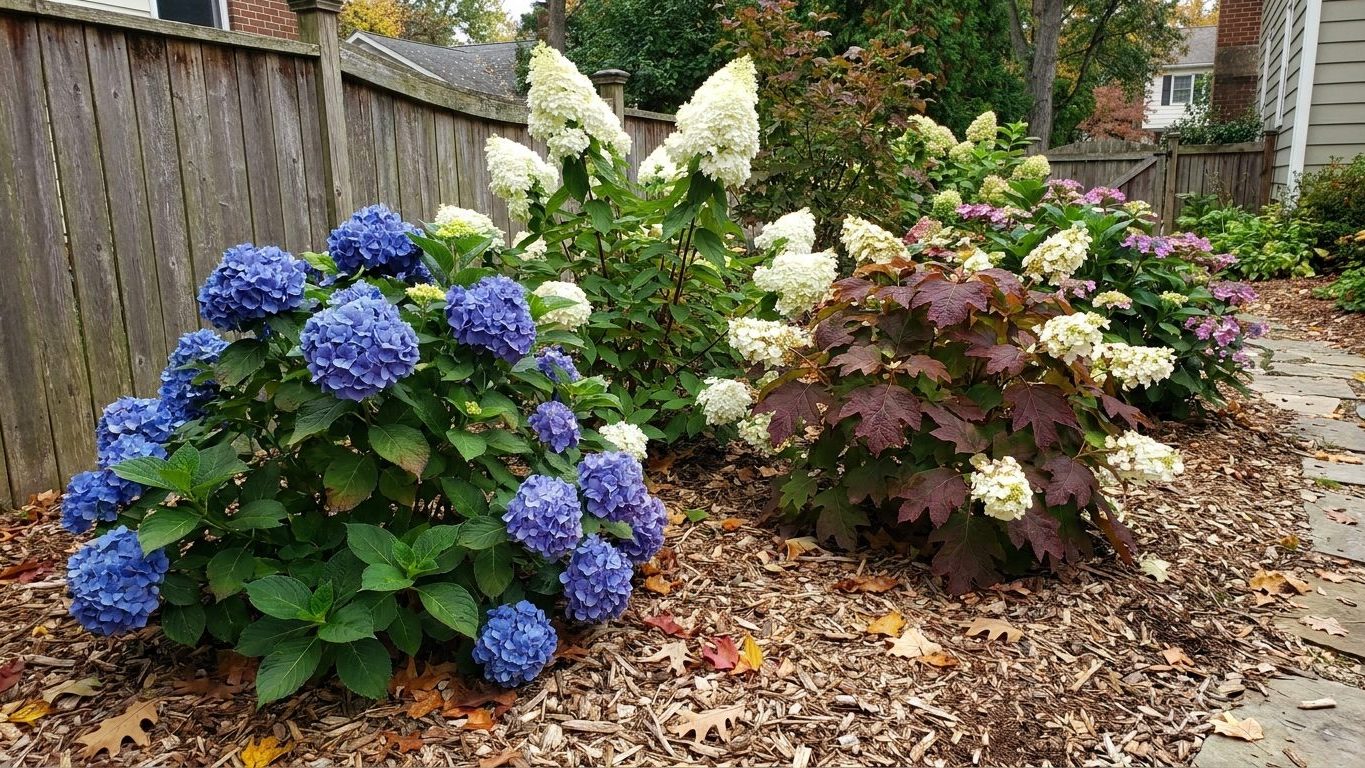
Panicle and smooth hydrangeas are the safest bets across Michigan, hardy enough for the state’s coldest zone and reliable enough to bloom every year because they set their flower buds on new wood. Bigleaf and mountain types can work near Detroit, where winters ease into the state’s mildest zone, but they need a sheltered spot and modest expectations for bloom in most years.
Hydrangeas that grow well in Michigan: The Short Answer
The USDA Plant Hardiness Zone Map puts Michigan anywhere from zone 4a in the Upper Peninsula to zone 6b near Detroit, and that spread decides which hydrangeas actually flower instead of just surviving. A shrub that only needs new wood to bloom shrugs off a Michigan winter, while one that depends on last year’s buds is gambling every season the cold decides to stay hard.
Panicle Hydrangea

Hydrangea paniculata sets its flower buds on new wood each spring, so a hard Michigan winter never touches next summer’s bloom. It tolerates the coldest pockets of the state and asks for little beyond full sun and normal watering. This is the variety most Michigan yards can plant and forget.
Smooth Hydrangea

Hydrangea arborescens, the native behind cultivars like Annabelle, also blooms on new wood and can die back hard some winters without losing next year’s flowers. It handles Michigan clay better than most hydrangeas and takes more shade than panicle types. Winter damage here is cosmetic, not fatal to the bloom.
Climbing Hydrangea

Hydrangea anomala subsp. petiolaris is hardy through the coldest Michigan zones, but it needs two or three seasons just to establish before it climbs or flowers at all. Patience is the real requirement, not cold tolerance. Give it a sturdy wall or trellis and Michigan winters are rarely the problem.
Mountain Hydrangea

Hydrangea serrata is a step down in reliability from the first three because some of its flower buds form on old wood, so a severe winter can trim the bloom without killing the plant. It handles cold slightly better than bigleaf types. In the state’s colder pockets, expect a smaller show most years.
Oakleaf Hydrangea

Hydrangea quercifolia usually survives a Michigan winter at the root, but its stems and the old-wood buds on them often do not, especially away from Detroit’s milder pocket. The plant regrows and the foliage still turns color in fall. Flowers are the part that becomes unreliable north of the state’s warmest zone.
Bigleaf Hydrangea

Hydrangea macrophylla is the riskiest pick statewide because it blooms mostly on old wood, and Michigan’s winter lows routinely kill those buds before they open. Gardeners near Detroit’s mild pocket have the best odds, and even there a hard winter can mean a summer with leaves but no flowers.
Michigan — the year and the numbers
- State
- Michigan
- USDA zones
- 4a-6b
- Last spring frost
- April 30 in the Detroit area; early to mid May across most of the Lower Peninsula
- First fall frost
- October 6 to October 21
- Annual rain
- 34 in
- Lawn zone
- cool-season
- Source
- MSU Extension — Frost-Free Dates · Detroit
How to Work Out the Dates for Your Own Yard
- Find your last spring frost: MSU Extension’s Frost-Free Dates page puts it around April 30 near Detroit and early to mid May across most of the Lower Peninsula, and that week or two of gap changes when it is safe to plant.
- Count back from your first fall frost: the season closes between October 6 and October 21 in zone 6a, so a shrub set out in August has roughly six to ten weeks to root before cold arrives.
- Match your planting to the state’s windows: April, May, August, and September are the months the calendar allows, and picking the one closest to your local frost date beats guessing.
- Prune bigleaf only in June or July: pruning outside that window risks cutting the old-wood buds that carry next year’s bloom, since a Michigan winter has already thinned them once.
- Fertilize on the March, May, and July schedule: feeding later pushes soft new growth that will not harden off before the fall frost window closes.
- Recheck after a rough winter: if bigleaf or mountain hydrangeas show dieback, wait until late May before pruning so live wood is easy to tell from dead.
A panicle hydrangea planted in May shrugs off both ends of that calendar because it flowers on wood it grows the same year. A bigleaf hydrangea planted on the same day is betting its buds survive a winter low the zone map already flags as the risk.
Michigan North to South: How the Dates Shift
Michigan’s own geography moves these dates around more than a single statewide number suggests, since the Great Lakes act like a thermal buffer wrapped around three sides of the state.
- The Upper Peninsula and the far north (Marquette, Sault Ste. Marie, Gaylord): the coldest ground in the state, where the growing season starts later and closes first, favoring panicle and smooth hydrangeas almost exclusively.
- Inland Lower Peninsula away from open water (Lansing, Mount Pleasant): fewer lake effects mean sharper swings between day and night, so frost can linger past the dates that hold near open water.
- The Lake Michigan and Lake Huron shorelines (Traverse City, Grand Haven, Port Huron): the lakes delay both the spring warm-up and the fall cool-down, softening the extremes that damage bigleaf buds.
- Southeast Michigan near Detroit (Detroit, Ann Arbor, Monroe): the state’s mildest pocket, and the closest match to the reference frost dates.
The state guide breaks these zones down further for anyone planting close to a county line.
Mistakes Michigan Punishes
Pruning bigleaf hydrangeas in fall
Cutting back bigleaf or mountain hydrangeas after summer removes the old-wood buds that already survived one winter and were about to carry next year’s flowers. The state’s own calendar reserves June and July for this cut. Wait until then, and only remove wood that stayed bare after new leaves appear elsewhere.
Skipping winter protection on exposed sites
A bigleaf or mountain hydrangea planted against a north or west wall takes the full force of wind that drops effective temperatures well below the zone map’s number. Mound mulch over the crown before the ground freezes and choose a spot with a building or fence between the shrub and prevailing wind.
Fertilizing past midsummer
Feeding a hydrangea in August or later, outside the March, May, and July windows, pushes tender new growth that has no time to harden before the first fall frost arrives in early to mid October. That soft growth dies back and takes some of next year’s buds with it. Stop feeding after July.
Michigan Extension Offices and County Contacts
The state’s 4a to 6b range is a starting point, not a verdict for your specific yard, and county-level detail fills in the rest. Michigan State University Extension keeps that detail current for growers across the state.
- Your state page: the frost dates and the pruning window for wherever you live in Michigan.
- The bloom calendar: the month-by-month schedule for planting, fertilizing, and pruning hydrangeas here.
- What goes wrong here: the pests and problems that actually show up on Michigan hydrangeas, and what fixes them.
Find your county’s office through Michigan State University Extension before deciding which of these varieties goes in the ground next.
Common questions
Can bigleaf hydrangeas survive Michigan winters?
Root systems usually survive down to the state’s coldest zone, but the old-wood flower buds that give bigleaf hydrangeas their color often do not, especially away from the milder ground near Detroit. Expect a shrub that lives but skips blooming in some years.
What is the best hydrangea for a Michigan yard that gets full winter wind?
Panicle or smooth hydrangeas handle wind and cold together better than any other type sold in Michigan, because they rebuild their flower buds from new wood every spring regardless of what the winter did to the stems above ground.
Do hydrangeas need winter protection in Michigan?
Panicle and smooth types rarely need it. Bigleaf, mountain, and oakleaf hydrangeas benefit from mulch mounded over the crown before the ground freezes, particularly north of the Detroit area where the zone map already shows a colder low.