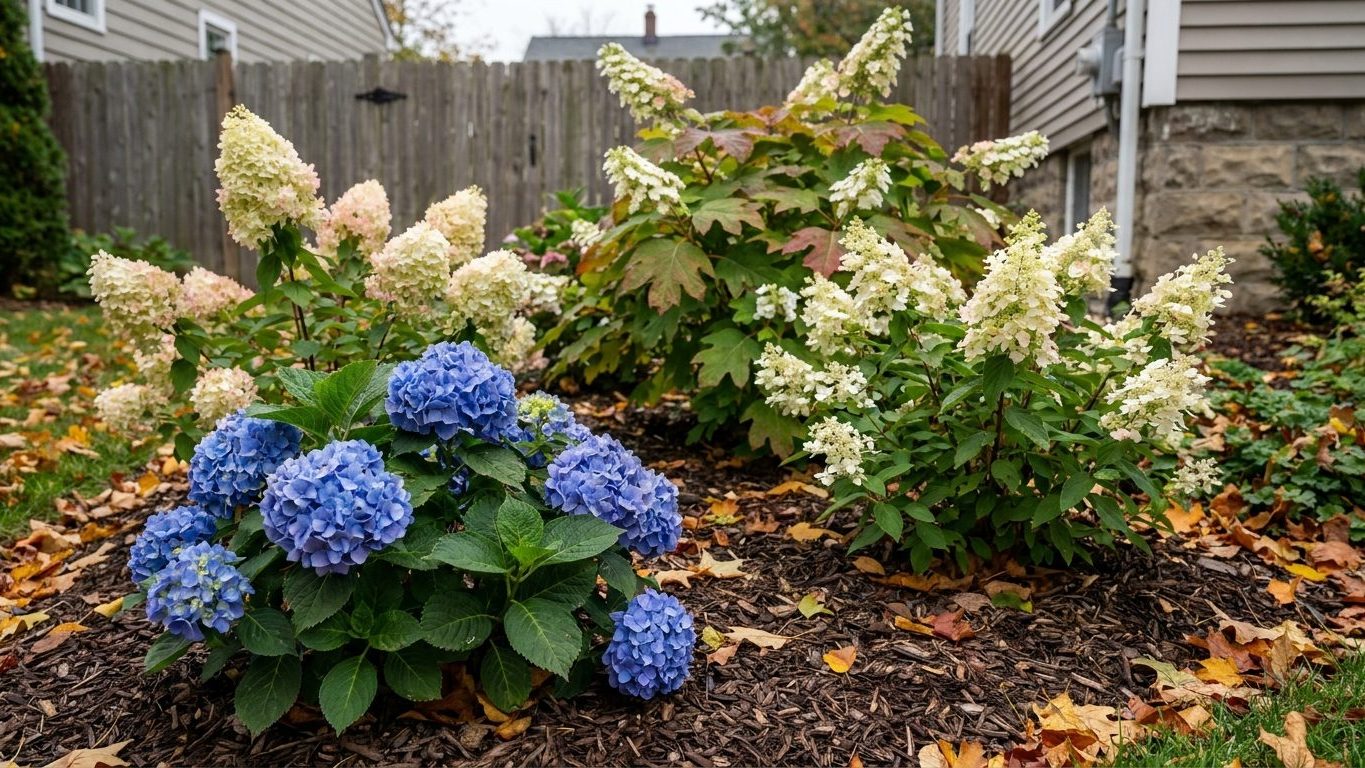
Panicle and smooth hydrangeas grow most reliably across Illinois, from Chicago’s lakefront yards down to the farm country near Springfield. Both bloom on new wood, so a rough winter never erases the flower show the way it does with other types. Bigleaf hydrangea struggles through most of the state and needs a sheltered, protected spot to set buds that actually survive to spring.
Hydrangeas that grow well in Illinois: The Short Answer
Six species cover nearly every yard in the state, and the order below runs from the one that almost never disappoints to the one that breaks the most hearts near Chicago.
Smooth hydrangea

Hydrangea arborescens is native to the eastern United States and shrugs off an Illinois winter without any wrapping or mulch. It flowers on new wood, so even a stem that dies back to the ground still produces a full round of blooms that same summer. This is the safest starting point for a first-time grower anywhere in the state.
Panicle hydrangea

Hydrangea paniculata handles the cold near the lake and the humid summers farther south with the same ease. Like the smooth type, it sets flowers on new growth, so a late frost or a hard prune rarely costs a season of color. Full sun brings the largest flower heads and the sturdiest stems that hold up in wind.
Oakleaf hydrangea

Hydrangea quercifolia adds fall color and peeling bark that neither smooth nor panicle types offer. It performs well through the southern half of the state but can lose its flower buds to a harsh late freeze in the counties closest to Chicago. A spot against a wall or fence on the north side of the house buys it a little extra protection.
Climbing hydrangea

Hydrangea anomala subsp. petiolaris is slow to settle in and can take a few seasons before it flowers at all. Once it roots, it climbs brick or a sturdy trellis and tolerates the state’s cold with little complaint. Patience matters more than skill with this one.
Mountain hydrangea

Hydrangea serrata flowers on both old and new wood, which gives it a second chance after a rough winter wipes out the first round of buds. It stays smaller than bigleaf hydrangea and fits a tighter city lot better. A ring of mulch around the base still helps in the coldest corners of Illinois.
Bigleaf hydrangea

Hydrangea macrophylla is the riskiest pick here. The USDA Plant Hardiness Zone Map puts Illinois at 5a to 7b, and its flower buds form the previous fall, rarely surviving an open winter this far north. Growers who insist on it wrap the shrub in burlap or grow it in a container that comes indoors.
Illinois — the year and the numbers
- State
- Illinois
- USDA zones
- 5a-7b
- Last spring frost
- April 11 to April 22
- First fall frost
- October 24 to November 3
- Annual rain
- 38 in
- Lawn zone
- cool-season
- Source
- NOAA NCEI 1991-2020 Climate Normals, 32F freeze probabilities · Chicago
How to Work Out the Dates for Your Own Yard
Working out your own planting and pruning dates starts with the frost window for your county, not the calendar page taped to the shed.
- Find your local frost window: NOAA NCEI 1991-2020 Climate Normals puts the last spring frost near Chicago between April 11 and April 22, and county lines farther from the lake often push that later by a week or two.
- Plant only inside the state’s window: Illinois planting runs April, May, August, and September, so hold off setting a new hydrangea until spring frost risk has passed near that April date.
- Feed on the three-month schedule: fertilize in March, May, and July, timing the first round to new growth rather than to a fixed calendar date.
- Prune bigleaf hydrangeas in early summer only: June and July are the only safe months, since cutting earlier removes the buds the shrub already set the year before.
- Watch the fall date to protect what you planted: the first fall frost lands between October 24 and November 3 near Chicago, and mulch should go down before that date arrives.
A panicle hydrangea planted in that April window sails through both ends of this schedule, since its buds form after the last frost and never face the winter cold at all. A bigleaf hydrangea planted the same week spends the whole season racing the October frost date to harden its wood, and most years it loses that race.
Illinois North to South: How the Dates Shift
Illinois stretches a long way from the Wisconsin line to the Ohio River, and that distance alone shifts every date on the schedule above.
- Northern Illinois near Lake Michigan (Cook, Lake, DuPage counties): the lake holds spring back a little and pushes fall later along the immediate shoreline, which can help bigleaf hydrangea just enough to matter.
- Central Illinois (Springfield, Bloomington, the flat prairie counties): frost arrives close to the reference-city numbers above, with little buffer from wind or open water either way.
- Southern Illinois (Cairo, Carbondale, the Shawnee Hills): frost eases off earliest in spring and holds off longest in fall, giving bigleaf hydrangea its best shot anywhere in the state.
Whichever part of the state you garden in, the Illinois hydrangea calendar is the starting point, not the final word for your particular yard.
Mistakes Illinois Punishes
Pruning bigleaf hydrangea in fall
Cutting stems back in September or October removes the flower buds already formed for next summer, since bigleaf sets its buds the year before it blooms. Prune only in June or July, the window the state calendar allows, and skip the fall cleanup on this one shrub.
Planting too close to the first fall frost
NOAA NCEI 1991-2020 Climate Normals puts the first fall frost near Chicago between October 24 and November 3, and a hydrangea set out in late September has only a few weeks to root in before then. Move fall planting earlier in that window or wait for spring instead.
Leaving bigleaf hydrangea unwrapped over winter
An open winter with no snow cover or burlap kills the buds on bigleaf hydrangea across most of the state’s 5a to 7b range, leaving a shrub that leafs out but never flowers. Wrap the base in burlap or plant panicle or smooth hydrangea instead.
Illinois Extension Offices and County Contacts
The frost dates and zone range above come from one weather station and one statewide map. Your county office and the pages below fill in what actually changes on your block.
- Illinois hydrangea guide: the state page with the full-year overview and hardiness range for the whole territory.
- Illinois hydrangea calendar: month-by-month planting, fertilizing, and pruning dates measured against the frost windows above.
- University of Illinois Extension: county-by-county contacts for soil tests and site-specific advice.
Common questions
Do hydrangeas bloom every year in Illinois?
Panicle and smooth hydrangeas bloom on new wood, so they flower reliably every summer regardless of how hard the previous winter hit. Bigleaf hydrangea sets its buds the fall before, so a cold, open winter near Chicago can mean a shrub full of leaves and no flowers at all.
What is the best hydrangea for Chicago-area yards?
Panicle hydrangea handles the cold closest to the lake with the least fuss, and smooth hydrangea runs a close second for anyone who wants a native option. Both tolerate the reference city’s frost window without any wrapping or special siting.
Can bigleaf hydrangea grow in Illinois at all?
It can, mostly in the southern counties where the growing season runs a little longer and winters open up a bit less harshly. Farther north, it needs a sheltered spot, a burlap wrap, or a container that comes indoors for winter to have a real shot at blooming.