Skip to content

When Do Peonies Bloom in Alberta?

When Do Peonies Bloom in Alberta?

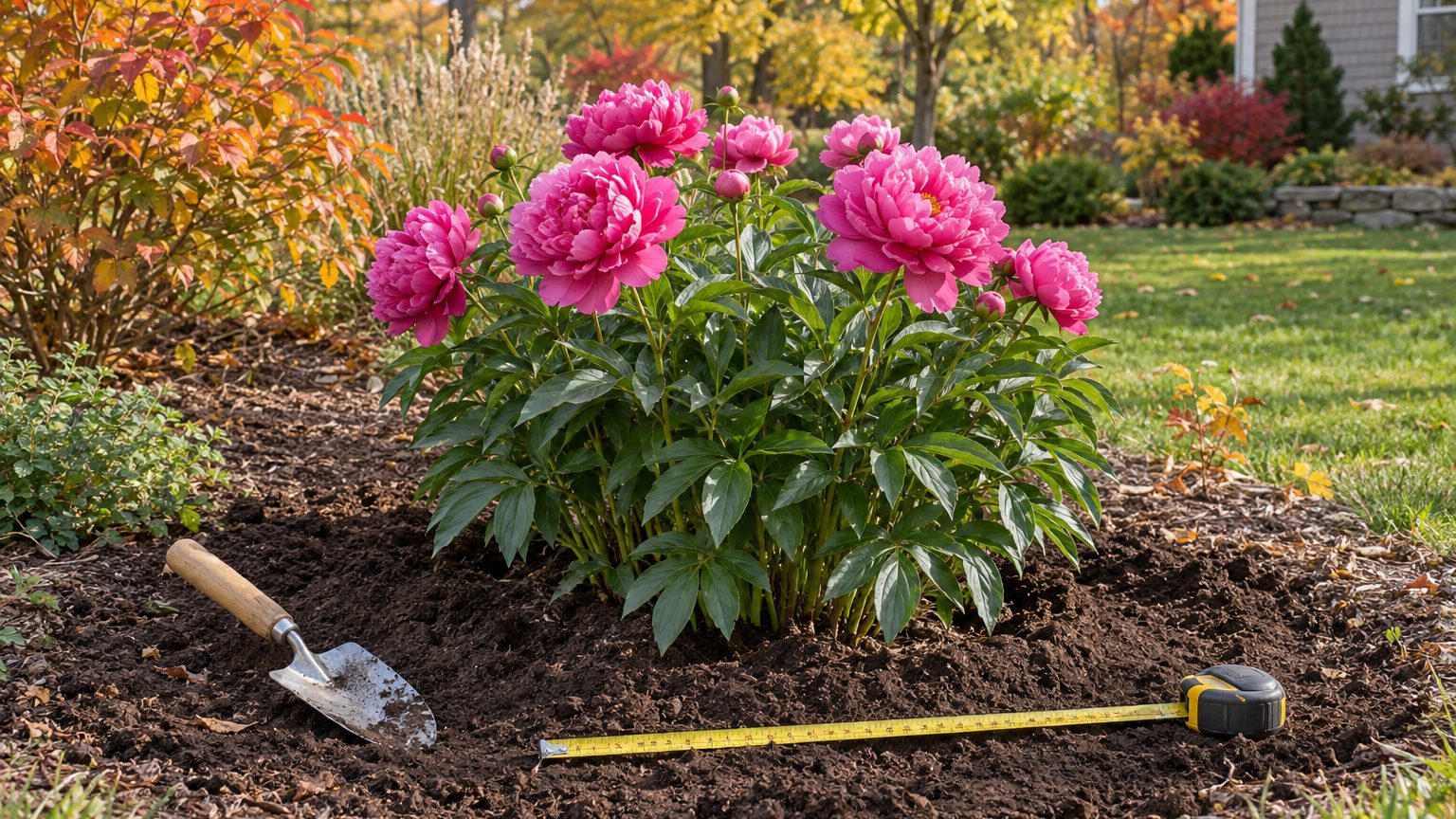
Red shoots push through cold Alberta soil long before a single bud shows, and the wait for flowers can feel long. Peonies here open in June, with some carrying on into early July. Because Alberta has no local extension page on peony timing, these dates follow the nearest comparable climate; confirm local timing with a local garden centre, a garden society or a provincial gardening group.

When Do Peonies Bloom in Alberta?

When Do Peonies Bloom in Alberta?

Peonies bloom in Alberta in June, and the season can stretch into early July. Cold winters do the groundwork, because a peony needs a long winter rest to set flowers, and Alberta delivers that rest reliably. Calgary sits in Canadian hardiness zone 4a, a system separate from the USDA zones.

Type of peony When it blooms in Alberta What to know
Herbaceous (garden) peony Early June into early July Dies back to the ground each fall and sends up new growth in spring

Itoh peonies, a cross between garden and tree peonies, die back each fall and are grown the same way as herbaceous ones, which makes them an easy choice. Tree peonies keep their woody stems through winter, so they need different handling in autumn. A newly planted or transplanted peony may not bloom in its first spring, so healthy foliage without flowers is normal.

How to Tell When Your Peonies Are About to Bloom

The plant announces its schedule well ahead of the flowers, and a quick walk past the bed tells you where things stand.

  • Red, pointed shoots breaking the soil mean the plant has woken up, so clear any leftover mulch from the crowns.
  • Shoots that darken after a cold night were caught by frost, and Calgary’s average last spring frost of May 21 is only a midpoint, since in one year out of two the frost lands later.
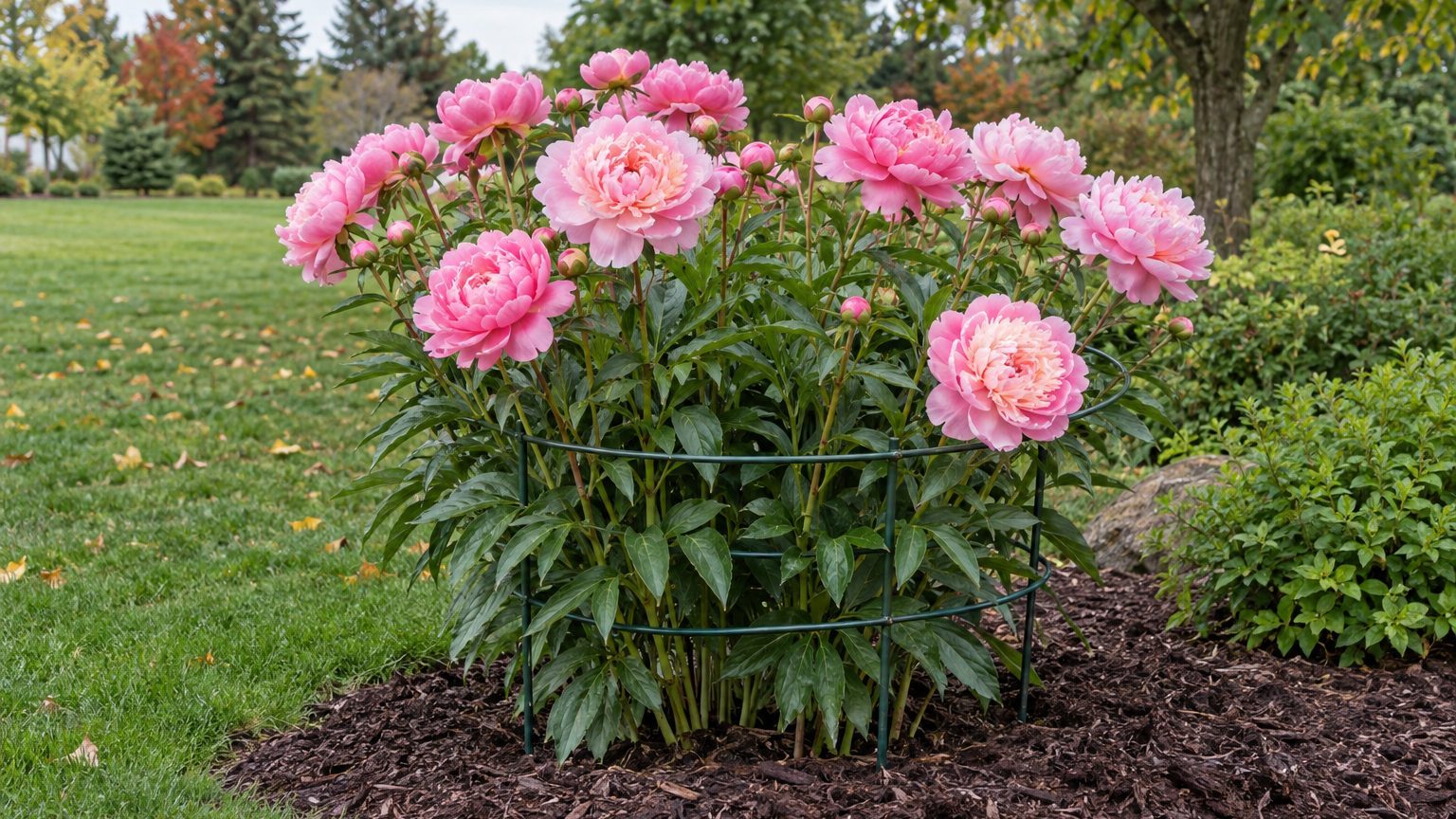
  • Stems that rise and fill with leaves tell you the plant is putting energy into growth, so this is the time for a stake or a support ring.
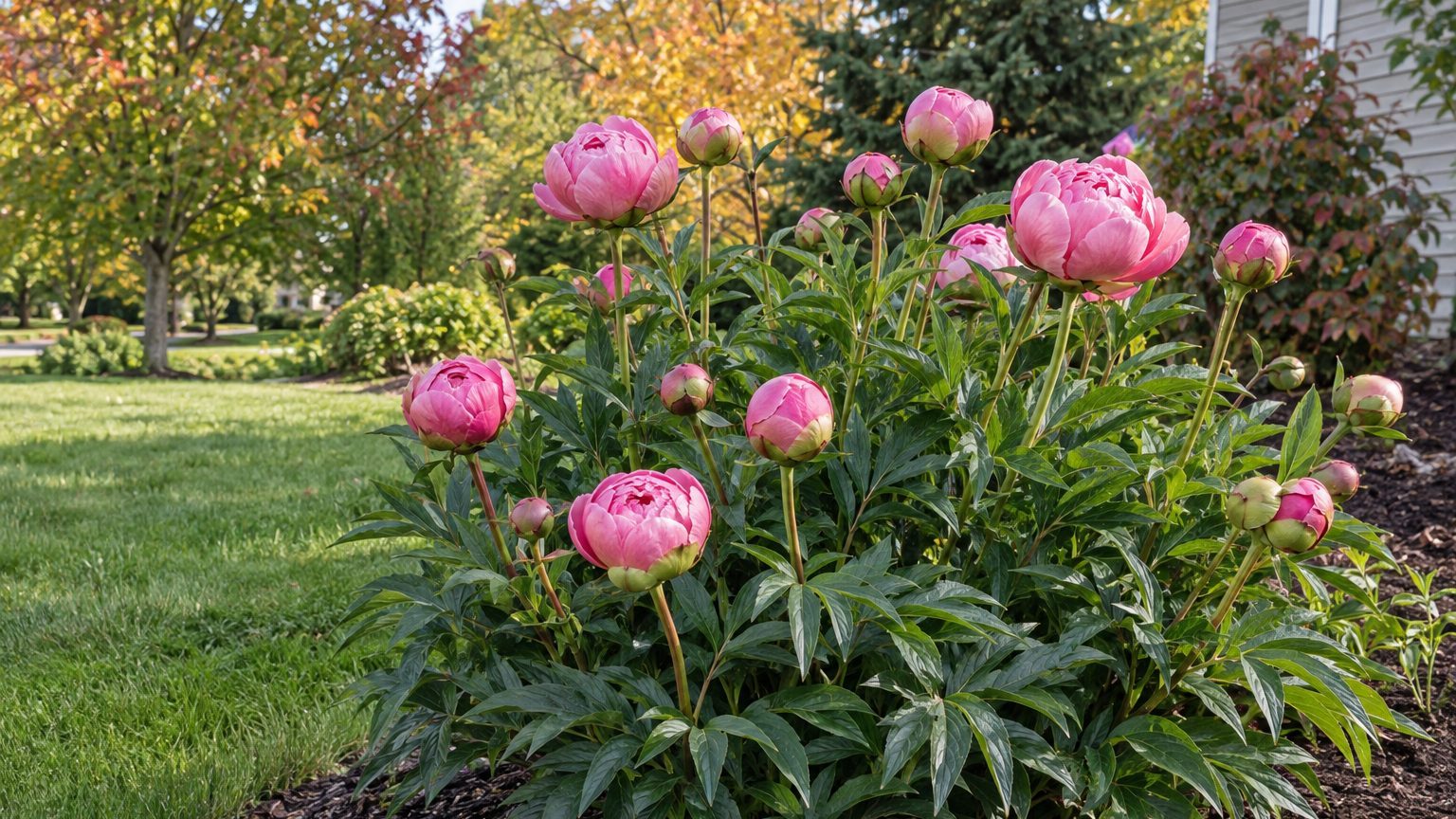
  • Small, hard buds the size of a pea show that the flowers are formed but still far from opening.
  • Buds that swell, lose their hardness and feel soft when pressed gently are close to opening, and color usually shows at the tip.
  • Petals that start to loosen from the bud mean the flower will open soon, which is when cutting for a vase works well.

Watching the buds beats watching the calendar, because a cool spring can hold them back for a while.

When to Cut Back Peonies in Alberta

In Alberta, cut herbaceous peonies back in October or November, after a hard freeze has killed the foliage. Cutting while leaves are still green robs the roots of energy they are still storing. Wait for the blackened, flopped-over look, then cut the stems to within a couple of inches of the ground.

Bag the cut stems and leaves and send them out with the trash, not to the compost pile. Peony foliage can carry disease that overwinters in the debris and returns the next spring. Deadheading spent flowers right after bloom keeps the plant tidy through summer.

Tree peonies are the exception. Their woody stems are permanent, so leave them standing and remove only dead or damaged wood.

How Peony Bloom Time Shifts Across Alberta

Alberta stretches a long way from south to north and climbs from prairie to mountain, so the same variety opens at different times depending on where it grows.

  • Calgary and the foothills: districts closer to the mountains, where the ground stays cold longer, run a little behind Calgary.

A peony in a sunny spot against a south-facing wall will also open before one on a cold, shaded side of the same yard.

Where to Get Peony Advice in Alberta

Questions about peony timing can go to the province and to local growers. Alberta Agriculture and Irrigation publishes gardening information for the province.

  • Local garden centres know which varieties are doing well in your district, and spring is a good time to ask while potted peonies are on the shelves.
  • Garden societies and master gardener groups hold plant sales and meetings where long-time growers share what blooms when in your area, so check their calendars before autumn planting.

Common Questions

When Should You Plant or Divide Peonies in Alberta?

September to early October is the window, so the roots settle in before the ground freezes. Bare-root peonies are sold in fall, and potted plants appear at garden centres in spring. Spring planting works with potted plants, but fall planting gives roots the head start.

Why Is a Peony Not Blooming in Alberta?

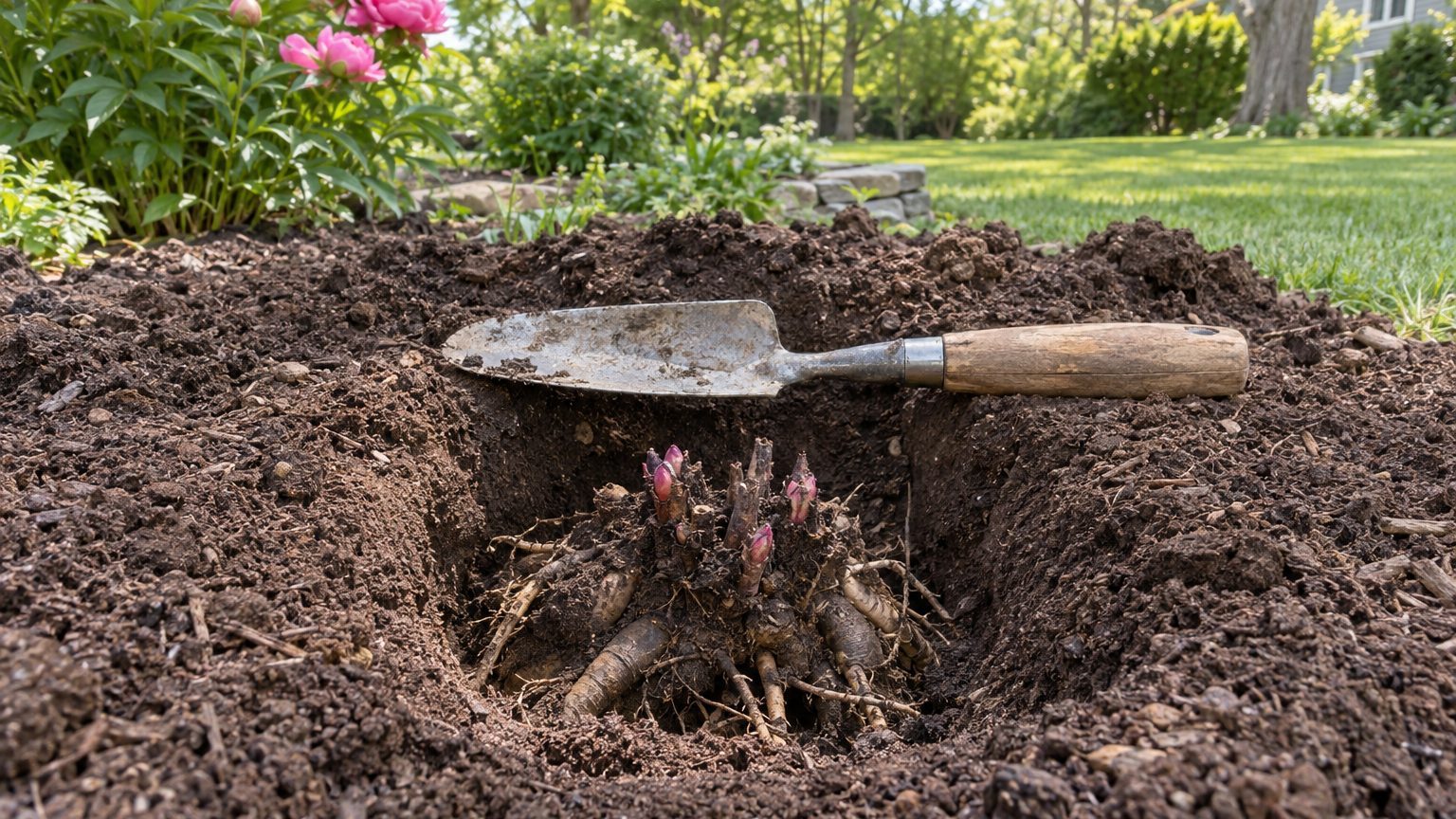
A plant with healthy leaves but no buds is often planted too deep, so check whether the pink buds on the crown sit near the soil surface. A peony that came up well but stayed bud-free in its first season is likely just settling in. Persistent deep planting is worth fixing by lifting and replanting in fall.

Do Tree Peonies Survive Alberta Winters?

Tree peonies are generally less hardy than herbaceous types, so they need a protected site or a layer of mulch over winter. A spot sheltered from wind, near a fence or the house, helps the woody stems get through. Herbaceous and Itoh peonies are the easier choice if you want little winter fuss.
When Do Peonies Bloom in Alaska?

When Do Peonies Bloom in Alaska?

Peony buds in most American yards open in late spring, but in Alaska the show moves to the height of summer. Cold ground holds the plants back, and long daylight then pushes them quickly once growth starts. Here is when the flowers open across the state, and what to watch for as they get close.

When Do Peonies Bloom in Alaska?

When Do Peonies Bloom in Alaska?

Peonies bloom in Alaska in July and August, and some plants open as early as June. That is later than elsewhere in North America, which is why Alaska-grown peonies reach the market when most other growers are finished.

The type you plant moves the date within that stretch. Cold winters suit peonies well, since they need a cold rest to flower, and most of Alaska delivers it generously.

Type of peony When it blooms in Alaska What to know
Herbaceous, early June to July The earliest part of Alaska’s bloom window
Herbaceous, main season July to August The usual window for garden peonies in the state
Herbaceous, late August Extends the show after the main flush fades

Ask a local garden center before choosing a tree peony or Itoh hybrid for an Alaska garden. A tree peony keeps its woody stems through winter, which matters in a state where cold can reach the buds. A newly planted or transplanted peony may not bloom the first spring.

How to Tell When Your Peonies Are About to Bloom

The plant shows that flowers are on the way, so a quick walk past the bed can be useful.

  • Red shoots pushing up through the soil in spring mean the plant has woken, and the bloom clock has started.
  • Shoots that darken to green and unfold into leaves show the stems are building the strength to carry flowers.
  • Small round buds at the stem tips show where flowers may open.
  • Buds that swell and grow plump are close, so stake or ring the clump before heavy blooms bend the stems.
  • Buds that swell and soften are close to opening.
  • A plant that grows leaves but does not flower may be planted too deep, since the eyes belong near the soil surface.

When to Cut Back Peonies in Alaska

Cut herbaceous peonies back in fall after a hard frost has blackened the foliage. Alaska has no local extension page on pruning peonies, so ask a local garden center or gardening group about local details.

Use clean pruners and cut the stems down close to the ground, leaving only a short stub above the soil. Remove cut foliage from the bed; if it shows disease, put it in the trash rather than composting it.

Tree peonies are the exception. Their woody stems are permanent, so leave them standing and only snip off anything dead or broken. Cutting a tree peony to the ground removes the wood that carries next summer’s flowers.

How Peony Bloom Time Shifts Across Alaska

Alaska is huge, and its growing seasons differ a great deal from one region to the next. The direction of the shift is clear even where exact dates are not.

  • Anchorage: This is one of the milder inhabited parts of the state, but bloom timing still depends on conditions in your own yard.
  • Fairbanks and the Interior: Summers are shorter than in Anchorage, but the Georgeson collection typically blooms from late June through the end of July. Long summer daylight helps the plants make up lost time.

Where to Get Peony Advice in Alaska

Alaska’s growing conditions are unusual enough that local advice pays off. People who garden in your valley or town can help match peony varieties and planting dates to local conditions.

  • The University of Alaska Fairbanks Cooperative Extension Service offers guides on growing peonies and other perennials, and its pages are worth reading in winter before ordering plants.
  • Your local extension office can answer questions about your soil and microclimate, so call in late summer, before fall planting in September.

Common Questions

Can You Plant a Peony in Fall in Alaska?

Yes, September is the month to plant or divide peonies, while the ground is still workable. The roots then settle in before the soil freezes. Set the eyes near the surface, since a peony planted too deep may bloom poorly or fail to come up.

Why Do Alaska Peonies Bloom Later than Peonies in Other States?

Cold soil and a short season hold growth back in spring, so the flowers open in July and August. The plants still get the cold winter rest they need, and the long summer daylight helps them catch up once they start.

Are Peonies Hardy Enough for Alaska?

Peonies are a good fit for much of the state, since they need cold winters to flower well. The USDA hardiness zones across Alaska run from 1a to 8a, so check the zone for your own town before choosing a plant, especially for tree peonies.

When Do Peonies Bloom in Alabama?

When Do Peonies Bloom in Alabama?

Peony buds swelling on a warm spring day are a clear sign that the garden has turned the corner. In Alabama, those blooms open in April and May, with a few early varieties showing color as soon as March.

When Do Peonies Bloom in Alabama?

When Do Peonies Bloom in Alabama?

Peonies bloom in Alabama in April and May, and early-blooming cultivars can open as soon as March. Early types matter in the South because they finish before hot weather sets in, and they are also less prone to botrytis blight.

Type of peony When it blooms in Alabama What to know
Early-blooming herbaceous As early as March Flowers open before the heat arrives and face less botrytis blight
Single and Japanese herbaceous April and May Usually perform much better in the South than the doubles do
Double herbaceous April and May, as late as May Often struggle in the lower South, where winters are too mild

Alabama gardens span USDA zones 7a to 9a, but that range describes extreme winter lows rather than the winter chilling peonies need. They need a cold winter rest to flower, so they may bloom poorly in mild-winter climates. A peony planted too deep can also bloom poorly or fail to come up, so keep the eyes near the soil surface. And a newly planted or transplanted peony may not bloom the first spring.

How to Tell When Your Peonies Are About to Bloom

The plant itself gives plenty of warning, and watching for these changes lets you plan around the flowers instead of guessing.

  • Red shoots pushing out of the soil in late winter mean the plant has come out of its cold rest and growth has begun.
  • Small round buds at the tips of the stems mean the plant is putting its energy into flowers rather than leaves.
  • Buds that begin to swell are getting close, so this is the time to put stakes or cages in place before the stems get heavy.
  • Buds that feel soft when you squeeze them gently are ready to open, often soon after warm weather arrives.
  • Buds that stay small, hard and brown, or blacken before opening, point to botrytis blight, which is more common when spring turns warm and damp.

Early-blooming varieties will show all of these signs ahead of the rest, so a garden with mixed types gives you a longer show.

When to Cut Back Peonies in Alabama

Cut back herbaceous peonies in November, after a frost has killed the foliage. If the season runs a little early or late, October and December also work, as long as frost has already done its job.

Cut the dead stems down to the soil surface, and keep the cut clean so no stubs are left to collect moisture. Bag up the foliage and throw it away rather than composting it, because leftover leaves can carry fungal problems such as botrytis into the next spring.

Tree peonies are different. They keep their woody stems through winter and are never cut to the ground, so leave them standing.

How Peony Bloom Time Shifts Across Alabama

Alabama stretches from the cooler hills of the north to the warm Gulf coast, and the flowers follow that gradient.

  • North Alabama and the Tennessee Valley: Winters are colder here, so peonies get the chill they need and bloom more reliably, usually in April and May.
  • Birmingham and central Alabama: Peonies can do well, but early-blooming singles and Japanese types are the safer bet and often open earlier in spring.
  • Mobile and the Gulf Coast: Mild winters often leave too little chilling, so peonies here may flower poorly or not at all.

Because bloom time follows the local winter, a garden at higher elevation will generally open later than one in a warm, sheltered spot farther south.

Where to Get Peony Advice in Alabama

Local conditions vary a lot from county to county, so it helps to ask someone who knows your soil and climate. Alabama Cooperative Extension System offers research-based guidance, and your county office can answer questions specific to your yard.

  • The extension website has plant guides on varieties, planting depth and disease, and these are worth reading before you order roots.
  • Your county extension office can help with peonies that fail to bloom, and fall is a good time to call, since planting and dividing happen in late September or October.

Common Questions

Can You Grow Peonies in South Alabama?

It is difficult. Peonies often do not perform well in the lower South because winters do not give them enough chilling. If you want to try, choose early-blooming, single or Japanese types, which handle Southern conditions better.

When Should You Plant or Divide Peonies in Alabama?

Late September or October is the time. The roots then have the cool season to settle in before spring growth begins, and planting shallow keeps the eyes near the surface where they belong.

Why Did My Peonies Bloom Only Briefly?

Hot spells shorten the show, particularly for late bloomers. Early-blooming varieties open before the heat and tend to last better in Alabama springs.

How Much Water Do Peonies Need?

How Much Water Do Peonies Need?

Tall stems and swelling buds in spring are the moment a peony starts drawing hard on the soil. A deep soaking helps it more than a light sprinkle. The rest of the year, the ground around it should drain freely. How much water that means depends on your climate and on the kind of peony.

How Much Water Do Peonies Need?

In Washington, tree peonies should be watered deeply when the soil is dry below the surface. In South Dakota, peonies benefit from regular watering in spring while they grow and form blooms.

Climate and type change the answer. A garden peony in a hot, dry region needs the hose more often than one in a rainy region, and tree peonies and potted peonies follow habits of their own. Sandy soil empties faster than loam, so the same plant can need different care in neighboring yards.

Use the state selector below to find the watering calendar for your state.

How to Water Peonies

How Much Water Do Peonies Need?

A new peony and an established one share most of the routine, and the steps run from the planting spot to the changing seasons.

  1. In Virginia, avoid sites where water pools; in Washington, keep peonies away from automatic sprinklers that leave soil constantly moist.
  2. In Illinois, water at least once per week during most of fall if it does not rain.
  3. Check the soil with a finger or trowel before every watering, because the top can look dry while the root zone is still damp. In Washington, soil can be dry on top and still moist 6-12″ below the surface.
  4. In Iowa, soak the soil to a depth of 12 inches.
  5. In Virginia, irrigate overhead in the morning and avoid late-afternoon or evening watering when possible.
  6. Give peonies a liberal supply while the stems grow and the buds open, then go back to waiting for dry soil, so that the plant gets what it needs without sitting in wet ground. In Kansas, give peonies plenty of water during spring growth and especially while they are in bloom.

Amounts differ from place to place, so treat them as guides. In South Carolina, the advice is to water thoroughly and deeply once every 10 to 14 days. In Utah, growers apply 1 to 2 inches per irrigation. Either way, the finger test in the soil has the last word.

Watering Needs by Peony Type

Garden peonies, tree peonies and peonies in pots do not drink the same way. The difference comes down to when the soil should be allowed to dry and how much the leaves and roots tolerate being wet.

Local advice shows the contrast clearly, and each row reflects guidance written for the place named.

Peony Type What changes Why it matters
Garden peony Regular watering through spring growth and bloom Stems are growing and buds are forming (South Dakota, Kansas)
Tree peony Wait until the soil is dry below the surface, and skip watering if it still holds moisture Wet leaves invite fungus (Washington)
Peony in a container Avoid wet roots in winter and irrigate in the morning Dormant roots rot more readily, and late irrigation leaves foliage damp (Virginia)

Peonies grown for cut flowers in a high tunnel get 1 to 2 inches per irrigation in Utah. Cut stems kept in water or a fresh-keeping liquid should stay there only for a short period.

Peony Watering Mistakes to Avoid

Sprinkling Over the Leaves

Sprinkling Over the Leaves — How Much Water Do Peonies Need?

In Ohio, avoiding overhead irrigation may help suppress disease. In Ohio, avoid overhead irrigation and use drip irrigation if available.

In Virginia, run overhead irrigation in the morning if it cannot be avoided. Better still, use drip irrigation if available.

Light Daily Sips

Light Daily Sips — How Much Water Do Peonies Need?

A quick splash wets only the top of the soil, which looks damp while the roots below stay thirsty. It also keeps the surface wet in a way that does the plant no favors.

Wait until the soil is dry below the surface, then soak deeply. In Washington, gardeners are told that soil dry for the first 4-6″ plus slightly drooping leaves means it is time to water the roots deeply.

Watering Dormant Plants

A peony cut back for winter looks like it has nothing going on, but the roots are still there and they hate sitting in cold, soggy ground. In Virginia, dormant peonies are more prone to root rots when their roots stay wet.

In Virginia, avoid leaving dormant peonies with wet roots in winter, and make sure water can drain away.

How Often to Water Peonies in Your State

In Washington, water deeply when the soil is dry below the first 4-6″ and the leaves droop slightly. Water when the soil is dry below the surface, and do not water if the soil has moisture.

  • The page for your state gives the months when peonies need the most attention where you live, so open it before the spring growth begins.
  • Keep checking the soil, since the state page sets the months and conditions in the bed determine the day.

Common Questions

Why Do Peony Leaves Droop in Early Spring?

Droopy leaves on the first warm days often come from an imbalance between the root system and the new leaf growth, not from thirst. This pattern is described for Washington. Dig a finger in: if the soil below the surface is moist, hold off on the hose, and if it is dry down deep, water slowly.

Can Peonies Grow in Heavy Clay?

Heavy clay is a poor choice for peonies. In Connecticut, roots can rot quickly in poorly drained soil. In Indiana, the site must drain well while still holding some moisture, so a loose, well-drained bed beats a soggy one.

Can You Keep Cut Peonies in Water?

Cut stems can stand in water or a fresh-keeping liquid, but wet storage works only for a short period. Once the blooms open, enjoy them in the vase and do not count on them lasting long in storage.

Types of Peonies Compared: Herbaceous, Tree and Itoh

Types of Peonies Compared: Herbaceous, Tree and Itoh

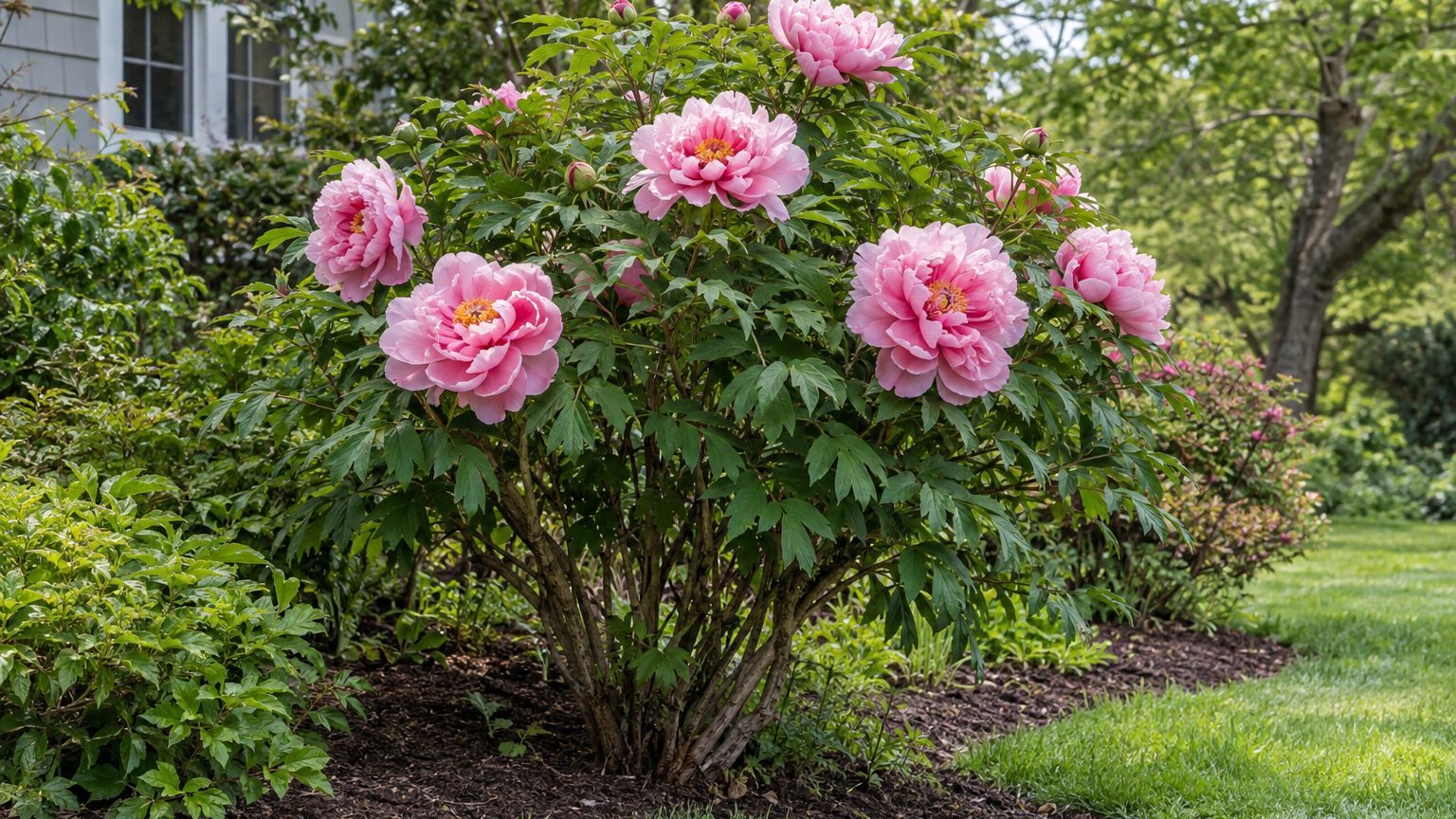
Herbaceous peonies vanish to bare ground each winter and push up fresh stems in spring, while tree peonies keep woody branches through the cold months. Itoh peonies sit between them, with the big flowers of a tree peony on a plant that dies back like a garden peony. Size, bloom timing and staking differ among these types.

What Are the Main Types of Peonies?

Across the country, peonies fall into herbaceous, tree and Itoh (also sold as intersectional) types, with fern-leaf and woodland peonies as smaller specialty groups. The general rule is simple: herbaceous types die back and regrow, tree types stay woody, and Itoh types die back but bloom later. Climate changes how tall each one gets and how long the show lasts.

Herbaceous peonies are the familiar garden peony, with thick, bushy foliage that dies back to the ground each winter. Tree peonies are shrubs in everything but name. Itoh hybrids borrow from both parents, and fern-leaf and woodland types stay small.

The state selector just below this section leads to the page for your state, where timing is written for your climate.

How to Tell Peony Types Apart

Types of Peonies Compared: Herbaceous, Tree and Itoh

Start with the plant itself, then match it to the space and the bloom season you want. These steps go in the order you would actually use them, whether you are shopping or identifying a plant already in the yard.

  1. Look at the plant in winter, so that you know the type before spring. Bare ground where the plant stood means herbaceous or Itoh, while bare woody branches still standing mean a tree peony.
  2. Measure the height you have room for, so that the plant does not crowd the window or the walkway. In Pennsylvania, tree peonies run 3 to 7 feet, herbaceous types 2 to 4 feet, and fern-leaf types stay under about 2 feet in Iowa.
  3. Measure the width too, because peonies are wider than people expect. In Pennsylvania, most have a spread of at least 3 to 5 feet, and in South Carolina a mature herbaceous peony covers about 3 to 4 feet.
  4. Decide how you feel about staking, so that heavy blooms do not end up in the mud after rain. Mature tree peonies in Indiana usually go without stakes because woody branches carry the flowers, while herbaceous types often need a support ring.
  5. Choose cultivars that open at different times, so that the show lasts. In Illinois, mixing early, mid-season and late cultivars stretches bloom over a 4- to 6-week period.

Bloom size is the last clue. Tree peony flowers in Washington can be 7 to 10 inches across, a good reason to give them a spot where they can be seen from the house and have room to spread.

Peony Types Compared by Peony Type

The figures below come from Pennsylvania, where height ranges are given for each type side by side. Other states report slightly different numbers, because soil, sun and winter cold all shift how large a plant gets.

Bloom order comes from Connecticut, where Itoh hybrids open after the herbaceous types finish.

Peony Type What changes Why it matters
Herbaceous Grows 2 to 4 feet tall and dies back to the ground each winter Leaves a gap in the bed from late fall until spring shoots appear
Tree Reaches 3 to 7 feet with woody branches that stay through winter Needs a permanent spot with room overhead and little staking once mature
Itoh (intersectional) Stays 2 to 2.5 feet tall and blooms after herbaceous types in Connecticut Fits smaller beds and extends the season past the garden peony

For most yards, the choice comes down to how much winter structure you want. Tree peonies give a shrub shape in a bare bed, while herbaceous and Itoh plants leave open ground. Woodland peonies, about 1 to 1.5 feet tall in Pennsylvania, suit shade edges and small corners, and fern-leaf peonies work in front-of-bed spots where a big mound would block the view.

Peony Selection Mistakes to Avoid

Planting a Tree Peony Too Close to the House

Tree peonies in Washington reach heights of 7 feet and spread 4 or 5 feet, which is far more than a young plant in a nursery pot suggests. Crowded against a wall or walkway, the shrub gets shaded and shoved around. Mark the full mature footprint on the ground before you dig, and leave that space clear.

Treating Every Peony Like a Garden Peony

Treating Every Peony Like a Garden Peony — Types of Peonies Compared: Herbaceous, Tree and Itoh

A tree peony does not die back, so cutting it to the ground in fall, as you would an herbaceous plant, removes the woody framework that carries next year’s flowers. Learn which type you own from the stems in winter. Cut herbaceous stems down after they die back, and leave tree peony wood standing.

Choosing One Bloom Time

Buying several plants of the same cultivar means they all flower at once and then the bed sits green. Instead, pick early, mid-season and late varieties, and add an Itoh if you want bloom after the garden peonies finish. A planting mixed this way keeps color going far longer than a single block of one kind.

Best Peony Types for Your State

The sign that points you to the right type is what the plant does in winter: bare ground or standing woody stems. Match that to the height and bloom season you want, then check the planting and care months for your state.

  • Your state’s page gives the months for planting and caring for peonies in your climate, so open it before you buy.
  • Go there while the bare stems still show which type you are working with.

Common Questions

Is a Tree Peony Actually a Tree?

No. Tree peonies are shrubs, and in South Carolina they grow about 4 to 5 feet tall under normal conditions. The woody stems are the reason for the name.

Which Peony Types Bloom First?

In Connecticut, the white woodland peony opens first, followed by tree peonies, then herbaceous types, and finally the intersectional hybrids. Planting a few from each group gives you flowers over a long stretch of late spring.

How Tall Do Fern-Leaf Peonies Get?

In Iowa, fern-leaf peonies are often the smallest peony type and rarely reach more than 2 feet. That makes them a good fit near a walkway or at the front of a bed, where a taller peony would block the view.

Tree Peonies: Planting, Pruning and Winter Care

Tree Peonies: Planting, Pruning and Winter Care

A tree peony carries blooms the size of a salad plate on bare, woody branches that were already standing the winter before. Those stems are the whole difference from the garden peonies most people know, and they change how you plant, prune and protect the shrub.

How Do Tree Peonies Differ From Herbaceous Peonies?

Tree peonies are woody shrubs whose stems survive winter, while herbaceous peonies die back to the ground each year. That one habit shapes everything else: planting depth, pruning and winter care all follow from it, and the details shift a little with the type of peony and your climate.

Mature plants grow into sizable multi-stemmed shrubs, and the woody branches usually hold the big flowers without staking. In Iowa, the blooms often reach 6 to 9 inches across.

The state selector shown just under this section takes you to the page for your own state, where the local timing lives.

How to Grow a Tree Peony

Tree Peonies: Planting, Pruning and Winter Care

Most of the work happens on planting day, because a tree peony is usually grafted and the depth of that graft decides how the plant roots in. After that, the care is light.

  1. In North Carolina, plant in the fall, when crowns are best planted or moved, so the roots settle before the next growing season.
  2. Set the graft union well below the surface, so that the upper section of the plant forms its own roots and grows true. Guidance differs by place: in Washington the graft goes about 4 to 5 inches down, in Connecticut 4 to 5 inches of soil should cover it, and in South Carolina an inch is enough.
  3. Bury a plant on its own rootstock less deeply, with the stem junction two inches below the soil surface in Pennsylvania, since there is no graft to bury.
  4. Check moisture below the top layer before watering, so that you do not soak roots that are still damp. Soil can look dry on top and stay moist well below the surface.
  5. Feed only when the soil needs phosphorus and potassium, so that the shrub does not receive nutrients it already has. In Kansas, a complete fertilizer such as 10-10-10 is applied at 2.5 pounds per 100 square feet, equal to 1 rounded teaspoon per square foot.
  6. Spread a light mulch over the roots for winter, so that the plant is cushioned against cold. Kansas gardeners do this even though tree peonies there are hardy to Zone 4.

Pruning differs sharply from herbaceous care. In North Carolina, prune only to shape the shrub and do not cut the stems to the ground in winter. Those woody stems carry next spring’s flower buds.

Tree Peony Care by Peony Type

Not every peony in the garden follows the same rules, and a woody plant sold next to herbaceous ones can fool you at the nursery. The type decides how deep the plant goes and what you do with it in winter.

Tree peonies are also called woody peonies, and Paeonia suffruticosa is a tree-peony species. In Arkansas it is described as a deciduous shrub up to 6 feet tall and wide, with flowers as much as 8 inches across in late April.

Peony Type What changes Why it matters
Tree peony Planted with the graft 4 to 6 inches below the surface in Pennsylvania, 6 inches in Washington Deep grafts encourage the plant to grow its own roots
Tree peony In North Carolina, stems stay through winter and are pruned only for shape Cutting them down removes next year’s flower buds
Herbaceous peony Cut to the ground in winter and planted shallower than a tree peony Treating a woody plant this way harms it

For you, the practical rule is to check the tag before you pick up the shears or the trowel. A plant labeled as a tree or woody peony goes deeper and keeps its stems, while a herbaceous one is the opposite on both counts.

Tree Peony Mistakes to Avoid

Planting the Graft Too Shallow

Planting the Graft Too Shallow — Tree Peonies: Planting, Pruning and Winter Care

A graft left near the surface keeps the plant living on its rootstock rather than forming roots of its own. That can leave it weaker over the years. Bury the graft union at least 4 inches deep, as advised in Kansas, and use the shallower depth only where local guidance such as South Carolina’s says so.

Cutting Stems to the Ground

Cutting Stems to the Ground — Tree Peonies: Planting, Pruning and Winter Care

Gardeners used to herbaceous peonies often cut everything down in fall. On a tree peony, that removes the woody framework that carries the buds, and you may lose the next season’s bloom. Leave the stems standing and trim only to shape the shrub.

Watering by the Surface Alone

Topsoil dries fast and misleads. Watering because the top looks dry can leave roots too wet when the soil well below the surface is still moist. Push a finger or trowel into the ground first, and water only when it feels dry at that depth. Tree peonies are native to northern China, where annual rainfall is fairly modest.

Tree Peonies in Your State

The sign that triggers the work is the season turning to fall, when planting and moving make sense, and the dormant stems that need only shaping. Exact months differ across the country, so your own state’s page is the place to check.

  • Look at your state’s page before planting day to see which fall months suit your area.
  • Return to it before winter to time the mulching over the roots.

Common Questions

Do Tree Peonies Need Staking?

Rarely. In Indiana, mature plants are described as needing no stakes, because their woody branches hold the large flowers. Young plants may still lean a little while they build that framework.

How Tall Do Tree Peonies Get?

In Iowa, tree peonies reach about 3 to 5 feet tall. Leave room for a shrub that is nearly as wide as it is tall.

Can You Transplant a Tree Peony?

In North Carolina, fall is the time for transplanting tree peonies and planting new crowns. Replant at the same depth you would for a new plant, with the graft kept below the soil surface.

When to Move a Peony, and How to Transplant It

When to Move a Peony, and How to Transplant It

A peony that has sat in the same spot for years starts to crowd its neighbors, and the clump gets thick enough that you start wondering about a move. Fall is the season for that job, when the plant is resting and the soil is still workable.

When Can You Move a Peony?

State guidance varies, so move the plant while it is resting during your local window. Where that falls on the calendar depends on your climate and on the peony type. In Iowa, September is the month for dividing and planting, while in Maine the window opens in late August or early September.

In cooler places, watch the soil and the plant to judge when roots can settle before the ground freezes. In Indiana, October is the month given for bare root stock, because dormant plants handle the digging better. Connecticut allows spring too, as soon as soil is workable.

The state selector just below this section takes you to the page for your state.

How to Transplant a Peony

When to Move a Peony, and How to Transplant It

A peony dislikes being disturbed, so the goal is a quick move with as little root damage as possible. In Maine, divide or transplant a clump only every 10 years or so, and remember that it may need no move for decades.

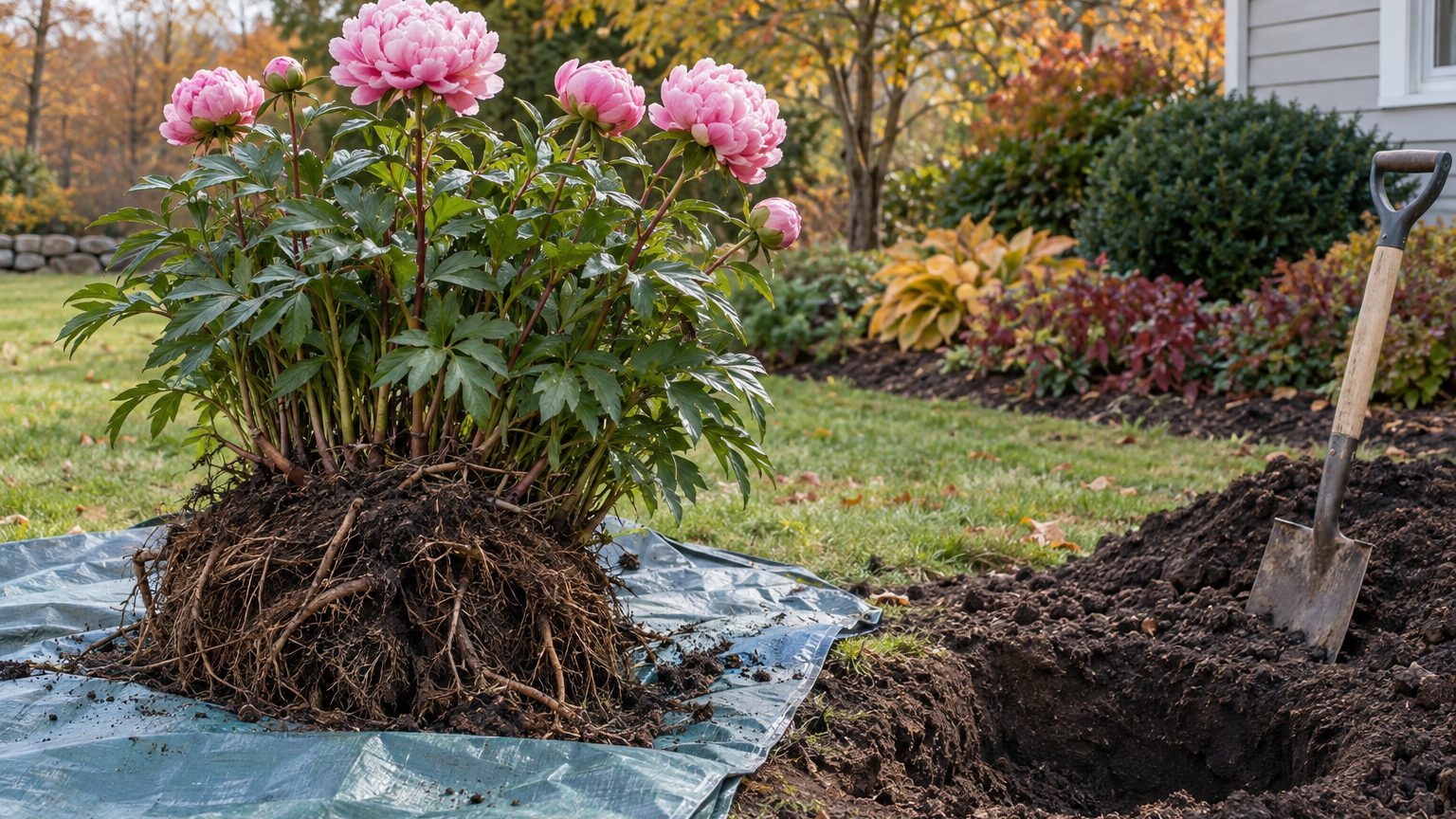
  1. Dig a wide circle around the clump and lift it with as much root as you can, so that the thick storage roots are not snapped.
  2. Wash or shake off the soil and look the clump over, so you can see where the buds sit and divide the clump cleanly.
  3. Prepare the new hole before the plant comes out of the ground, so the roots are not left drying in the open air.
  4. In Iowa, plant the division with its buds 1 to 2 inches below the soil surface.
  5. Space plants 3 to 4 feet apart in Indiana’s advice, so air can move through the leaves and each clump has room to grow.
  6. Water the soil in around the roots and firm it gently, so no air pockets are left against the roots.

Mulch comes later, after the ground has chilled. In Kentucky, a 4- to 6-inch layer goes over new plantings in mid- to late November. Expect a pause in flowers too. Divided plants may take 2 to 3 years to recover and bloom well in North Dakota, and in Arkansas a moved peony may skip the next spring but bounce back the year after.

Transplanting by Peony Type

Garden peonies and tree peonies share one trait: neither likes to be disturbed, and both can stay put for many years. In Washington, that holds for both kinds.

In Washington, garden and tree peonies may remain undisturbed for many years.

Peony Type What changes Why it matters
Garden peony In Maine, divide or transplant only every 10 years or so, and often not for decades Leaving it alone protects bloom, so dig only when the clump has a reason to move
Tree peony Left in place for many years, like the garden type Disturbance is a setback, so plan the spot carefully the first time
Garden and tree peonies In Washington, both types may remain in the same location for many years Move either type only when there is a clear reason

For a home garden, the lesson is to choose the site carefully and treat any move as a rare event. Herbaceous clumps that have outgrown their space are the usual candidates, while tree peonies are best left alone unless the spot truly fails.

Peony Transplanting Mistakes to Avoid

Planting Too Deep

Planting Too Deep — When to Move a Peony, and How to Transplant It

In Iowa, keep the buds 1 to 2 inches below the soil surface. In Iowa, if a plant has settled too deep, lift it in fall and reset it 1 to 2 inches below the soil surface.

Moving at the Wrong Time

Moving at the Wrong Time — When to Move a Peony, and How to Transplant It

Digging a plant in active growth stresses it, so wait until it is dormant. Wait for the cooler season that suits your state, then move the clump while it rests. Spring moves are possible in Connecticut once soil can be worked, though fall is preferred there.

Dividing Too Often

Divide a healthy clump only when it needs it, not simply because it is big. A divided plant can need 2 to 3 years to bloom well again in North Dakota. Leave an established peony alone until crowding or poor flowering gives you a clear reason.

When to Move Peonies in Your State

The sign to act is the end of the growing season, when foliage fades and the plant slips into rest, as the weather cools toward fall. Each state’s months are on the page for that state.

  • Open your state page to see the months that suit your climate, and check it before you pick up a shovel.
  • Return to your state page before moving a plant, so you can check when the local season begins.

Common Questions

Will a Moved Peony Bloom the Next Spring?

Maybe not. In Arkansas, a disturbed peony may skip the next spring, then bloom the following year once it recovers.

How Far Apart Should You Plant Peonies?

In Indiana, the advice is 3 to 4 feet apart, so each plant has room to develop.

Do You Need to Cover a Newly Planted Peony for Winter?

In Kentucky, a 4- to 6-inch layer of mulch goes over new plantings in mid- to late November, after the ground has cooled.

How to Support Peonies So the Blooms Do Not Flop

How to Support Peonies So the Blooms Do Not Flop

Peony stems can look sturdy early in the growing season, then rain in bloom season can bend them to the mud. The fix goes in before the flowers do. Staking peonies means setting a ring, grid or stake system around the clump while the shoots are still short, so the stems grow up through it and carry the heavy blooms.

Do Peonies Need Staking?

Many garden peonies with big, full flowers do, and heavier blooms are more likely to need support. Climate changes the picture too, because a wet spring or a windy site loads the flower heads with water and pulls stems down.

Type matters as well. In Kentucky, plants with single flowers do not need staking. In Pennsylvania, tree peonies with healthy, mature stems usually go without. Double-flowered herbaceous types are the ones that tend to need help.

The state selector just below this section takes you to the page for your own state.

How to Support Peonies

How to Support Peonies So the Blooms Do Not Flop

The order matters more than the hardware, because a support that goes on early lets the plant grow into it and hide it.

  1. Pick a grow-through support, such as a metal hoop or ring, so that the stems rise inside it and lean on it as they thicken. Iowa gardeners set these over the plants in early spring.
  2. In South Dakota, watch for new shoots to poke through the soil, then set the support over the clump before the stems grow tall.
  3. Use stiff wire fencing if you prefer to make your own, since a couple of feet of height is plenty in Iowa and keeps the frame low enough to disappear behind the foliage.
  4. Push a stake in behind the plant if you tie with twine loops, so that the loops have something solid to pull against. In Kansas, a 2-by 2-inch stake is the suggested size.
  5. In Iowa, look the frame over as the flower buds form and adjust any loops or ties so the stems stay upright as the buds swell.

Ready-made rings are easy to find. In Kansas, a common size stands 30 inches high. The top ring measures 18 inches across, and the lower ring measures 14 inches, which leaves a cage that narrows toward the base and holds the stems together as they open.

Support Needs by Peony Type

Peonies are not all alike. Flower form is what decides how much help a plant wants, because large, full blooms weigh more and soak up more rain.

Gardeners with a mixed bed can treat each type a little differently instead of caging everything.

Peony Type What changes Why it matters
Herbaceous and Itoh Stake early in the growing season (advice from Colorado) The flowers are very heavy and tend to hold water and flop over
Double-flowered Many must be staked or supported (advice from Iowa) Full blooms are the ones that flop when open
Single-flowered No staking needed (advice from Kentucky) Skipping support saves effort and keeps the plant looking natural
Tree peonies Healthy, mature stems usually go unstaked (advice from Pennsylvania) Woody stems carry the flowers without a frame

Sort plants by flower form before deciding which ones need support. In Iowa, support double-flowered peonies; in Colorado, support herbaceous and Itoh peonies; Kentucky single-flowered plants need none, and mature Pennsylvania tree peonies usually go without.

Peony Support Mistakes to Avoid

Putting Support in Late

Putting Support in Late — How to Support Peonies So the Blooms Do Not Flop

Once stems are tall and the buds are fat, a ring has to be forced down over them, and stems snap or end up pushed to one side. In North Dakota, gardeners install supports in early May, before the plants get too large.

If you missed the window, tie loose loops around the clump on a stake instead of forcing a ring over it.

Relying on Twine Alone

Relying on Twine Alone — How to Support Peonies So the Blooms Do Not Flop

A loop of twine around a clump cuts into stems as the weight of the blooms grows, and the whole bunch tips outward in a storm. A stake hidden behind the plant gives the loops something to pull against, as the Kansas advice describes.

Tie the loops loosely and adjust their height as the stems grow.

Skipping Support After a Dry Spring

A dry spring can lull you into thinking staking is optional. But in Kentucky, large blossoms tend to bend over onto the ground after a spring rain. The blooms can bend onto the ground after rain.

Make support a yearly habit, set up each spring whatever the forecast, as the Kansas advice recommends.

When to Support Peonies in Your State

The sign to watch for is new shoots pushing up through the soil in spring. That is the moment to set the frame, and the exact months shift from state to state.

  • The page for your state gives its months for staking, so open it before the shoots appear.
  • Use that page again when buds begin to form, to check whether your supports still match the plant’s height.
  • Keep the hoops or stakes stored where you can find them, so they are in hand when the shoots show.

Common Questions

Can You Use a Cattle Panel to Support Peonies?

Yes. In South Dakota, woven wire or a piece of cattle panel is recommended, suspended about a foot above the ground by surrounding stakes. The stems grow up through the openings and spread their weight across the grid.

Is It Too Late to Stake Peonies Once the Buds Have Formed?

Not necessarily. In Iowa, staking as the flower buds form can still keep the blooms upright, though earlier is easier. Move gently, since swollen buds on long stems break easily.

Why Do Peony Stems Bend Even When the Plant Is Healthy?

Healthy plants flop too. In Indiana, the large blooms are heavy, and the long stems cannot carry that weight alone. Rain-filled flowers and a gust of wind add to the load, as in Arkansas, where blooms fall over when filled with rain or hit by heavy wind.

Where to Plant Peonies: Sun, Soil and Spacing

Where to Plant Peonies: Sun, Soil and Spacing

A peony can stay in the same spot for many years, so choosing the site carefully pays off. Pick a place with open sun, soil that drains after a storm, and enough room that air moves through the leaves.

Where Is the Best Place to Plant Peonies?

Across the country, the answer is a sunny, open spot with deep, well-drained soil and room to spread. Peonies tolerate part shade, but they pay for it in flowers. Peonies do not tolerate wet ground.

What shifts the answer is the type of peony and the climate. Standard and dwarf types need different spacing, and local climate should guide the choice of site.

The state selector just below this section leads to the page for your state, where the local picture is laid out.

How to Prepare a Planting Site for Peonies

Where to Plant Peonies: Sun, Soil and Spacing

Preparation happens before the plant goes in, and it pays off for years because a peony is rarely moved once settled.

  1. Choose a spot with full sun, since in Utah the advice is at least 6 to 8 hours of direct light, and low light means fewer flowers.
  2. Check how water behaves after rain, because peonies need excellent drainage and do not tolerate wet feet.
  3. Test the soil pH, since in Indiana peonies are described as thriving at a pH of 6.0-7.0, and in Alaska a soil analysis will likely come back acidic and will tell you how much lime to add.
  4. Dig the planting area deep, because in Nebraska the advice is to work the soil 18 to 24 inches down, knowing the plant will stay for many years.
  5. Mix in well-decomposed organic matter such as compost, so the roots find rich, loose soil; in Missouri that means working it 10 to 12 inches deep across the general area.
  6. Mark the spacing before planting, so that neighbors do not crowd the crown and leaves dry quickly after rain.

Dig the individual hole at least several days ahead of planting, as advised in Washington, so the amended soil has time to settle. That hole can run from one foot up to 3 feet across. In Kansas, an area about 18 inches in diameter and about the same depth is the suggestion. Wide holes let the roots spread instead of curling.

Spacing and Air Circulation

In Kansas, Iowa and Indiana, the guidance for peonies is 3 to 4 feet apart. That gap keeps foliage from touching, so moisture does not linger on the leaves. In mixed beds, Washington guidance keeps other plants at least 12 inches from the crown.

Sun and Soil Needs by Peony Type

The basic needs of sun and drainage hold for every peony, but spacing is where the type shows up. Dwarf peonies stay smaller and can sit closer to their neighbors than the standard types.

Light is similar for all, though the numbers differ by place. Connecticut guidance calls for 8 hours or more for full sun, while Washington guidance asks for six hours.

Peony Type What changes Why it matters
Dwarf Leave a generous gap between plants A smaller plant needs less room, so it fits a tighter bed
Standard At least 4 feet between plants Larger clumps need open space so air moves through the foliage

Kansas distinguishes spacing by peony type, while Kansas, Iowa and Indiana recommend 3 to 4 feet as general spacing. Soil pH is where places disagree a little: Connecticut points to 6.5 to 7.5, deep and rich in organic matter, while Washington and Indiana say 6.0 to 7.0. Those pH ranges overlap.

Peony Placement Mistakes to Avoid

Planting in Too Much Shade

A peony in part shade will grow and may look healthy, yet it flowers less. Connecticut guidance says 5-6 hours of daily sun is tolerated with fewer blooms. If the plant already sits in shade, the better move is to relocate it to a spot with full sun, instead of waiting for flowers that may not come.

Crowding the Crown

Crowding the Crown — Where to Plant Peonies: Sun, Soil and Spacing

Tucking peonies tightly between other plants traps damp air around the leaves. Keep neighbors at least 12 inches from the crown, as Washington guidance suggests for mixed beds, and give each plant the spacing its type needs. A dwarf can sit nearer its neighbors than a standard type.

Choosing Low, Wet Ground

Choosing Low, Wet Ground — Where to Plant Peonies: Sun, Soil and Spacing

Soggy ground is a poor home because peonies do not tolerate wet feet. Water that lingers after rain around a low corner of the yard is a warning. Pick a slightly higher, open spot instead, where water does not pool around the roots.

Where to Plant Peonies in Your State

The signal to act is a spot that gets full sun and drains quickly after rain. Once you have it, local timing and conditions depend on where you live, and each state has its own page with its months.

  • Use the state selector to reach your state page, where the months for planting peonies in your area are laid out.
  • Walk the yard on a sunny day before you go, and note which corner keeps its light the longest.

Common Questions

Can You Plant a Peony Near a Tree or Shrub?

Roots compete with peonies for water and nutrients, and shade cuts the light they need for flowers. A spot well clear of large trees, with open sun, is the safer choice. In Washington, guidance says to leave at least 12 inches between the crown and nearby plants.

Do Peonies Need Cold Winters?

Yes. In Washington, guidance says peonies need a location that has a month of temperatures below 40 degrees F. In a mild-winter yard, that is a reason to read your state page before buying plants.

Should You Mulch Around a Peony?

In Kansas, a couple of inches of mulch is considered sufficient. Keep it light and spread around the plant, so moisture does not sit against the crown.

When to Plant Peonies: Fall Dates and Planting Depth

When to Plant Peonies: Fall Dates and Planting Depth

On bare-root herbaceous peonies, the buds on top, called eyes, look like pink potato sprouts. Where the eyes sit and how far apart the plants stand matter nearly as much as the date. Their depth and the space between plants strongly affect how well the clump establishes and blooms.

When Is the Best Time to Plant Peonies?

The best planting season depends on local climate, soil conditions and the type of peony. Planting while the soil is workable gives roots a chance to settle before new growth begins.

Climate moves the exact window. Local conditions should determine the planting window. The type of peony shifts the timing too, since herbaceous, tree and Itoh peonies do not all behave alike.

The state selector just below this section leads to the page for your state, where the months for your climate are laid out.

How to Plant a Peony

When to Plant Peonies: Fall Dates and Planting Depth

Planting goes in a clear order, and each step protects the buds that will become new stems.

  1. Test the soil well ahead of time, so that any correction is done before the root goes in. In Alaska, gardeners are advised to test at least 1 year before fall planting, and in Indiana lime is added only when the pH is below 5.5.
  2. Prepare a wide bed and dig the hole several days early, so that the loosened soil has time to settle. In Washington, dig the hole at least one foot in diameter. Indiana advice is to prepare the soil at least 1 foot deep.
  3. Size the hole to the root, so that the crown does not sink as the soil settles. In Indiana, the hole is 1.5 to 2 times the width of the root ball but only an inch deeper than its height.
  4. Set the eyes at the right depth, so that the plant can push up through the soil and still bloom. In Wisconsin, eyes sit about 1 to 2 inches below the surface, and in Ohio the buds go no deeper than 2 inches.
  5. Space the plants generously, so that air moves between them and roots are not competing. In Kansas, Iowa and North Dakota, 3 to 4 feet apart is the guide, giving each clump room to develop.

Planting too deeply can keep a healthy peony from flowering. Recommendations vary by location, and in Arkansas the eyes go no deeper than ½ to 1 inch. Follow the depth recommended for your location, then firm the soil and water the hole well.

Planting Time by Peony Type

Herbaceous and Itoh peonies share a planting depth, while tree peonies are set quite differently. They are woody shrubs grafted onto a root, so the depth is measured at the graft union instead of at the eyes.

Those differences affect how deep you dig, so check the tag before the hole is started.

Peony Type What changes Why it matters
Herbaceous Eyes 2 to 3 inches below the surface in Washington Too deep and the plant leafs out without blooming
Itoh Same depth as herbaceous, 2 to 3 inches in Washington Planted like a herbaceous peony even though it is a hybrid
Tree 4 to 6 inches deep in Washington, with the graft union 6 inches deep A deeper graft lets the plant develop its own roots

In Washington, herbaceous and Itoh peonies are planted shallowly, while tree peonies go deeper. Mixing them up is easy when a bed contains different peony types.

Peony Planting Mistakes to Avoid

Planting Too Deep

Planting Too Deep — When to Plant Peonies: Fall Dates and Planting Depth

Buried eyes can leave a peony growing green without flowering. In North Dakota, the advice is no more than 2 inches of soil over the top bud. If an established plant refuses to bloom, check its planting depth before deciding whether to lift and reset it.

Crowding the Plants

Crowding the Plants — When to Plant Peonies: Fall Dates and Planting Depth

Peonies look small in the nursery pot, so they get tucked too close together. Clumps spread as they mature, and in Nebraska holes are spaced at least 3 feet apart so plants do not crowd one another. Measure the spacing before digging, and leave the gap even if it looks empty at first.

Skipping Soil Prep

A hole dug just before planting in unprepared ground can leave roots in compacted soil that later settles. Loosen a wide area ahead of planting, then correct pH only if a test calls for it. Adding lime by habit, without a test, can leave the soil in worse shape than before.

When to Plant Peonies in Your State

The planting season depends on local climate, and the cue to act is soil that is still soft enough to dig. Once those conditions arrive, the months that suit your climate are on your state’s page.

  • Open your state’s page when you buy bare roots, so you can match the planting window to your local climate.
  • Check it again before digging if you are adding tree peonies, since their depth differs from herbaceous and Itoh types.

Common Questions

Can You Plant a Peony in Spring?

Potted peonies can go in during spring, while bare-root planting depends on the local climate. A spring planting needs steadier watering while the roots settle.

How Far from a House or Tree Should a Peony Go?

Give it open ground with room to spread, since a clump needs space on every side. Crowding from shrubs or walls leaves less air and light around the foliage.

Should You Plant a Peony in a Mound?

Some gardeners in Alaska plant in mounds, with the highest eye about 2 thumb widths below ground level. The mound can help where drainage is poor, as long as the eyes stay at the right depth.

The almanac, state by state. Every date on this site comes from a state’s own frost facts and its extension service’s calendar — and says where it comes from.