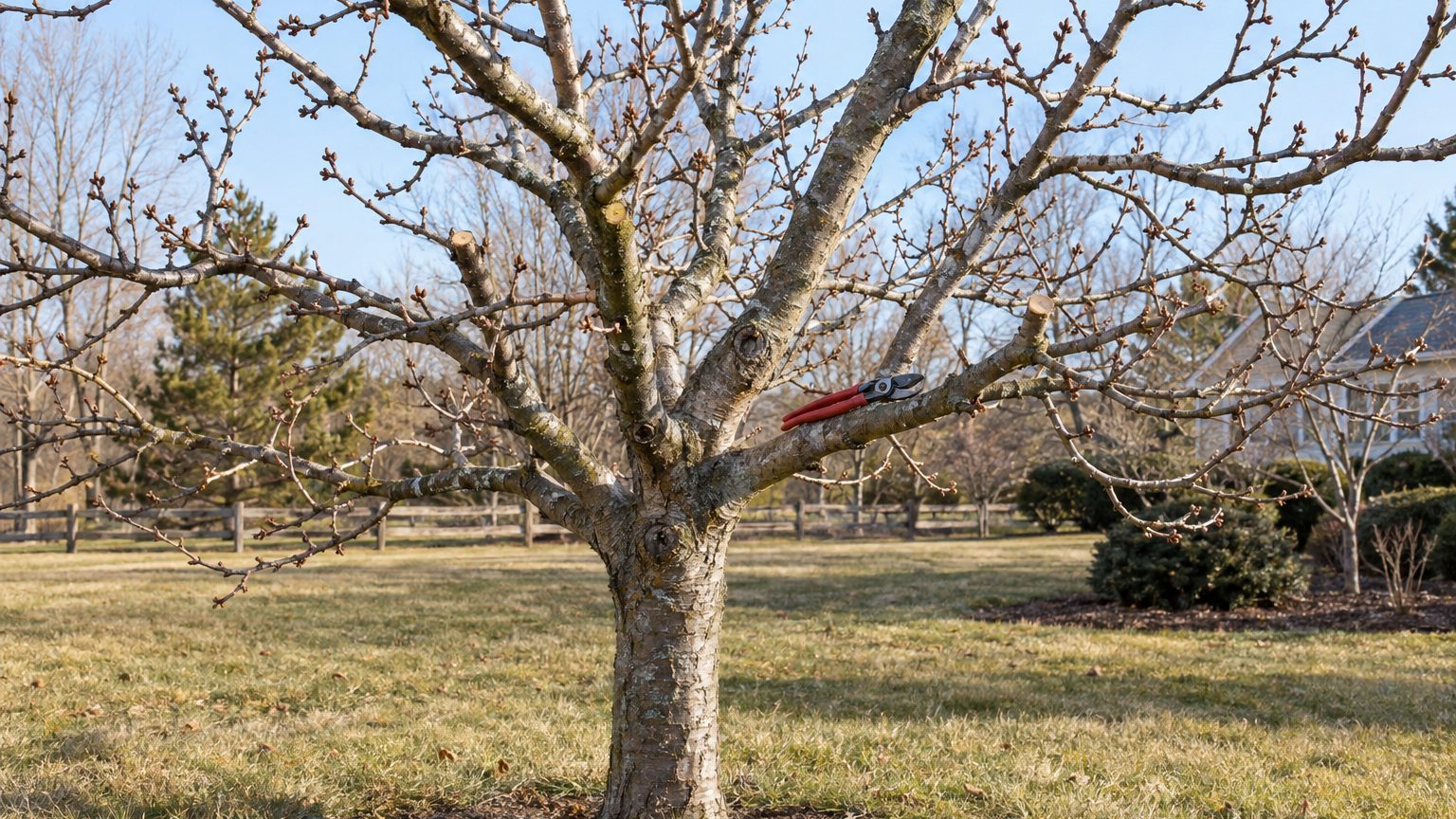
Bare apple and cherry branches against a gray winter sky are the cue to pick up the pruning saw. In Montana, fruit trees are pruned in late winter, once the hardest cold has passed and before the buds start to open. Cutting at that moment lets the tree heal quickly and keeps the cuts from coming too early.
When to Prune Fruit Trees in Montana

Prune fruit trees in Montana while they are still dormant, in the stretch from February to March, after the worst cold and before the buds swell. It can also be done in April if winter ran long. The same window covers apples, pears, peaches, cherries and plums.
| Fruit tree | When to prune in Montana | Why |
|---|---|---|
| Apples and pears | February to March, while dormant | Cuts heal before growth starts, and the branch structure is easy to read with no leaves |
| Peaches and nectarines | February or March, last in line and close to bloom | Flower buds are easily hurt by cold, so they are left until the hardest weather is behind you |
| Cherries and plums | February to March, before bud swell | Pruned dormant, with time left to apply a preventative dormant oil spray |
| Young trees | Late winter, while dormant | Planted in April as bare-root trees, they are shaped the same way, before the buds open |
Pruning in fall or early winter is avoided, because new growth stimulated by a cut may not harden before the cold arrives. Mountain valleys in Montana can see frost in any month, so a mild spell in winter is no reason to hurry. Billings, one of the milder valleys, sees its last spring frost between April 29 and May 10.
Montana — the year and the numbers
- State
- Montana
- USDA zones
- 3a-6a
- Last spring frost
- April 29 to May 10
- First fall frost
- October 1 to October 14
- Annual rain
- 14 in
- Lawn zone
- transition-season
- Source
- NOAA NCEI 1991-2020 Climate Normals, 32F freeze probabilities · Billings
How to Tell Your Fruit Trees Are Ready to Prune
The tree gives better signals than a date on the wall, and they matter most in a state where winters can swing from mild to brutal.
- The tree is bare, with every leaf gone, which means it is dormant and ready for cuts.
- The deepest cold of winter, the stretch of below-zero nights, has passed, so cut wood will not be hit by a hard freeze.
- The buds are still tight and closed, which tells you there is time before growth begins.
- Buds that start to swell and turn plump mean the window is closing, and peaches in particular should be done by then.
- Soil that has begun to thaw and a spell of milder days point toward the late-winter weeks when pruning is safest.
Walk the trees on a mild afternoon and look closely at the buds. Plump, loosening buds mean it is time to finish the job.
When to Prune Peach and Apple Trees in Montana
Apples go first. They are pruned in the middle of the dormant season, in February or March, when the tree is fully at rest and the cold will not trouble a fresh cut. Without leaves, crossing branches and crowded centers are easy to spot and remove.
Peaches come last, closest to bloom, because their flower buds are easily hurt by cold. Waiting until February or March lets you see which buds made it through winter before you decide what to cut. A peach pruned too early can lose the very wood that would have carried the crop.
Both trees are pruned while dormant, so the order is simple: start with the apples, finish with the peaches, and stop when the buds swell. Summer pruning is not part of the routine for these trees.
Where to Get Fruit Tree Advice in Montana
Montana is a big state with many microclimates, so local advice counts for a lot. A valley orchard and a high-elevation yard can be on very different schedules.
- Montana State University Extension offers fruit tree guidance written for the state, and it is a good first stop before the pruning season starts.
- Your county extension office can speak to your valley and elevation, so call in winter, before the buds begin to move.
Common Questions
Can You Prune Fruit Trees in April in Montana?
Yes, if the buds are still closed. April works as a fallback when winter ran long, but once the buds swell the best time has passed.
What Is the Best Time to Plant a Fruit Tree in Montana?
April is the main month, with March and May also workable. Bare-root trees go in only in spring, while they are still dormant and the buds have not opened.
Which Pears Do Well in Montana?
Parker and Golden Spice are the pears that performed best at Montana research sites, which makes them a sound starting point for a home orchard.