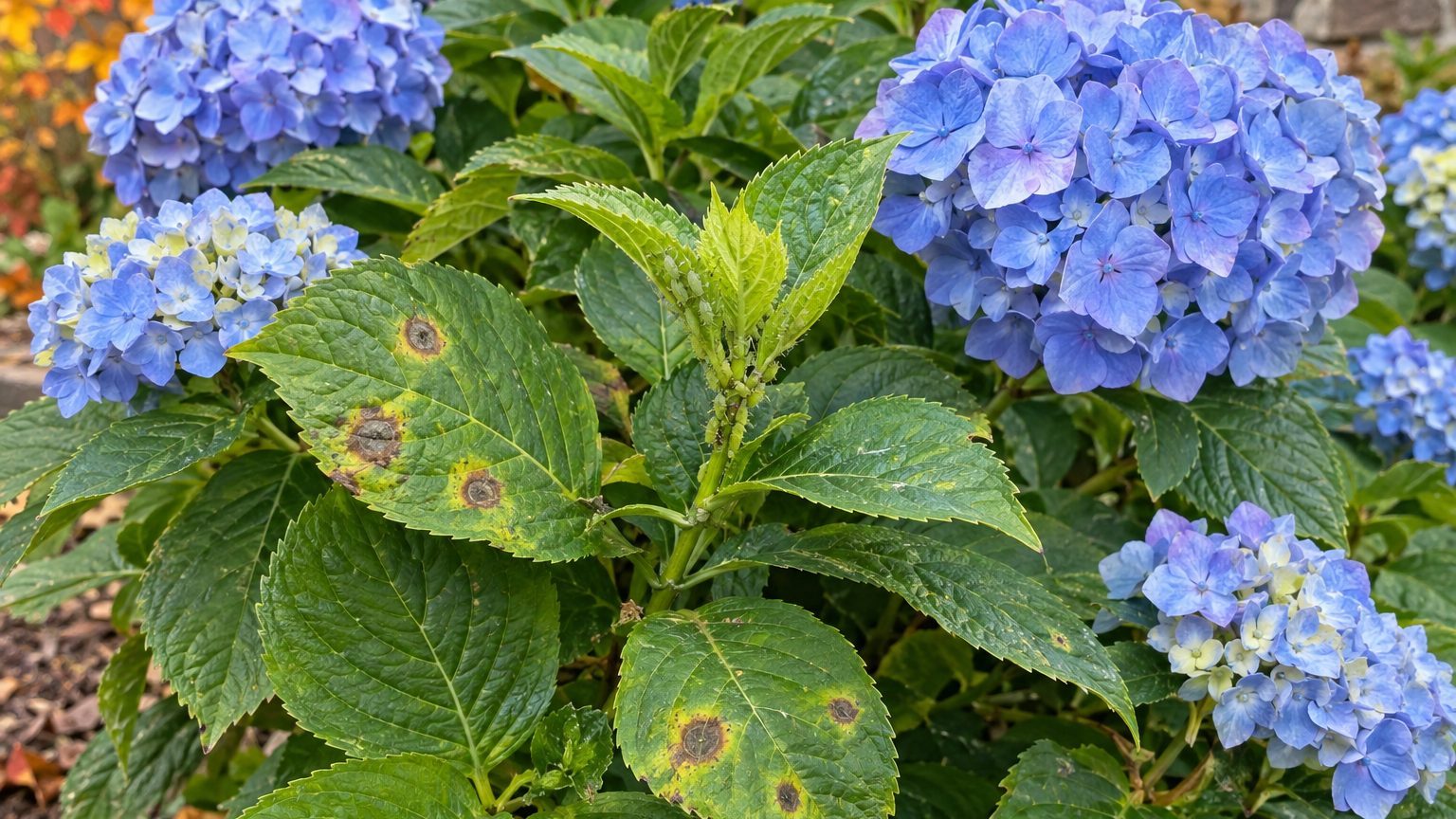
In Phoenix and across the low desert, hydrangeas rarely die from cold. What actually shows up are heat and mineral related problems: iron chlorosis from alkaline soil, spider mites and aphids feeding in dry heat, sunscorched leaf margins, and occasional fungal spotting after monsoon humidity. Knowing which one you have decides whether you reach for shade cloth, chelated iron, or a hose.
Hydrangea pests and diseases Arizona: The Short Answer
USDA Plant Hardiness Zone Map lists Arizona at 4b to 10b, and Phoenix sits deep in the warm end, where hydrangeas answer to heat and soil chemistry, not winter cold. With 32°F showing up in only 6 of the last 30 Phoenix springs, everything on this list traces back to sun, dryness, and alkaline caliche.
Aphids on new growth
Aphids cluster on tender spring shoots as soon as new growth pushes, leaving curled leaves and a sticky residue that draws ants. A strong water spray knocks most of them off, and a soap spray handles the rest before the March fertilize round pushes even softer growth.
Iron chlorosis in alkaline soil
Yellow leaves with dark green veins show up on hydrangeas planted straight into alkaline caliche, since the plant cannot pull iron from high pH soil no matter how much fertilizer goes down. Chelated iron and lowering soil pH before the next October planting window fix it faster than more feeding.
Spider mites in summer heat

Fine stippling and pale, dusty leaves with faint webbing on the underside point to spider mites, which multiply fastest in the hottest, driest weeks before the July prune. A forceful hose rinse every few days breaks their cycle better than any spray, since dust and drought are what feed them.
Leaf scorch on afternoon sun

Crispy brown margins on the west side of the shrub trace straight back to Arizona’s intense afternoon sun, not disease, and they show up hardest in the peak summer weeks. Afternoon shade or a shift to morning-only exposure solves it, no spray needed.
Grasshoppers chewing leaf edges

Ragged, chewed leaf edges and holes appear in mid to late summer as desert grasshopper populations peak, especially near open lots or grassy edges. Row cover during the worst weeks and hand removal in the cool morning work better than most sprays once numbers build ahead of the July fertilize round.
Powdery mildew after monsoon

A gray-white dusting on leaf tops and stems tends to appear once monsoon humidity arrives in late summer, after weeks of dry heat gave the shrub no reason to expect it. Better air movement between plants and watering the soil instead of the leaves keeps it from spreading.
Root rot in heavy soil
Wilting despite wet soil and a blackened base mean roots are drowning in dense, poorly draining ground, usually after a heavy monsoon storm sits in a low spot. Raised planting and a wider drainage hole beat any fungicide, and it is easier to fix at the next planting window than mid-season.
Arizona — the year and the numbers
- State
- Arizona
- USDA zones
- 4b-10b
- Frost
- none in an average year
- Annual rain
- 7 in
- Lawn zone
- warm-season
- Source
- NOAA NCEI 1991-2020 Climate Normals + NOAA RCC ACIS daily records, station USW00023183 — https://www.ncei.noaa.gov/access/services/data/v1?dataset=normals-annualseasonal&stations=USW00023183 · Phoenix
How to Work Out the Dates for Your Own Yard
Figuring out which problem you actually have starts with ruling out the calendar, not the bug.
- Rule out frost first: NOAA NCEI climate data for Phoenix show 32°F in only 6 of the last 30 springs, so blackened tips in January are almost always a cold snap, not disease.
- Check where your yard falls in the zone range: the statewide spread runs 4b to 10b, and whether your soil sits at the cold or hot end decides if a symptom is cold stress or heat stress.
- Match the timing to the fertilize window: symptoms that show up right after the March, May, or July feeding are more likely nutrient lockup from alkaline soil than pest damage.
- Match the timing to the prune window: stress or wilting that follows the June or July cut usually points to heat shock from over-thinning, not a new pathogen.
- Check the planting season: a shrub struggling with root problems that went in outside the January, February, October, or November window is often fighting transplant shock, not rot.
- Call before you spray: a county extension office can confirm which of the problems above is actually on the leaf before any product goes down.
Once frost, zone, and the calendar are eliminated, whatever is left on the leaf almost always matches one of the problems above.
Arizona North to South: How the Dates Shift
USDA Plant Hardiness Zone Map spans Arizona from 4b to 10b, and that range folds into a few hours of driving instead of a thousand miles. Elevation changes which pest or disease shows up first far more than the calendar does.
- The Low Desert (Phoenix, Tucson, Yuma): heat and alkaline soil dominate, so spider mites, chlorosis, and sunscorch show up well before any fungal problem gets a foothold.
- The Central Highlands (Prescott, Payson, Sedona): cooler nights and a bit more moisture bring aphids and occasional powdery mildew earlier in the season than the valley ever sees.
- The High Country (Flagstaff, Show Low, Alpine): real winter cold shifts the whole conversation toward frost damage and slow spring growth rather than heat stress.
Whichever zone matches your yard, the state calendar page lines up the fertilize and prune windows for that spot.
Mistakes Arizona Punishes
Watering on autopilot
Setting sprinklers to run daily regardless of weather drowns roots in Arizona’s dense caliche long before the surface looks overwatered. Water deeply and less often, checking two knuckles down before the next round, and match soil moisture instead of the clock.
Planting into afternoon sun
A west or south-facing spot with no shade after noon guarantees scorched margins by midsummer no matter how well the shrub is watered. Morning sun with afternoon shade, or dappled light under a taller tree, keeps leaves intact through the hottest stretch between the June and July prune.
Skipping the soil pH fix
Feeding a chlorotic hydrangea more fertilizer without correcting alkaline soil wastes the product, since the plant still cannot absorb iron at high pH. Chelated iron and sulfur worked in before the next planting window fix the root cause instead of masking it season after season.
Pruning outside the June-July window
Bigleaf hydrangeas set next year’s flower buds soon after blooming, so pruning outside the June-July window cuts off next season’s flowers even on an otherwise healthy plant. Stick to that window for any real cutting, and treat pest damage separately with spot removal instead of a full prune.
Arizona Extension Offices and County Contacts
Arizona Cooperative Extension backs up everything above with county-level diagnosis, since caliche depth, elevation, and monsoon timing shift block by block. Treat the state-level facts here as a starting point, not the final word for your yard.
- The Arizona hydrangea calendar: month by month fertilize, plant, and prune windows for the whole state.
- Which hydrangeas hold up here: varieties ranked from most reliable to riskiest in Arizona heat and soil.
- Arizona Cooperative Extension: county offices that confirm what is actually on the leaf before anything gets sprayed.
Common questions
Do Arizona hydrangeas get spider mites more than in other states?
Yes. The dry heat and dust of the low desert favor spider mites far more than humid climates do, so a hose rinse during the hottest weeks matters more here than any store-bought treatment.
Is powdery mildew common on Arizona hydrangeas?
It is less common than in humid regions, but it can appear briefly once monsoon humidity arrives in July and August, easing off again as soon as the air dries back out.
What is the most common hydrangea problem in the Phoenix area?
Iron chlorosis from alkaline caliche soil is the most persistent issue around Phoenix, showing up as yellow leaves with green veins no matter how much fertilizer goes down.