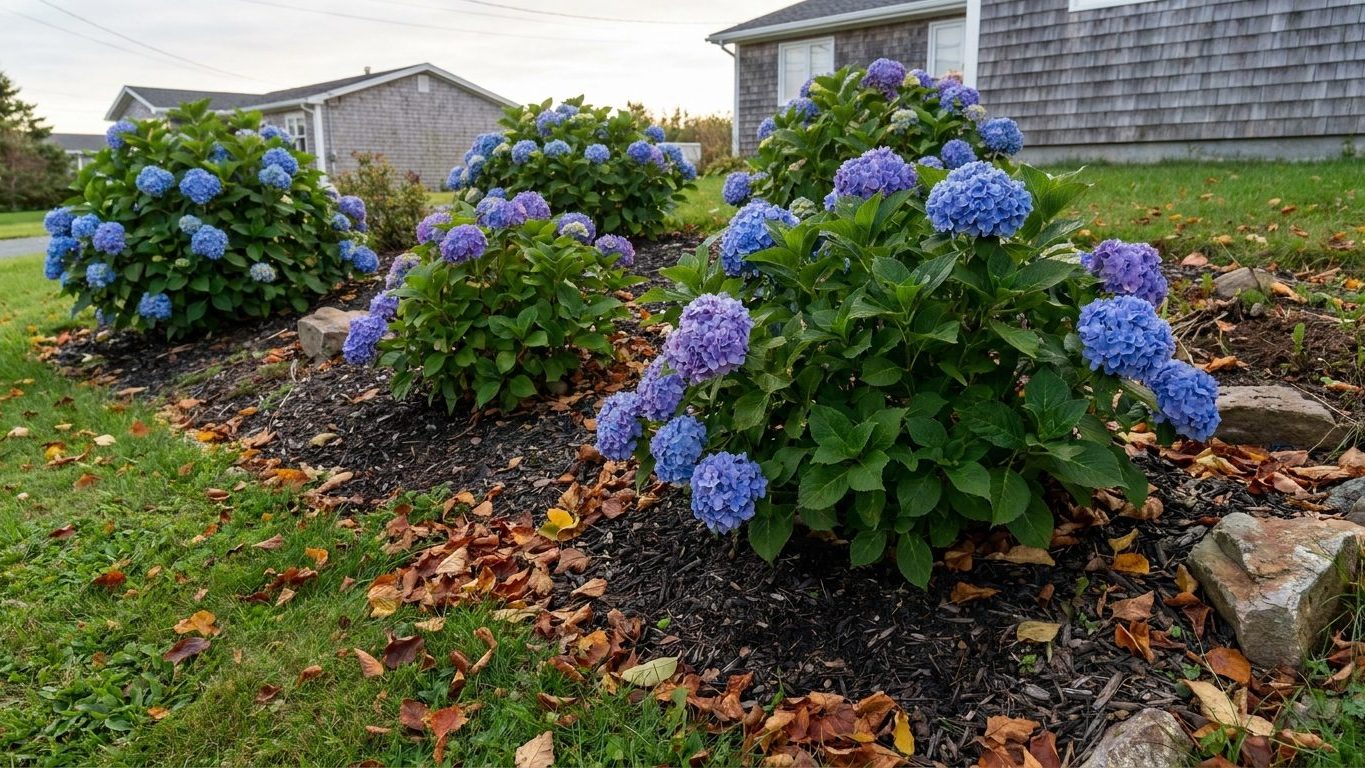
Hydrangeas grow in Newfoundland and Labrador, but the choice of kind matters more here than almost anywhere else in this guide. St. John’s sits in Canadian hardiness zone 6a, with an average last frost near May 30 and first frost near October 17. Panicle and smooth types, which bloom on new wood, ride out that cold far better than bigleaf varieties built for milder winters.
Hydrangeas Care Calendar for Newfoundland and Labrador

Environment and Climate Change Canada’s Canadian Climate Normals put St. John’s average last frost at May 30 and its average first frost at October 17, both averages that miss the mark in half the years, not guarantees.
- Dormancy: the safe window to move a plant, before buds swell and roots sit undisturbed.
- Planting: spread across May, June, August and September, once the ground has shed its spring chill.
- Bud break: watch new growth closely near the May 30 mean, since a late frost can still nip it back.
- Fertilizing: two rounds only, one in May and one in July, then no more feeding for the year.
- Pruning bigleaf: June and July, right after the first flush of bloom fades.
- Mulching: ahead of the October 17 mean first frost, to bank heat around next year’s buds.
- Winter cover: through the coldest months, since a Canadian zone 6a rating still allows a hard freeze.
Nothing on this list is a fixed date, since these are averages from a station network, not a promise for any single yard.
Newfoundland and Labrador — the year and the numbers
- State
- Newfoundland and Labrador
- Hardiness zones
- 6a
- Last spring frost
- May 30
- First fall frost
- October 17
- Annual rain
- 60 in
- Lawn zone
- cool-season
- Source
- Environment and Climate Change Canada — Canadian Climate Normals 1981-2010, station ST JOHN'S A · St. John's
Best Hydrangeas for Newfoundland and Labrador
Natural Resources Canada’s Plant Hardiness Site rates St. John’s a Canadian zone 6a, a number built from seven climate variables rather than one, and it decides which hydrangeas keep their flower buds through winter.
Shrubs that set next year’s blooms on new wood shrug off a hard freeze, since dieback costs stems, not flowers. Shrubs that bloom on old wood gamble every winter on buds formed the summer before.
| Kind | Flowers on | Verdict here | Why |
|---|---|---|---|
| Panicle (Hydrangea paniculata) | New wood | Reliable | Blooms even after a hard winter kills the old stems |
| Smooth (Hydrangea arborescens) | New wood | Reliable | Native to cold pockets of eastern North America, same new-wood logic |
| Bigleaf (Hydrangea macrophylla) | Old wood, some rebloom on new | Risky | Old-wood buds often die in a zone 6a winter at St. John’s |
| Mountain (Hydrangea serrata) | Old wood | Risky | Same old-wood exposure as bigleaf, slightly hardier stems |
Oakleaf and climbing hydrangeas need more heat and a longer, gentler shoulder season than St. John’s gets, so the other kinds are on their own pages.
When to Plant, Prune and Feed Hydrangeas in Newfoundland and Labrador
Environment and Climate Change Canada’s average last frost of May 30 anchors the three windows below, but the months themselves come straight from the province’s growing calendar, not from new arithmetic.
Plant across May, June, August and September, whenever the soil is workable and not baking in midsummer heat. Feed twice, in May and again in July, then stop so new growth can harden before fall.
| Task | Window here | Counted from |
|---|---|---|
| Plant | May, June, August, September | Spread on either side of summer’s peak heat |
| Fertilize | May, July | First at green-up, again as buds set |
| Prune bigleaf | June, July | Right after bloom, before next year’s buds form |
Prune a bigleaf outside June or July and the cut risks removing next year’s flower buds, since bigleaf sets those buds not long after this year’s bloom fades.
Hydrangeas Problems in Newfoundland and Labrador and What Causes Them
No blooms after a hard winter
Bigleaf and mountain hydrangeas set next year’s flowers on old wood, and a Canadian zone 6a winter at St. John’s can kill those buds outright, leaving healthy leaves but no flowers. Choose a new-wood panicle or smooth type instead, or check the province’s own page on which kinds hold up here.
Buds nipped by a late spring frost
The May 30 last frost is only an average, so in about half the years cold arrives later and catches new growth off guard. Hold off cutting back dead-looking wood until new leaves confirm what actually survived, and check the calendar page before assuming the season has turned.
Leaves spotted in damp, foggy summers
Coastal humidity along this province’s shoreline keeps foliage wet longer than inland gardens, and that favors fungal spotting on crowded shrubs. Space plants for airflow, water at the soil rather than overhead, and see the province’s page on what goes wrong here for the specific culprits.
Newfoundland and Labrador North to South: How the Dates Shift
The frost dates and zone rating above describe St. John’s, on the Avalon Peninsula, and the rest of the province leans colder rather than milder from there.
- Avalon Peninsula and the Southeast Coast (St. John’s, Conception Bay): closest to the mean dates above, with the ocean softening the worst cold spells.
- Central and Western Newfoundland (Grand Falls-Windsor, Corner Brook): more inland swing, so a late frost can linger past the province’s average.
- Labrador: a harder climate overall, where the safe planting window opens later and closes sooner than anything dated from St. John’s.
Treat the province’s page as a starting point tied to St. John’s, and lean later rather than earlier if the yard sits inland or north of it.
Newfoundland and Labrador Extension Offices and County Contacts
The Canadian zone 6a rating at St. John’s, and the plant, fertilize and prune windows above, are a starting point, not a substitute for asking someone who gardens near you.
- Department of Fisheries, Forestry and Agriculture: the province’s own agriculture contacts for growing conditions specific to your district.
- Which ones hold up here: the page that goes deeper on panicle, smooth, bigleaf and the rest.
- What goes wrong here: the page that covers pests and disease beyond winter dieback.
This month falls inside the plant window, so finishing any September planting before the ground cools is the one job worth doing now.
Common questions
Can hydrangeas survive winter in Newfoundland and Labrador?
Yes, especially panicle and smooth types that bloom on new wood. Bigleaf and mountain hydrangeas survive too, but a Canadian zone 6a winter at St. John’s can kill the old-wood buds that carry their flowers, so the shrub lives without blooming.
What hardiness zone is Newfoundland and Labrador?
St. John’s sits in Canadian zone 6a, per Natural Resources Canada’s Plant Hardiness Site using 1991-2020 normals. That is a Canadian rating built on seven climate variables, not a USDA zone, so it should not be matched against USDA numbers used elsewhere.
When is the last frost date in Newfoundland and Labrador?
St. John’s averages a last spring frost on May 30 and a first fall frost on October 17, according to Environment and Climate Change Canada’s Canadian Climate Normals. Both are averages, so treat them as the middle of a window rather than a safe date.