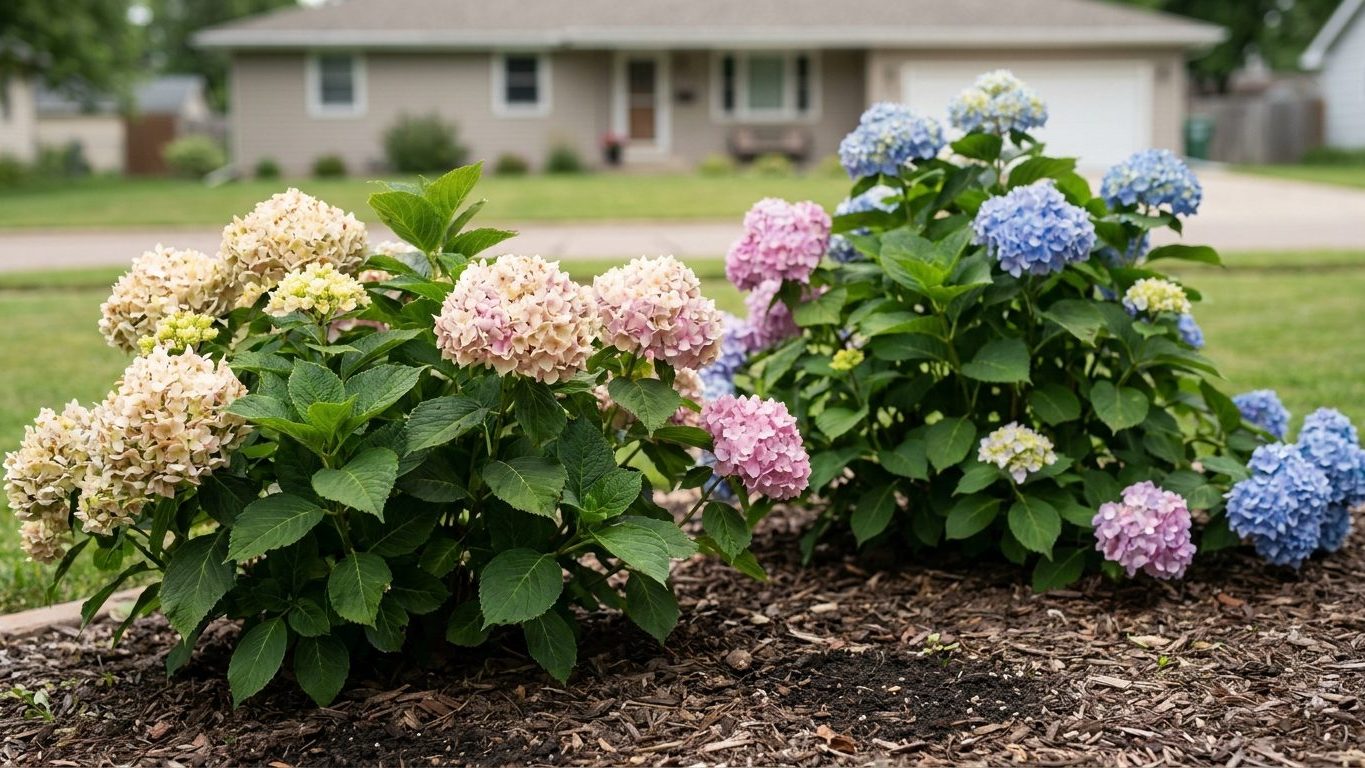
Hydrangeas can grow well across South Dakota, but the type matters more here than almost anywhere else. Panicle and smooth hydrangeas, which flower on new wood, shrug off the state’s zone 3b to 5b winters. Bigleaf and mountain types, which set buds on old wood, usually skip blooming after a hard freeze. Plant in the weeks after the last spring frost, and match the variety to the climate before anything else.
Hydrangeas Care Calendar for South Dakota

In Sioux Falls, the last spring frost falls between April 29 and May 9, and the first fall frost lands between September 24 and October 4, based on NOAA NCEI 1991-2020 Climate Normals. The state runs from zone 3b to 5b, cold enough that bud survival decides whether a hydrangea blooms at all.
- Dormancy: from late fall through very early spring, before buds swell, is the one stretch when roots can be moved, divided, or transplanted without much shock.
- Planting: wait two to three weeks after the last frost, once the soil has warmed past the raw chill of April, and the new plant gets a full season of root growth before winter.
- Spring feeding: as the first leaves unfurl, usually alongside the last frost window, a balanced fertilizer worked into the soil helps the plant push new stems and set the buds that carry summer’s flowers.
- Summer watering: through the driest stretch of July and August, a deep soak twice a week keeps buds from aborting under heat stress, especially on plants in full sun.
- Fall taper: four to six weeks ahead of the first fall frost, cut back on fertilizer and water so new growth has time to harden before cold arrives.
- Winter mulch: once the ground freezes solid, a heavy mound of mulch or leaves over the crown protects the buds of bigleaf and mountain types through the coldest months.
Skip one of these windows and most hydrangeas still survive the winter, since panicle and smooth types are built for this climate, but the bloom count is usually what pays for a missed step.
South Dakota — the year and the numbers
- State
- South Dakota
- USDA zones
- 3b-5b
- Last spring frost
- April 29 to May 9
- First fall frost
- September 24 to October 4
- Annual rain
- 28 in
- Lawn zone
- cool-season
- Source
- NOAA NCEI 1991-2020 Climate Normals, 32F freeze probabilities · Sioux Falls
Best Hydrangeas for South Dakota
The USDA Plant Hardiness Zone Map puts South Dakota between zones 3b and 5b, cold enough that any hydrangea setting its flower buds on the previous year’s wood risks losing them to a hard winter before they ever open.
Panicle and smooth hydrangeas flower on the current season’s growth, so a rough winter costs a few inches of stem, not the whole bloom. Bigleaf, mountain, and most oakleaf varieties set buds on old wood, and that’s the gamble in this climate.
| Kind | Flowers on | Zones | Verdict here |
|---|---|---|---|
| Panicle | New wood | 3-8 | Reliable, the safest bet statewide |
| Smooth | New wood | 3-9 | Reliable, native and cold hardy |
| Oakleaf | Old wood | 5-9 | Marginal, only in the mildest zone 5b pockets |
| Bigleaf | Old wood | 6-9 | Poor, buds usually killed over winter |
| Mountain | Old wood | 6-9 | Poor, same old-wood risk as bigleaf |
Panicle and smooth hydrangeas cover most yards in the state, in sun or part shade. The other kinds are on their own pages, worth reading before you plant one on a whim, since a bigleaf bought at a big-box store in spring rarely repeats its first bloom here.
When to Plant, Prune and Feed Hydrangeas in South Dakota
Planting, pruning, and feeding all key off the same two anchors, the last spring frost, dated April 29 to May 9 in Sioux Falls by NOAA NCEI Climate Normals, and the first fall frost, dated September 24 to October 4. Everything else in the calendar counts forward or back from those two windows.
Panicle and smooth types take a hard prune while dormant, bigleaf and mountain types only right after they finish blooming. Feeding follows the same split, timed to when each type is actually building next year’s buds.
| Task | Window here | Counted from |
|---|---|---|
| Planting | Two to three weeks after last frost, into early June | Last spring frost, April 29-May 9 |
| Pruning, panicle and smooth | Late winter into early spring, before new growth starts | Weeks ahead of the last frost |
| Pruning, bigleaf and mountain | Within a few weeks of the last bloom fading | Bloom time, not the frost dates |
| Feeding | Two to three weeks after last frost, then again in early summer | Last spring frost, April 29-May 9 |
Stop feeding by four to six weeks before the first fall frost, September 24 to October 4 in Sioux Falls, so new growth has time to harden off. Prune later than that window and a plant heads into winter with soft, exposed stems.
Hydrangeas Problems in South Dakota and What Causes Them
No blooms after a hard winter
Bigleaf and mountain hydrangeas set their flower buds on the previous year’s stems, and in a state running zone 3b to 5b those buds routinely freeze before spring. The plant leafs out fine, it just skips flowering. Switch to a panicle or smooth variety, covered on the varieties page, and the problem mostly disappears.
Leaves scorched on the sunny, windy side
South Dakota summers pair strong sun with steady wind, and a hydrangea planted in full exposure often shows brown, crisp edges by July. The fix is part shade in the afternoon, plus deep watering during hot stretches, rather than moving the plant entirely.
Stunted growth in heavy clay soil
Much of the state sits on dense clay that drains slowly and stays cold into spring, which slows root establishment and can stunt a young hydrangea for its first year or two. Working compost into the planting hole and building a slightly raised bed both help roots spread faster.
South Dakota North to South: How the Dates Shift
Frost dates and winter cold both shift across South Dakota, mostly with elevation and distance from the Missouri River, and the Sioux Falls dates above are a starting point, not a state-wide rule.
- The Black Hills and the west (Rapid City, Spearfish, Custer): higher elevation pushes both frost dates later in spring and earlier in fall, shortening the safe planting window.
- The James River Valley and central counties (Huron, Mitchell, Aberdeen): flatter, more exposed ground means harder winter wind, so mulch and winter protection matter more here.
- The southeast and the Missouri River corridor (Sioux Falls, Yankton, Vermillion): the mildest pocket in the state, closest to zone 5b, and the easiest place to push a marginal variety.
Check the frost dates and zone for your own county before leaning on any single city’s numbers.
South Dakota Extension Offices and County Contacts
South Dakota State University Extension, at extension.sdstate.edu, covers the whole state, and the county office nearest you will know local frost timing better than any single station average.
- Your state page: the frost dates and pruning window for South Dakota, gathered in one place.
- Which ones hold up here: a longer look at panicle, smooth, and the varieties best skipped in this zone.
- What goes wrong here: winter bud kill, scorch, and soil issues specific to South Dakota yards.
Common questions
Can bigleaf hydrangeas survive winter in South Dakota?
Most years, the plant survives at the roots but loses the flower buds, since South Dakota’s zone 3b to 5b winters routinely dip below what bigleaf wood can tolerate. Heavy mulch and a sheltered spot help, but panicle or smooth types bloom reliably without the extra work.
When is it too late to plant a hydrangea in South Dakota?
Planting after mid-summer leaves too little time for roots to establish before the first fall frost, which lands between September 24 and October 4 in Sioux Falls. Aim for the weeks right after the last spring frost instead, or very early fall at the latest.
Do hydrangeas need winter protection in South Dakota?
Panicle and smooth types generally don’t, since they die back to live wood and regrow from the base each spring. Bigleaf and mountain types benefit from a thick mulch mound over the crown once the ground freezes, protecting next year’s buds.