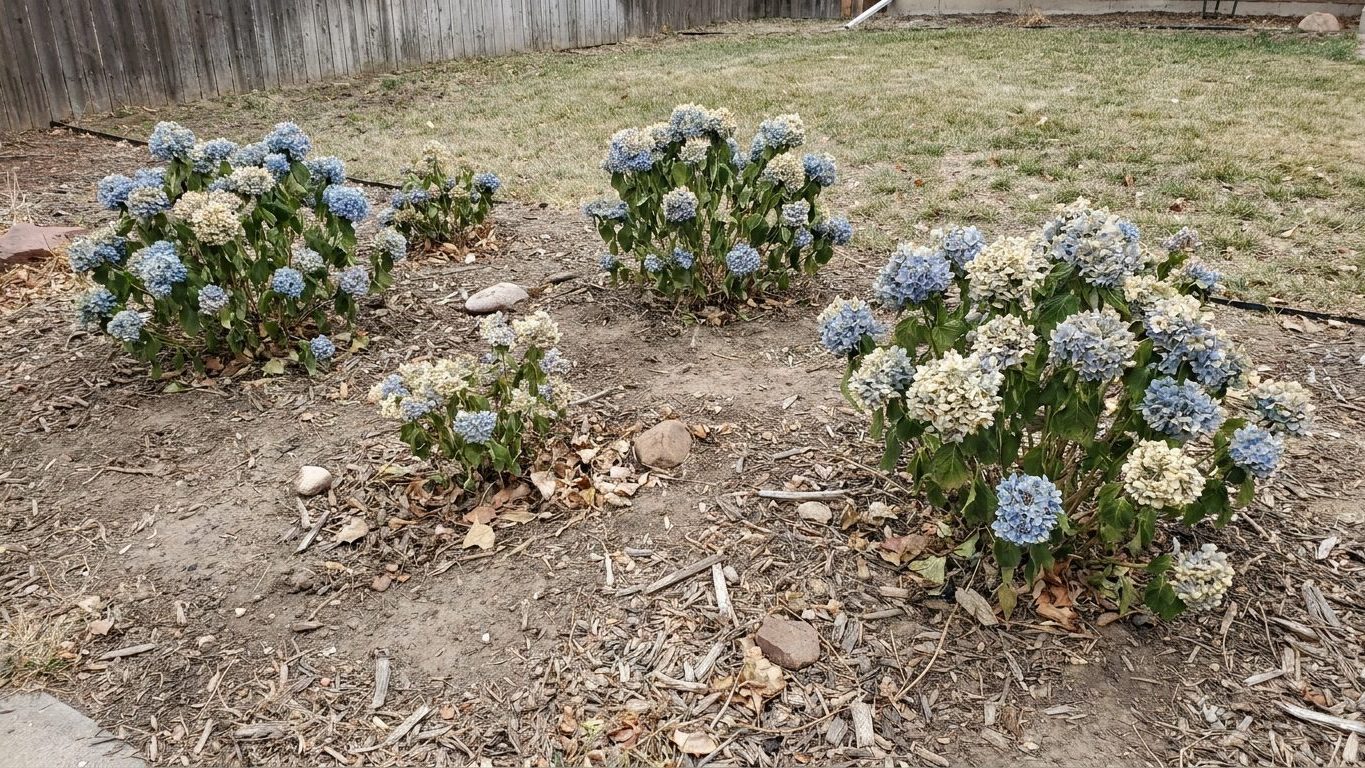
Hydrangeas grow in Alaska mostly as a coastal experiment, not a statewide habit. The mildest ground, centered on Anchorage, gives a shrub about 143 frost-free days, and only the kinds that bloom on new wood have a real shot at flowering before the season closes.
Hydrangeas Care Calendar for Alaska

Anchorage’s last spring freeze runs May 3 to May 12, and NOAA NCEI 1991-2020 Climate Normals sets the first fall freeze at September 22 to October 1, for about 143 frost-free days, the mildest window Alaska offers and still short enough to decide every date here.
- Dormancy: late April, before growth starts, is the one stretch to move or divide a shrub without disturbing new roots.
- Planting: wait until the freeze risk clears, two to three weeks after the last spring freeze near Anchorage.
- Establishment: water deeply through June and July, the plant’s main stretch of daylight and warmth to build roots.
- Bloom watch: expect color by mid to late July on kinds that flower on new wood, the only bloom timing that fits this season.
- Fall prep: stop feeding by late August, roughly six weeks ahead of the first fall freeze, so growth can harden off.
- Winter protection: mound mulch over the crown once the first fall freeze passes, September 22 to October 1 near Anchorage.
Skip the mulch step and a shrub that made it through summer can still lose its crown to the first hard freeze of fall.
Alaska — the year and the numbers
- State
- Alaska
- USDA zones
- 1a-8a
- Last spring frost
- May 3 to May 12
- First fall frost
- September 22 to October 1
- Annual rain
- 16 in
- Lawn zone
- cool-season
- Source
- NOAA NCEI 1991-2020 Climate Normals, 32F freeze probabilities · Anchorage
Best Hydrangeas for Alaska
USDA Plant Hardiness Zone Map sets Alaska’s range at zone 1a to 8a, and Anchorage sits near the milder end of that span, the only realistic ground for a shrub bred for longer, warmer summers.
What matters more than the zone number is where a hydrangea sets its flower buds. A shrub that blooms on new wood can lose its top growth to winter and still flower the same summer.
| Kind | Verdict here | Why |
|---|---|---|
| Panicle hydrangea | Best bet | Blooms on new wood, so a hard winter does not erase the season’s flowers |
| Smooth hydrangea | Good bet | Also flowers on new wood and tolerates a cold, short-season winter |
| Bigleaf hydrangea | Rarely blooms | Sets buds on old wood, which an Anchorage winter typically kills before flowering |
| Oakleaf hydrangea | Marginal, sheltered spots only | Needs milder winters than this state’s outdoor zones reliably give |
Climbing hydrangea is on its own page, where the longer season it needs to establish gets more room than a state-level page allows.
When to Plant, Prune and Feed Hydrangeas in Alaska
Every hydrangea date in Alaska counts from one of two markers, the last spring freeze, May 3 to May 12 near Anchorage, or the first fall freeze, September 22 to October 1.
Planting, pruning and feeding each get measured backward or forward from those two dates, since the gap between them leaves little room for guessing.
| Task | Window here | Counted from |
|---|---|---|
| Planting | Mid to late May | Two to three weeks after the last spring freeze |
| Pruning | Before growth starts, late April | Ahead of the last spring freeze |
| Feeding | June through early August | Stops about six weeks before the first fall freeze |
The stretch between the two freezes runs about 143 frost-free days, so each task gets counted in weeks, not months. Prune in June instead of April, and the plant loses one of its only long enough windows to recover.
Hydrangeas Problems in Alaska and What Causes Them
No flowers on a healthy shrub

This usually points to a bigleaf hydrangea, which sets buds on last year’s wood. Anchorage’s winter kills those buds before they open, so the fix is choosing a new-wood bloomer instead, covered on the varieties page above.
Stems dead to the ground each spring

Cold below what the shrub can take kills the top growth outright. Mulching the crown right after the first fall freeze, September 22 to October 1, protects the roots even when the stems above ground do not survive.
Leaves and buds nipped in late spring

This happens when a plant leafs out before the last spring freeze clears, May 3 to May 12 near Anchorage. Holding off on feeding and pruning until that window closes avoids most of the damage.
Alaska North to South: How the Dates Shift
The reference dates on this page describe Anchorage, and the rest of the state shifts in one direction or another from there.
- Southcentral and the coast (Anchorage, the Kenai Peninsula, the Mat-Su Valley): the mildest ground in the state, closest to the dates used here.
- Southeast (Juneau, Sitka, Ketchikan): coastal and wetter, generally a longer frost-free stretch than Anchorage but more rain to manage around a shrub’s roots.
- The Interior (Fairbanks, Delta Junction): colder winters and a shorter season than Anchorage, which narrows every window described above.
- The North and West (Nome, Utqiagvik, the North Slope): outdoor hydrangeas are not a realistic option, since the season closes before a shrub can establish.
The state page above still holds for Southcentral gardens, but anyone farther north or west should treat these dates as a starting point, not a guarantee.
Alaska Extension Offices and County Contacts
Alaska’s zone range, 1a to 8a, covers ground from Anchorage to the North Slope, so a local answer beats any statewide one for a specific yard.
- Your state page: the frost dates and hardiness range for Alaska gathered in one place.
- Which ones hold up here: panicle, smooth, and why bigleaf struggles this far north.
- What goes wrong here: winter kill, missed bud set, and the fix for each one.
The University of Alaska Fairbanks Cooperative Extension Service can connect a gardener to the district office nearest their yard. Call before the ground freezes, and ask what other gardeners nearby are actually growing.
Common questions
Can hydrangeas survive winter outdoors in Alaska?
Only in the mildest parts of the state, mainly around Anchorage, and only kinds that bloom on new wood, since a hard winter killing the top growth still leaves next summer’s flowers intact.
What is the best hydrangea for Alaska?
Panicle hydrangea is the strongest bet here, followed by smooth hydrangea, both of which set their flower buds on the current season’s growth rather than on stems that have to survive winter.
When should I plant hydrangeas in Alaska?
Mid to late May near Anchorage, roughly two to three weeks after the last spring freeze, gives a shrub the longest stretch of the frost-free season to establish before fall.