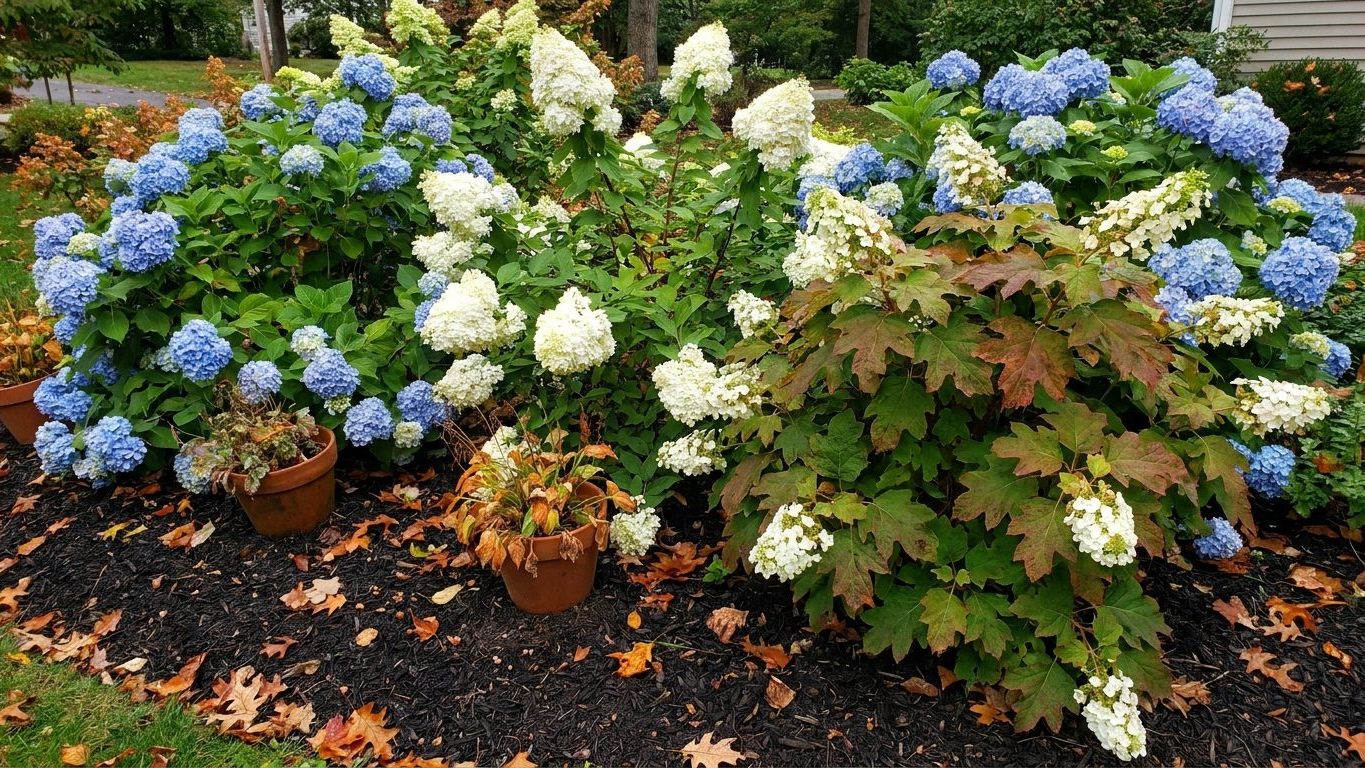
Oakleaf, bigleaf and panicle hydrangeas earn their space in Texas yards, with oakleaf the safest bet and smooth and climbing types the ones that sulk. Houston is the reference city for the dates below, and it sits at the mild Gulf end of a state that runs from piney woods to high plains. Afternoon shade matters as much as the name on the tag.
Hydrangeas that grow well in Texas: The Short Answer
In Houston, NOAA NCEI Climate Normals for the IAH station put the last spring freeze between February 4 and March 1 and the first fall freeze between December 1 and December 19. Winter rarely tests a hardy shrub here, so summer heat, soil and afternoon sun sort the six below, safest first.
Oakleaf hydrangea

Hydrangea quercifolia comes from the Southeast and handles heat, humidity and a dry spell better than its showier cousins. The cone-shaped white blooms age to pink, and the lobed leaves turn burgundy in fall. Give it part shade and it is the safest pick for a Houston yard.
Bigleaf hydrangea
Hydrangea macrophylla is the classic mophead and lacecap. It wants morning sun and afternoon shade, because leaves scorch and flowers fade under a Texas afternoon. It prefers acidic, well-drained soil, and in alkaline ground the leaves can yellow between the veins.
Panicle hydrangea
Hydrangea paniculata takes more sun than any other species on this list and blooms on new wood, so a late freeze rarely costs you the flowers. Blooms open white and fade to pink. Expect it to sulk through July and August without regular watering.
Mountain hydrangea
Hydrangea serrata is a smaller, finer cousin of bigleaf, with lacecap flowers on compact plants. It copes better with cold than with Gulf heat. Reserve it for deep shade and reliable irrigation, and treat any bloom as a bonus.
Smooth hydrangea
Hydrangea arborescens, best known as ‘Annabelle’, produces big white snowballs but wilts hard in long Texas heat. It only makes sense with morning sun and soil that never dries out. In Houston I would treat it as a gamble.
Climbing hydrangea
Hydrangea anomala subsp. petiolaris is the riskiest on the list. It takes years to establish, likes cool roots and feels at home in northern gardens. In Texas it needs a shaded wall and a lot of patience.
Texas — the year and the numbers
- State
- Texas
- USDA zones
- 6a-10a
- Last spring frost
- February 4 to March 1
- First fall frost
- December 1 to December 19
- Annual rain
- 52 in
- Lawn zone
- warm-season
- Source
- NOAA NCEI 1991-2020 Climate Normals, 32F freeze probabilities · Houston
How to Work Out the Dates for Your Own Yard
The Houston windows are a starting point, and the arithmetic behind them takes five steps you can repeat with your own county’s numbers.
- Write your frost window in words: for Houston, NOAA NCEI Climate Normals for the IAH station put the last spring freeze between February 4 and March 1 and the first fall freeze between December 1 and December 19. Ranges, never single dates.
- Count back from the first fall freeze: take a few weeks off the December 1 to December 19 window and you land in roughly late October to mid-November, which sits inside the October and November planting months.
- Count forward from the last spring freeze: add a couple of weeks of margin to February 4 to March 1 and you get mid-February to mid-March, matching the February and March planting months.
- Pick the name that survives your summer: oakleaf passes because it is a Southeast native that copes with heat and humidity, and winter never threatens it when the first freeze holds off until December. Smooth hydrangea fails the same test because it wilts in long Gulf heat.
- Date the pruning to the bloom: bigleaf gets its cut in June and July, right after flowering, so next season’s buds stay on the stem.
Hobby airport runs two weeks milder than IAH, so a yard near the Gulf can shift every range earlier by that much. Fertilizer follows the same logic: March, May and July. Inland, throw the Houston numbers out and start with When to Plant and Prune Hydrangeas in Texas.
Texas North to South: How the Dates Shift
The USDA Plant Hardiness Zone Map runs from 6a to 10a across Texas, and what moves your dates inside that spread is latitude, elevation and distance from the Gulf.
- Gulf Coast (Houston, Galveston, Beaumont): the mildest freezes and the earliest planting window, but heat and humidity are the real test for bigleaf and smooth types.
- East Texas Piney Woods (Tyler, Lufkin, Nacogdoches): acidic soil and more rain suit oakleaf and bigleaf, and freezes arrive somewhat earlier than on the coast.
- Central Texas and Hill Country (Austin, Fredericksburg, Kerrville): higher ground brings cooler nights, but thin, limestone-based soil is alkaline and pushes bigleaf toward yellow leaves.
- North Texas (Dallas, Fort Worth, Denton): colder winters and hard late freezes push planting later in spring and favor panicle and oakleaf.
- Panhandle and High Plains (Amarillo, Lubbock): the earliest fall freezes, the latest spring ones and wind that dries leaves, so choose panicle and shelter everything else.
The full picture for your part of the state lives on Hydrangeas in Texas.
Mistakes Texas Punishes
Copying Houston dates statewide
NOAA NCEI Climate Normals for the IAH station put Houston’s last freeze between February 4 and March 1, the mild Gulf end of Texas. Panhandle yards freeze later in spring and earlier in fall. Build your range from your county, starting with When to Plant and Prune Hydrangeas in Texas.
Planting in summer heat
A hydrangea set out in June has to build roots while its leaves lose water faster than they can replace it. Plant in October or November, or in February or March, so roots settle before the next summer. If leaves already scorch, check Hydrangea Pests and Diseases in Texas.
Pruning bigleaf in fall or winter
Bigleaf sets next year’s flower buds soon after it finishes blooming, so a winter haircut removes them. Prune in June or July, right after flowers fade, and take only spent blooms and dead wood. The dated list sits on Hydrangeas in Texas.
Texas Extension Offices and County Contacts
Houston’s range is a starting point. Your county extension office knows your soil and freeze history, and AgriLife Extension at agrilifeextension.tamu.edu, also listed in the USDA NIFA Land-Grant University Extension directory, points you to it.
- Hydrangeas in Texas: the state overview, with the frost dates and the pruning window in one place.
- When to Plant and Prune Hydrangeas in Texas: the month-by-month order of planting, feeding and cutting.
- Hydrangea Pests and Diseases in Texas: what goes wrong through the season, worth a read before the first spotted leaf shows.
Common questions
Which hydrangea is easiest to grow in Texas?
Oakleaf, because it tolerates heat, humidity and dry spells better than the others. Give it part shade and decent drainage. Bigleaf and panicle come next, with panicle the better choice where sun is strong or winters run cold.
Should I plant hydrangeas in spring or fall in Texas?
The planting months are February, March, October and November. Fall planting gives roots a full cool season before the first summer. Outside the Gulf area, check your county extension office before you dig, since freezes fall on different dates.
Will my bigleaf bloom blue in Texas?
Color follows soil chemistry. Acidic soil gives blue and alkaline soil gives pink. Much of Central and West Texas has alkaline ground, so expect pink unless you amend the bed, and amending is a repeating chore, not a one-time fix.