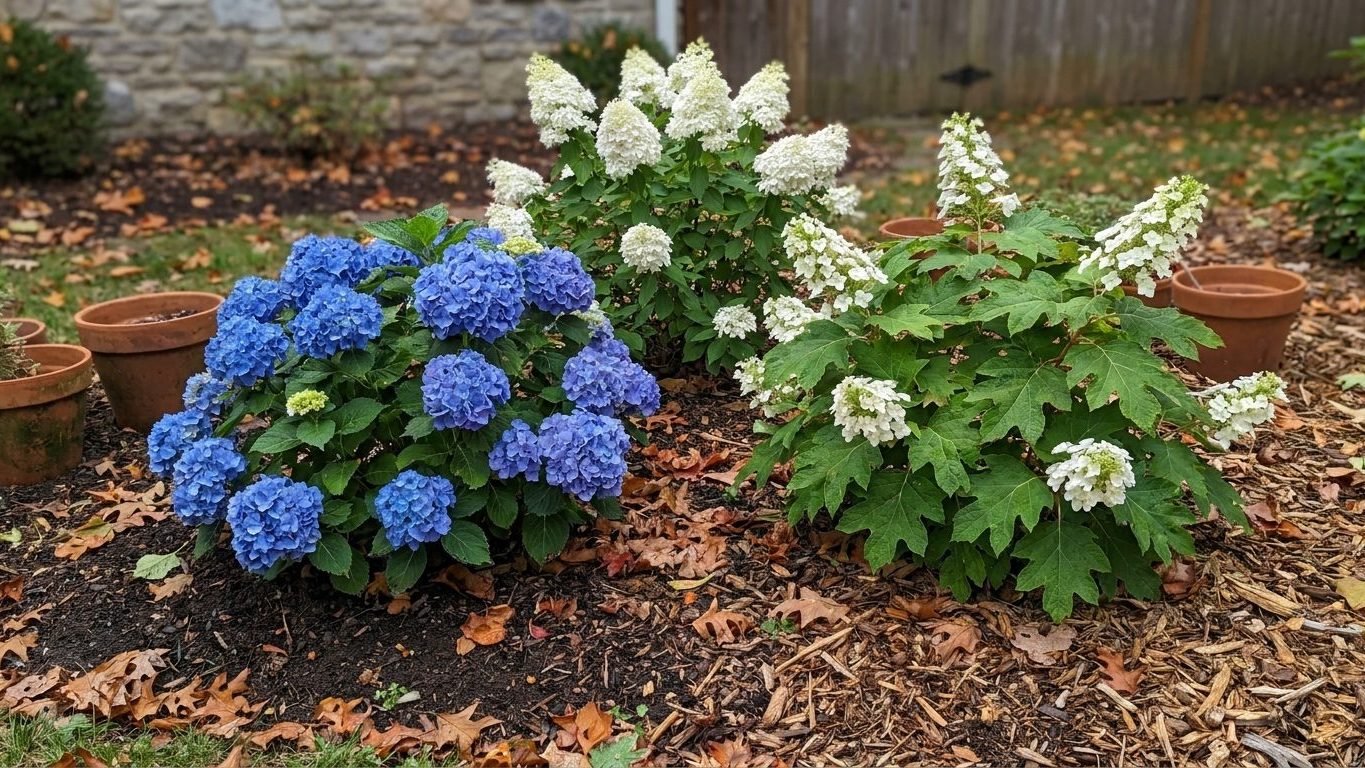
None of the classic garden hydrangeas survive a winter outdoors in Nunavut. Rankin Inlet sits in Canadian hardiness zone 0a, and the frost-free window between June 19 and September 13 leaves barely enough summer for a container plant to leaf out, let alone root a shrub in open ground. Every variety named below is a container plant here, not a permanent border shrub.
Hydrangeas that grow well in Nunavut: The Short Answer
Natural Resources Canada’s Plant Hardiness Site rates Rankin Inlet, the reference city for this territory, at Canadian zone 0a, the coldest class the country maps. No hydrangea sold at a garden center is bred to finish a winter in that zone, so every plant has to live as a container specimen, moved indoors before the ground freezes.
Smooth hydrangea (Hydrangea arborescens)

This is the toughest of the group farther south, and it is the one worth trying first in a large pot. It dies back hard even in mild climates, so a Nunavut freeze that kills the top growth is not fatal as long as the roots spend winter somewhere that never drops below freezing.
Panicle hydrangea (Hydrangea paniculata)

It blooms on new wood, which matters here because a plant that regrows from the base each spring can still flower the same summer. It still needs the coldest months indoors, since Rankin Inlet’s climate sits far below anything the species handles outdoors.
Mountain hydrangea (Hydrangea serrata)

Bred as a hardier cousin of the bigleaf types, it carries a reputation for slightly more cold tolerance in trials farther south. That reputation was built in places with a real autumn, not a three-month summer, so treat it as a sunroom plant that visits the porch in July.
Bigleaf hydrangea (Hydrangea macrophylla)

This is the hydrangea most homeowners picture, with mophead or lacecap blooms, and it is also the least equipped for this climate. It flowers on old wood, so any stem that freezes over winter takes next year’s blooms with it, and here that means nearly the whole plant.
Oakleaf hydrangea (Hydrangea quercifolia)

Grown for its cone-shaped blooms and fall color farther south, it needs a longer, warmer season than the one bounded by June 19 and September 13 to mature its wood before frost. Expect a plant that survives indoors but rarely flowers on the Nunavut calendar.
Climbing hydrangea (Hydrangea anomala subsp. petiolaris)

This woody vine wants years of undisturbed growth on a wall or trellis to reach blooming size, which makes it the least practical of the six for a plant that lives in a pot and moves indoors each fall. Try it only once the other five are already established.
Nunavut — the year and the numbers
- State
- Nunavut
- Hardiness zones
- 0a
- Last spring frost
- June 19
- First fall frost
- September 13
- Annual rain
- 12 in
- Lawn zone
- cool-season
- Source
- Environment and Climate Change Canada — Canadian Climate Normals 1981-2010, station RANKIN INLET A · Rankin Inlet
How to Work Out the Dates for Your Own Yard
The two mean dates from Environment and Climate Change Canada’s Canadian Climate Normals give you a starting point, not a guarantee, so work through your own yard before you trust a pot to the outdoors.
- Start from the mean, not a calendar square: the average last spring frost at Rankin Inlet falls on June 19, but that is a midpoint, so in half of all years frost lands later.
- Add a margin for your own site: if you garden away from Rankin Inlet, on higher ground or farther from open water, push that date back a week or two before moving a container outside.
- Work backward from the fall mean the same way: the average first fall frost lands September 13, and again it arrives earlier in half of all years, so bring pots in at the first cold snap rather than waiting for the calendar.
- Time feeding and pruning to the same short season: fertilize in May and again in July, and prune a bigleaf plant only in June or July, while it still has weeks of light to recover before it goes back inside.
Of the six varieties above, smooth hydrangea gets through a Nunavut summer because it flowers on wood it grows fresh each June, matching the outdoor window exactly. Climbing hydrangea does not get through even one season here, since it needs years of undisturbed stem growth that a plant carried indoors every September never allows.
Nunavut North to South: How the Dates Shift
Nunavut is not one climate, and the Rankin Inlet dates describe only the Kivalliq region around it.
- The Kivalliq coast (Rankin Inlet, Arviat, Whale Cove): nearby open water keeps the shoulder seasons a touch milder than inland sites at the same latitude, which is the only reason a container plant gets any outdoor time at all.
- The Kitikmeot region (Cambridge Bay, Gjoa Haven, Kugluktuk): farther west of the reference station, expect the safe outdoor window to run shorter than the Rankin Inlet dates suggest.
- The Qikiqtaaluk region (Iqaluit, Pond Inlet, Pangnirtung): this stretch covers the territory’s most southerly and most northerly communities at once, so a Baffin Island yard can sit closer to or far colder than the Kivalliq mean depending on exactly where it sits.
None of this changes the bottom line, it only changes how much margin to build in before trusting a pot to the outdoors.
Mistakes Nunavut Punishes
Planting a hydrangea straight into garden soil
The mistake comes from treating a Nunavut yard like a temperate one, where a shrub roots in and stays. At Canadian zone 0a, an in-ground hydrangea does not survive its first winter, so keep every plant in a pot that can move under cover before the season turns.
Trusting the fall date as a hard deadline
The mean first frost is not a promise, and in half of all years it lands earlier than the chart suggests. Watch the forecast instead of the calendar, and bring containers indoors at the first cold snap rather than waiting for a date to arrive.
Pruning a bigleaf plant in August
Cutting back old wood outside the June or July window leaves fresh cuts with no time to callus before the plant goes back indoors. Stick to the June or July pruning window, and leave August growth alone until the next cycle.
Nunavut Extension Offices and County Contacts
Rankin Inlet’s numbers are a starting point, and the federal department fills in what a single weather station cannot tell you about your own yard.
- Agriculture and Agri-Food Canada: the federal department’s site, since Nunavut does not run its own public gardening line.
- Your state page: the frost dates and the pruning window gathered in one place for Nunavut.
- What goes wrong here: the pests and problems specific to growing a hydrangea in this climate.
Common questions
Can any hydrangea survive outdoors year-round in Nunavut?
No. Canadian zone 0a at Rankin Inlet is colder than any hydrangea species is bred to handle outdoors, so every plant needs to spend winter under cover.
Which hydrangea is the best starting point for a Nunavut container garden?
Smooth hydrangea, since it flowers on wood it grows fresh each June and tolerates a hard dieback better than the other five varieties named above.
How long is the outdoor growing season for a potted hydrangea in Nunavut?
The mean window runs from June 19 to September 13 at Rankin Inlet, and since that is an average, some years give less time and some give more.