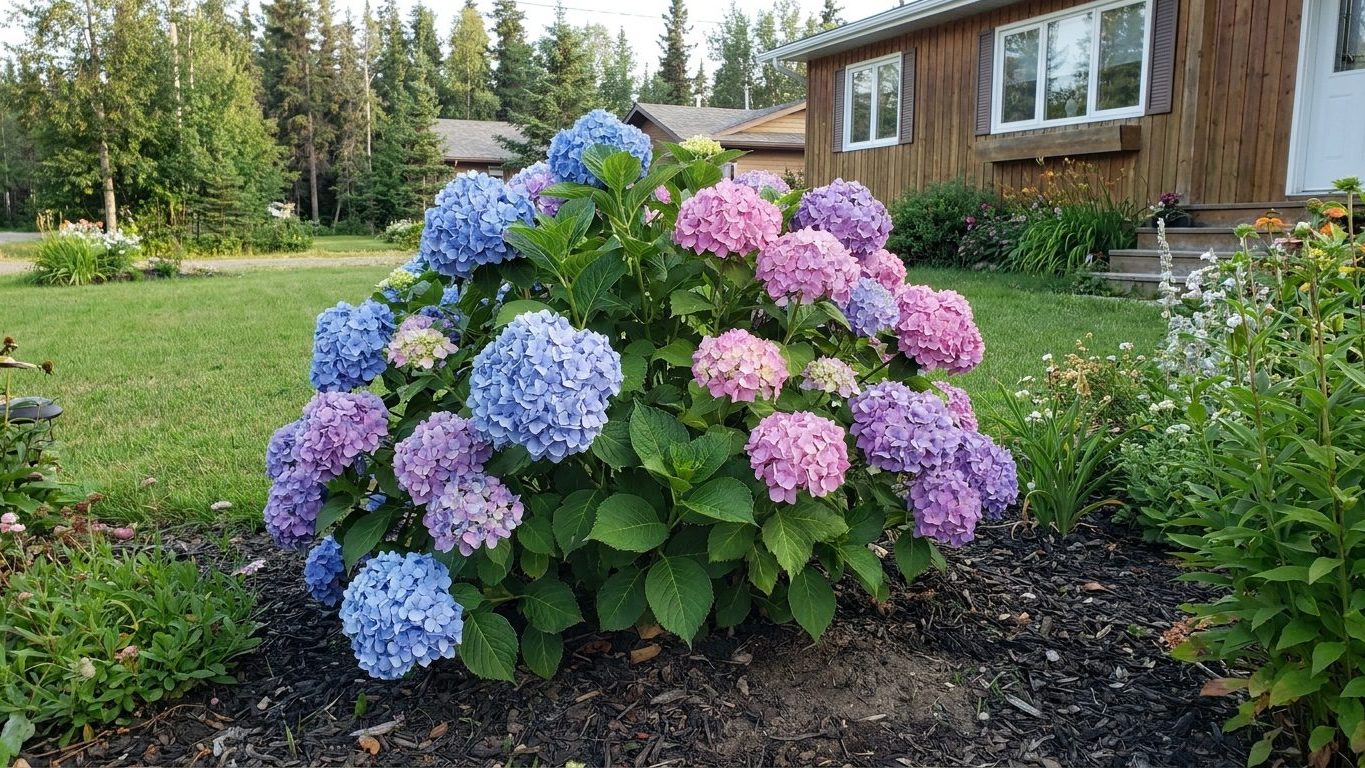
Hydrangeas in the Northwest Territories face one dominant problem, and it isn’t a bug or a fungus. Cold arrives early enough and stays hard enough that dieback and failed flower buds outnumber every insect or disease complaint combined. That single fact shapes when you plant, when you prune, and how much bloom you can reasonably expect from a shrub pushed to the far edge of its range in a zone this cold.
Hydrangea pests and diseases Northwest Territories: The Short Answer
Natural Resources Canada’s Canada’s Plant Hardiness Site rates Yellowknife at zone 1b in the Canadian system, a rating cold enough that most of what gardeners here call a hydrangea problem turns out to be winter injury rather than a pest or a pathogen.
Environment and Climate Change Canada’s mean dates for station YELLOWKNIFE A put a last spring frost near May 25 and a first fall frost near September 18, a frost-free stretch of roughly 116 days too short for many hydrangea insects and fungi to build up any real presence.
No blooms after a hard winter
Bigleaf hydrangeas set next year’s flowers on stems grown the previous summer, and zone 1b cold kills those buds most winters. A shrub can leaf out fully and still skip flowering entirely. Check the which-ones-hold-up guide before choosing a variety that blooms only on old wood.
Blackened stems after the last frost

New growth pushed out before the mean frost date often blackens within days if a late frost follows, since May 25 is a midpoint and half of all years run later. Cut stems back to live green tissue during the June pruning window, and hold new plantings until the calendar’s window opens.
Leaves scorched along the edges

Constant wind across open yards dries leaf margins faster than roots in cool ground can resupply, leaving a brown, papery edge by midsummer. Site the shrub out of prevailing wind and mulch heavily to hold soil moisture, since there is little room to lose leaf area in such a short season.
Stunted growth in a short season

A frost-free stretch of roughly 116 days limits how much a hydrangea can put on before it has to start hardening for fall. Fertilize only in the May and July windows the calendar allows, since a late feeding pushes soft growth the plant has no time left to ripen.
Roots sitting in cold, wet soil
Thin soils over rock or permafrost drain slowly in low spots, and roots left sitting in cold water through a wet spring weaken before top growth even starts. Plant in a raised bed or amended, well-drained spot rather than the lowest corner of the yard.
Northwest Territories — the year and the numbers
- State
- Northwest Territories
- Hardiness zones
- 1b
- Last spring frost
- May 25
- First fall frost
- September 18
- Annual rain
- 11 in
- Lawn zone
- cool-season
- Source
- Environment and Climate Change Canada — Canadian Climate Normals 1981-2010, station YELLOWKNIFE A · Yellowknife
How to Work Out the Dates for Your Own Yard
Work outward from the two mean dates instead of trusting a single square on a calendar, since neither one is a promise.
- Mark May 25 as a midpoint, not a deadline: Environment and Climate Change Canada’s Canadian Climate Normals for station YELLOWKNIFE A set the mean last spring frost at May 25, and in half of all years the real frost lands later than that.
- Wait for the site’s planting window to open: the calendar above only lists May, June, July, and August for planting, so treat early May as too soon even with the mean frost already past.
- Fertilize only in the two months allowed: May and July are the sole feeding windows listed here, so a June feeding wastes fertilizer on roots still waking from cold soil.
- Prune bigleaf stems in June or July: cutting in May risks removing wood that survived winter, so wait until new growth shows which stems actually made it through.
- Count back from September 18: that is the mean first fall frost at the same station, so treat late August as the point to stop pushing new growth and start letting stems harden.
Once those dates are marked, matching a symptom to its cause gets easier. A shrub with blackened stems in early June is showing frost damage, not disease, if the timing lines up with a cold snap after May 25.
A shrub with no blackening but no flowers either is more likely carrying bud kill from winter, the more common of this territory’s two main complaints.
Northwest Territories North to South: How the Dates Shift
Yellowknife sits near the middle of the territory’s settled corridor, and every other community shifts those mean dates in one direction or another.
- The southern Mackenzie Valley (Hay River, Fort Smith, Fort Providence): lower latitude and the moderating pull of Great Slave Lake stretch the frost-free window a little longer than Yellowknife sees, though still far short of a long growing season.
- The central corridor (Yellowknife, Behchokǫ̀, Dettah): this is the reference band the dates above describe, and it sets the calendar the rest of this guide uses.
- The Arctic communities (Inuvik, Tuktoyaktuk, Sachs Harbour): higher latitude and permafrost close in the frost-free window further still, so a planting date drawn from Yellowknife should be read as generous, not exact, that far north.
Whichever community you garden in, use the territory guide as the starting point and shift toward a shorter season the farther north you sit.
Mistakes Northwest Territories Punishes
Planting on the first warm day
Nursery stock often appears in early May, well before the mean last frost near May 25 has any chance to pass, and gardeners plant the same week it arrives. Wait for the site’s May-through-August window to genuinely open, and check the ground itself rather than the store shelf.
Pruning before new growth shows
Cutting bigleaf stems back in May, before the June pruning window, often removes wood that actually survived winter and still holds live buds. Wait until new leaves appear so you can see which stems made it, then prune only in June or July.
Skipping stem protection before fall
Leaving stems bare past the mean first fall frost near September 18 lets an early cold snap kill more wood than a season this short can afford to lose. Wrap or mulch stems before that date arrives, not after the first hard freeze already hit.
Northwest Territories Extension Offices and County Contacts
The zone 1b rating above is a starting point, not the whole story for your particular yard. The territorial agriculture office fills in the rest, from soil questions to what’s actually surviving nearby.
- Your territory guide: the frost dates and the pruning window for the Northwest Territories as a whole.
- Which ones hold up here: the hydrangea types worth the space in a zone 1b yard.
- GNWT Agriculture and Agrifoods: the territorial office to call before committing a hydrangea to open ground.
Common questions
Can a hydrangea survive winter in Yellowknife without protection?
Most types struggle at zone 1b without help, and even hardy stems often lose their flower buds to cold that lands after the mean May 25 frost date. Wrapping or mulching before the mean first fall frost near September 18 improves the odds but doesn’t guarantee bloom the following summer.
What’s the earliest safe date to plant a hydrangea here?
The calendar for this territory opens planting in May, but the mean last frost sits near May 25 and runs later in half of all years. Waiting until closer to June, once the planting window is fully open, avoids losing a new shrub to a late cold snap.
Why won’t my hydrangea bloom even though it looks healthy?
Healthy leaves don’t mean healthy flower buds. Bigleaf types set next year’s blooms on old wood, and zone 1b winters often kill that wood even when the roots and lower stems survive fine. Check the which-ones-hold-up guide for types that bloom on new growth instead.