Skip to content

Hydrangea Pests and Diseases in Rhode Island

Hydrangea Pests and Diseases in Rhode Island

Hydrangeas in Rhode Island face a fairly short list of real problems: aphids and four-lined plant bugs early in the season, powdery mildew and leaf spot through humid summer stretches, and winter bud kill on bigleaf varieties when a hard freeze catches unprotected stems. Providence, the reference city for the state’s climate data, anchors most of what follows below.

Hydrangea Pests and Diseases Rhode Island: The Short Answer

Seven problems account for nearly every hydrangea complaint that reaches Providence-area garden centers, and they tend to arrive in a predictable order tied to the growing season. Knowing which one is active this week turns the fix from a guess into a five-minute check.

Aphids on new growth

Aphids cluster on soft spring tips as hydrangeas push new leaves, curling foliage and leaving a sticky residue behind. They multiply fast in mild weather but rarely kill an established shrub. A strong water spray or insecticidal soap knocks populations down within a week.

Four-lined plant bug spots

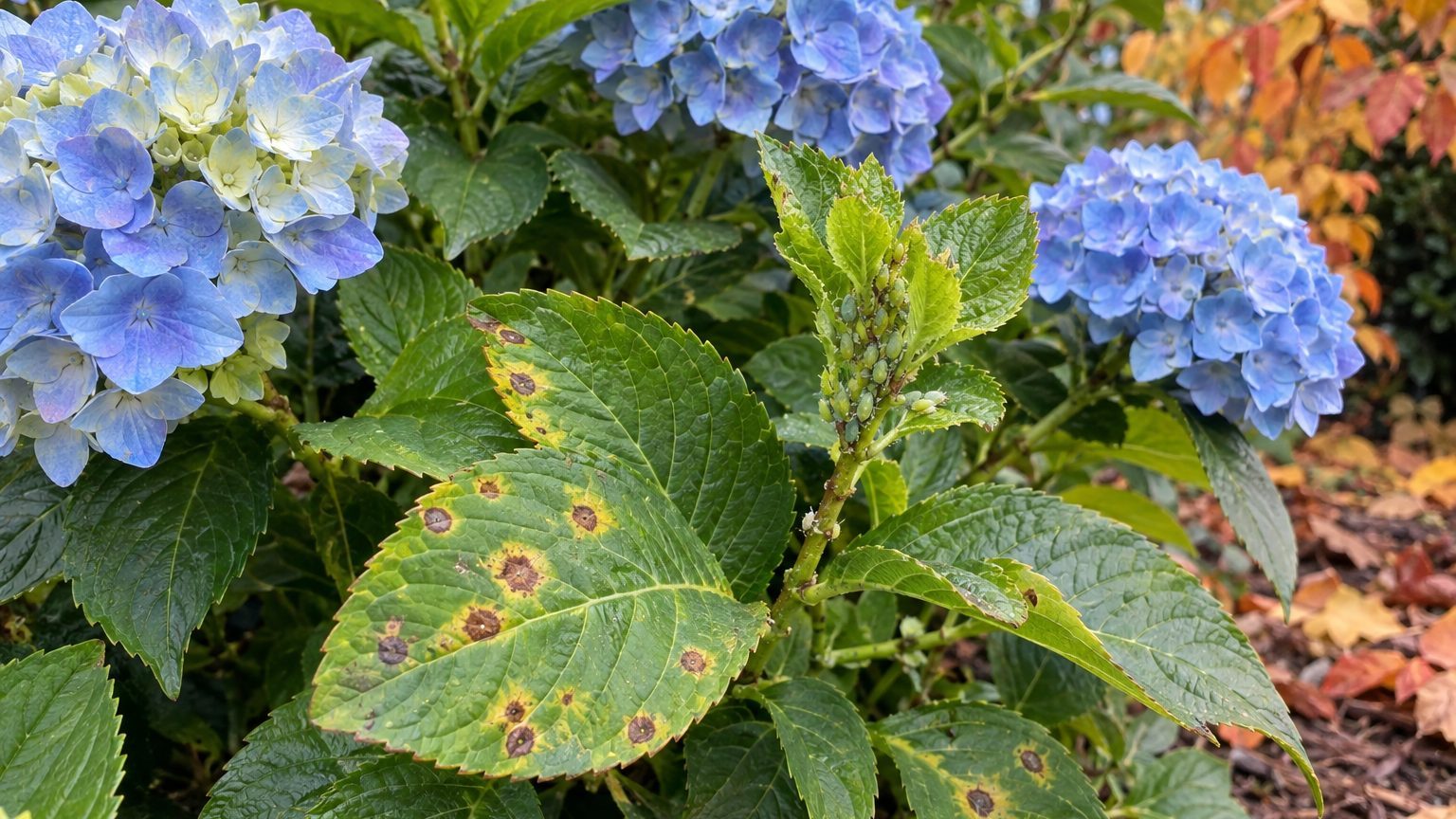
Small circular brown spots that appear almost overnight on leaves in late May or June point to four-lined plant bug, an insect active for only a few weeks each year. The damage looks alarming but stays cosmetic, and most shrubs simply grow past it by midsummer.

Powdery mildew on leaves

A gray-white film across upper leaf surfaces during humid stretches signals powdery mildew, which thrives where air barely moves. Spacing shrubs for airflow and watering the soil instead of the foliage keeps it from spreading. It dulls the show more than it threatens the plant.

Cercospora leaf spot

Purple-brown spots ringed in yellow on lower leaves late in the season are the calling card of Cercospora leaf spot, a fungus that builds up in wet, crowded plantings. Removing affected leaves rather than composting them keeps next year’s infection lighter.

Botrytis blight on blooms

Botrytis blight on blooms — Hydrangea Pests and Diseases in Rhode Island

Cool, wet stretches can turn flower clusters and soft stems brown and mushy almost overnight, a sign of Botrytis blight. Thinning stems for airflow and deadheading spent blooms promptly limits how far it spreads, especially on shrubs already stressed by an earlier dry spell.

No flower buds after winter

When a bigleaf hydrangea leafs out but skips flowers entirely, winter bud kill is almost always the cause. The USDA Plant Hardiness Zone Map puts Providence at zone 6a to 7b, where a hard snap can freeze next year’s buds outright. A loose mulch collar over the crown each fall is the fix that holds.

Deer browsing in fall

Stripped leaves and snapped stems low on the shrub in October and November usually mean deer, not disease, especially once other food sources thin out. A physical barrier over winter protects both the wood and next year’s flower buds better than repellent sprays alone.

How to Work Out the Dates for Your Own Yard

Matching a symptom to the right week takes counting backward from Providence’s frost windows rather than from a fixed calendar date.

  1. Mark the frost windows: NOAA NCEI U.S. Climate Normals puts Providence’s last spring frost between April 7 and April 17 and the first fall frost between October 24 and November 3, and every timeline below sits inside that stretch.
  2. Watch the weeks right after last frost: aphids and four-lined plant bug show up as soon as new growth hardens off, once frost risk has cleared.
  3. Track the humid middle of summer: powdery mildew and Cercospora leaf spot build during the same stretch the calendar table above calls for a summer fertilizer round.
  4. Check bloom timing against blight risk: cool, wet weeks ahead of the October to November fall frost window are when Botrytis moves fastest through open blooms.
  5. Test bud survival at the first spring push: if leaves emerge but flower buds stay bare past mid-May, count back to the winter’s coldest snap rather than to any insect.
  6. Call in the extension office for a confirmed ID: a sample in a sealed bag beats a phone description every time.

None of this replaces looking at the actual leaf or stem in hand, but lining up the symptom against the week of the year it appeared cuts most of the guesswork out of a diagnosis.

Rhode Island North to South: How the Dates Shift

Rhode Island barely stretches 40 miles top to bottom, but that’s enough to shift both frost timing and disease pressure across three rough bands.

  • Coastal Rhode Island (Newport, Narragansett, Westerly): the ocean holds heat into fall, delaying the first frost and stretching the powdery mildew season a few extra weeks.
  • Providence and the inland lowlands (Providence, Cranston, Warwick): this is the reference band for the state’s frost dates and zone figures, and where the calendar above lines up most closely.
  • Northern uplands (Woonsocket, Chepachet, Foster): colder air pools here first, and the zone 6a end of the state’s range sits mostly in this band, raising winter bud kill risk.

Check the state guide’s zone map for which band a given zip code falls into before setting a treatment or winter protection schedule.

Mistakes Rhode Island Punishes

Watering the leaves at dusk

Evening sprinklers that leave foliage wet overnight give powdery mildew and Cercospora leaf spot exactly the damp window they need, and humid summer air makes that window last. A soaker hose at the base, run in the morning, dries leaves by nightfall.

Skipping fall cleanup

Leaving matted leaves under the shrub through winter lets leaf spot spores and Botrytis overwinter right where they’ll reinfect new growth in spring. Raking and discarding fallen leaves, not composting them, closes that loop before the ground freezes.

Pruning bigleaf hydrangea outside June and July

Cutting back a bigleaf hydrangea outside its window removes the very buds that survived winter and were about to bloom, on top of whatever cold damage the season already caused. Sticking to June and July protects next year’s flowers twice over.

Rhode Island Extension Offices and County Contacts

Providence’s frost dates and zone 6a to 7b range are a starting point, not a diagnosis. The University of Rhode Island Cooperative Extension office fields the calls that follow, and often asks for a leaf sample before naming a fungus or an insect for certain.

  • Your state page: the frost dates and pruning window for wherever you live in Rhode Island.
  • Which hydrangeas hold up here: variety by variety picks matched to zone 6a to 7b.
  • The planting calendar: the fertilize, plant, and prune months laid out in order.

Common questions

Do all Rhode Island hydrangeas get powdery mildew?

No. Panicle and smooth hydrangeas resist it far better than bigleaf varieties, whose broad, closely spaced leaves trap moisture against the plant.

Is winter bud kill treatable once it happens?

Not for that season. A shrub that loses its buds to a hard freeze will still leaf out and grow, just without flowers, and next year’s buds can be protected with mulch instead.

Should I spray hydrangeas preventively each spring?

Most Rhode Island yards don’t need it. Spacing plants for airflow and watering at the soil line prevents more disease than any routine spray schedule does.
When to Prune Hydrangeas in Rhode Island

When to Prune Hydrangeas in Rhode Island

Providence is the reference point for Rhode Island’s frost dates, and that changes when a hydrangea can safely go into the ground or come under the pruning shears. Planting opens in April and May, then again in August and September. Bigleaf pruning belongs to June and July only, right after bloom, never in fall.

When to prune hydrangeas in Rhode Island: The Short Answer

Here is how the year unfolds for a Rhode Island yard, using Providence’s frost dates and the state’s own fertilize, plant, and prune windows as the anchor points.

  • January: The ground stays frozen most weeks. Hydrangeas sit fully dormant, so the only task is checking that heavy snow hasn’t cracked a branch.
  • February: Order bare-root stock or sketch out a bed location. Nothing goes into the soil yet, since the ground is still too cold to dig.
  • March: March opens the first fertilize window on Rhode Island’s calendar. Feed established shrubs once soil turns workable, but hold off on planting new ones.
  • April: Planting opens this month, though NOAA NCEI U.S. Climate Normals 1991-2020 puts Providence’s last spring frost between April 7 and April 17. Wait until that window passes before a new hydrangea touches the ground.
  • May: May carries a fertilize round and one of the year’s two strongest planting months. Soil has warmed enough by now that roots settle in fast.
  • June: Pruning bigleaf hydrangeas begins once the first bloom flush fades. Cut spent stems back to a strong bud pair, never touching healthy new wood.
  • July: The pruning window closes here, alongside the third and final fertilize month. This is the last feeding before shrubs shift energy into next year’s buds.
  • August: Planting reopens for fall, the first of two remaining months on the calendar. Warm soil and cooling air give new roots an easier start than spring offers.
  • September: This is the second fall planting month, and the earlier in the month a shrub goes in, the more root time it gets before frost returns.
  • October: Providence’s first fall frost lands between October 24 and November 3, so this month is for deep watering, not planting.
  • November: Once frost has settled in for good, mound mulch over the root zone of bigleaf varieties to protect the flower buds already set for next year.
  • December: Shrubs are fully dormant and need no feeding or cutting. Brush heavy snow off the branches before the weight snaps a stem.

Those twelve months follow Rhode Island’s actual fertilize, plant, and prune windows, not a generic national calendar. A shrub planted in June or pruned in September breaks both rules at once.

How to Work Out the Dates for Your Own Yard

Every date on that calendar starts from the same anchor, Providence’s frost window, and shifts by math a homeowner can run at home.

  1. Start from the airport average: NOAA NCEI U.S. Climate Normals 1991-2020 puts Providence’s last spring frost between April 7 and April 17, and that range is a floor, not a guarantee, for the rest of the state.
  2. Add a week or two for a rural yard: Suburban and rural gardens typically see frost linger one to two weeks longer than the airport gauge, so a yard outside the city core should treat late April as the real starting line.
  3. Match the state’s planting months: Rhode Island’s calendar opens planting in April and May, then again in August and September, so pick whichever window falls after your adjusted frost date.
  4. Count forward to the pruning months: A hydrangea planted this spring won’t need cutting back until June or July, once the first bloom cycle finishes.
  5. Check your zone before choosing a variety: USDA Plant Hardiness Zone Map 2023 places Rhode Island between zone 6a and 7b, and a shrub rated no hardier than 7a is gambling on the colder half of that range.

Run those five checks against your own address and the calendar above turns from a state average into a personal schedule.

Rhode Island North to South: How the Dates Shift

Rhode Island is small, but a few miles inland or up the bay can shift these windows by a week or more.

  • Coastal Rhode Island (Newport, Narragansett, Block Island): the ocean holds heat longer, so both frost dates run later in fall and earlier in spring than Providence’s average, giving hydrangeas a longer season.
  • The Providence area and the Bay (Providence, Warwick, East Providence): this is the reference zone the state’s frost windows are built from, so the calendar above applies most directly here.
  • Inland and northern Rhode Island (Woonsocket, Chepachet, the Blackstone Valley): higher ground and distance from the bay mean frost arrives sooner in fall and lingers longer in spring, so lean toward the late end of every window.

For the state’s own frost and hardiness figures rather than these regional shifts, the Rhode Island hydrangea guide keeps the full range in one place.

Mistakes Rhode Island Punishes

Planting before the last frost clears

New hydrangeas set out before Providence’s window closes, April 7 to April 17 per NOAA NCEI U.S. Climate Normals 1991-2020, can lose their first flush of leaves to a late cold snap. Wait for the window to pass, then use April or May instead of guessing.

Pruning bigleaf hydrangeas in fall

Cutting bigleaf stems back in September or October removes flower buds already set for next year, since this species blooms on old wood. Keep pruning inside June and July, the only two months Rhode Island’s calendar allows for this cut.

Skipping winter protection on exposed buds

A bigleaf hydrangea left bare through a Rhode Island winter often blooms only from the base the following summer, because exposed buds die in the cold. Mound mulch over the root zone once the first fall frost settles in, typically by early November.

Rhode Island Extension Offices and County Contacts

Rhode Island’s hardiness range and frost windows come from statewide weather stations and USDA maps, but a local office can confirm what’s happening in a specific yard. The University of Rhode Island Cooperative Extension is the state’s land-grant contact for that kind of check.

  • Your state page: the Rhode Island hardiness zones and frost dates gathered in one place.
  • Which ones hold up here: the hydrangea varieties matched to Rhode Island’s zone 6a to 7b range.
  • What goes wrong here: the pests and problems most common in Rhode Island yards, and the fix for each.

Common Questions

Can I plant hydrangeas in Rhode Island in the fall?

Yes. August and September are both planting months on Rhode Island’s calendar, and fall planting often outperforms spring because the soil stays warm while the air cools, letting roots establish without heat stress.

What happens if I prune bigleaf hydrangeas outside June and July?

The shrub survives, but it skips a bloom season, because pruning in fall, winter, or spring removes flower buds already set on old wood. June and July are the only months the state’s calendar sets aside for this cut.

Does Rhode Island’s coast really change the planting window?

It can. Coastal spots near Narragansett Bay tend to see a later first fall frost and an earlier last spring frost than Providence’s airport average, stretching the safe planting season by a week or more in a mild year.

Hydrangeas That Grow Well in Quebec

Hydrangeas That Grow Well in Quebec

Panicle and smooth hydrangeas top the list for Quebec yards, tolerating winters that test Canadian zone 5b around Montreal without much trouble. Bigleaf hydrangea struggles here, since its flower buds rarely survive the cold intact. The difference comes down to one detail, whether the shrub blooms on new wood grown each spring or old wood set the summer before, and that detail decides whether a Quebec garden flowers most years or sits green and bare.

Hydrangeas that grow well in Quebec: The Short Answer

Panicle and smooth hydrangeas hold up best around Montreal, where Natural Resources Canada’s Plant Hardiness Site puts the region at zone 5b in the Canadian system, a scale built on seven climate variables rather than the single-variable USDA zones used south of the border. Bigleaf hydrangea sits at the other end of that list, since its flower buds rarely make it through a Montreal winter whole.

Panicle hydrangea (Hydrangea paniculata)

Panicle hydrangea (Hydrangea paniculata) — Hydrangeas That Grow Well in Quebec

It flowers on new wood grown fresh each spring, so even a hard winter that kills the top growth back barely costs it a season of bloom. Full sun and ordinary soil are about all it asks for here.

Smooth hydrangea (Hydrangea arborescens)

Smooth hydrangea (Hydrangea arborescens) — Hydrangeas That Grow Well in Quebec

Native across eastern North America, this species treats a Quebec winter as routine weather rather than a threat. It also blooms on new wood, and it tolerates more shade than paniculata, which makes it useful under the maple canopy so many yards already have.

‘Limelight’ panicle hydrangea

'Limelight' panicle hydrangea — Hydrangeas That Grow Well in Quebec

A named selection of the hardy species above, ‘Limelight’ brings reliable lime green blooms that age toward pink without any extra winter wrapping. Gardeners on cooler, upland sites report it performing almost as well as those close to the city center.

‘Annabelle’ smooth hydrangea

'Annabelle' smooth hydrangea — Hydrangeas That Grow Well in Quebec

This selection produces oversized white blooms every summer no matter how rough the preceding winter was, since it shares the new wood habit of its parent species. Its stems are soft though, so a spot sheltered from wind matters more than any frost concern.

Oakleaf hydrangea (Hydrangea quercifolia)

Oakleaf hydrangea (Hydrangea quercifolia) — Hydrangeas That Grow Well in Quebec

This one sits in the middle of the list. Its flower buds form on old wood the year before, so a severe winter can erase a coming summer’s bloom even while the shrub itself lives on. A wall-sheltered corner and the fall foliage color make it worth the gamble.

Bigleaf hydrangea (Hydrangea macrophylla)

Bigleaf hydrangea (Hydrangea macrophylla) — Hydrangeas That Grow Well in Quebec

This is the shrub that disappoints most first-time buyers here. It flowers mostly on old wood set the previous year, and Quebec’s winter routinely takes those buds before spring, leaving a healthy green plant that skips flowering entirely some years. Reserve it for the most sheltered, heavily mulched corner of the yard.

How to Work Out the Dates for Your Own Yard

Working out whether a specific hydrangea will thrive in your own yard, rather than in a province-wide average, comes down to matching its wood type and root hardiness against the numbers for your own microclimate.

  1. Check your own frost window: Environment and Climate Change Canada’s Climate Normals put the mean last frost across the Montreal area at around May 6, though half of all years run later than that, so treat the following two or three weeks as still risky for tender new growth.
  2. Count backward from first fall frost: the mean date sits around October 5, which gives roughly five months of growing season before wood needs to harden off for winter.
  3. Match the bloom type to the wood: panicle and smooth hydrangeas bloom on new wood grown after May, so a late frost barely costs them a season, while bigleaf and oakleaf set buds on old wood the previous fall and can lose them outright in a hard winter.
  4. Plant inside the state’s planting months: stick to May, June, August, or September, skipping peak midsummer heat so roots establish before the next stress arrives.
  5. Fertilize only in the two feeding months: May and July line up with active growth, and feeding outside that window pushes soft late growth that winter kills.
  6. Prune bigleaf only in June or July: pruning any later removes the buds that would have carried next year’s bloom.

Take ‘Limelight’ as the name that clears every check here: new wood, forgiving of the May frost window, and reliably in bloom by August most years. Bigleaf hydrangea fails the same test in most Quebec yards, since buds set the previous September rarely survive intact to June.

Quebec North to South: How the Dates Shift

Quebec’s frost dates don’t apply evenly from the St. Lawrence Valley to the boreal edge, and elevation or nearness to open water shifts them further than most gardeners expect.

  • The Montreal and Monteregie lowlands (Montreal, Longueuil, St-Hubert): the mildest planting window in the province.
  • The Quebec City corridor and Eastern Townships (Quebec City, Sherbrooke, Estrie): farther from the moderating St. Lawrence flow, so frost lingers a bit longer into spring and returns a bit sooner in fall.
  • Saguenay-Lac-Saint-Jean and the north shore (Saguenay, Chicoutimi, Baie-Comeau): colder air pools here well before it reaches Montreal, pushing safe planting weeks behind the provincial reference dates.
  • The Gaspésie coast (Gaspé, Rimouski, Matane): exposed to wind off the gulf, which delays spring warmth but also softens the sharpest winter lows near the water.

Whichever part of the province you garden in, your own yard’s exposure decides the final week.

Mistakes Quebec Punishes

Planting bigleaf in an open, windswept spot

Cold air pools in low, exposed yards, and Quebec winters push straight through unprotected bigleaf hydrangea, killing buds set the year before. Choose a wall-sheltered or fence-sheltered corner instead, and mound mulch over the crown before the ground freezes.

Pruning bigleaf hydrangea in fall

Cutting back bigleaf or oakleaf after summer removes the buds meant to open the following June, since both set flowers on old wood. Save pruning for June or July only, right after bloom, and stop once September planting winds down.

Fertilizing outside the two feeding months

A late summer feeding pushes soft new growth that has no time to harden before the mean fall frost arrives. Stick to May and July only, then let the plant slow down naturally into fall.

Quebec Extension Offices and County Contacts

The zone 5b figure for Montreal is a starting point, not a verdict on your own street, and Quebec’s agricultural ministry carries the local detail from there.

  • Quebec hydrangea calendar: month-by-month planting, feeding, and pruning windows for this province.
  • What goes wrong with hydrangeas in Quebec: the pests and cold-damage symptoms specific to this climate.
  • MAPAQ: Quebec’s agriculture ministry connects to regional offices for soil and pest questions by county.

Common Questions

Will bigleaf hydrangea survive winter in Quebec?

The plant itself usually survives, but its flower buds often don’t, since they form on old wood the previous fall. A heavily mulched, wall-sheltered spot improves the odds, but expect some years with green growth and no blooms at all.

When should I plant hydrangeas in Quebec?

Stick to the state’s planting months, May, June, August, or September, so roots have time to settle before summer heat or winter cold arrives. Planting outside those windows gives the shrub less time to establish before stress hits.

Do hydrangeas need winter protection in Quebec?

Panicle and smooth hydrangeas rarely need it, since they rebuild their blooms from new wood every spring. Bigleaf and oakleaf benefit from a thick mulch mound over the crown before the ground freezes, left in place until new growth starts.

Hydrangea Pests and Diseases in Quebec

Hydrangea Pests and Diseases in Quebec

In Quebec, hydrangea trouble follows the calendar more than the plant itself. Winter bud kill shows up first, then aphids and mildew once summer humidity settles over the St. Lawrence valley, and yellowing leaves from alkaline clay run through the whole season. Montreal/St-Hubert’s cold winters cause most of what a bigleaf hydrangea shows here.

Hydrangea pests and diseases Quebec: The Short Answer

Natural Resources Canada’s Plant Hardiness Site puts Montreal/St-Hubert at zone 5b on the Canadian scale, and that number explains why the most common problem on a Quebec hydrangea isn’t a bug at all: it’s cold injury to last year’s flower buds. The second most common problem is fungal, powdery mildew or leaf spot, showing up once July humidity settles over Montérégie and the Eastern Townships.

Bare stems, no flowers in June

Bare stems, no flowers in June — Hydrangea Pests and Diseases in Quebec

Most bare bigleaf hydrangeas in Quebec lost last fall’s flower buds to a hard cold snap, not to disease, since zone 5b winters routinely dip below what those buds tolerate. Scratch a stem for green wood before cutting, and mulch crowns heavily going into next winter.

Curled new growth in early summer

Curled new growth in early summer — Hydrangea Pests and Diseases in Quebec

Aphids cluster on tender shoot tips as soon as June growth flushes, leaving sticky honeydew and sometimes sooty mold on the leaves below. A strong jet of water from the hose knocks most colonies off, and insecticidal soap clears out the rest without harming visiting bees.

White dust on upper leaves by midsummer

Powdery mildew moves in once July nights stay humid, coating leaves in a pale film that rarely kills the shrub outright but weakens it before fall dormancy sets in. Spacing plants for airflow and watering the soil instead of the foliage keeps most infections from taking hold.

Brown spots ringed in purple

Brown spots ringed in purple — Hydrangea Pests and Diseases in Quebec

Cercospora leaf spot shows up on the lower, older leaves first, then spreads upward as late summer rain splashes spores from leaf to leaf. Pulling off the worst leaves and binning rather than composting them keeps the fungus from overwintering in the debris at the base.

Gray, fuzzy patches on blooms

Gray, fuzzy patches on blooms — Hydrangea Pests and Diseases in Quebec

Botrytis blight favors the cool, wet stretches Quebec gets in early fall, turning flower clusters soft, brown, and gray almost overnight. Cutting spent blooms and clearing damp leaf litter before the average first fall frost on October 5 keeps the fungus from settling in for winter.

Sunken, dark cankers on stems

Sunken, dark cankers on stems — Hydrangea Pests and Diseases in Quebec

Botryosphaeria dieback girdles a cane below a winter crack or pruning wound, killing everything above it while the rest of the shrub still looks healthy. Prune the dead cane back to clean white wood a few inches below the canker, disinfecting shears between every cut.

Leaves yellow between green veins

Iron chlorosis comes from Quebec’s often-alkaline clay soils locking up nutrients the roots can’t absorb, not from any pest or fungus. A simple soil test confirms the pH, and an iron chelate drench greens the leaves back up within a few weeks.

How to Work Out the Dates for Your Own Yard

Diagnosing a Quebec hydrangea problem is mostly a matter of matching the symptom to the calendar, since most of what goes wrong here is tied to a specific stretch of the season rather than random bad luck.

  1. Check the timing first: a shrub bare of flowers in late May points to winter bud kill, not disease, because that’s before any fungus on this list gets going.
  2. Look at which leaves are affected: spots or mildew on lower, older leaves first mean a soil-borne fungus, while curling at the newest growth tips in June points to aphids instead.
  3. Count the days since the last rain: powdery mildew and Cercospora both need days of humidity to establish, so a dry stretch followed by symptoms usually rules out a fresh infection.
  4. Test before you treat for chlorosis: yellowing between green veins looks alarming but is a soil pH issue in Quebec’s clay far more often than a pest, so a soil test before buying a spray saves money.
  5. Watch the average frost windows: Environment and Climate Change Canada’s Canadian Climate Normals put Montreal/St-Hubert’s last spring frost at an average of May 6 and its first fall frost at an average of October 5, and cold damage clusters right around those windows while fungal issues cluster in the humid weeks between them.
  6. Match the fix to the prune window: since bigleaf pruning here runs June and July, cutting out dead or diseased wood inside that window avoids opening fresh wounds right before a cold snap.

Running through this order takes a few minutes and usually narrows six possible problems down to one before you touch a spray bottle.

Quebec North to South: How the Dates Shift

Quebec’s hydrangea problems don’t hit every region on the same week, since the province stretches from the mild St. Lawrence lowlands to boreal country further north.

  • Montérégie and Montreal’s south shore (closest to the Montreal/St-Hubert reference station): bud kill is mildest here and the fungal window runs longest, since humidity and mild winters both favor bigleaf hydrangeas.
  • Estrie and the Eastern Townships (hillier, cooler nights): expect more winter bud kill and a shorter fungal season, since cool nights slow the fungi even as they stress flower buds more.
  • Capitale-Nationale and Quebec City (a step colder than Montreal): bud kill becomes the dominant problem, and gardeners here often see almost no flowers on bigleaf types most years.
  • Saguenay-Lac-Saint-Jean and points north (short, cool summers): fungal disease pressure drops off sharply, but winter injury is severe enough that panicle and smooth types outperform bigleaf almost every year.
  • Gaspésie and the Côte-Nord (maritime cold, short season): winter injury and cold-related dieback dominate, while the fungal issues common near Montreal barely have time to develop before frost returns.

Whichever part of the province you garden in, your local frost window shifts these problems earlier or later than the reference dates for Montreal/St-Hubert on the state page.

Mistakes Quebec Punishes

Pruning bigleaf hydrangeas in fall

Cutting bigleaf stems back in September or October removes next year’s flower buds along with the wood, since those buds are already set for the following summer. Save pruning for June or July instead, and let winter dieback guide what comes off in spring.

Planting too late in the season

A hydrangea set into the ground in late September has almost no time to root before the first fall frost, and shallow roots rarely survive a zone 5b winter. Stick to the May, June, August, and September planting windows and get roots established well before the cold arrives.

Skipping mulch before winter

Bare soil around the crown lets frost reach roots and buds directly, and that’s often the real cause of a bare shrub the following June, not a pest at all. A thick layer of shredded leaves or bark laid down before the ground freezes protects the base through the coldest months.

Quebec Extension Offices and County Contacts

Zone 5b and the Montreal/St-Hubert frost dates are a starting point, not the whole picture, since soil, drainage, and microclimate vary from block to block. MAPAQ, the province’s agriculture ministry, tracks pest and disease alerts by region.

  • Your state page: the Quebec calendar with frost dates and the bigleaf pruning window for where you live.
  • Which ones hold up here: the hydrangea varieties that tolerate zone 5b winters without dying back to the ground.
  • MAPAQ: provincial guidance on local pests, soil testing, and extension contacts by region.

Common questions

Do I need to spray a Quebec hydrangea for pests every year?

No. Aphids and mildew show up most summers in some form, but a healthy shrub with good spacing and morning watering often shrugs them off without any spray at all, so treat only what you actually see.

Why does my hydrangea leaf out fine but never flower?

On bigleaf types in Quebec, that’s almost always winter bud kill rather than a growing problem, since the leaves come from buds lower on the stem than the flower buds that died over winter.

Can one product treat both chlorosis and a fungal leaf spot?

No. Chlorosis is a soil pH problem that needs an iron treatment and possibly a pH adjustment, while leaf spot needs sanitation and airflow, so a soil test first prevents treating the wrong problem.

When to Prune Hydrangeas in Quebec

When to Prune Hydrangeas in Quebec

In the Montreal area, the safe stretch for putting a hydrangea in the ground runs across four months on the provincial planting calendar: May, June, August, and September. That window sits inside a hardiness zone of 5b under the Canadian system, and it hugs the space between a mean last spring frost and a mean first fall frost that bookend the growing season here.

When to prune hydrangeas in Quebec: The Short Answer

Environment and Climate Change Canada’s Canadian Climate Normals put the mean last spring frost for the Montreal area, recorded at station Montreal/St-Hubert A, at May 6, and the mean first fall frost at October 5. Between those two dates, the province’s own planting calendar keeps hydrangeas out of the ground everywhere except May, June, August, and September, with bigleaf pruning confined strictly to June and July.

Here’s how those months break down across the full year:

  • January: The ground is frozen and the shrub is fully dormant, so there is nothing to plant or prune. A layer of snow over the root zone does the insulating for you.
  • February: Still deep winter here, so order any new hydrangea stock now for spring shipping. Resist pruning this early, since wounds this far from the growing season invite dieback.
  • March: The mean last frost is still roughly two months out, so soil stays too cold and wet to dig. Use the month to check drainage where you plan to plant.
  • April: Frost risk stays real this close to the May 6 average, so hold off on setting new shrubs. Watch buds on established plants for winter dieback instead.
  • May: The plant window opens, and fertilizing starts too, but the mean last frost falls on May 6 itself, meaning frost lands later than that in about half of years. Plant late in the month once soil has firmly warmed.
  • June: Planting continues, and this is also the first month of the bigleaf pruning window. Cut spent flowers back to a strong bud pair, never into old wood beyond that.
  • July: Fertilizing opens a second time, and bigleaf pruning is still on the table. Water deeply through the month, since summer heat pulls moisture fast from new plantings.
  • August: The plant window reopens, giving roots a full two months to settle before the ground cools. Skip pruning now, since next year’s buds are already forming on bigleaf wood.
  • September: This closes the plant window, so anything going in needs roots settled before frost returns. Hold off on fertilizer, since new growth this late won’t harden off in time.
  • October: The mean first fall frost lands on October 5, so treat the whole month as past the safe planting date. Mulch generously once the ground firms up.
  • November: The shrub heads into dormancy, and this is the month to build winter protection around bigleaf varieties relying on old wood for blooms. No pruning, no fertilizing.
  • December: Fully dormant, the plant needs nothing beyond keeping heavy ice off the branches. Let the snow do its job as insulation.

None of this replaces watching your own yard. A microclimate against a south-facing wall can push the safe planting date earlier than the mean, while a low spot that collects cold air can hold frost well past October 5.

How to Work Out the Dates for Your Own Yard

The zone number and frost dates on the provincial overview are averages from one station, so translating them to your own property takes some counting back and a walk around the yard.

  1. Start from the mean last frost: Environment and Climate Change Canada’s Canadian Climate Normals set that date at May 6 for the Montreal-area station, so treat it as the middle of the window, not a guarantee.
  2. Push the safe window two to three weeks later: since roughly half of years see frost fall after that mean date, the safer stretch for tender new stock sits closer to late May.
  3. Check the plant window itself: the calendar for this province opens planting in May, June, August, and September, so anything outside those four months works against you regardless of the thermometer that week.
  4. Count forward to the first fall frost: at a mean of October 5, September plantings need roughly four to six weeks of root growth before that date to settle in properly.
  5. Match pruning to the plant, not the month alone: bigleaf hydrangeas get their cut in June or July here, timed to when the current year’s wood has already set next year’s flower buds.

None of this is a fixed formula, since a slope that drains fast or a lawn that pools water can shift these dates a week or two either way. Walk the ground yourself before trusting any calendar, including this one.

Quebec North to South: How the Dates Shift

The May 6 and October 5 dates cited here belong to one station near Montreal, and the province is too large and too varied in terrain for that pair of dates to hold everywhere.

  • The Montreal and Monteregie lowlands: closest to the reference station itself, so the frost dates in this guide apply most directly here, with the mildest and longest growing window in the province.
  • The Laurentians and the Eastern Townships uplands: higher elevation and colder night air push both frost dates later in spring and earlier in fall, shrinking the safe planting stretch on either end.
  • The Outaouais and the Ottawa River corridor: a milder river valley keeps this pocket closer to the Montreal timing than its latitude alone would otherwise suggest.
  • The Gaspésie, the North Shore, and points further north: colder air arrives sooner in fall and lingers longer in spring, so gardeners there should expect this whole calendar to run behind by a noticeable margin.

Your own yard’s frost pattern matters more than the region it sits in, so treat this as a general lean. Check the provincial overview page for the reference numbers, then weigh your own microclimate against them.

Mistakes Quebec Punishes

No flowers on a healthy shrub

No flowers on a healthy shrub — When to Plant and Prune Hydrangeas in Quebec

This almost always traces back to pruning bigleaf hydrangeas outside the June and July window, cutting off buds already set for next season. Stick to that window only, and if a plant needs a hard reset, do it right after it finishes blooming.

Leaves scorched on the sunny side

A hydrangea planted in full, unbroken afternoon sun struggles once Quebec’s summer heat sets in, especially on the fast-draining soil common in many yards here. Give bigleaf types afternoon shade and mulch to keep roots cooler through July.

Roots frozen before they can settle

Planting in April, weeks before the mean May 6 last frost, puts new roots in the ground before they can establish, and a late freeze finishes them off. Hold new plantings to the May through September window on the provincial calendar, no matter how mild an early spring feels.

Quebec Extension Offices and County Contacts

The May 6 and October 5 dates above start the conversation, not end it. MAPAQ and your local horticultural society fill in what a single averaged station can’t.

  • MAPAQ: the provincial agriculture ministry carries soil and climate resources built for Quebec growing conditions.
  • Your local horticultural society: most Quebec municipalities have one, and they know the frost pattern on your exact street better than any station average.
  • The provincial overview page: the zone 5b rating and the full frost window for the Montreal reference station live there.

Common questions

Can I plant hydrangeas in Quebec after October?

No. The plant window closes in September on the provincial calendar, and the mean first fall frost on October 5 leaves no time for roots to settle before dormancy sets in.

Is Quebec’s hardiness zone the same as a USDA zone?

No. Zone 5b here comes from Natural Resources Canada’s Canadian system, built on seven climate variables rather than the single one the USDA system uses, so the number doesn’t convert directly to a US zone rating.

Do I need to prune hydrangeas every year in Quebec?

Not necessarily. Bigleaf types only need cutting in June or July when reshaping or removing old wood, and skipping a year rarely hurts a healthy, established shrub.

Hydrangeas That Grow Well in Prince Edward Island

Hydrangeas That Grow Well in Prince Edward Island

Panicle and smooth hydrangeas are the two safest bets for a Prince Edward Island yard, since both set their flower buds on new wood and rebuild every spring no matter how hard the winter bites. Climbing and oakleaf hydrangeas can work in a sheltered corner. Bigleaf hydrangeas, the mophead type sold at most garden centers, carry the highest risk here and often skip blooming entirely after a rough winter.

Hydrangeas that grow well in Prince Edward Island: The Short Answer

Natural Resources Canada’s Plant Hardiness Site places Charlottetown, the reference city for this island, in Canadian hardiness zone 5b.

That number decides almost everything on this list, because a hydrangea that rebuilds its flower buds on new wood every spring shrugs off a zone 5b winter, while one that stores next summer’s blooms on stems standing through a Charlottetown winter can lose the whole show in a single hard freeze.

The six names below run from the safest choice for this exposure to the one that asks the most from a gardener willing to gamble.

Panicle hydrangea (Hydrangea paniculata)

Panicle hydrangea (Hydrangea paniculata) — Hydrangeas That Grow Well in Prince Edward Island

This is the one that never disappoints on the Island. It blooms on new wood, so even a winter that kills the stems back to the snow line still leaves a full show of cone-shaped flowers by late summer. It also tolerates the wind off the water better than most.

Smooth hydrangea (Hydrangea arborescens)

Smooth hydrangea (Hydrangea arborescens) — Hydrangeas That Grow Well in Prince Edward Island

Just as forgiving as panicle types and just as new-wood dependent. Cut it back hard in spring and it still fills out with rounded white clusters by midsummer. The winter doesn’t touch next year’s bloom because the bloom hasn’t formed yet.

Climbing hydrangea (Hydrangea petiolaris)

Climbing hydrangea (Hydrangea petiolaris) — Hydrangeas That Grow Well in Prince Edward Island

Slower to settle in than the shrub types, but genuinely hardy once its roots are established. It wants a wall or fence that breaks the worst gusts, and it can take three seasons before the flowers show up in any number.

Oakleaf hydrangea (Hydrangea quercifolia)

Oakleaf hydrangea (Hydrangea quercifolia) — Hydrangeas That Grow Well in Prince Edward Island

A borderline choice on this island. The oak-shaped foliage and fall color make it worth the gamble, but the flower buds form the summer before, so a wind-sheltered corner matters more here than it would further south.

Mountain hydrangea (Hydrangea serrata)

Mountain hydrangea (Hydrangea serrata) — Hydrangeas That Grow Well in Prince Edward Island

Related to bigleaf and just as prone to losing flower buds in a hard freeze, though its smaller frame recovers faster from a rough season. Treat it as a container plant that overwinters somewhere unheated but out of the direct wind.

Bigleaf hydrangea (Hydrangea macrophylla)

Bigleaf hydrangea (Hydrangea macrophylla) — Hydrangeas That Grow Well in Prince Edward Island

The classic mophead is the riskiest name on this list for the Island. Its flower buds form on old wood the summer before, and a Charlottetown winter can erase those buds before spring even starts, leaving healthy green leaves and no flowers at all.

How to Work Out the Dates for Your Own Yard

The frost window here isn’t a single day, it’s a range built around a mean, and knowing how to count backward and forward from that midpoint matters more than memorizing the date itself.

  1. Start from the average last spring frost: Environment and Climate Change Canada puts it at May 16 for Charlottetown, and that figure is a mean date, not a guarantee, so one year in two the real frost lands later.
  2. Treat the weeks around that date as the risk zone: anything planted right on May 16 is planted at the coin-flip point of the season, not on the safe side of it.
  3. Wait for the calendar’s actual planting months: the site’s own schedule for this island keeps new hydrangeas out of the ground until May, then opens again in June, August, and September, spreading the risk instead of betting on one week.
  4. Count forward to the average first fall frost: October 17 marks the other end of the season, so anything planted in September has only a few weeks to root before cold sets in.
  5. Match the variety to the wood it blooms on: a panicle or smooth hydrangea planted in that May window blooms on wood grown after the frost risk has passed, while a bigleaf planted the same week is still gambling on buds that formed the year before.
  6. Prune bigleaf only inside the window the calendar sets: June and July, after bloom, so a late freeze never lands on a fresh cut.

A panicle hydrangea planted in early June, weeks past the mean frost date, roots through summer and blooms on schedule no matter what January does to it.

A bigleaf planted the same week still needs a mild winter to flower at all, which is the whole difference between a plant that survives here and one that merely visits.

Prince Edward Island North to South: How the Dates Shift

A province this size still isn’t one climate, and coastal exposure moves these dates around more than distance alone would suggest.

  • The North Shore (Prince County, Queens County): direct exposure to Gulf of St. Lawrence winds keeps spring cooler here and tends to push the safe planting start later than the harbor towns.
  • Charlottetown and the harbor belt (Queens County): the water around the harbor moderates both ends of the season, part of why the reference station for this whole province sits right here.
  • Kings County and the east: farther from the Northumberland Strait’s moderating effect, this end of the island tends to see both frost dates drift further apart from the mean than the sheltered center does.

None of that changes the mean dates published for Charlottetown. It just means a garden on an exposed point should treat the window as starting later and closing earlier than the province-wide figure suggests.

Mistakes Prince Edward Island Punishes

Pruning bigleaf hydrangeas in fall

Cutting back a bigleaf hydrangea in September or October removes the very wood that would have carried next summer’s flowers. The calendar for this island keeps that pruning to June and July, right after bloom, so the plant has a full season to set new buds before frost returns.

Planting outside the window and hoping for the best

A hydrangea set in the ground in April or late October has almost no time to root before Environment and Climate Change Canada’s mean frost dates of May 16 and October 17 close in from either side. The island’s planting months run May, June, August, and September for that reason.

Leaving bigleaf hydrangeas unprotected through winter

Bigleaf buds form the summer before and sit exposed through a Charlottetown winter with nothing but bark for cover. A mound of leaves or mulch piled over the base once the ground firms up protects buds that panicle and smooth varieties never needed shielding for in the first place.

Prince Edward Island Extension Offices and County Contacts

The Canadian hardiness zone for Charlottetown is a starting point, not the full picture, and the province’s own agriculture office fills in what a general zone map leaves out.

  • Prince Edward Island Department of Agriculture: the province’s agriculture topic page, for local advisories that affect what goes into the ground near water.
  • Your state page: the Prince Edward Island guide, gathering the frost dates and the pruning window for this island in one place.
  • What goes wrong here: the companion page on pests and problems specific to island hydrangeas, plus a reminder to call ahead if your lot touches the shoreline where buffer rules apply.

Common questions

Can bigleaf hydrangeas survive winter in Prince Edward Island?

The plant itself usually survives, since roots and crown are hardier than flower buds, but those buds often don’t. Expect green leaves most years and blooms only after a mild winter, which is why panicle and smooth types are the safer choice for anyone who wants flowers every summer.

What is the best time to plant hydrangeas on the island?

The planting months set for this island are May, June, August, and September, chosen to sit clear of the average frost dates at either end of the season. Early May and late September carry more risk than the weeks in the middle of those months.

Do hydrangeas need winter protection in a Canadian zone 5b climate?

Panicle and smooth hydrangeas don’t need it, since they rebuild from the ground each spring. Bigleaf, mountain, and oakleaf types benefit from a mound of leaves or mulch over the base once the ground firms up, protecting the buds that carry next year’s bloom.

When to Prune Hydrangeas in Prince Edward Island

When to Prune Hydrangeas in Prince Edward Island

Plant hydrangeas in Prince Edward Island in May, June, August, or September, working around Charlottetown’s mean last frost of May 16 and first fall frost of October 17. Prune bigleaf varieties only in June or July, once new growth shows which stems made it through winter.

When to prune hydrangeas in Prince Edward Island: The Short Answer

Environment and Climate Change Canada’s Canadian Climate Normals put Charlottetown’s mean last spring frost at May 16 and the mean first fall frost at October 17, and the province’s planting and pruning windows run around those two dates as follows.

  • January: The ground is frozen solid this far from either frost date, so there’s nothing to plant or prune, just check that fall mulch hasn’t blown off the base.
  • February: Still deep winter, more than three months from the mean thaw, so hold off on any yard work beyond checking stems for ice damage.
  • March: Frost is still the rule, not the exception, this many weeks before the mean May 16 date, so keep hydrangeas out of the ground.
  • April: The soil is thawing but the mean last frost hasn’t arrived, so planting now risks a hard freeze on tender new roots.
  • May: The planting and fertilize windows both open, but the mean is only an average, so a late frost can still catch an early planting.
  • June: Planting continues and the prune-bigleaf window opens, once new leaves show which stems survived winter.
  • July: The prune-bigleaf window continues alongside the second fertilize window, giving one more chance to feed before bloom set.
  • August: The planting window reopens, giving roots close to ten weeks to settle before the mean October frost.
  • September: This is the last month in the planting window, since anything set out later has little time to root before the first fall frost.
  • October: The mean first frost lands October 17, so this is the month to stop planting and start protecting what’s already in the ground.
  • November: Frost is well established by now, so the only gesture left is mounding mulch over the base before the ground locks up.
  • December: The shrub is fully dormant, and there’s no planting, pruning, or fertilizing gesture left on the calendar until spring.

Those four planting months and two pruning months are the only active windows in the year. Everything else on the ribbon above is dormancy or protection, not action.

How to Work Out the Dates for Your Own Yard

Charlottetown’s averages are a starting point, not a rule for your particular yard, so working out your own dates means adjusting from that reference.

  1. Start from the mean last frost: Environment and Climate Change Canada’s Canadian Climate Normals set Charlottetown’s average at May 16, and treat that as a midpoint, since frost lands later in half of all years, not a deadline you can bank on.
  2. Add a buffer before planting tender growth: since the average is a coin flip, wait until the soil has visibly warmed rather than counting days off a printed date.
  3. Check your yard’s microclimate: low spots, shaded corners, and ground near open water hold frost longer than the Charlottetown station suggests.
  4. Match to the site’s planting window: keep new hydrangeas to May, June, August, or September, the four months the province’s calendar allows.
  5. Hold pruning until new growth confirms live wood: bigleaf types only get cut in June or July, once winter-killed stems are obvious against green shoots.
  6. Count forward to the fall frost: the mean October 17 date marks the outer edge for September planting, so aim for the earlier half of that month if you can.

None of these steps replace watching your own thermometer. The Charlottetown averages tell you what usually happens, not what will happen this particular year.

Prince Edward Island North to South: How the Dates Shift

Prince Edward Island is small, but coastline, elevation, and distance from the Charlottetown station still nudge these dates in one direction or another.

  • North Shore (Cavendish, Brackley, Savage Harbour): the open Gulf of St. Lawrence moderates spring’s arrival but also slows the ground’s warm-up, so plantings here often trail the provincial average by a few days.
  • Central PEI around Charlottetown (Hunter River, Cornwall, Stratford): sitting closest to the reference station, yards here can use the mean dates about as they’re published.
  • Western Prince County (Tignish, Alberton, O’Leary): wind off the Northumberland Strait and greater distance from the capital’s moderating harbor can push both frost dates a little further apart.
  • Eastern Kings County (Souris, Montague, Georgetown): coastal exposure on the eastern tip works similarly to the north shore, tempering extremes but delaying the soil’s spring wake-up.

Wherever you garden on the Island, the province-wide guide above is the safest starting point, adjusted a few days in either direction for your own shoreline or shelter.

Mistakes Prince Edward Island Punishes

Planting before the soil has caught up

Setting out potted hydrangeas in April, weeks before the mean May 16 last frost, invites a hard freeze on roots that haven’t settled in. Wait for the May planting window covered above, and give tender growth another week if your yard sits low or shaded.

Skipping the fall mulch layer

Leaving bigleaf stems bare into a Charlottetown winter that settles in after the mean October 17 frost lets buds die back to the ground, meaning no blooms the following summer. Mound mulch over the base once top growth goes dormant, before the ground locks hard.

Pruning bigleaf hydrangeas outside June or July

Cutting stems back in fall or early spring removes old wood carrying next year’s flower buds, since bigleaf types bloom on growth from the previous season. Wait for the June or July window described above, once new leaves make it clear which stems survived winter.

Prince Edward Island Extension Offices and County Contacts

Charlottetown’s frost dates are a province-wide starting point, but Prince Edward Island’s Agriculture and Land page carries the specifics for local soil, disease alerts, and county-level advice a single weather station can’t cover.

  • Agriculture and Land: princeedwardisland.ca/en/topic/agriculture covers province-wide growing advice and where to direct local questions.
  • Your provincial guide: the frost dates and planting windows for the rest of Prince Edward Island in one place.
  • Which ones hold up here: the hydrangea species and varieties suited to a Canadian zone 5b winter.

Call before you dig if your yard sits on heavier clay than the Island average, since amendments change the timing too.

Common questions

Can I plant hydrangeas in Prince Edward Island in October?

No, October falls outside the province’s planting window. The mean first fall frost lands October 17, and anything planted that late has little time to root before dormancy sets in.

What Canadian hardiness zone is Prince Edward Island?

Natural Resources Canada lists Charlottetown at zone 5b under the Canadian system, which is built on seven climate variables and doesn’t convert directly to the USDA zones used elsewhere on this site.

When should I stop fertilizing hydrangeas in PEI?

The province’s calendar allows fertilizing in May and July only. Feeding outside those months pushes soft new growth right before a frost window instead of during active growth.

Hydrangeas That Grow Well in Pennsylvania

Hydrangeas That Grow Well in Pennsylvania

Panicle and smooth hydrangeas succeed almost anywhere in Pennsylvania, from the Alleghenies to Philadelphia. Bigleaf hydrangea is the pickier choice: its flower buds survive a typical winter only in the mildest end of the state’s USDA range, closest to Philadelphia. Oakleaf and climbing hydrangea sit in between, reliable in most yards but worth siting with care in the colder northern tier.

Hydrangeas that grow well in Pennsylvania: The Short Answer

The USDA Plant Hardiness Zone Map puts Pennsylvania at 5a to 7b, with Philadelphia sitting at the mild end and the northern tier and the Alleghenies running colder. That single range decides which hydrangea keeps its flower buds through winter and which one gets reduced to bare stems every spring.

Here are six names ranked from the one that forgives almost any yard to the one that only performs in the mildest pocket of the state.

Panicle hydrangea

Panicle hydrangea — Hydrangeas That Grow Well in Pennsylvania

Panicle hydrangea blooms on new wood, so a hard winter never touches next summer’s flowers. It tolerates full sun better than any other type here and shrugs off both the cold pockets of the Alleghenies and the muggy summers near Philadelphia. This is the safest name on the list for a first hydrangea in Pennsylvania.

Smooth hydrangea

Smooth hydrangea — Hydrangeas That Grow Well in Pennsylvania

Smooth hydrangea, the species behind ‘Annabelle’, is native to the eastern woodlands and treats a Pennsylvania winter as routine. It also flowers on new wood, so a late frost or a rough pruning cut rarely costs a season of blooms. A bit of afternoon shade suits it well in most yards here.

Climbing hydrangea

Climbing hydrangea — Hydrangeas That Grow Well in Pennsylvania

Climbing hydrangea is hardy across the entire state but slow, often taking several years to settle in before it climbs or flowers at all. Once established against a wall or a sturdy trellis, it shrugs off a Pennsylvania winter without any protection. Patience matters more than the zone number here.

Oakleaf hydrangea

Oakleaf hydrangea — Hydrangeas That Grow Well in Pennsylvania

Oakleaf hydrangea holds up across most of the state, with bold foliage that turns burgundy in fall. Its flower buds form the summer before, closer to the way bigleaf behaves, so a late cold snap in the northern tier can still nip them. A sheltered spot away from open winter wind helps.

Mountain hydrangea

Mountain hydrangea — Hydrangeas That Grow Well in Pennsylvania

Mountain hydrangea, sold under names like ‘Bluebird’, sets flower buds that are somewhat tougher than bigleaf but still exposed on old wood through the cold months. In the milder Philadelphia corner it blooms most years. Farther north or at higher elevation, a late freeze can strip the buds before they open.

Bigleaf hydrangea

Bigleaf hydrangea — Hydrangeas That Grow Well in Pennsylvania

Bigleaf hydrangea is the riskiest name on this list. Its flower buds form on old wood and sit exposed all winter, so anywhere colder than the mildest pocket near Philadelphia risks a shrub that leafs out but never blooms. Reblooming cultivars help some years, but a hard frost still wins others.

How to Work Out the Dates for Your Own Yard

NOAA NCEI U.S. Climate Normals puts Philadelphia’s last spring frost between March 29 and April 6, and every planting or pruning date counts forward or backward from that single range.

  1. Find your local frost range first: Philadelphia typically clears frost by early April, but the northern tier and the Alleghenies run two to four weeks later, so adjust every date below to match.
  2. Wait for the plant window to open: March and April make up the state’s first planting stretch, timed to follow frost in the mildest yards before the ground warms further.
  3. Feed only in the listed fertilize months: March, May, and July match active root and leaf growth, so a shrub still bare in early spring simply waits for the next round.
  4. Prune bigleaf inside June and July only: cutting earlier removes old wood that is about to flower, and cutting later strips next year’s buds before they even set.
  5. Use the fall planting window with care: September and October give new roots time to grip soil before the first frost, November 5 to November 16 near Philadelphia.
  6. Recheck the whole sequence against your address: a yard in the Alleghenies follows the same order of steps, just shifted later by the weeks its frost dates run behind Philadelphia.

Panicle hydrangea shrugs off this entire calendar, since it can be planted in either window and pruned in early spring instead of the bigleaf-only months and still bloom on schedule.

Bigleaf hydrangea is less forgiving, since missing the June-to-July window by even a few weeks can erase a summer of flowers.

Pennsylvania North to South: How the Dates Shift

The frost dates and the hardiness range describe Philadelphia, the mildest reference point in the state, and every other pocket of Pennsylvania drifts from there in a known direction.

  • Southeastern Pennsylvania (Philadelphia, the Delaware Valley, Lancaster County): the mildest ground in the state, closest to the top of the USDA range and first to clear frost each spring.
  • The Alleghenies and central ridges (State College, the Laurel Highlands): elevation pushes both frost dates outward, so hydrangeas here go into the ground later and lose their leaves sooner in fall.
  • The northern tier and the Poconos (Wayne County, the New York border): NOAA NCEI U.S. Climate Normals notes this ground runs two to four weeks later in spring than Philadelphia, the widest gap in the state.
  • The Lake Erie shoreline (Erie County): the lake itself moderates both ends of the season, an unusually mild pocket for a northern latitude.

Match your yard to one of these bands before trusting a single statewide date, and use the Pennsylvania hydrangea guide for the frost and zone numbers themselves.

Mistakes Pennsylvania Punishes

Pruning bigleaf outside June and July

Cutting bigleaf hydrangea back in fall or early spring removes the old wood that was about to flower, since the state calendar lists only June and July for this cut. Wait until new leaves confirm which stems are alive, then prune inside that window. The month-by-month calendar page lays out every other cut.

Planting past the fall window

NOAA NCEI U.S. Climate Normals puts the first fall frost near Philadelphia between November 5 and November 16, and a hydrangea planted after October rarely has time to root before that date. Roots set too late often heave or dry out over winter. Stick to the March, April, September, or October planting months instead.

Treating the whole state as one zone

The USDA Plant Hardiness Zone Map spans 5a to 7b across Pennsylvania, so a bigleaf hydrangea that thrives in a Philadelphia yard can die back to the ground every year in the northern tier or the Alleghenies. Plant panicle or smooth hydrangea instead in the colder half of the state. The which-ones list above ranks every option by that same risk.

Pennsylvania Extension Offices and County Contacts

The statewide hardiness range is a starting point, not a verdict for your yard. Penn State Extension and your county’s extension office track local frost pockets, soil pH, and disease pressure that a state map can’t show.

  • Penn State Extension: extension.psu.edu covers planting windows, pruning timing, and pest calls for every county in the state.
  • Your county extension office: the local horticulture agent knows whether your yard runs closer to Philadelphia’s mild end or the northern tier’s colder one.

Call before you plant if your address sits in a frost pocket the county map does not already show.

Common questions

Can bigleaf hydrangea survive a Pennsylvania winter?

It can in the mildest pocket of the state, near Philadelphia, where the USDA Plant Hardiness Zone Map tops out at 7b. Farther north or at higher elevation, in the 5a to 6a part of that same range, its old-wood flower buds often die back and the shrub blooms poorly or not at all.

When should I prune hydrangeas in Pennsylvania?

Bigleaf hydrangea has a narrow window, June and July only, on the state calendar. Panicle and smooth hydrangea bloom on new wood, so they tolerate a cut outside that window far better, though the state calendar does not list a separate month for them.

What is the best month to plant hydrangeas in Pennsylvania?

The state calendar lists two planting stretches, March and April in spring and September and October in fall. Either works, but fall planting near the first frost, November 5 to November 16 around Philadelphia, needs enough lead time for roots to settle before the cold arrives.

Hydrangea Pests and Diseases in Pennsylvania

Hydrangea Pests and Diseases in Pennsylvania

Hydrangeas in Pennsylvania run into more fungus than insects most years. Cool, wet springs around Philadelphia set up Botrytis blight and leaf spot before summer humidity brings on powdery mildew. Aphids show up on soft new growth, four-lined plant bugs leave neat round scars in early summer, and black vine weevil larvae work the roots of older shrubs planted in heavy clay.

Hydrangea pests and diseases Pennsylvania: The Short Answer

NOAA NCEI U.S. Climate Normals puts the last spring frost in Philadelphia at March 29 to April 6, and that soft new growth right after is what aphids and Botrytis blight go for first. By the time the bigleaf pruning window arrives in June and July, the season has usually already picked its main problem for the yard.

Aphids on new growth

Small green or black insects cluster on tender tips right after the frost window closes, curling leaves and leaving sticky honeydew behind. A strong water spray or insecticidal soap knocks them down before ants and sooty mold move in.

Botrytis blight on flower buds

Gray, fuzzy mold shows up on damaged petals and stems during cool, damp stretches in spring. It spreads fastest where old flower heads sit wet against foliage, so I strip spent blooms and space plants for airflow.

Four-lined plant bug damage

Round, sunken brown spots appear on leaves in late spring as nymphs feed with piercing mouthparts. The damage looks worse than it is, and by midsummer the bugs are gone on their own, so I skip spraying for this one.

Cercospora leaf spot

Purple-edged tan spots start on lower leaves during humid midsummer stretches and climb the plant if foliage stays wet overnight. Removing and bagging fallen leaves each fall keeps the fungus from wintering over in the bed.

Powdery mildew in shade

Powdery mildew in shade — Hydrangea Pests and Diseases in Pennsylvania

A white, powdery film coats leaves in shadier corners once summer humidity settles in, usually without much real damage to the shrub. Better spacing and morning sun on the foliage clear it up faster than any spray.

Black vine weevil

Black vine weevil — Hydrangea Pests and Diseases in Pennsylvania

Adults notch leaf edges at night in summer, but the real damage is grubs chewing roots through fall and winter in heavy, wet clay. Shrubs that wilt despite moist soil are worth digging near the crown to check.

How to Work Out the Dates for Your Own Yard

Working out which problem you actually have starts with the calendar, not a leaf sample.

  1. Mark the last frost window: NOAA NCEI U.S. Climate Normals puts Philadelphia’s last spring frost at March 29 to April 6, so anything on new growth past that date points to aphids or Botrytis rather than winter injury.
  2. Watch the four to six weeks after that: four-lined plant bug spotting and early Botrytis both show up in this stretch, so a piercing round hole says insect and a fuzzy gray patch says fungus.
  3. Check leaves again at the July fertilize round: Cercospora leaf spot and powdery mildew both build through the humid middle of summer, and by the July feeding they are usually visible on the lower third of the plant.
  4. Dig near the crown before the fall frost window: if a shrub wilts in moist soil sometime before November 5 to November 16, pull back the mulch and look for black vine weevil grubs rather than assuming drought stress.
  5. Bag and remove fallen leaves at cleanup: this single step breaks the cycle for both leaf spot and Botrytis going into next spring.

None of this replaces an actual look at the plant, but matching the symptom to the point in the calendar rules out most of the guesswork before you spray anything.

Pennsylvania North to South: How the Dates Shift

Pennsylvania stretches from a mild river city to a snowy plateau, and the pest and disease calendar shifts with it.

  • The Southeast Corridor (Philadelphia, Bucks, Chester counties): the mildest ground in the state, so aphids and Botrytis start earliest here and powdery mildew often runs into a longer, muggier stretch through August.
  • The Piedmont and Lehigh Valley (Lancaster, Berks, Lehigh counties): a week or two behind the southeast, with the same fungal pressure but a shorter window before the fall frost sets in.
  • The Allegheny Plateau and Northern Tier (Erie’s inland counties, Potter, Tioga, Bradford): spring arrives two to four weeks later here, which pushes aphid and Botrytis activity back and shortens the whole disease season, though winter injury opens more wounds for black vine weevil.
  • The Lake Erie Shore (Erie County lakefront): lake humidity keeps leaves wet longer into fall, stretching the Cercospora and powdery mildew window past what the rest of the state sees.

Whichever corner of the state you garden in, the state guide’s frost window is the number to adjust from, not the one to use as written.

Mistakes Pennsylvania Punishes

Watering the leaves at dusk

Overhead watering late in the day leaves foliage wet all night through Pennsylvania’s humid summers, which is exactly what Botrytis blight and Cercospora leaf spot need to spread. Water the soil in the morning instead so leaves dry by afternoon, and save any spray for open blooms only when spotting shows up.

Pruning bigleaf hydrangea outside June and July

Cutting stems in spring or fall removes the flower buds bigleaf hydrangea already set for next year and leaves fresh wounds open right when fungal spores are most active in the yard. Stick to the June and July window instead, and the shrub heals faster with fewer entry points for disease.

Piling mulch against the crown

Thick, wet mulch stacked against the base holds moisture right where black vine weevil grubs and root rot both thrive best through a Pennsylvania winter. Pull mulch a few inches back from the stems and let the crown stay dry between waterings during the growing season.

Pennsylvania Extension Offices and County Contacts

Pennsylvania’s hardiness range runs 5a to 7b on the USDA Plant Hardiness Zone Map, and that gap alone is why a county agent’s read on your yard beats any statewide number.

  • Your state page: the frost dates and the pruning window for wherever you live in Pennsylvania.
  • Which ones hold up here: the hydrangea varieties bred to handle this zone range without much fuss.
  • Penn State Extension: county offices that can confirm a pest or disease from a photo or a sample.

Common questions

What is the most common hydrangea disease in Pennsylvania?

Cercospora leaf spot and powdery mildew show up most often, both tied to the humid stretch of summer rather than anything in the soil. Neither one usually kills an established shrub, but both spread faster where foliage stays wet overnight.

Do I need to spray my hydrangeas for pests every year?

Most Pennsylvania yards get by without a regular spray schedule. Aphids and four-lined plant bug damage usually clear up on their own by midsummer, and a strong water spray handles the rest.

Can black vine weevil kill a hydrangea?

A heavy grub infestation can girdle roots enough to wilt or kill an older shrub, especially one already stressed by wet clay. Digging near the crown when a plant wilts despite moist soil catches it before the damage goes that far.

When to Prune Hydrangeas in Pennsylvania

When to Prune Hydrangeas in Pennsylvania

Plant hydrangeas in Pennsylvania during two windows: spring, from March through April, once the ground has thawed past the last frost, and early fall, September through October, while soil still holds summer warmth. Philadelphia sits at the mild edge of the state’s range. Gardeners north of the Alleghenies wait longer on both ends. Prune bigleaf varieties in June or July, right after their flowers fade.

When to prune hydrangeas in Pennsylvania: The Short Answer

NOAA NCEI U.S. Climate Normals 1991-2020 puts Philadelphia’s last spring frost between March 29 and April 6, and everything below tracks the year against that line, plus the fall frost that follows between November 5 and November 16.

  • January: hydrangeas sit dormant, weeks before that last spring frost date arrives. Leave the stems alone and skip any feeding.
  • February: frost risk stays high across the whole state. Hold off on planting, pruning, or fertilizing.
  • March: the state’s earliest planting window opens, and it’s the first of three fertilizing months this year. Feed shrubs only once the ground has fully thawed.
  • April: the planting window continues through the month. Wait until nighttime lows stop dropping below freezing before setting new roots.
  • May: this is a fertilizing month, not a planting one. Feed shrubs already showing a full flush of new leaves.
  • June: the pruning window for bigleaf hydrangeas opens, right after the first flowers fade. Cut spent blooms back to the first healthy pair of buds.
  • July: pruning for bigleaf closes out and fertilizing reopens. Feed lightly, then stop until fall so new growth has time to harden.
  • August: nothing is scheduled on the calendar. Focus on watering deeply twice a week through the hottest stretch.
  • September: the fall planting window opens. Roots set now still have weeks before the first fall frost arrives.
  • October: the last planting month of the year. Get shrubs into the ground early in the month, not late.
  • November: the first fall frost lands across most of the state this month. Mulch heavily at the base once the ground starts to cool.
  • December: dormancy sets in with nothing left on the calendar. Check mulch depth after any hard freeze-thaw cycle.

None of these dates are fixed points. They’re the middle of a range, and a shrub planted a week early or late rarely notices as long as the soil has thawed and drains well.

How to Work Out the Dates for Your Own Yard

The state figures above are anchored to Philadelphia, and your own yard can run one to four weeks off that line depending on elevation and how close you sit to a lake or a ridge in the Alleghenies.

  1. Find your zone: the USDA Plant Hardiness Zone Map 2023 places Pennsylvania between zone 5a and 7b, built on the average annual extreme minimum temperature, so a shrub rated for zone 6 is a safer bet than one rated for zone 7 anywhere outside Philadelphia.
  2. Count back from the last frost: subtract two to three weeks from the March 29 to April 6 window to find when soil has usually thawed enough to dig, landing most of the state in mid to late March.
  3. Count forward from the first fall frost: work backward six weeks from the November 5 to November 16 window to get a safe fall planting cutoff, roughly the third week of September.
  4. Match the gesture to the calendar months: plant only in March, April, September, or October, fertilize in March, May, or July, and prune bigleaf hydrangeas only in June or July.
  5. Check your own microclimate: a south-facing wall or a low spot that pools cold air can shift these dates by a week or more in either direction.

None of this replaces reading the ground itself. Soil still frozen an inch down isn’t ready, no matter what the calendar says.

Pennsylvania North to South: How the Dates Shift

The state is not one climate, and a date that works in one county can arrive weeks off in another.

  • The Southeast (Philadelphia, Delaware County, Chester County): the mildest corner of the state, closest to the frost window named above, with the widest planting margin on both ends.
  • The Allegheny Plateau and the northern tier (Bradford County, Potter County, Tioga County): frost lingers longer than in Philadelphia, so every date on the calendar shifts later.
  • Lake Erie’s shoreline (Erie County): the lake itself delays spring frost and pushes back fall frost compared with inland spots at the same latitude.
  • The Alleghenies and the Laurel Highlands (Somerset County, Fayette County): elevation adds its own delay on top of the northern shift, often the last part of the state to clear frost in spring.

For the numbers that apply to a single county, the state-level guide is the place to check before setting a date.

Mistakes Pennsylvania Punishes

Pruning bigleaf hydrangeas in fall

Cutting back bigleaf stems in September or October removes buds already set for next summer, since bigleaf blooms on old wood. The calendar reserves pruning for June and July, right after the flowers fade. Wait for that window and next year’s blooms follow.

Planting too late in fall

A shrub set into the ground in November has only days before the first frost lands, not the weeks of root growth it needs. The planting calendar closes in October for a reason. Move fall planting earlier if the ground still works.

Feeding right before frost

Fertilizing in fall pushes soft new growth that a hard freeze then kills outright. The calendar keeps feeding to March, May, and July, months when new growth has time to harden before cold returns. Skip the fertilizer bag once autumn arrives.

Pennsylvania Extension Offices and County Contacts

USDA NIFA’s Land-Grant University Extension directory lists Penn State Extension as the state’s service, and a county office fills in what the statewide range can’t, since soil and shade vary block by block.

  • Your state page: the frost dates and the pruning window where you live.
  • Which ones hold up here: the bigleaf, panicle, and smooth varieties suited to Pennsylvania’s range of zones.
  • Penn State Extension: county-by-county advice for questions specific to one yard.

Common questions

Can I plant hydrangeas in Pennsylvania in summer?

The planting calendar covers March, April, September, and October only. Summer heat stresses new roots before they’ve had a chance to establish, so July and August are for watering, not digging.

Do all Pennsylvania hydrangeas need winter protection?

It depends on where you garden inside the 5a to 7b range. A shrub rated for the colder end of that range needs less help than one rated for the warmer end planted in the northern tier.

When exactly should I prune bigleaf hydrangeas?

June and July, right after the first flush of blooms fades. Pruning outside that window risks cutting off buds already set for next year’s flowers.

The almanac, state by state. Every date on this site comes from a state’s own frost facts and its extension service’s calendar — and says where it comes from.