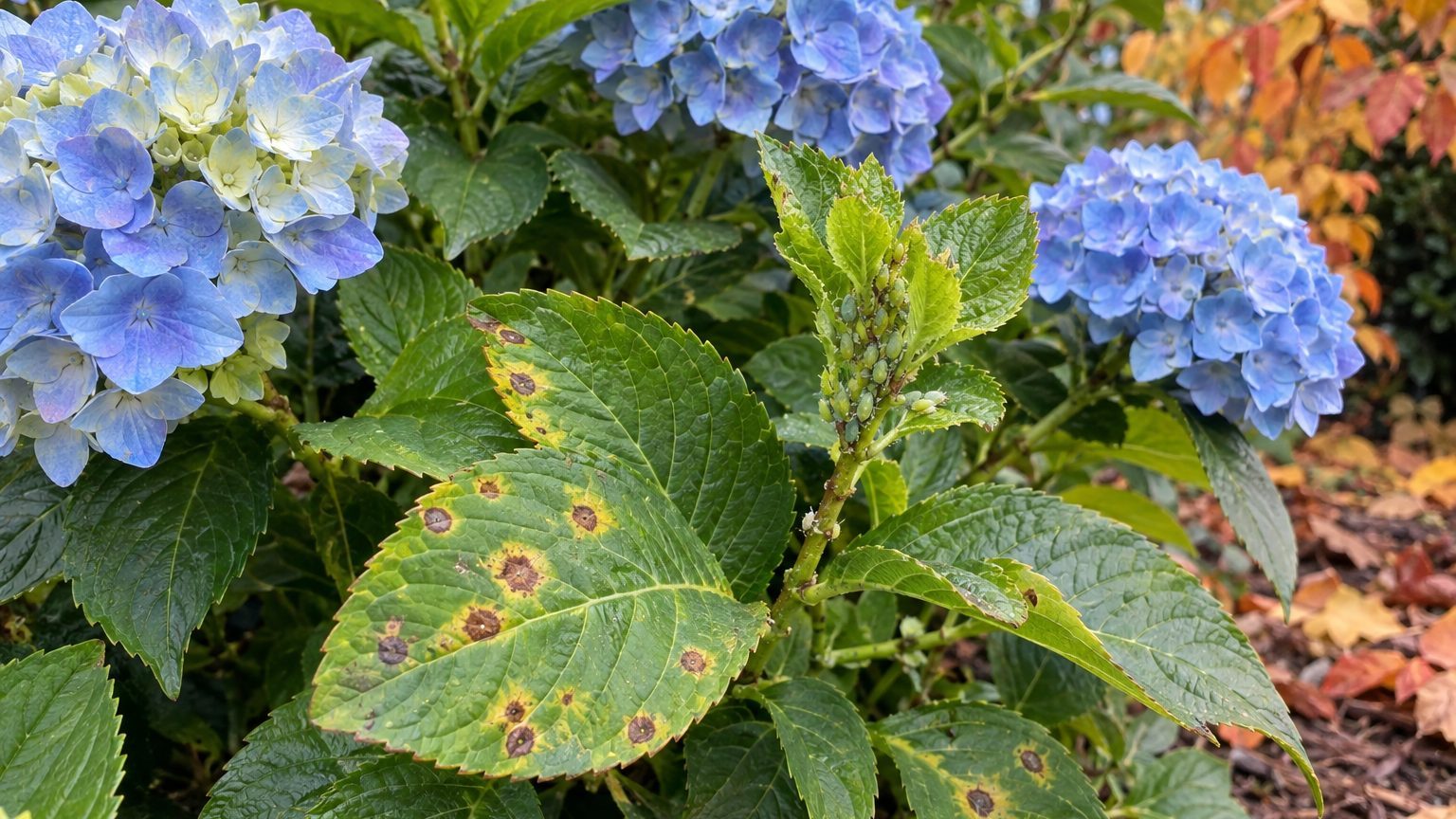
In Quebec, hydrangea trouble follows the calendar more than the plant itself. Winter bud kill shows up first, then aphids and mildew once summer humidity settles over the St. Lawrence valley, and yellowing leaves from alkaline clay run through the whole season. Montreal/St-Hubert’s cold winters cause most of what a bigleaf hydrangea shows here.
Hydrangea pests and diseases Quebec: The Short Answer
Natural Resources Canada’s Plant Hardiness Site puts Montreal/St-Hubert at zone 5b on the Canadian scale, and that number explains why the most common problem on a Quebec hydrangea isn’t a bug at all: it’s cold injury to last year’s flower buds. The second most common problem is fungal, powdery mildew or leaf spot, showing up once July humidity settles over Montérégie and the Eastern Townships.
Bare stems, no flowers in June

Most bare bigleaf hydrangeas in Quebec lost last fall’s flower buds to a hard cold snap, not to disease, since zone 5b winters routinely dip below what those buds tolerate. Scratch a stem for green wood before cutting, and mulch crowns heavily going into next winter.
Curled new growth in early summer

Aphids cluster on tender shoot tips as soon as June growth flushes, leaving sticky honeydew and sometimes sooty mold on the leaves below. A strong jet of water from the hose knocks most colonies off, and insecticidal soap clears out the rest without harming visiting bees.
White dust on upper leaves by midsummer
Powdery mildew moves in once July nights stay humid, coating leaves in a pale film that rarely kills the shrub outright but weakens it before fall dormancy sets in. Spacing plants for airflow and watering the soil instead of the foliage keeps most infections from taking hold.
Brown spots ringed in purple

Cercospora leaf spot shows up on the lower, older leaves first, then spreads upward as late summer rain splashes spores from leaf to leaf. Pulling off the worst leaves and binning rather than composting them keeps the fungus from overwintering in the debris at the base.
Gray, fuzzy patches on blooms

Botrytis blight favors the cool, wet stretches Quebec gets in early fall, turning flower clusters soft, brown, and gray almost overnight. Cutting spent blooms and clearing damp leaf litter before the average first fall frost on October 5 keeps the fungus from settling in for winter.
Sunken, dark cankers on stems

Botryosphaeria dieback girdles a cane below a winter crack or pruning wound, killing everything above it while the rest of the shrub still looks healthy. Prune the dead cane back to clean white wood a few inches below the canker, disinfecting shears between every cut.
Leaves yellow between green veins
Iron chlorosis comes from Quebec’s often-alkaline clay soils locking up nutrients the roots can’t absorb, not from any pest or fungus. A simple soil test confirms the pH, and an iron chelate drench greens the leaves back up within a few weeks.
Quebec — the year and the numbers
- State
- Quebec
- Hardiness zones
- 5b
- Last spring frost
- May 6
- First fall frost
- October 5
- Annual rain
- 39 in
- Lawn zone
- cool-season
- Source
- Environment and Climate Change Canada — Canadian Climate Normals 1981-2010, station MONTREAL/ST-HUBERT A · Montreal
How to Work Out the Dates for Your Own Yard
Diagnosing a Quebec hydrangea problem is mostly a matter of matching the symptom to the calendar, since most of what goes wrong here is tied to a specific stretch of the season rather than random bad luck.
- Check the timing first: a shrub bare of flowers in late May points to winter bud kill, not disease, because that’s before any fungus on this list gets going.
- Look at which leaves are affected: spots or mildew on lower, older leaves first mean a soil-borne fungus, while curling at the newest growth tips in June points to aphids instead.
- Count the days since the last rain: powdery mildew and Cercospora both need days of humidity to establish, so a dry stretch followed by symptoms usually rules out a fresh infection.
- Test before you treat for chlorosis: yellowing between green veins looks alarming but is a soil pH issue in Quebec’s clay far more often than a pest, so a soil test before buying a spray saves money.
- Watch the average frost windows: Environment and Climate Change Canada’s Canadian Climate Normals put Montreal/St-Hubert’s last spring frost at an average of May 6 and its first fall frost at an average of October 5, and cold damage clusters right around those windows while fungal issues cluster in the humid weeks between them.
- Match the fix to the prune window: since bigleaf pruning here runs June and July, cutting out dead or diseased wood inside that window avoids opening fresh wounds right before a cold snap.
Running through this order takes a few minutes and usually narrows six possible problems down to one before you touch a spray bottle.
Quebec North to South: How the Dates Shift
Quebec’s hydrangea problems don’t hit every region on the same week, since the province stretches from the mild St. Lawrence lowlands to boreal country further north.
- Montérégie and Montreal’s south shore (closest to the Montreal/St-Hubert reference station): bud kill is mildest here and the fungal window runs longest, since humidity and mild winters both favor bigleaf hydrangeas.
- Estrie and the Eastern Townships (hillier, cooler nights): expect more winter bud kill and a shorter fungal season, since cool nights slow the fungi even as they stress flower buds more.
- Capitale-Nationale and Quebec City (a step colder than Montreal): bud kill becomes the dominant problem, and gardeners here often see almost no flowers on bigleaf types most years.
- Saguenay-Lac-Saint-Jean and points north (short, cool summers): fungal disease pressure drops off sharply, but winter injury is severe enough that panicle and smooth types outperform bigleaf almost every year.
- Gaspésie and the Côte-Nord (maritime cold, short season): winter injury and cold-related dieback dominate, while the fungal issues common near Montreal barely have time to develop before frost returns.
Whichever part of the province you garden in, your local frost window shifts these problems earlier or later than the reference dates for Montreal/St-Hubert on the state page.
Mistakes Quebec Punishes
Pruning bigleaf hydrangeas in fall
Cutting bigleaf stems back in September or October removes next year’s flower buds along with the wood, since those buds are already set for the following summer. Save pruning for June or July instead, and let winter dieback guide what comes off in spring.
Planting too late in the season
A hydrangea set into the ground in late September has almost no time to root before the first fall frost, and shallow roots rarely survive a zone 5b winter. Stick to the May, June, August, and September planting windows and get roots established well before the cold arrives.
Skipping mulch before winter
Bare soil around the crown lets frost reach roots and buds directly, and that’s often the real cause of a bare shrub the following June, not a pest at all. A thick layer of shredded leaves or bark laid down before the ground freezes protects the base through the coldest months.
Quebec Extension Offices and County Contacts
Zone 5b and the Montreal/St-Hubert frost dates are a starting point, not the whole picture, since soil, drainage, and microclimate vary from block to block. MAPAQ, the province’s agriculture ministry, tracks pest and disease alerts by region.
- Your state page: the Quebec calendar with frost dates and the bigleaf pruning window for where you live.
- Which ones hold up here: the hydrangea varieties that tolerate zone 5b winters without dying back to the ground.
- MAPAQ: provincial guidance on local pests, soil testing, and extension contacts by region.
Common questions
Do I need to spray a Quebec hydrangea for pests every year?
No. Aphids and mildew show up most summers in some form, but a healthy shrub with good spacing and morning watering often shrugs them off without any spray at all, so treat only what you actually see.
Why does my hydrangea leaf out fine but never flower?
On bigleaf types in Quebec, that’s almost always winter bud kill rather than a growing problem, since the leaves come from buds lower on the stem than the flower buds that died over winter.
Can one product treat both chlorosis and a fungal leaf spot?
No. Chlorosis is a soil pH problem that needs an iron treatment and possibly a pH adjustment, while leaf spot needs sanitation and airflow, so a soil test first prevents treating the wrong problem.