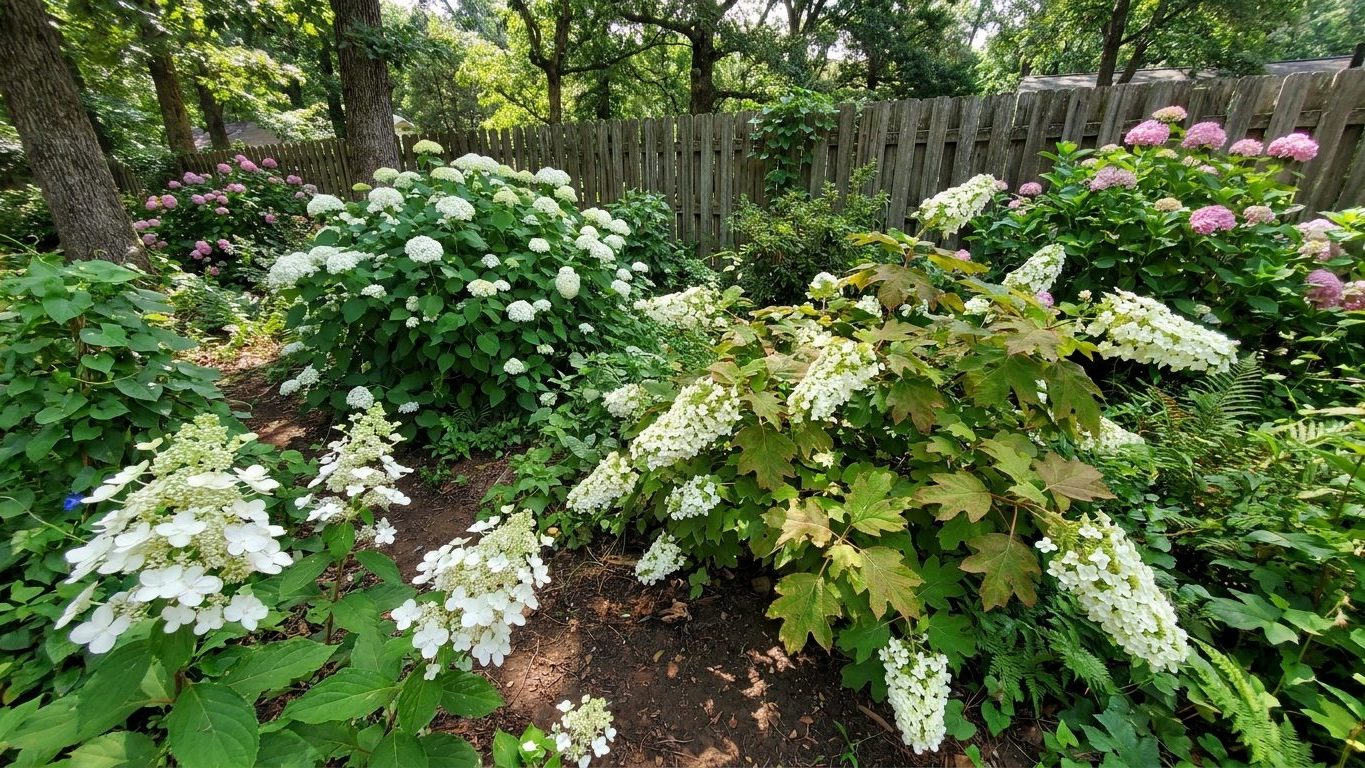
Oakleaf, panicle, and smooth hydrangea handle South Carolina’s swing between Upstate frost and Lowcountry humidity better than any other type, and Columbia’s climate splits that range down the middle.
Bigleaf mophead varieties still grow here, just with more risk to their flower buds. The riskiest pick, climbing hydrangea, wants a cooler summer than most of the state offers.
Hydrangeas that grow well in South Carolina: The Short Answer
The USDA Plant Hardiness Zone Map puts South Carolina at 7a to 9a, with Columbia sitting mid-range in that span. Six hydrangea types settle into the state at that range, and their order runs from the toughest to the least dependable.
Oakleaf hydrangea

Native to the Southeast, oakleaf hydrangea handles Columbia’s humid summers and the occasional Upstate cold snap without complaint. Its cone-shaped blooms fade to tan through fall, and the plant tolerates part shade to full sun once established. It is the safest bet across the whole 7a to 9a range.
Panicle hydrangea

Panicle hydrangea blooms on new wood each spring, so a late frost that nips young growth still leaves a full flower show later in the season. It tolerates more direct sun than other types, which suits Midlands and Lowcountry yards. Winter cold rarely troubles it anywhere in the state.
Smooth hydrangea

Smooth hydrangea, the type behind the classic white ‘Annabelle’ look, is native to the eastern United States and shrugs off both frost and heat. It prefers a bit more water than oakleaf or panicle, especially through a Lowcountry August. Light shade helps it hold its blooms longer.
Bigleaf hydrangea

Bigleaf hydrangea is the classic mophead sold at every garden center in the state, and it grows well in Columbia and points south. Its flower buds form on old wood, so a hard late frost or a badly timed fall prune can erase a season’s blooms. It rewards a sheltered spot.
Mountain hydrangea

Mountain hydrangea, a close relative of bigleaf, sets some of its buds lower on the stem, so it recovers faster after a cold snap. It suits the Upstate better than the humid coast, where the plant can look ragged by late summer. Morning sun with afternoon shade works best.
Climbing hydrangea

Climbing hydrangea is the riskiest name on this list for South Carolina. It comes from a cooler, more humid native range and tends to sulk through a Lowcountry July, growing slowly and blooming sparsely. It has the best odds in the shaded, cooler pockets of the Upstate.
South Carolina — the year and the numbers
- State
- South Carolina
- USDA zones
- 7a-9a
- Last spring frost
- February 28 to March 17
- First fall frost
- November 20 to December 5
- Annual rain
- 53 in
- Lawn zone
- warm-season
- Source
- NOAA NCEI 1991-2020 Climate Normals, 32F freeze probabilities · Charleston
How to Work Out the Dates for Your Own Yard
NOAA NCEI’s 1991-2020 Climate Normals put Columbia’s last spring frost between February 28 and March 17, and that window is the anchor for every date below.
- Start from the frost window: treat anything planted before March 17 as exposed to a possible freeze, especially new growth on bigleaf hydrangea.
- Match it to the plant window: the state calendar opens for planting in February and March, then again in September and October, skipping the summer heat between.
- Pick a hardy type to start: panicle hydrangea sets buds on new wood, so it tolerates a mistimed planting far better than a bigleaf mophead.
- Weigh a riskier type against it: climbing hydrangea wants a cooler summer than Columbia offers, so it belongs in a shaded, elevated yard rather than a sunny Midlands lot.
- Hold bigleaf pruning to its own window: cut back only in June and July, after bloom, so next year’s buds have time to set before the first fall frost.
- Fold in fertilizer timing: feed in March, May, and July, matching root growth to the same stretch the calendar sets for planting and pruning.
Every date on this list bends around that one frost window, so a yard that runs warmer or colder than the Columbia station needs its own adjustment before any of it holds.
South Carolina North to South: How the Dates Shift
Elevation and distance from the coast move these dates in opposite directions across the state, even though the hardiness range covers all of it.
- Upstate (Greenville, Spartanburg, the foothills): frost lingers longest here, tightening both ends of the window measured at Columbia, so mountain hydrangea and other cold-hardy types have an edge.
- Midlands (Columbia, the Sandhills): the numbers above hold closest to this belt, since the reference station sits here.
- Lowcountry and coast (Charleston, Beaufort): milder winters push the range toward its 9a edge, favoring heat-tolerant types like panicle and smooth hydrangea over a fussy bigleaf.
For the exact month-by-month dates tied to your part of the state, the South Carolina hydrangea calendar breaks the frost window down by task.
Mistakes South Carolina Punishes
Pruning bigleaf after its window closes
Cutting bigleaf hydrangea back in fall or winter removes buds already set on old wood for next spring. Prune only in June and July, right after bloom fades, so the plant has time to set new buds before the first frost arrives.
Planting outside the calendar windows
Setting a new hydrangea out in the heat of July skips the mid-March frost risk that NOAA NCEI’s Climate Normals track for Columbia, but it trades that risk for transplant stress in hot soil. Stick to February, March, September, or October instead.
Skipping afternoon shade near the coast
Full sun all day scorches bigleaf and mountain hydrangea leaves once Lowcountry humidity and heat combine in midsummer. Give afternoon shade south of the Midlands, and reserve full sun for panicle or smooth hydrangea, which tolerate it far better.
South Carolina Extension Offices and County Contacts
The 7a to 9a hardiness range is a statewide starting point, and a county’s soil, drainage, and shade decide the rest for any given yard.
- South Carolina hydrangea calendar: the month-by-month planting, fertilizing, and pruning dates tied to the Columbia frost window.
- What goes wrong with hydrangeas in South Carolina: the pests and problems that show up here, in the order they appear through the season.
- Clemson Cooperative Extension: find your county office through the statewide directory and ask for a soil test before you plant.
Common questions
Which hydrangea is easiest to grow in South Carolina?
Oakleaf hydrangea is the most forgiving statewide, since it tolerates both Upstate cold snaps and Lowcountry humidity without much fuss once it’s established.
Do hydrangeas need full sun in South Carolina?
Most do better with morning sun and afternoon shade, especially south of the Midlands, where panicle and smooth hydrangea handle the extra light better than bigleaf types.
When should I prune bigleaf hydrangea in South Carolina?
Prune only in June and July, right after the blooms fade, since the plant sets next year’s buds on old wood soon after, and an earlier or later cut removes them.