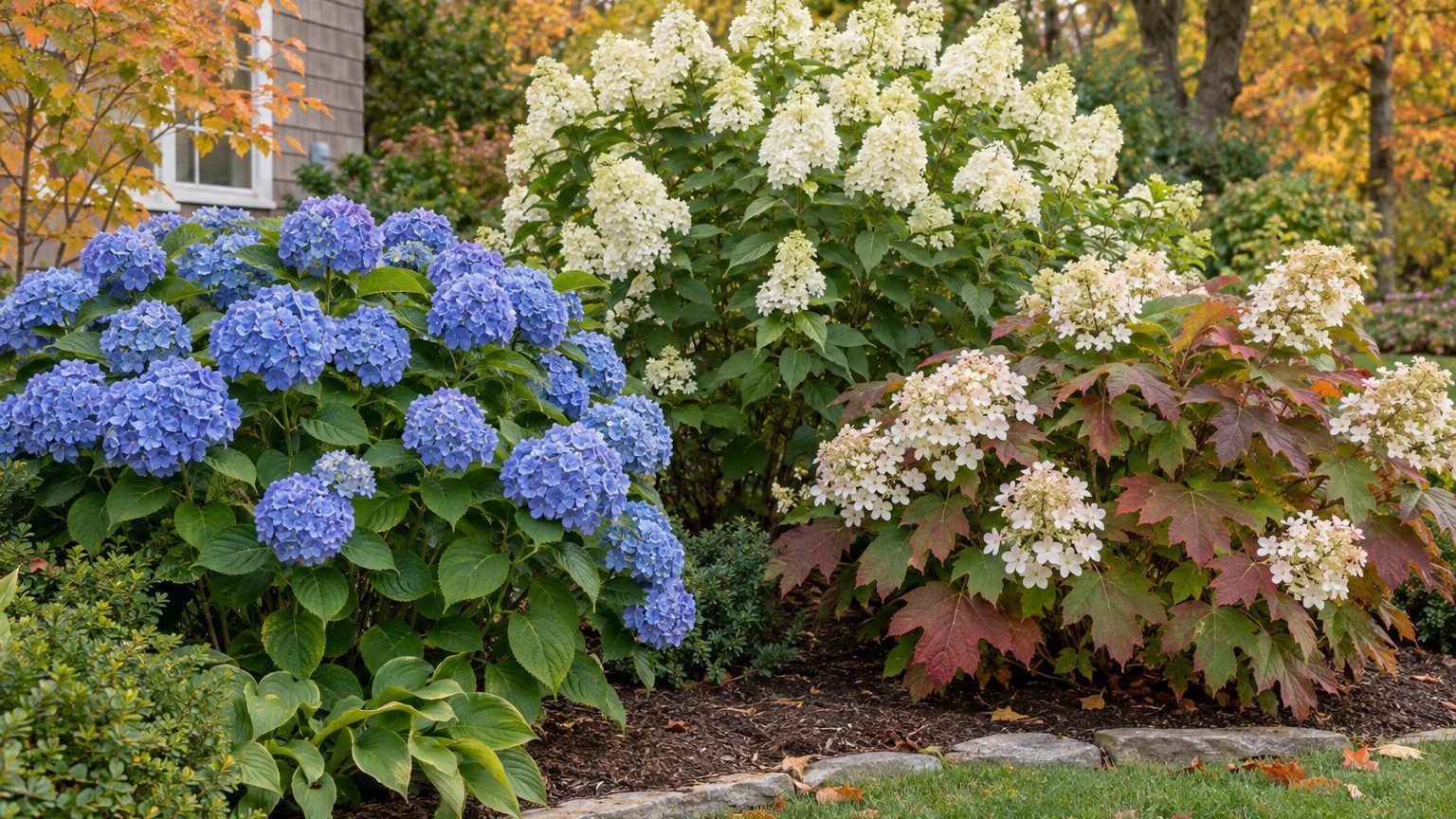
Providence sits in USDA zone 6a to 7b, and that range decides which hydrangeas keep their flower buds through a Rhode Island winter. Panicle and smooth hydrangeas take the state’s cold in stride because they bloom on new wood grown each spring. Bigleaf hydrangea is the riskier pick here, since its buds form the previous fall and can die in a hard freeze before they ever open.
Hydrangeas that grow well in Rhode Island: The Short Answer
The zone number only tells part of the story. The USDA Plant Hardiness Zone Map puts Providence at zone 6a to 7b, but what actually kills a hydrangea’s bloom season is a January cold snap that dips below the wood’s tolerance, or a wind-exposed spot that dries out stems faster than the cold alone. Some species shrug that off. Others gamble every year on a mild winter.
Panicle Hydrangea (Hydrangea paniculata)

The safest bet in this zone. It blooms on new wood, so a hard winter that kills stem tips still leaves plenty of live growth below to flower by midsummer. Cultivars like ‘Limelight’ and ‘Tardiva’ show up in yards across New England for exactly this reason.
Smooth Hydrangea (Hydrangea arborescens)

Native to the eastern United States and hardy well past Rhode Island’s coldest nights. Sold as ‘Annabelle’ and similar types, it blooms on new wood too, tolerates the clay soils common inland, and rarely skips a season of flowers.
Oakleaf Hydrangea (Hydrangea quercifolia)

Holds up in most of the state but can lose buds in an exposed, windy spot during a severe cold snap. A sheltered corner rewards it with peeling winter bark and deep red fall foliage few other hydrangeas offer.
Mountain Hydrangea (Hydrangea serrata)

Sets buds lower on the stem than bigleaf, which gives it a better shot at surviving a Rhode Island winter with flowers intact. It still does best against a wall or hedge, out of open winter wind.
Bigleaf Hydrangea (Hydrangea macrophylla)

The variety most people picture, and the riskiest for this zone. Buds form in late summer and sit exposed on old wood all winter, so a cold snap can erase a season’s blooms even while the shrub itself survives fine.
Climbing Hydrangea (Hydrangea petiolaris)

Hardy enough for Rhode Island but slow, often taking several years to establish before it flowers at all. Plant it against a sturdy wall or trellis and treat the early bare years as normal, not failure.
Rhode Island — the year and the numbers
- State
- Rhode Island
- USDA zones
- 6a-7b
- Last spring frost
- April 7 to April 17
- First fall frost
- October 24 to November 3
- Annual rain
- 48 in
- Lawn zone
- cool-season
- Source
- NOAA NCEI U.S. Climate Normals 1991-2020, 32F freeze probabilities · Providence
How to Work Out the Dates for Your Own Yard
Providence’s frost window is a starting point, not a guarantee for every yard in the state.
- Start from Providence’s frost range: NOAA NCEI U.S. Climate Normals put the last spring freeze there between April 7 and April 17, and the first fall freeze between October 24 and November 3.
- Push both dates out for an inland or low-lying yard: subtract a week or two from the spring end and add a week or two to the fall start if you’re away from the coast or sitting in a frost pocket.
- Match the hydrangea to the wood it blooms on: choose panicle or smooth hydrangea for reliable flowers, since both grow new wood every spring regardless of winter damage.
- Save bigleaf and mountain hydrangea for a sheltered spot: a south-facing wall or a break from prevailing winter wind buys those old-wood bloomers a real chance.
- Plant inside the state’s window: Rhode Island’s planting stretch runs April, May, August, and September, giving roots time to settle before summer heat or fall cold arrives.
- Prune bigleaf only in June or July: pruning any later removes the buds that would have opened the following year.
Smooth hydrangea passes both tests here. It shrugs off Providence’s coldest nights and doesn’t mind a stretch of August heat once mulched. Bigleaf fails the winter test more often than not in an open yard, which is why so many healthy green bushes across the state simply won’t flower most years.
Rhode Island North to South: How the Dates Shift
Rhode Island is compact, but a few miles from Narragansett Bay or a few miles inland can shift both hardiness and bloom timing.
- The Coast and South County (Newport, Narragansett, Westerly): moderated by the Atlantic, this stretch runs milder in winter and lets bigleaf and mountain hydrangea set buds with less winter kill, though storm-driven salt spray can scorch leaves.
- The Providence Metro Area (Providence, Cranston, Warwick): the state’s warmest inland pocket thanks to lower elevation and urban heat, this is where the reference-city numbers apply most directly.
- Northern Rhode Island and the Blackstone Valley (Woonsocket, Burrillville, Glocester): colder nights and a later spring warm-up push both frost dates further out, so treat bigleaf here as a genuine gamble and lean on panicle or smooth hydrangea instead.
Check the Rhode Island hydrangea guide for the frost and zone numbers that match your part of the state before committing to an old-wood bloomer.
Mistakes Rhode Island Punishes
Pruning bigleaf hydrangea in fall
Bigleaf sets its flower buds on old wood by late summer, so a fall cleanup cut removes next year’s blooms before they open. Prune only in June or July, right after the current season’s flowers fade.
Skipping winter shelter on an exposed coastal lot
Wind and salt spray off Narragansett Bay dry out stems faster than cold alone. A burlap wrap or a spot behind a hedge cuts that damage, and it matters more for bigleaf and mountain hydrangea than for panicle or smooth varieties.
Planting outside the state’s window
A hydrangea set in the ground in October or November rarely has time to root before Providence’s first fall freeze arrives. Stick to April, May, August, or September, and water deeply the first few weeks.
Rhode Island Extension Offices and County Contacts
Providence’s zone and frost numbers are a starting point, not the full picture for your soil or your yard’s microclimate. County offices and the state’s extension service fill in what a state-wide range can’t.
- Your state page: the Rhode Island hydrangea guide with the frost dates and zone range for the reference city.
- Your month-by-month calendar: the planting and pruning windows laid out by month for this state.
- URI Cooperative Extension: county-level help with soil tests, disease identification, and variety questions for your yard.
Common questions
Do hydrangeas need winter protection in Rhode Island?
Panicle and smooth hydrangea don’t need it since they bloom on new wood. Bigleaf, mountain, and oakleaf hydrangea benefit from a wind-sheltered spot or a burlap wrap in an exposed yard, especially near the coast where salt spray adds to the stress.
Which hydrangea blooms every year in Rhode Island?
Panicle hydrangea is the most consistent bloomer across the state’s zone 6a to 7b range, followed closely by smooth hydrangea. Both grow flower buds on new wood each spring, so winter damage to old stems doesn’t erase the coming season’s flowers.
Can I grow bigleaf hydrangea on the Rhode Island coast?
Yes, with better luck than inland, since the ocean moderates winter lows. A spot sheltered from direct salt spray and wind still improves bud survival, and mountain hydrangea is a slightly hardier substitute if bigleaf keeps skipping blooms.