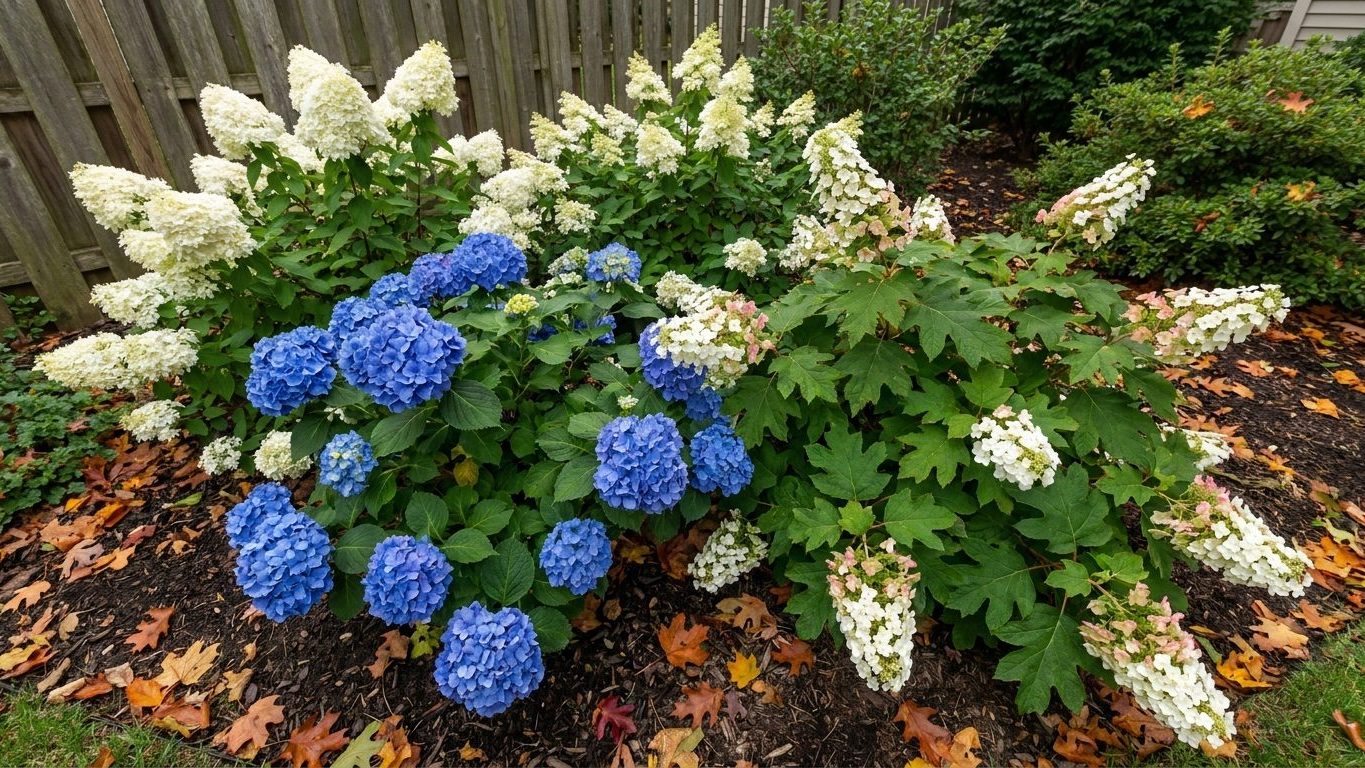
Panicle, smooth, and oakleaf hydrangeas grow well across Oklahoma, holding up to the clay soil, wind, and summer heat that define yards from Oklahoma City to Tulsa. Bigleaf and climbing types survive too, but only with more shade and more water than most Oklahoma summers offer for free. The safest bets bloom on new wood, so a late spring freeze never costs you the season.
Hydrangeas that grow well in Oklahoma: The Short Answer
Panicle and smooth hydrangeas hold up best across the state, tolerating the heat spikes and clay soils that push more delicate types into decline. The USDA Plant Hardiness Zone Map puts Oklahoma at 6a to 8a, with Oklahoma City sitting near the middle of that range, which is exactly where the toughest species earn their keep.
Panicle Hydrangea

Hydrangea paniculata blooms on new wood, so a late frost in Oklahoma City never touches the flower buds. It shrugs off full sun and clay soil, and its cone-shaped blooms fade to pink without any color-shifting fuss from soil pH. This is the shrub to plant first if you want a sure thing.
Smooth Hydrangea

Hydrangea arborescens, often sold as Annabelle, is native to woodland edges not far from Oklahoma and handles the state’s droughty summers without much complaint. It flowers on new wood too, so winter dieback rarely costs a season of blooms. Give it afternoon shade and it keeps its rounded white heads upright longer.
Oakleaf Hydrangea

Hydrangea quercifolia comes from the same humid Southern range that touches southeastern Oklahoma, and its deep roots tolerate the dry spells that follow. Part shade keeps the leaves from scorching in August. Fall color and peeling bark carry interest once the white flower panicles brown, making it a strong three-season choice.
Mountain Hydrangea

Hydrangea serrata sets flower buds on old wood like its bigleaf cousin, but those buds tend to survive Oklahoma’s freeze-thaw swings a bit better. It still wants morning sun and afternoon shade, plus soil that never fully dries out. Expect smaller, lacecap-style blooms rather than the big mophead look.
Bigleaf Hydrangea

Hydrangea macrophylla is the classic mophead, and it struggles here because its flower buds form on old wood, which a late Oklahoma spring freeze can wipe out before bloom. Consistent moisture and afternoon shade help, but a sheltered courtyard or north wall matters more than variety choice once summer heat sets in.
Climbing Hydrangea

Hydrangea anomala subsp. petiolaris is the riskiest pick, since it wants cool, consistently moist soil and takes years to establish a bloom-worthy structure. Oklahoma’s wind and summer heat dry out young vines before their roots reach deep enough. Save it for a shaded, irrigated wall rather than a typical front-yard fence.
Match the species to the site, not the other way around: full sun and clay favor panicle and smooth, while any bigleaf or climbing type needs the shadiest, most sheltered spot on the property to make it through most winters.
Oklahoma — the year and the numbers
- State
- Oklahoma
- USDA zones
- 6a-8a
- Last spring frost
- March 28 to April 10
- First fall frost
- October 29 to November 8
- Annual rain
- 36 in
- Lawn zone
- transition-season
- Source
- NOAA NCEI U.S. Climate Normals 1991-2020, 32F freeze probabilities · Oklahoma City
How to Work Out the Dates for Your Own Yard
Counting backward from Oklahoma City’s frost window turns a vague planting date into one you can actually act on.
- Find your zone placement: the USDA Plant Hardiness Zone Map puts the state at 6a to 8a, and Oklahoma City sits inside that range, so check which end your yard is closer to before buying anything rated only for warmer zones.
- Mark the spring frost window: NOAA NCEI U.S. Climate Normals list Oklahoma City’s last spring freeze as falling between March 28 and April 10, so tender new growth on bigleaf types needs frost cloth ready through early April.
- Mark the fall frost window: the first fall freeze in Oklahoma City typically lands between October 29 and November 8, which is the cue to stop fertilizing and let new wood harden off.
- Count back for planting: aim to get roots in the ground during March, April, August, or September, avoiding the peak heat of July when a new hydrangea has no established root system to draw on.
- Time the pruning: save cuts on bigleaf and mountain hydrangeas for June or July, after flowering finishes and before next year’s buds start to set on old wood.
Panicle hydrangea passes both tests, shrugging off the March freeze window because it blooms on new wood and coasting through August heat once established. Bigleaf hydrangea often fails the first test, since a freeze inside that late-March window can kill buds that already broke dormancy on a warm February day.
Oklahoma North to South: How the Dates Shift
Elevation, wind exposure, and how close a yard sits to Oklahoma’s lakes all nudge these dates earlier or later than what Oklahoma City sees.
- The Panhandle and northwest (Cimarron, Texas, and Beaver counties): higher elevation and open plains push the fall frost earlier and the spring frost later, so gardeners here should lean on the cooler end of every planting and pruning window.
- Central Oklahoma (Oklahoma City, Norman, Edmond): this is the reference zone the state’s frost data comes from, and it sits in the middle of most planting decisions made statewide.
- Green Country and the northeast (Tulsa, Bartlesville, Grove): higher humidity and more tree cover moderate summer heat swings, often letting bigleaf hydrangeas hold shade-grown blooms a little longer into August.
- Southeastern Oklahoma (McAlester, Durant, Broken Bow): closer to the humid Gulf air mass, so frost tends to arrive later in fall and leave earlier in spring, stretching the growing season for oakleaf and panicle types.
Check the state page for the county-level detail behind each of these shifts before locking in a date.
Mistakes Oklahoma Punishes
These three habits show up in yard after yard across the state, and each one is fixable.
Bigleaf planted in full afternoon sun
Oklahoma’s July heat and wind pull moisture out of big, thin bigleaf leaves faster than roots can replace it, so full afternoon sun turns a healthy shrub scorched and wilted by August. Plant it on the east or north side of the house instead, where panicle types can take the open sun.
Fertilizing past the summer window
A late feeding pushes soft new growth right before the first Oklahoma City freeze, which NOAA NCEI U.S. Climate Normals place between October 29 and November 8, and that tender growth dies back the hardest. Stick to the March, May, and July fertilizing months and stop there, letting new wood harden off before fall.
Pruning bigleaf too early or too late
Cutting bigleaf or mountain hydrangeas outside June and July removes next year’s flower buds before they even form, since both set buds on old wood. Wait until flowering finishes, then prune within that two-month window and no later, or skip a whole season of blooms.
Oklahoma Extension Offices and County Contacts
The zone and frost numbers above are a starting point, not a guarantee, since soil, wind, and shade shift block by block. Oklahoma State University Extension keeps the county-level detail that fills in the rest.
- Oklahoma State University Extension: county offices answer soil test questions and confirm local frost timing for your exact address.
- Your county extension office: find the office nearest your yard through the OSU Extension directory for site-specific pruning and planting advice.
- The state hydrangea guide: cross-check the frost windows and hardiness range against your part of Oklahoma before buying.
Call before you plant, especially if you’re within a mile of a county line.
Common questions
Which hydrangea blooms every year in Oklahoma without fail?
Panicle hydrangea is the closest thing to a sure bet, since it flowers on new wood and never depends on old buds surviving a late freeze.
Can bigleaf hydrangeas survive Oklahoma winters at all?
Many do, especially against a sheltered wall or foundation, but a cold snap after an early warm spell can still take the flower buds for that year even when the plant itself lives on.
Do Oklahoma hydrangeas need afternoon shade?
Bigleaf, mountain, and climbing types generally do, while panicle and smooth types tolerate more sun, which is why matching the species to the site matters more than the calendar date alone.