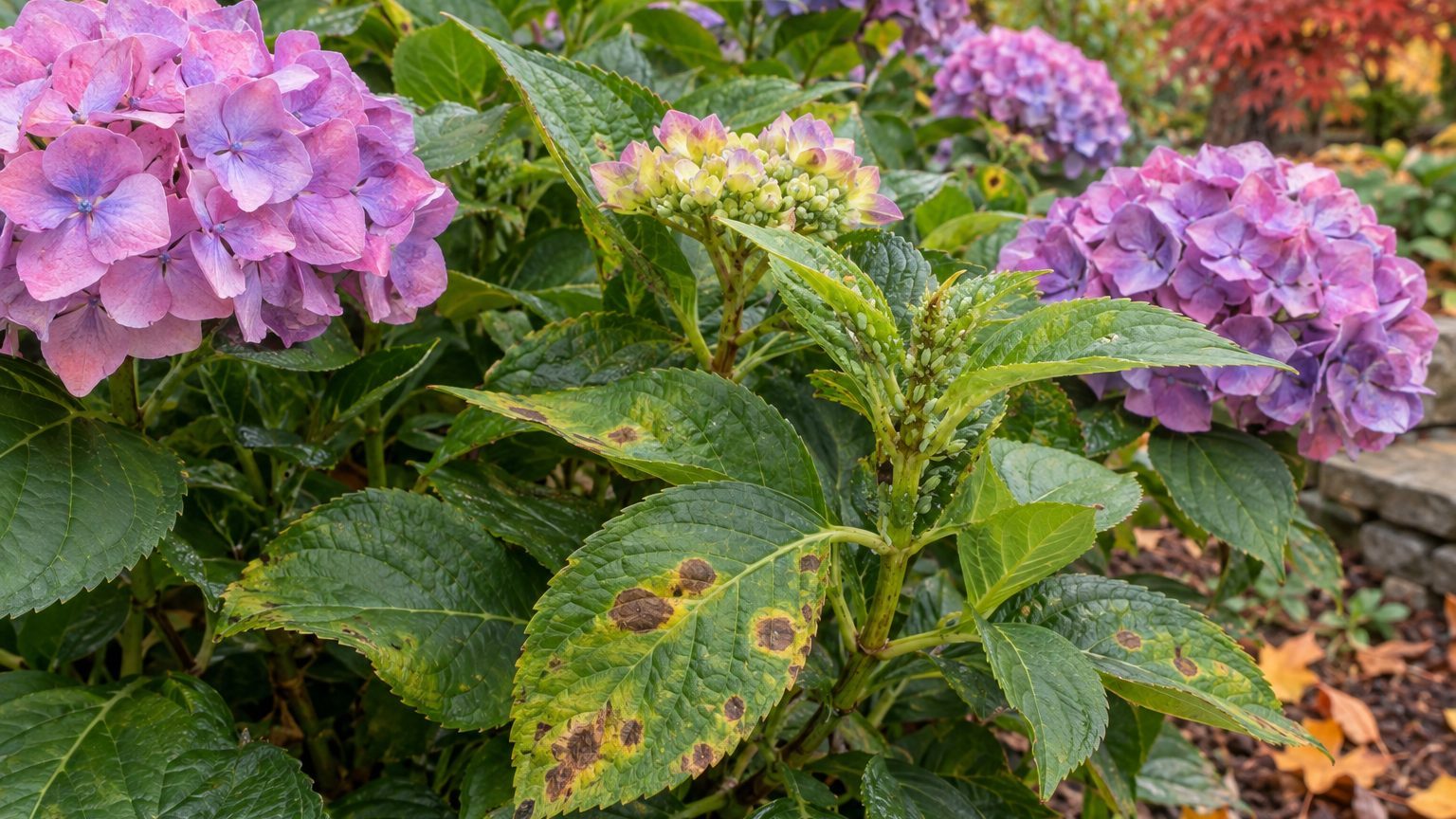
Rankin Inlet, the reference station Environment and Climate Change Canada uses for Nunavut, posts an average last spring frost of June 19 and a first fall frost near September 13, a stretch too short for hydrangea wood to hold enough insects or fungus to matter. The real threat here is cold injury, not a bug or a blight.
Hydrangea pests and diseases Nunavut: The Short Answer
Rankin Inlet sits in Canadian hardiness zone 0a, and at that reading a hydrangea almost never overwinters outdoors long enough to build the kind of tissue an aphid colony or a fungal spore needs to settle in. What a homeowner in Iqaluit or Cambridge Bay reads as disease is, nearly every time, frost. The Nunavut hydrangea guide lays out the growing calendar behind these numbers.
No new growth after planting

Soil at Rankin Inlet barely warms before the average last frost of June 19 passes, so roots set out too early just sit cold and stall. Hold new stock in a container until nights clear, then plant fast inside the June to August window. The planting calendar spells out the exact months.
Stems black by midsummer
What looks like a stem canker in July is usually a late frost bite from a spring that ran past June 19, the mean date, in one year out of two. Cut back to live wood once new leaves show and skip any fungicide, there is no blight to treat here.
Leaf edges yellowing in July
Marginal yellowing reads like a nutrient problem but is more often root chill, since soil temperature lags air temperature by weeks this far north. Feed only during the May or July windows, never later, so no soft new growth sits exposed before the first fall frost.
No flower buds at all

Old wood rarely survives a Nunavut winter to set buds, so a shrub that never blooms is not diseased, it simply lost its bud wood to the cold. Pick a variety that flowers on new growth, covered on the varieties page, rather than search for a fungal cause that is not there.
Powdery white coating indoors

True powdery mildew needs humid, still air, conditions found only in a greenhouse or sunroom here, never outdoors in a season this short. Improve air flow between pots and water at the base, since Rankin Inlet’s outdoor air is too dry and too brief for the fungus to establish outside.
Sticky residue on leaves

Aphids need weeks of mild weather to build a colony, and the gap between June 19 and September 13 rarely gives them that long. A light patch found on greenhouse-raised stock washes off with a hard spray of water, no insecticide is needed for a problem this short-lived.
Nunavut — the year and the numbers
- State
- Nunavut
- Hardiness zones
- 0a
- Last spring frost
- June 19
- First fall frost
- September 13
- Annual rain
- 12 in
- Lawn zone
- cool-season
- Source
- Environment and Climate Change Canada — Canadian Climate Normals 1981-2010, station RANKIN INLET A · Rankin Inlet
How to Work Out the Dates for Your Own Yard
Work backward from the frost window instead of a fixed date, since Rankin Inlet only gives an average, not a guarantee.
- Anchor the last frost first: Environment and Climate Change Canada’s average of June 19 for Rankin Inlet is a midpoint, so half of all years run later, treat anything before late June as risk.
- Plant only in the open window: set hydrangeas out during June, July, or August, the three months this territory’s calendar allows, never earlier.
- Prune bigleaf wood in June or July: those are the only two months the calendar gives for pruning, cut later and new growth has no time to harden before fall.
- Feed inside May or July: fertilizing outside those two months pushes soft growth toward the September 13 average first frost, which then reads as disease.
- Match the variety to zone 0a: a panicle type bred to bloom on new wood tends to outlast a bigleaf type bred for old wood, check the varieties page before buying.
- Recheck symptoms after frost, not before: anything that appears after the first fall frost is almost always cold damage, not a pest needing treatment.
None of these dates move because a neighboring yard sits in a hollow or on a windy point, the next section covers that shift.
Nunavut North to South: How the Dates Shift
Nunavut spans three administrative regions, and none of them match Rankin Inlet’s numbers without some adjustment.
- Kivalliq (Rankin Inlet, Arviat, Baker Lake): this is the reference region itself, so the frost window above applies closest to home here, though inland stations often run colder.
- Qikiqtaaluk (Iqaluit, Pond Inlet, Cape Dorset): farther north and often coastal, expect the frost-free stretch to open later and close sooner than the reference window.
- Kitikmeot (Cambridge Bay, Gjoa Haven, Kugluktuk): western Arctic exposure pushes both frost dates further apart from the reference window, shortening the usable season again.
Whichever region a yard sits in, the territory-wide hydrangea guide is the place to start before adjusting for local exposure.
Mistakes Nunavut Punishes
Planting before the window opens
Setting hydrangeas out in May, before the calendar’s June start, exposes roots to soil that has not caught up with air temperature, and a late cold snap near the June 19 average finishes them off. Wait for the June through August planting window instead.
Pruning outside June or July
Cutting bigleaf wood in August or later leaves fresh wounds with no time to callus before the September 13 average first frost, and the whole cut stem often dies back. Keep pruning inside June and July, the only two months the calendar allows.
Fertilizing into late summer
A feeding in August pushes soft new growth right into the fall frost, and that dieback then gets mistaken for a fungal disease. Stick to the May and July feeding windows only, and let anything after that go unfed.
Nunavut Extension Offices and County Contacts
Rankin Inlet’s numbers are a starting point, not the final word, and Nunavut has no county extension network, so the federal agriculture department is the closest official contact for a territory this size.
- Your state page: the frost dates and the pruning window for the whole territory, gathered on the Nunavut hydrangea guide.
- Which ones hold up here: the varieties page ranks options from safest to riskiest for zone 0a.
- Agriculture and Agri-Food Canada: agriculture.canada.ca is the federal contact point, since the provincial office’s own site could not be verified.
Common Questions
Can hydrangeas actually survive winter in Nunavut?
Outdoors, rarely past a single season, since Canadian hardiness zone 0a at Rankin Inlet sits far below what any hydrangea type is bred to handle. Most gardeners here treat them as container plants brought indoors before the first fall frost.
What does frost damage look like versus a real disease?
Frost damage shows as sudden blackening or wilting right after a cold night, while true disease spreads gradually and often carries spots, powder, or a slow yellowing pattern. In Nunavut’s short season, sudden and sitewide almost always means cold.
Which pests are the biggest threat to container hydrangeas indoors?
Aphids and spider mites show up occasionally on plants wintered inside a heated sunroom, drawn by the same warm, still air that keeps the shrub alive. A hard rinse under the tap handles most early infestations without any spray.