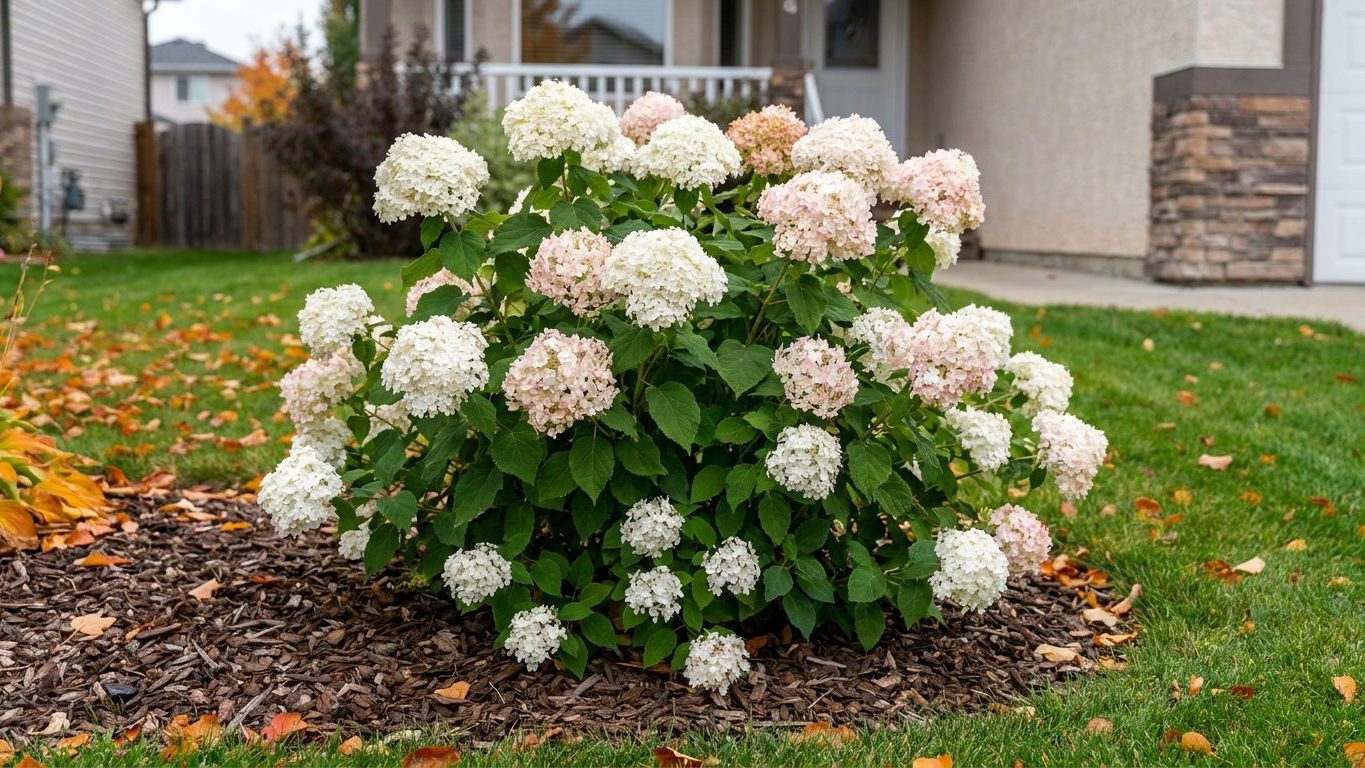
Plant hydrangeas in Alberta between May and August, once the ground has warmed well past the region’s mean last spring frost. Calgary’s frost-free stretch runs from roughly May 21 to September 16 in an average year, and that four-month plant window sits right inside it. Bigleaf types get their pruning done in June and July, in the middle of that same stretch.
When to prune hydrangeas in Alberta: The Short Answer
Environment and Climate Change Canada’s Canadian Climate Normals put Calgary’s average last spring frost at May 21 and the average first fall frost at September 16, and the twelve months below run against that same, single frost line.
- January: The shrubs sit dormant under mulch, with the mean last frost still four months off. There is nothing to plant or prune this month, just check that winter mulch hasn’t blown clear of the roots.
- February: Frost is still roughly three months out, so hydrangeas stay wrapped and left alone. Use this quiet stretch to order stock for the May planting window instead of touching the plants.
- March: With around eight weeks left before the mean frost date, soil is still too cold to dig planting holes. Start hardening off any greenhouse-grown plants on mild afternoons only.
- April: About four weeks out from the average frost, prep beds and work in compost so May planting goes fast. Resist planting early, since a late frost can still hit well past this point.
- May: Planting opens as the mean last frost of May 21 passes, and this is also the first of the two fertilize months. Get bigleaf types in the ground early in the window so roots settle before summer heat.
- June: Planting continues, and this is the first of the two months set aside for pruning bigleaf hydrangeas. Cut back only spent or damaged wood, since bigleaf sets next year’s buds on old growth.
- July: Both planting and bigleaf pruning stay open, alongside the second fertilize window. Water deeply through summer heat, since new transplants dry out fast in Alberta’s dry prairie air.
- August: This is the last month in the four-month planting window, so anything going in now needs the rest of the season to root before frost returns. Hold off on further pruning past this point.
- September: The average first fall frost lands September 16, so treat mid-month as the line for any exposed new growth. Stop feeding and pruning, and start planning winter protection.
- October: With the mean frost date now behind, pile mulch deep over the root zone before the ground freezes hard. Leave faded flower heads on the stems for extra bud insulation.
- November: Ground is freezing solid across most of the province, so wrap or cage exposed stems if last month’s mulch feels thin. A zone 4a winter tests any shrub left uncovered.
- December: Everything stays dormant and buried until spring, with no gestures needed beyond a snow check. Brush heavy snow off cages so the weight doesn’t snap branches.
None of these twelve months are a hard rule, since a mean frost date means half of all years run later than that. Treat May and September as the pivot points, and let August close the planting window before the average fall frost arrives.
Alberta — the year and the numbers
- State
- Alberta
- Hardiness zones
- 4a
- Last spring frost
- May 21
- First fall frost
- September 16
- Annual rain
- 17 in
- Lawn zone
- cool-season
- Source
- Environment and Climate Change Canada — Canadian Climate Normals 1981-2010, station CALGARY INT'L A · Calgary
How to Work Out the Dates for Your Own Yard
Working from the mean frost dates turns one province wide guess into a window that actually fits your own yard, not just the airport station the numbers come from.
- Start from the mean last frost: Calgary’s average is May 21, and treat it as the middle of a window, not a guarantee, since frost lands later than that in half of all years.
- Push planting two to three weeks past that date: waiting into early June for potted bigleaf hydrangeas gives roots a buffer against the years when frost runs long.
- Count backward from the mean fall frost: September 16 is the average, so anything planted after early August has barely six weeks to root before cold weather returns.
- Check your own microclimate: a yard against a south facing wall or in a low frost pocket can run a week or two earlier or later than the Calgary station these dates are built from.
- Match pruning to bloom type: bigleaf hydrangeas only get cut back in June and July, since they set next year’s flower buds on the current season’s old wood.
- Watch soil temperature, not the calendar: cold, wet clay in early May can hold root growth back even after the air has warmed past frost risk.
None of this replaces walking the yard itself. A thermometer pushed a few inches into the soil where the shrub will go tells you more than any date on a page.
Alberta North to South: How the Dates Shift
Frost timing shifts across the province with elevation, latitude, and how close a spot sits to the Rockies.
- Southern Alberta (Calgary, Lethbridge, Medicine Hat): sits closest to the dates above, with the mildest and longest stretch between spring and fall frost in the province.
- Central Alberta (Red Deer, Camrose, Stettler): typically loses a week or two off each end of the growing season compared with Calgary, so treat the plant window as a touch narrower.
- Northern Alberta and the Peace Country (Grande Prairie, Peace River, Fort McMurray): frost can linger deeper into spring and arrive noticeably earlier in fall, favoring hardier panicle and smooth types over bigleaf.
- Foothills and higher elevation towns (Cochrane, Canmore, Bragg Creek): cold air pools at elevation, so gardeners here often see frost weeks outside the Calgary averages in both directions.
Whichever part of the province you garden in, check the Alberta guide for the province wide frost dates first, then adjust toward whichever end of this list your town sits closer to.
Mistakes Alberta Punishes
Planting Before the Mean Frost Passes
Getting a bigleaf hydrangea into the ground in early May, right after the soil finally thaws, invites a hit from the mean frost still sitting at May 21. Wait until the plant window truly opens and give the shrub the extra two weeks of buffer instead.
Pruning Bigleaf Outside June and July
Cutting bigleaf stems back in September or the following spring removes the very buds meant to open into next year’s flowers, since this species blooms on old wood. Keep pruning inside the June and July window and nowhere else on the calendar.
Leaving Roots Bare Into Winter
Skipping a thick mulch layer before the ground locks up exposes roots to a zone 4a winter that regularly kills stems back to the snow line. Pile mulch deep by October, right after the mean fall frost date passes, not after the first hard freeze.
Alberta Extension Offices and County Contacts
The province wide numbers above are a starting point, not the last word for your own yard. Alberta Agriculture and Irrigation and your local county office fill in what these dates can’t.
- Your province page: the frost dates and pruning window for all of Alberta in one place.
- Which ones hold up here: hydrangea varieties matched to Alberta’s zone 4a winters.
- What goes wrong here: the pests and problems this province’s growing season brings on hydrangeas.
Common questions
Can I plant hydrangeas in Alberta in early spring?
Hold off until May at the earliest. The mean last frost falls May 21, and planting into cold, still-thawing soil before then sets roots back rather than ahead.
Do hydrangeas survive Alberta winters without protection?
Most need help. In a zone 4a winter, exposed bigleaf stems commonly die back to the snow line, so a deep mulch layer or a wrap by October matters more than the variety label on the tag.
When should I prune hydrangeas in Alberta?
Bigleaf types get pruned in June and July only, since they set next year’s buds on this year’s wood. Pruning outside that window removes flowers before they ever open.