A tomato plant that looks fine one day and has bare stems the next usually has a fat green caterpillar hiding in the foliage. Tomato hornworms feed on leaves and fruit, and they blend in so well that most gardeners find them late. Knowing what they look like, where they sit and what to do about them saves the plant.
Tomato Hornworms: What You See

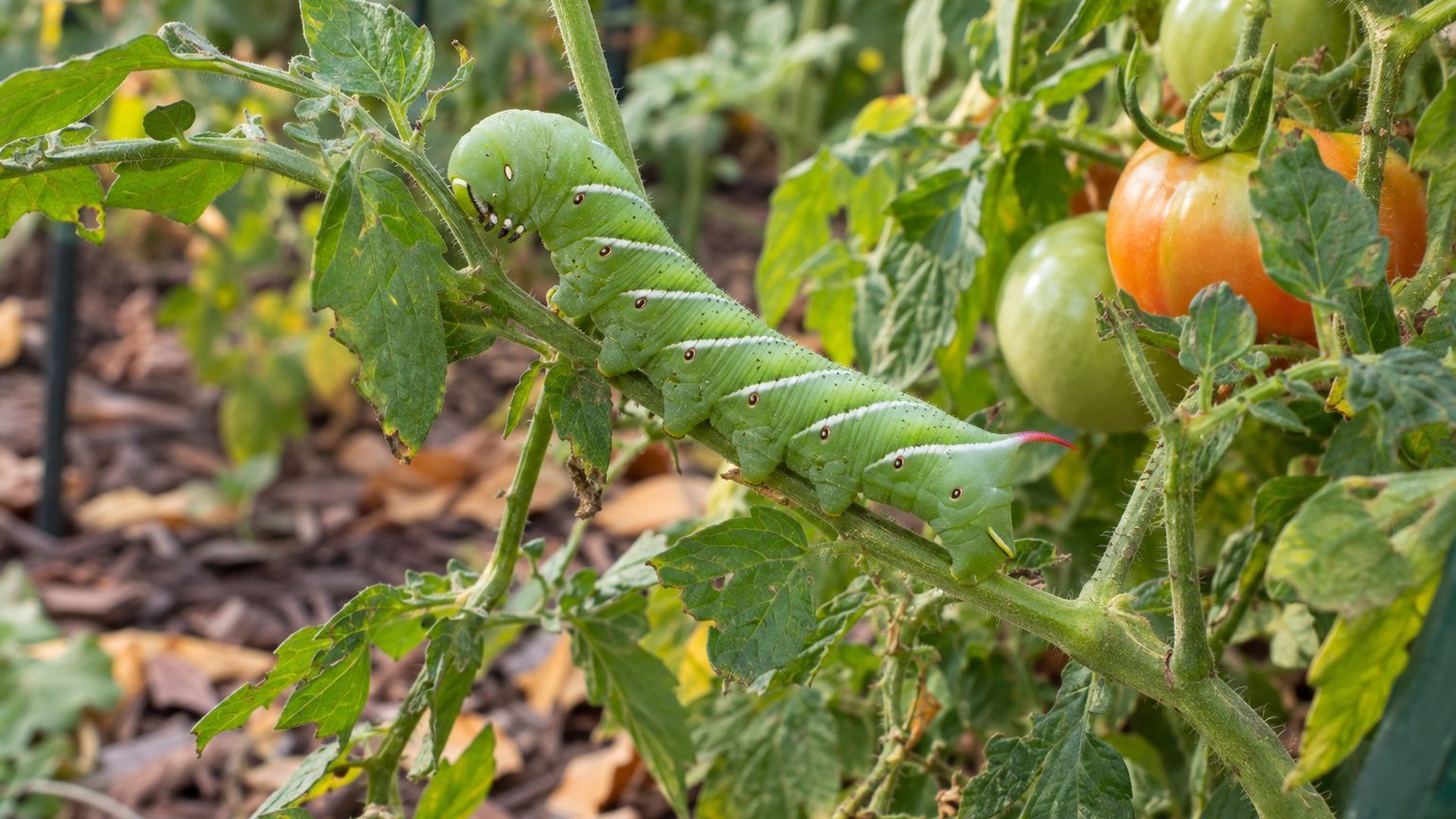
Look for a thick green caterpillar on the stems and leaves, and check the signs below.
- A pointed horn at the rear end of the body gives the larva its name.
- Eight V-shaped marks run along each side of the body, and the horn is fairly straight and blue-black.
- Full-grown larvae can reach four inches in length, big enough to spot once you know where to look.
- Leaf blades are chewed first at the top of the plant, with the damage moving down the stems.
- Droppings on a few leaves are sometimes the only clue that a caterpillar is feeding nearby.
- Fruit can be chewed as well as foliage.
Small larvae feed unnoticed in thick, lush foliage, then strip vines quickly as they near the end of their feeding cycle.
Tomato Hornworms or Something Else?
Two other things can be mistaken for the caterpillar on your plant. One is a close relative that feeds on the same crop. The other is damage you find without seeing any caterpillar at all.
Check the markings on the body and the color of the horn together before deciding, since either one alone can mislead.
| Looks like | How to tell them apart |
|---|---|
| Tobacco hornworm, a green caterpillar on tomato leaves | Red horn and straight diagonal stripes on the sides, where the tomato hornworm has V-shaped marks and a blue-black horn |
| Chewed leaves with no caterpillar in sight | Look for droppings on the leaves below the damage, then search the stems and the undersides of leaves near the top of the plant |
The tobacco hornworm is a sphinx moth larva too, and it feeds on tomatoes in much the same way. Whichever one you find, the control steps are the same.
What Causes Tomato Hornworms, and Where It Is Worst
The caterpillars are the larvae of large sphinx moths, and only the larvae feed on tomato plants. Besides tomatoes, they damage eggplant, potato and pepper plants. They overwinter as pupae in earthen cocoons, which means the next generation starts in the soil where the plants grew.
Hornworms turn up wherever tomatoes grow. In a state like Kansas, where two generations of tomato and tobacco hornworms appear each season, the caterpillars can be present well before anyone notices.
Large caterpillars can strip a plant fast. In Illinois, one or two worms can defoliate a five-foot tomato plant in less than three days.
How to Treat Tomato Hornworms
Handle them early, and work in this order so the plant keeps its leaves.
- Inspect the plant from the top down, so that you find the freshly chewed leaves and droppings that point to the caterpillar.
- Look along the stems and under the leaves near the damage, because the green body blends in with the foliage.
- Pick off every caterpillar you find, so that the feeding stops right away.
- Drop them into a container of soapy water, so that they do not crawl back onto the plants.
- Check the plant again soon, since small larvae are easy to miss in thick foliage.
- Ask your state extension office before using any spray, since it knows which products are approved where you live.
Hand picking is enough for a few plants. Look closely at the fruit too, because the caterpillars feed on it as well as on the leaves.
How to Prevent Tomato Hornworms Coming Back
Because the pupae overwinter in the soil, prevention follows the garden year.
- In early spring, before planting, turn the soil in the tomato bed so that overwintering pupae in their earthen cocoons are exposed.
- Once the plants are growing, check them regularly from the top down, since young larvae feed unseen in lush foliage.
- In Kansas, look again for droppings and chewed tops, because a second generation can follow the first.
- In fall, clear the old vines and loosen the soil, so that pupae are not left sheltered in the bed.
Rotating the tomato bed with other crops is also sensible, since eggplant, potato and pepper are hosts as well.
Where This Comes From
The details here come from university extension and cooperative extension publications in Kansas, Arizona, Illinois and Pennsylvania. Your state extension office can confirm timing and approved controls for your area.
Common Questions
Do Hornworms Eat Tomato Fruit?
Yes. They feed on both leaves and fruit, so check the tomatoes as well as the foliage.
Do Hornworms Feed on Plants Other than Tomatoes?
They also damage eggplant, potato and pepper plants.
Do the Moths Hurt Tomato Plants?
No. Only the larvae feed on the plants, and the adults are sphinx moths.