Skip to content

Best Grass Seed for Missouri

Best Grass Seed for Missouri

Walk a Missouri lawn in July and you can usually tell what was planted: some patches stay green and soft while others go tan and crunchy. Missouri sits where cool-season and warm-season grasses both struggle, so the right seed depends on your sun, your traffic, and how much you want to water and mow.

Which Grass Grows Best in Missouri?

Missouri is a transition zone, so cool-season grass suits many yards, with warm-season grass working well in full sun if you accept a brown winter. The USDA hardiness range runs from 5b to 7b, reflecting differences in average annual extreme minimum temperature across Missouri.

Tall Fescue

Tall fescue is the workhorse for Missouri yards. Its deep roots help it handle summer heat, and it can retain color into winter. It grows from seed, and late summer is the time to sow it.

Kentucky Bluegrass

Kentucky bluegrass does best on cooler, higher ground and in the northern part of the state. It makes a dense, fine lawn that repairs itself, but it needs regular water to stay green when July and August turn hot.

Bermudagrass

Bermudagrass loves full sun and heat, and you can start it from seed or sod. It handles foot traffic and drought well. The tradeoff is that it turns tan after the first hard frosts and stays that way until spring warms the soil.

Zoysiagrass

Zoysiagrass forms a thick, tight turf that crowds out weeds, but it is mostly planted as sod or plugs rather than seed. It is slow to fill in and also goes dormant and brown in winter. It suits patient homeowners with sunny yards.

How to Choose Grass Seed for a Missouri Yard

Start with the light your yard gets and the way you use it. Sunlight and use quickly narrow the choice.

Then think about water and mowing. Warm-season grasses cope with drought better, while cool-season grasses stay green for more of the year.

Your yard Grass to pick Why
Full sun, heavy traffic Bermudagrass Tough, recovers fast, thrives in heat
Part shade, general use Tall fescue Tolerates some shade and summer stress
Cool, higher ground, water available Kentucky bluegrass Dense and self-repairing in cooler spots
Full sun, low weed pressure wanted Zoysiagrass Thick turf, planted as sod or plugs
Little watering Bermudagrass Handles dry spells in summer

If you dislike frequent mowing, tall fescue is a calmer pace than bermudagrass, which wants regular cuts all summer. Deep shade is difficult for all of these grasses, so shade-tolerant tall fescue is a practical choice there, and bare ground under dense trees may need mulch instead.

Which Grasses Grow Where in Missouri

The state is long enough that north and south behave differently, and the Ozarks add their own twist.

  • Northern Missouri: Winters are colder here, so Kentucky bluegrass and tall fescue are the dependable pair, and bermudagrass can suffer winter damage.
  • Kansas City and St. Louis: These metro areas sit in the middle of the transition zone, where tall fescue is the common choice and bermudagrass or zoysia suits hot, sunny lots.
  • The Ozarks and the Bootheel: Summers are longer and milder winters favor bermudagrass and zoysia, while tall fescue works with more care in summer.

Southern Missouri warms earlier in spring than the north, so warm-season planting can start a little sooner there.

Grass Seed Mistakes to Avoid in Missouri

Planting the Wrong Grass

Sowing bluegrass in a hot, sunny southern yard or bermudagrass in a shady northern one sets you up for thin turf. Match the species to your sun and your part of the state before you buy.

Seeding at the Wrong Time

Tall fescue and bluegrass go in the ground in August, with September as a backup, so seedlings root before winter. Warm-season grass belongs in May, and June still works. Spring seeding of fescue often loses to summer heat and crabgrass.

Burying or Skimping on Seed

Cover seed with no more than 0.25 inch of soil and press it down so it touches the ground firmly. Deep burial keeps seedlings from emerging. Follow the rate printed on the bag, since too little leaves gaps for weeds and too much crowds seedlings out.

Where to Get Lawn Advice in Missouri

Local soil and microclimate vary from county to county, so a quick check with local experts saves guesswork before you buy seed.

  • University of Missouri Extension offers lawn guides and variety advice, and it is a useful resource before the late-summer seeding window.
  • Your county extension office can explain soil testing and what grows in your area, so visit in early summer to plan ahead.

Common Questions

Can You Plant Tall Fescue in Spring in Missouri?

You can, but seedlings often struggle when summer heat arrives. Late summer gives the grass cooler weather to root, and the fall seeding window is the better plan for a lasting lawn.

Does Bermudagrass Stay Green All Year in Missouri?

No. It greens up in late spring and turns tan after frost, staying dormant through winter. If winter color matters to you, tall fescue is the better pick.

When Should You Fertilize a Missouri Lawn?

Tall fescue does well with feeding in March and again in September and October, never in summer. Bermudagrass and zoysia are fed in May through July while they are actively growing.
Lawn Problems and Solutions in Missouri

Lawn Problems and Solutions in Missouri

Brown circles in July, crabgrass in the driveway edge, a lawn that thins out under the maple: Missouri yards show their troubles in predictable seasons. The state sits where cool-season and warm-season grasses both struggle, so common problems often trace back to summer stress, wet springs, or a mismatch between grass and care.

Lawn Pests and Diseases in Missouri

Crabgrass in Thin Spots

Crabgrass in Thin Spots — Lawn Problems and Solutions in Missouri

Crabgrass shows up as coarse, light green clumps that spread flat along the ground, usually where turf is thin or beside pavement. Seeds sprout as the soil warms in spring. A preventer applied in March works best, and February, April or May still work if you missed it.

Mowing at a steady height and keeping the lawn dense shades out the seedlings you did not catch.

Thatch Buildup

Pull back the grass and look at the brown, spongy layer above the soil. Up to 1/2 inch is healthy. Beyond that, water and fertilizer struggle to reach the roots, and disease settles in.

Dethatch or core aerate tall fescue in August or September. Bermuda and zoysia lawns are dethatched in May or June, and April also works.

Brown Patch in Summer Heat

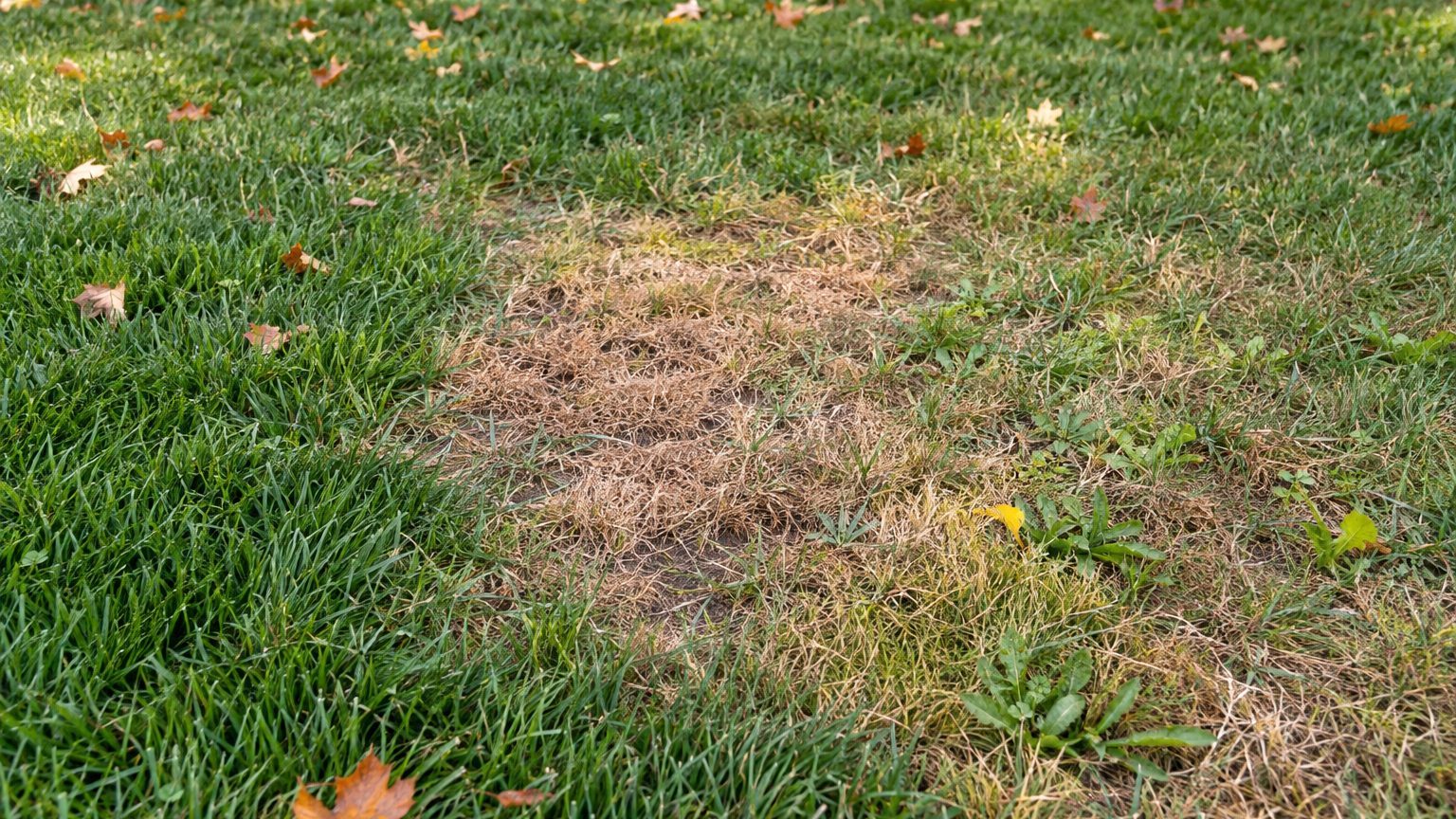
Brown patch appears as roundish tan to brown areas on tall fescue during warm, humid stretches. Missouri summers give it plenty of chances, especially on lawns watered in the evening or fed too heavily in warm weather.

Water deeply in the morning during June, July and August, and keep nitrogen out of the summer schedule for fescue. Patches usually fill in once cooler weather and fall seeding arrive.

Thin Turf After Summer

Tall fescue often comes out of summer weak and bare in places. Late summer is the repair window: aerate and overseed in August, and if you miss it, September still works.

Seed placed in loosened soil can root before the first fall frost, which falls between October 18 and October 29 around Kansas City and varies elsewhere in Missouri. Warm-season lawns follow a different schedule: seed in May, or in June if May gets away from you.

How to Tell Which Lawn Problem You Have

Do not rely on appearance alone. Pair what the damage looks like with where it sits and when it appeared, then check the plant itself: does it pull up, does it have roots, is the soil spongy underfoot?

Shade, sun and season narrow things quickly. A problem that follows the shadow line of a tree points elsewhere than one that sprawls across open, sunny turf.

What you see Where and when Likely cause
Coarse, flat, light green clumps Thin spots and edges, summer Crabgrass
Round tan patches on fescue Open lawn, hot humid spells Brown patch
Spongy turf, water runs off Whole lawn, any season Thatch buildup
Thin, weak grass Under trees, after summer Shade and summer stress

If the grass lifts easily like a loose carpet and has no roots beneath, the cause is likely in the soil rather than a leaf disease, which is worth confirming with an extension office before treating anything.

Where Lawn Problems Are Worst in Missouri

Missouri stretches across USDA hardiness zones 5b to 7b, so the same lawn faces different pressure depending on where it sits.

  • Northern Missouri: Colder winters favor tall fescue and bluegrass, while spring growth starts later, so early-season care may need to wait.
  • Kansas City and St. Louis: Hot, humid summers put cool-season lawns under disease stress, and brown patch is a regular visitor.
  • The Bootheel and southern Missouri: Milder winters and longer heat make warm-season grasses like bermuda and zoysia a natural fit, with growth starting earlier in spring.

Check your grass type before you apply any regional advice, because timing changes with grass type.

Lawn Care Mistakes That Invite Problems in Missouri

Mowing Too Short

Scalped grass loses shade for its own roots and leaves bare soil where crabgrass takes hold. Mow regularly from March through November for tall fescue, and from April through October for bermuda and zoysia.

Instead of cutting low, raise the blade and take off only a small portion of the leaf at a time.

Shallow Evening Watering

Light, frequent watering after sundown keeps leaves wet overnight and invites brown patch. Water deeply and in the morning during June, July and August, when lawns need it most.

Feeding at the Wrong Time

Fertilizing tall fescue in summer feeds disease and weeds more than turf. Feed it in March, September and October, and April works too. Warm-season lawns are the opposite, fed in May, June and July when they grow actively.

Where to Get Lawn Advice in Missouri

University of Missouri Extension publishes lawn guidance for the state and offers local help that can account for conditions in your area.

  • The state site has articles on turf, weeds and disease that can help you decide what to do next.
  • Your county extension office can identify a problem from a sample or photo, so contact them before treating a patch you cannot name.

Common Questions

Can You Fix a Missouri Lawn in One Season?

Often you can start. Late summer seeding and aeration give tall fescue a useful head start, while warm-season lawns recover best with late spring care.

Why Does My Fescue Struggle While My Neighbor’s Bermuda Looks Fine?

Fescue is a cool-season grass that stalls in Missouri heat, while bermuda thrives in it. Each also has different timing for seeding and feeding.

Should You Dethatch Every Lawn?

No. A modest thatch layer is healthy, and dethatching only helps once it becomes excessive.

Missouri Lawn Care Schedule, Month by Month

Missouri Lawn Care Schedule, Month by Month

Tall fescue turns green in March while a bermuda or zoysia lawn next door stays straw-brown longer. Missouri sits where cool-season and warm-season grasses overlap, so the right month for a task depends on which grass you own.

What to Do Each Month in a Missouri Lawn

Lawn in Missouri

Cool-season lawns (tall fescue, bluegrass) do their heavy work in fall and early spring. Warm-season lawns (bermuda, zoysia) do theirs in late spring and summer, once the soil has warmed. Each row below says which grass it speaks to when it matters.

Month In the lawn
January Rest. The grass is dormant, so keep foot traffic light on frozen turf and leave it alone.
February Still mostly rest. A mild spell lets you put down crabgrass preventer early, before the weed seeds wake up.
March Spread crabgrass preventer and feed tall fescue as it wakes. The first mowing of the year usually comes now.
April Mowing picks up, and bermuda and zoysia begin to green. Preventer and fertilizer still work if March slipped by, and warm-season thatch can be pulled now too.
May Seed or sod bermuda and zoysia, dethatch them, and start feeding them. Preventer still works if you are late.
June Warm-season grass is growing hard, so keep feeding it and start watering. Seeding and sodding warm-season lawns still work this month. Leave tall fescue unfed, since fertilizer should never go on it in summer.
July Water deeply and keep feeding bermuda and zoysia. If you missed May and June, sod still works in July.
August Core aerate fescue, then seed it right away while the soil is warm. Dethatch cool-season turf, and keep new seed moist.
September Feed fescue, and dethatch if August got away from you. If you missed August, overseeding and aeration still work now.
October Feed fescue and keep mowing. Warm-season grass slows and browns, so its last mowings come now.
November Mow fescue as long as it grows, and rake leaves so they do not smother it. Bermuda and zoysia are dormant.
December Rest. The whole lawn is dormant, and the only job is staying off it when it is frozen.

If you are unsure which grass you have, settle that first. A fescue lawn and a bermuda lawn can sit side by side and need opposite things in the same month.

When Does the Lawn Season Start and End in Missouri?

Grass wakes up when the soil warms, not when the last frost passes. Cool-season seed germinates once the soil sits at 50 to 65 °F. Warm-season seed needs warmer soil, at 65 to 70 °F, so seeding bermuda and zoysia belongs in May or June rather than early spring.

Frost dates matter mostly for young seedlings. In the Kansas City area, the last spring freeze usually falls between April 6 and April 20, and southern Missouri is milder still. Warm-season seed sown before that window risks a late freeze burning the first green blades.

The fall side works the same way. The first freeze tends to arrive between October 18 and October 29 around Kansas City, and a fescue seedling needs to be rooted well before then. That is why late summer seeding beats waiting for October. Mature turf shrugs off a light frost, and growth slows with cooling soil, so mowing keeps going into November for fescue.

How the Lawn Calendar Shifts Across Missouri

Missouri runs from USDA hardiness zone 5b to 7b, so the north and the south do not wake up together. Shift the monthly tasks in the direction below.

  • Northern Missouri, around Kirksville and the Iowa line: Spring comes later and fall frost arrives earlier. Tall fescue and bluegrass dominate, and warm-season grasses are a gamble because winter can injure them. Push spring tasks toward the later end of their months and seed fescue at the start of the late-summer window.
  • Kansas City and St. Louis: These sit in the middle of the transition zone, where either grass type can work. Follow the calendar as written, and expect fescue to struggle in a hot summer.
  • The Ozarks around Springfield: Higher ground keeps nights cooler, so spring warmth arrives a little later than the valleys would suggest. Fescue does well here, and bermuda can suffer during severe winter cold.
  • The Bootheel in the southeast: This area has milder winters than northern Missouri, so spring starts earlier. Bermuda and zoysia thrive, while fescue works harder through summer heat. Lean toward the early end of spring tasks.

Within each region, a south-facing slope warms sooner than a shady north side, so different parts of the same yard can follow different schedules.

Lawn Care Timing Mistakes to Avoid in Missouri

Seeding Fescue in Spring

Spring seed sprouts fast and looks promising, then meets Missouri summer before the roots are deep. Heat and drought thin it out, and crabgrass fills the gaps. Wait for late summer, when warm soil and cooling air let seedlings root properly, and aerate first so the seed meets bare soil.

Late Crabgrass Preventer

Preventer stops crabgrass seeds from sprouting, but it does nothing to plants already up. Once seedlings appear, the product is wasted money. Apply it in March, or in February or April if the season runs early or late, and May is the last reasonable call.

Dethatching Warm-Season Grass in Fall

Pulling thatch from bermuda or zoysia as the lawn heads into dormancy leaves it bare and slow to recover. Weeds move into the open ground, and winter cold hits unprotected crowns. Do the job in May or June, while the grass is growing fast enough to fill in.

Where to Get Lawn Advice in Missouri

Soil, shade and grass variety differ from one Missouri yard to the next, and local experts can fine-tune the schedule above for yours.

  • The University of Missouri Extension publishes lawn guides for fescue, bermuda and zoysia, and a quick look in spring or late summer helps you plan the next job.
  • Your county extension office can answer questions about local weeds and soil, and it is worth a call before you buy seed or fertilizer.
  • A soil test through the county office can guide feeding decisions.

Common Questions

How Can You Tell If Your Lawn Is Tall Fescue or Bermuda?

Look at the color and the leaf. Fescue stays green well into November and has wide, coarse blades. Bermuda turns tan after the first hard frost and has fine blades with creeping runners. Check the color and leaf shape before you buy seed or fertilizer.

Can You Keep Fescue and Bermuda in the Same Yard?

You can, but they follow different calendars, so each patch needs its own feeding and seeding months. Mixed lawns often look uneven because the grasses green up and go dormant at different times. Treat each area as its own lawn for timing.

How Do You Know When a Brown Lawn Is Dormant and Not Dead?

Dormant grass is brown all over and the crowns near the soil stay firm and pale. Dead grass pulls up easily and leaves bare, dry patches. If the browning follows the seasons and the whole lawn matches, dormancy is the likelier cause.

Best Grass Seed for Mississippi

Best Grass Seed for Mississippi

Bare patches show up in a Mississippi lawn after a hard summer, and the urge to reseed hits when the weather turns pleasant. Grass choice matters, and so does sowing at the right time. Warm-season grasses suit this state, and a few of them grow from seed.

Which Grass Grows Best in Mississippi?

Warm-season grasses, not cool-season ones. Mississippi sits in USDA hardiness zones 7b to 9a, and its long, humid summers stress fescue and bluegrass while warm-season turf thrives. These grasses green up as the soil warms and rest through winter, which matches the state’s rhythm.

Bermudagrass

Bermudagrass grows from seed or sod and handles Mississippi heat and foot traffic well. It wants full sun and regular mowing. In shade it thins out quickly, so keep it to open yards.

Centipedegrass

Centipedegrass grows from seed and asks little of you, which suits a lawn you would rather not fuss over. It grows slowly and stays low, so mowing is lighter than with bermudagrass. It does not stand up to heavy play.

Bahiagrass

Bahiagrass also comes from seed and tolerates poor, sandy, dry ground. It gives a coarser, more open look than the others. Many owners accept that in exchange for a tough lawn on a large lot.

Zoysiagrass

Zoysiagrass makes a dense, carpet-like lawn, but it is mostly sold as sod or plugs, not seed. It spreads slowly, so expect patience after planting. The result is thick turf that crowds out weeds.

St. Augustinegrass

St. Augustinegrass is never sold as seed, so it enters a yard only as sod or plugs. It likes warmth and tolerates more shade than bermudagrass. It is sensitive to winter cold, so it is a poor fit where winters bite.

How to Choose Grass Seed for a Mississippi Yard

Start with sun, traffic and how much you want to mow. Those answers narrow the field before you start comparing labels. Water access matters too, since new seed needs steady moisture while it roots.

Sod and plugs are the route for grasses that do not come from seed. If your heart is set on one of them, buy it that way and skip the seed aisle.

Grass How it starts Suits this yard
Bermudagrass Seed or sod Full sun, kids and pets, regular mowing
Centipedegrass Seed Sunny, lower-effort lawn with light use
Bahiagrass Seed Dry, sandy or poor soil, big lots
Zoysiagrass Mostly sod or plugs Dense turf, sun to light shade
St. Augustinegrass Sod or plugs only Warm spots with some shade

Seeded grasses go in during May, and June still works if May slips by. Sod gives you more room: May is ideal, and April, June and July also work. Heavy shade under big oaks suits no lawn grass well, so thin the canopy or use mulch there.

Which Grasses Grow Where in Mississippi

The state stretches from cooler hills in the north to the warm Gulf, and the grass choice shifts with that slope.

  • North Mississippi: Winters run colder around Tupelo and Oxford, so bermudagrass and zoysiagrass are the steadier picks. St. Augustinegrass carries more risk of winter damage here.
  • The Delta: Heavy clay soil holds water and drains slowly. Bermudagrass does well in the open, flat fields of this region.
  • The Pine Belt: Sandy, acidic soils near Hattiesburg favor centipedegrass and bahiagrass, which both tolerate lean ground.
  • The Gulf Coast: Mild winters let St. Augustinegrass settle in, and salt spray and sandy soil reward tougher grasses near the water.

Your own yard often differs from the nearest town, so match the grass to your soil and sun before the map.

Grass Seed Mistakes to Avoid in Mississippi

Cool-Season Seed in a Warm Yard

Fescue and ryegrass mixes look tempting in fall displays, but they struggle through Mississippi summers. Buy seed of bermudagrass, centipedegrass or bahiagrass instead. Check the bag for the species name, not just a pretty photo.

Seeding at the Wrong Time

Warm-season seed needs warm soil to sprout and root. Sow in May, or in June if you missed it. In Jackson, the last spring freeze usually falls between March 6 and March 22; suburban and rural yards often see it later, so check with your county before rushing.

Too Much or Too Little Seed

Follow the rate printed on the bag for the species. Heavy sowing crowds seedlings, and thin sowing leaves gaps for weeds. Cover seed with no more than 0.25 inch of soil and press it down so each seed touches the ground.

Where to Get Lawn Advice in Mississippi

Local help beats guesswork on soil and grass choice. The resources below reflect Mississippi conditions and can help with lawn questions.

  • Mississippi State University Extension publishes lawn guides, so read up before you buy seed in spring.
  • Your county extension office can test your soil, so bring a sample before May.
  • Ask staff there which grass thrives in your part of the state before you plant.

Common Questions

Should You Dethatch or Aerate Before Seeding in Mississippi?

Core aeration works best in May, with June as a fallback. Dethatching fits May and June, and April also works. Doing either just ahead of seeding helps seed reach the soil.

When Should You Fertilize a New Lawn in Mississippi?

Fertilizing fits May through August, while warm-season grass is actively growing. Waiting until the seedlings have rooted keeps the feed from fueling weeds first.

How Long Should You Keep Watering a Mississippi Lawn?

Watering matters from May through September. New seed needs regular moisture to sprout, and established turf benefits through the hottest stretch of summer.

Lawn Problems and Solutions in Mississippi

Lawn Problems and Solutions in Mississippi

A patch of grass turns tan in the heat, a circle spreads after a wet spell, or a weed shows up where the turf thinned. Warm, humid weather can encourage lawn problems in warm-season grasses such as bermuda, centipede, zoysia and St. Augustine. Each problem has a look, a season and a fix.

Lawn Pests and Diseases in Mississippi

Spring Weeds in Thin Turf

Spring Weeds in Thin Turf — Lawn Problems and Solutions in Mississippi

Crabgrass and other weeds sprout as the soil warms and fill any gap the lawn left open over winter. You see pale green clumps spreading flat against the ground. Thick, regularly mowed turf crowds them out, so the better fix is filling thin spots before the weeds do.

Large Patch

Large patch shows up as broad, rounded tan or orange-brown rings in spring and again in fall when nights turn cool and damp. It commonly affects zoysia, centipede and St. Augustine. Water in the morning, skip heavy feeding when the rings are active, and keep thatch in check.

Thatch Buildup

A spongy, bouncy feel underfoot and water that runs off instead of soaking in point to thatch. A layer up to 1/2 inch thick is healthy, but above that, dethatch or core aerate. Dethatching works in May and June, and it also works in April.

Dollarweed in Wet Spots

Dollarweed has round, bright green leaves like tiny lily pads, and it takes over low, soggy corners and areas that get watered too often. Cutting back on irrigation often helps bring it under control. Fixing drainage in a stubborn spot helps it stay gone.

Chinch Bugs in Hot, Sunny Turf

Chinch bugs mostly attack St. Augustine in full sun. Irregular yellow patches turn brown and keep growing, usually along driveways and sidewalks where heat builds. Part the grass at the edge of a patch and look for tiny dark bugs at soil level before treating, since drought looks similar.

White Grubs

Grubs are fat, C-shaped white larvae that chew roots in late summer. The turf feels loose and lifts like a carpet, and birds or armadillos may tear it up while hunting them. Pull back a square of sod and look just below the soil surface to confirm.

Fall Armyworms

Armyworms arrive suddenly in late summer and chew blades down to stubs, leaving ragged brown areas that spread quickly. Soapy water poured on a suspect patch can bring the caterpillars to the surface. Check bermuda lawns often during that stretch, because damage moves fast.

How to Tell Which Lawn Problem You Have

One clue rarely settles it. Pair what the patch looks like with where it sits and when it appeared, then do a quick test by tugging the grass or parting the blades.

What you see Where and when Likely cause
Tan or orange rings that grow outward Spring or fall, after damp weather Large patch
Yellow to brown irregular patches, tiny dark bugs at the edge Sunny turf near pavement, midsummer Chinch bugs
Turf that lifts like a carpet Late summer, with torn-up soil White grubs
Chewed, ragged blades and fast-growing bare areas Late summer, open sun Fall armyworms
Round, coin-shaped leaves Wet, low spots in spring and summer Dollarweed
Pale clumps spreading across gaps Thin turf as spring warms Crabgrass

A lawn that feels springy and sheds water may simply have too much thatch, which weakens the grass and can make other problems harder to manage. When nothing matches, take a sample to your county office.

Where Lawn Problems Are Worst in Mississippi

Moisture, soil and winter cold shift from the coast to the northern hills, and problems follow them.

  • Gulf Coast: Sandy soil, heavy humidity and St. Augustine lawns make chinch bugs and fungal rings common, and salt spray can add stress near the water.
  • Delta: Heavy clay holds water, so dollarweed, large patch and other wet-soil troubles settle in where drainage is slow.
  • North Mississippi hills: Cooler winters mean slower green-up in spring, and gardens here often see frost later in spring and earlier in fall than the Jackson area.

Check your own county’s timing rather than relying on a city far from you.

Lawn Care Mistakes That Invite Problems in Mississippi

Mowing Too Short

Scalped grass has little leaf to feed roots, and bare soil invites weeds. Raise the blade and mow regularly from March through November while the grass is actively growing, taking care not to remove too much at once.

Watering Lightly and Late

Short, frequent sprinkles keep roots shallow and leaves wet overnight, which feeds fungus. Soak the lawn deeply in the morning instead. Water from May through September, and let the soil tell you when it needs more.

Feeding at the Wrong Time

Fertilizer put down before warm-season grass wakes up feeds weeds, and a late-season feeding can fuel large patch. Apply from May through August, when bermuda, zoysia, centipede and St. Augustine can use it.

Where to Get Lawn Advice in Mississippi

Mississippi State University Extension publishes lawn guidance written for the state’s soils and grasses, and county offices can look at a sample.

  • Browse the extension site first when you want to match a symptom to a grass type.
  • Call your county office when a patch keeps spreading, ideally before treating it.
  • Ask about a soil test before you buy fertilizer, so you feed only what the lawn lacks.

Common Questions

When Should You Core Aerate a Lawn in Mississippi?

May suits most warm-season lawns, because the grass is growing fast and fills the holes quickly. If you miss it, June also works.

When Should You Seed a Lawn in Mississippi?

May is the time to sow grasses such as bermuda, centipede and bahia, and June also works if you miss it. St. Augustine has no seed, so it goes in as sod or plugs.

When Should You Lay Sod in Mississippi?

May is the prime time, and sod also goes down in April, June and July. Water it regularly after installing so the roots knit into the soil.

Mississippi Lawn Care Schedule, Month by Month

Mississippi Lawn Care Schedule, Month by Month

Brown, crunchy turf in January is not a dead lawn. In Mississippi, warm-season grasses go dormant in winter and wake when the soil warms, so each task has a short stretch of months where it works best. A Mississippi lawn care schedule is mostly a matter of matching your chores to those stretches.

What to Do Each Month in a Mississippi Lawn

Lawn in Mississippi

Most of the real work lands between spring and late summer, when bermuda, centipede, zoysia and St. Augustine are growing hard. The cooler months are for resting and watching.

Month In the lawn
January Rest. The grass is dormant, so keep foot traffic light and pick up fallen limbs and leaves.
February Rest. Dormant turf still looks brown, and wet ground is easily torn up by heavy boots or equipment.
March Mowing begins as the first green shows. Cut off the dead top growth and keep the blade sharp.
April Keep mowing as growth picks up. Dethatching works now if the thatch is thick, and sod can go down too.
May The busiest month. Core aerate, dethatch, seed bermuda, centipede or bahia, lay sod, start fertilizing and begin regular watering.
June Fertilize, dethatch, water and mow. If you missed May, aeration, seeding and sod all still work now.
July Heat peaks. Keep fertilizing and watering, mow regularly, and lay sod only if you can keep it consistently moist.
August Finish the season’s fertilizing and keep watering through the heat. Mow as the grass demands.
September Keep watering while the weather stays dry, and mow as growth slows.
October Mow until growth stops. Skip fertilizer, since feeding now only pushes tender growth toward the cold.
November Last mowings as the grass fades to brown. Rake leaves so they do not smother the turf.
December Rest. The lawn is dormant, and the job is to keep leaves and debris off it.

St. Augustine has no seed, so it gets sod or plugs. For bermuda, centipede and bahia, May is the cleanest month to start a lawn from seed.

When Does the Lawn Season Start and End in Mississippi?

Grass starts growing when the soil warms, not when the last frost passes. Warm-season seed wants soil at 65 to 70 °F and rising, which is why seeding waits for May even though spring feels well underway by March.

Frost dates matter mostly for young grass. In Jackson, the last spring freeze usually falls between March 6 and March 22. Suburban and rural yards tend to freeze later than the city, and higher ground later still, so check with your county office for your own dates.

Fall works the same way in reverse. The first freeze in Jackson usually comes between November 7 and November 22, and yards outside the city often get it sooner. Growth fades well before that as soil cools, which is why mowing and feeding wind down in the fall while the grass is still green.

How the Lawn Calendar Shifts Across Mississippi

The state is long and mostly flat, so differences come from latitude and the Gulf more than from elevation.

  • Gulf Coast: Winters are milder along the coast, so grass wakes earlier and goes dormant later. Expect the growing season to run longer than the statewide months, and St. Augustine is common.
  • Jackson and the central Pine Belt: These areas fit the calendar as written, making it a practical starting point for local homeowners.
  • Northeast Mississippi and the Tupelo area: Spring warms later and fall cools sooner, so hold seeding and sod a little toward the later end of the stretch.

Whichever area you live in, let the warmth of the soil and the look of the grass decide the first mow.

Lawn Care Timing Mistakes to Avoid in Mississippi

Seeding Too Early

A warm week in March tempts many people to scatter seed. Bermuda, centipede and bahia need warm soil to sprout, and a cold snap or a late freeze can wipe out the seedlings. Wait for May, with June as a fallback.

Fertilizing Too Late

Feeding in fall seems kind to a tired lawn, but it pushes soft growth just before dormancy. Fertilize from May through August, when the grass can use it, and stop there.

Aerating in the Wrong Season

Pulling plugs from a dormant or slowing lawn leaves open soil that weeds fill first. Core aerate in May, or in June if you miss it, while the grass is growing fast enough to close the holes.

Where to Get Lawn Advice in Mississippi

Mississippi State University Extension publishes lawn guidance for the state’s grasses and soils, and county offices are staffed to answer homeowner questions.

  • Your county extension office can tell you which grass suits your soil and where frost tends to hit in your area, so call before spring seeding or sodding.
  • Many offices accept soil samples, which is worth doing before the first fertilizer in May.

Common Questions

Should You Water a Dormant Lawn in Winter?

Generally not. Dormant warm-season grass uses very little water, and soggy winter soil invites disease. Regular watering belongs to the growing months, from May through September.

Can You Lay Sod in Mississippi During Summer?

Yes. Sod goes down from April through July, with May the strongest choice. In midsummer heat, the new roots need steady moisture to take hold.

Is Thick Brown Thatch the Same as Dead Grass?

No. Thatch is a spongy layer of old stems and roots at the soil surface, while dead grass may remain rooted even after the blades turn brown. Press on the lawn and check whether the layer feels springy. If it does, dethatch in May or June.

Best Grass Seed for Minnesota

Best Grass Seed for Minnesota

When the snow melts off a Minnesota lawn, thin, matted patches often show where winter hit hardest. Minnesota winters, summer heat, shade and foot traffic narrow the field to a short list of cool-season grasses. Each one fits a different kind of yard.

Which Grass Grows Best in Minnesota?

Cool-season grasses do because they handle Minnesota winters and grow actively in spring and fall. Warm-season grasses go dormant too early and wake too late. Four cool-season types make up the lawn palette here.

Kentucky Bluegrass

Kentucky bluegrass is the familiar Minnesota lawn. It shrugs off hard cold, spreads by underground stems to fill thin spots, and recovers well from wear.

It wants sun and regular water in dry spells, and it sprouts slowly, so patience after seeding pays off.

Fine Fescues

Creeping red, chewings and hard fescue form a family that handles shade and poor, dry soil better than bluegrass does. Their thin blades make a soft, fine lawn that needs little fertilizer.

They stay hardy through Minnesota winters, which makes them the usual pick under maples and oaks.

Tall Fescue

Tall fescue sends roots deep, so it rides out dry summer stretches with less watering. The blades are wider and coarser than bluegrass, and it grows in clumps rather than spreading.

In the coldest parts of the state, hard winters can thin it, so it works best in the milder south.

Perennial Ryegrass

Perennial Ryegrass — Best Grass Seed for Minnesota

Perennial ryegrass sprouts fast, which helps hold soil and give a new lawn quick color. Perennial ryegrass can struggle with deep Minnesota cold.

Treat it as a minor partner blended with bluegrass or fescue rather than the whole lawn.

How to Choose Grass Seed for a Minnesota Yard

Start with what your yard actually does: how much sun lands on it, how many feet cross it, and how willing you are to run a sprinkler or a mower.

Most Minnesota lawns end up with a blend, since one yard often holds sun, shade and a dry strip along the driveway.

Your yard Grass Why it fits
Full sun, kids and dogs Kentucky bluegrass Spreads to fill worn spots and handles wear
Shade under trees Fine fescues Keep growing where light is limited
Little watering Tall fescue Deep roots hold up through dry spells
Less fertilizer and mowing Fine fescues Low demands and slow, fine growth
Quick cover on bare soil Perennial ryegrass in a blend Sprouts fast while slower grasses catch up

Read the seed tag for the species names rather than the front label. A blend of bluegrass and fine fescue covers patchy light well, and it saves you from guessing which corner of the yard gets which sun.

Which Grasses Grow Where in Minnesota

Minnesota stretches far enough that the same seed does not perform the same way from one end to the other.

  • Twin Cities and southern Minnesota: This is the mild part of the state, where all four grasses can work. Tall fescue is better suited here than in colder parts of the state, and the seeding window stays open longer than it does in northern Minnesota.
  • Red River Valley: Open, flat land means winter wind and exposure. Lean on hardy bluegrass and fine fescues, and skip ryegrass as a main grass.
  • Duluth and the North Shore: Cool air off Lake Superior slows spring warm-up near the water. Fine fescues and bluegrass handle it, and seeding needs to happen early in the window.
  • Iron Range and the far north: The growing season runs two to three weeks tighter than in the Twin Cities. Hardy bluegrass and fine fescues are the dependable choices.

Wherever you live, a sheltered spot behind a house can stay milder than the open lot next door.

Grass Seed Mistakes to Avoid in Minnesota

Wrong Grass for the Spot

Sun-loving bluegrass thins out in deep shade, and ryegrass alone can suffer in a hard winter. Match the species to the light and the cold in that exact corner of the yard.

Use a shade blend heavy in fine fescue under trees, and keep bluegrass for the open lawn.

Seeding at the Wrong Time

Seed sown in August or September has warm soil to sprout in and cool weather to root before freeze-up. If you miss that window, May still works, though summer heat and weeds will test young grass.

Hot midsummer seeding rarely pays off, because seedlings dry out before they get established.

Burying or Skimping on Seed

Cover seed with no more than 0.25 inch of soil, and press it down so it touches the ground. Seed buried deeper often never reaches the surface.

Spread the rate printed on the bag. Too much seed crowds seedlings, and too little leaves room for weeds.

Where to Get Lawn Advice in Minnesota

Local advice beats general advice, since soil and weather vary across the state. Local services can answer lawn questions for Minnesota yards.

  • University of Minnesota Extension publishes a lawn care calendar and seeding guides for the state, so check it before you buy seed.
  • Your county Extension office can speak to local soil and tree shade, and it is worth a call before you plan a large reseeding.

Common Questions

Can You Lay Sod Instead of Seeding in Minnesota?

Yes. Sod goes down well from May through June and again from August through October, and July also works if you water it carefully. It costs more than seed but gives you a finished lawn at once.

Does Dormant Seeding Work in Minnesota?

It does. Seed spread in November lies on cold soil and sprouts in spring. December through March works as a fallback when the ground is not covered in deep snow.

Can You Grow Warm-Season Grass in Minnesota?

Not reliably. Winters here are too cold for warm-season lawn grasses, which is why cool-season species are the standard. St. Augustinegrass is never sold as seed in any case.

Lawn Problems and Solutions in Minnesota

Lawn Problems and Solutions in Minnesota

Snow mold matting the grass in April, crabgrass filling thin spots in July, brown patches after a dry August: Minnesota lawns run through a predictable sequence of troubles, and most of them trace back to cold, short seasons and a few mowing, watering and feeding habits. Knowing which problem shows up when makes the fix far easier.

Lawn Pests and Diseases in Minnesota

Snow Mold in Early Spring

Snow Mold in Early Spring — Lawn Problems and Solutions in Minnesota

As the snow melts you may find circular, matted patches of grayish or pinkish grass. The cause is a fungus that thrives under long snow cover on unfrozen ground. Rake the patches gently to lift the mat and let air in. Most lawns recover without help once the grass starts growing.

Crabgrass in Thin Turf

Crabgrass looks like pale green, sprawling clumps that spread flat along the ground, usually in thin spots and along driveways. It sprouts as soil warms in spring. Preventer goes down in April or May, before the seeds germinate. A thick lawn is the long-term answer, since dense turf shades out seedlings.

Dandelions and Broadleaf Weeds

Dandelions, clover and plantain show up in open spots and compacted soil. Pulling works on a small yard if you get the taproot. For larger infestations, treat broadleaf weeds in September or October, when they are pulling energy down into their roots. May and June also work.

Grubs Under Pulled-Up Turf

Grubs are fat, white, C-shaped larvae that chew grass roots. The sign is turf that lifts like a loose carpet, often with skunks or birds tearing at the lawn. Check by cutting a square of sod and peeling it back. A healthy, well-watered lawn tolerates a few grubs, and heavy numbers call for targeted treatment.

Dollar Spot and Summer Patches

Small, sunken, straw-colored spots about the size of a silver dollar appear in warm, humid weather, especially on lawns short on nitrogen. Water deeply in the morning so the blades dry by evening, and feed in September or October so the lawn goes into the next summer with more reserves.

Thatch Buildup

Thatch is the spongy layer of stems and roots between the green blades and the soil. A layer up to 1/2 inch is healthy. Above that, dethatch or core aerate in August or September, when the grass can fill in quickly afterward.

How to Tell Which Lawn Problem You Have

A clue rarely settles the diagnosis on its own. Pair what the patch looks like with when it appeared and where it sits, then test it by tugging the grass or peeling back a small piece of sod.

Shade versus full sun matters as much as shape. A ragged patch that pulls up easily points below the surface, while a patch that stays rooted points to disease or stress.

Sign When and where Likely problem
Gray or pink matted circles Right after snowmelt, low or shaded spots Snow mold
Sprawling pale clumps Summer, thin turf near pavement Crabgrass
Turf peels back like carpet Late summer, animals digging Grubs
Small straw-colored spots Warm humid weather, hungry lawn Dollar spot
Spongy feel underfoot Anywhere, older lawns Thatch
Thin grass, bare soil Under trees, in shade Too little light

Dandelions and clover are easy to name on sight, and they tend to mark compacted or thin areas rather than cause the thinness themselves.

Where Lawn Problems Are Worst in Minnesota

The state is long, so problems arrive at different times depending on where you live.

  • Twin Cities: The mild south gets the earliest spring, so crabgrass and weeds start sooner, and the last spring frost lands between April 17 and April 30.
  • Northern Minnesota, including Duluth and the Iron Range: Seasons run tighter, so snow mold lingers longer under deep snow, and seeding and fertilizing need to fit a shorter window.
  • Red River Valley: Heavy clay soils compact easily and hold water in spring, which favors weeds and shallow roots.

Wherever you are, shade from mature trees can thin turf even when pests are absent.

Lawn Care Mistakes That Invite Problems in Minnesota

Mowing Too Short

Scalping the lawn exposes soil to sunlight, which wakes weed seeds, and it weakens roots going into hot spells. Mow regularly from May through October and keep the blades tall enough to avoid scalping.

Shallow, Frequent Watering

Light daily sprinkling keeps roots near the surface and keeps the blades damp, which favors fungus. Water deeply and less often from May through October, and do it in the morning so the grass dries during the day.

Feeding at the Wrong Time

Fertilizer in hot mid-summer pushes soft growth that stresses in heat and feeds weeds and disease. University of Minnesota Extension advises against it, so feed in September or October, with May or early August as a fallback. Fall feeding builds roots and thickens turf for spring.

Where to Get Lawn Advice in Minnesota

Local help is easy to reach, and it fits your soil and shade better than general advice does. Start with the state extension service.

  • University of Minnesota Extension has lawn care guides, including dormant seeding and a seasonal calendar, so check it before planning a project.
  • Your county extension office can look at a sample of damaged turf, so bring one when a problem is spreading.

Common Questions

Can You Seed a Lawn in Minnesota After the Growing Season Ends?

Yes. Dormant seeding in November works, with seed sitting on cold soil and sprouting in spring. December through March also works if you missed it.

Why Does Grass Thin Out Under Trees?

Shade and root competition limit light and water. Thin grass that stays bare year after year, even with good care, usually means too little sun rather than disease.

When Is Sod a Better Choice than Seed?

Sod suits bare, erosion-prone areas because it can go down from May through October, including August and September. Seed is cheaper but more limited, with August and September as the main window.

Minnesota Lawn Care Schedule, Month by Month

Minnesota Lawn Care Schedule, Month by Month

Snow melts off a Minnesota lawn in a gray, matted mess, and the first green flush tends to come before the weather feels settled. The grass here is quiet in winter, then grows actively in spring and again in late summer. A Minnesota lawn care schedule is mostly about matching each chore to those bursts.

What to Do Each Month in a Minnesota Lawn

The year splits into a long rest and a working season that peaks in late summer and early fall. Cool-season turf does its best rebuilding then, so seeding, feeding and weed control cluster in those months.

Month In the lawn
January Rest. The grass is dormant under snow. If you missed November, seed scattered on cold soil still sprouts in spring.
February Rest. Keep traffic off frozen turf. Dormant seeding still works now, since the seed waits out the cold.
March The thaw begins and the grass is still asleep. Dormant seeding works through March, and you can watch for bare patches as the snow goes.
April Apply crabgrass preventer before crabgrass sprouts. The first mowing also works in April once the grass has started to grow.
May Mowing and watering settle into a rhythm. Preventer still works in May, and sod goes down well. Seeding, aeration, feeding and broadleaf weed control all work too if spring is your window.
June Mow, water and lay sod. Broadleaf weeds can still be treated in June.
July Heat slows the grass. Keep mowing and watering, and skip fertilizer. Sod can go down in July if you water it faithfully.
August The big renewal starts. Seed, aerate, dethatch and lay sod. Early August also works for a light feeding.
September Peak month for almost everything. Seed, aerate, dethatch, feed, treat broadleaf weeds and lay sod. Minnesota law bars phosphorus fertilizer on lawns unless a soil test shows a need or you are starting a new lawn from seed or sod, and requires fertilizer to be swept off pavement.
October Aerate, feed and treat broadleaf weeds. If you miss September, October still works for all three. Sod and mowing continue until the grass stops growing.
November Seed on cold soil for spring germination. A last mowing also works early in the month.
December Rest. The grass is dormant, and dormant seeding still works until the ground is buried in snow.

Watering runs from May through October, and new seed and fresh sod need steady moisture. Established turf gets by on less, and it tells you when it is thirsty by turning a dull blue-gray and holding footprints.

When Does the Lawn Season Start and End in Minnesota?

Growth begins when the soil warms, not when the last frost passes. Cool-season grasses such as bluegrass and fescue wake up and germinate in soil at 50 to 65 °F, which is why spring seeding is a weaker bet than late summer, when the ground is warm and the air is cooling.

Frost dates matter mostly for young seedlings. In Minneapolis, the last spring freeze usually lands between April 17 and April 30, and a lawn started from seed before then can be nipped back.

The first fall freeze in Minneapolis usually arrives between October 11 and October 23. Seed sown in August and September has time to root before that, which is the reason those months are preferred. Mature grass shrugs off a light frost and keeps growing until the soil cools.

How the Lawn Calendar Shifts Across Minnesota

A schedule built around the Twin Cities shifts earlier or later with local soil warmth and grass growth.

  • Twin Cities and the Minnesota River valley: Use the Twin Cities dates as a local reference, because conditions elsewhere in the Minnesota River valley can differ.
  • Rochester and southeastern Minnesota: Let local soil warmth and grass growth guide the start of crabgrass prevention and mowing.
  • Duluth and the North Shore: Lake Superior keeps spring cool and slow, so the lawn wakes late. Fall seeding should happen at the start of its window to beat the first frost.
  • Bemidji, International Falls and the northern counties: The season is tighter at both ends. Favor the early part of August for seeding and expect dormant seeding to arrive sooner.

The farther north you live, the more you should lean on soil warmth and the look of the grass instead of the calendar page.

Lawn Care Timing Mistakes to Avoid in Minnesota

Fertilizing in Midsummer Heat

Fertilizing in Midsummer Heat — Minnesota Lawn Care Schedule, Month by Month

Heat pushes cool-season grass toward dormancy, and feeding it then forces soft growth it cannot support. Do not fertilize during hot midsummer weather. Wait for September and October, when the roots are actively building.

Seeding Too Late in Fall

Seed sown after the best fall window may sprout and then die when hard frost arrives, leaving thin ground in spring. Seed in August or September for fall germination. Once the cold sets in, switch to dormant seeding in November and let spring do the sprouting.

Crabgrass Preventer After the Weeds Sprout

Preventer blocks seeds from germinating and does nothing for plants already up. Apply it in April or May, before crabgrass sprouts, and skip it on any patch you plan to seed, since it stops grass seed too. Those spots are better handled in late summer.

Where to Get Lawn Advice in Minnesota

Soil, shade and grass type vary from one yard to the next, so local help fills in what a statewide schedule cannot.

  • The University of Minnesota Extension publishes lawn calendars and weed guides, and it is a good first stop in early spring when you plan the year.
  • Your county extension office can answer questions about soil tests and local conditions, so call before you feed in September.

Common Questions

Can You Lay Sod in July in Minnesota?

It can work, but heat is hard on new sod. Water it regularly so the roots knit into the soil, and expect an easier time in May, June, or the late summer months.

Is It Too Late to Mow in October?

No. Keep mowing as long as the grass keeps growing, and put the mower away after the last cut once growth stops. Leaving the grass long into winter invites matting under snow.

Does Dormant Seeding Really Work in Minnesota?

Yes, when the soil is cold enough that the seed stays put. It lies dormant through winter and germinates as the ground warms in spring, though results are usually thinner than a late summer seeding.

Best Grass Seed for Michigan

Best Grass Seed for Michigan

Walk a Michigan lawn in late summer and you can tell which grasses are happy: the ones staying thick and green through the cool nights. Cool-season grasses suit this state, and a practical seed choice is usually bluegrass, fine fescue, tall fescue or ryegrass, matched to your sun, shade and foot traffic.

Which Grass Grows Best in Michigan?

Cool-season grasses are well suited to Michigan because they are active in spring and fall and tolerate cold winters. Michigan spans USDA hardiness zones 4a to 6b, so winter survival matters more than summer heat. The main choices are Kentucky bluegrass, fine fescues, tall fescue and perennial ryegrass, each with different strengths.

Kentucky Bluegrass

Kentucky bluegrass is the classic Michigan lawn grass. It shrugs off hard winters and spreads by underground stems, so it slowly fills thin spots on its own.

The trade-off is patience. It germinates slowly and wants sun, so patience matters after seeding.

Fine Fescues

Creeping red, chewings and hard fescue form a fine, soft turf that handles shade, dry soil and cold better than bluegrass. They suit lawns under maples and oaks, and they need less fertilizer.

They do not love heavy foot traffic, so they fit the quiet corners of the yard more than the kids’ play area.

Tall Fescue

Tall fescue is a coarser, deep-rooted grass that stays green through dry spells and wears well under traffic. It grows in clumps rather than spreading, so bare patches need reseeding instead of filling in by themselves.

Its winter performance varies with local conditions, especially farther north.

Perennial Ryegrass

Perennial Ryegrass — Best Grass Seed for Michigan

Perennial ryegrass sprouts fast, which makes it handy for quick cover and for blending into mixes. It can struggle when winters turn harsh and snow cover is thin.

Use it as a partner in a blend rather than as the whole lawn, especially as you move north.

How to Choose Grass Seed for a Michigan Yard

Start with the yard you actually have, not the lawn on the bag. Sun, shade, foot traffic, and how much you want to water and mow determine which grass will keep looking good over time.

Most real yards mix conditions, and that is fine. Seed each patch with what suits it, or use a blend whose grasses can adapt to different parts of the yard.

Your yard Grass Why it fits
Full sun, regular use Kentucky bluegrass Dense turf that recovers and fills in
Shade under trees Fine fescues Tolerate low light and root competition
Heavy traffic, pets, kids Tall fescue Tough, deep roots that wear well
Little watering Tall fescue or fine fescues Hold up better when summer turns dry
Less frequent mowing Fine fescues Grow slowly and can be left a bit taller
Fast cover on bare soil Perennial ryegrass in a blend Sprouts quickly and shelters slower grasses

If you like a neat, frequently mowed look and have sun, bluegrass rewards the effort. If you want a lawn that asks for less, lean on fescues.

Which Grasses Grow Where in Michigan

Michigan is long and lake-bound, so winter cold and lake influence change which grass is the safer bet from one part of the state to another.

  • In Detroit, the last spring frost comes around April 30, though local lawn timing still depends on conditions in the yard. Tall fescue and bluegrass blends do well, and ryegrass is a lower risk here than elsewhere.
  • Along the Lake Michigan shore: Lake air can moderate winter cold and slow spring warm-up. Bluegrass and fescue mixes settle in comfortably.
  • Upper Peninsula: Winters are colder here, and snow can linger. Lean on Kentucky bluegrass and fine fescues, and keep ryegrass to a small share of any blend.

Whatever your corner, cold-hardy grasses are the safe default, and local snow cover is the thing to watch.

Grass Seed Mistakes to Avoid in Michigan

Choosing the Wrong Grass

Grass that does not match the light in a yard may thin out or struggle. Match the seed to the light in each part of the yard, and check the bag for the species names rather than the marketing.

Seeding at the Wrong Time

Late summer is the sweet spot here, with August and September giving seed warm soil and cool air. That timing lets young grass root well before the first fall frost, which arrives October 6 to October 21 in Detroit.

If you miss it, April and May still work, but crabgrass preventer applied in spring can stop new seed from sprouting, so choose one job or the other.

Burying the Seed Too Deep

Grass seed is small and needs light and moisture to sprout. Cover it with no more than 0.25 inch of soil and press it firmly so every seed touches the ground. Seed left on top of thatch or buried deeper tends to come up patchy.

Where to Get Lawn Advice in Michigan

Soil, shade and microclimate vary yard by yard, so a nearby expert can tune any of this to your lot.

  • MSU Extension offers lawn guidance written for Michigan conditions, which is handy before you buy seed in late summer.
  • Your county extension office can answer questions about your local soil, and a soil test taken ahead of seeding tells you what the yard needs.

Common Questions

Should You Aerate Before Seeding a Michigan Lawn?

On compacted or thatchy turf, yes. Core aeration works well in September, and April or May is a fallback. It opens the soil so seed sits in contact with ground rather than on top of the thatch.

Is a Seed Blend Better than a Single Grass?

For most yards, a blend is safer because different grasses cover different conditions, from sunny stretches to shady corners. Single-species seed makes sense when the whole yard is alike, such as an open, sunny lot.

Can Warm-Season Grass Grow in Michigan?

It is a poor match. Warm-season grasses turn brown and dormant for a long stretch in cold weather, and Michigan winters are hard on them. The cool-season grasses described above stay the dependable choice.

The almanac, state by state. Every date on this site comes from a state’s own frost facts and its extension service’s calendar — and says where it comes from.