Skip to content

Hydrangea Pests and Diseases in Maryland

Hydrangea Pests and Diseases in Maryland

Hydrangeas in Maryland face a handful of recurring problems, most tied to the state’s humid summers and shifting frost windows. Aphids show up on new growth in spring, fungal leaf spots and powdery mildew spread once summer humidity settles in, and botrytis blight follows cool, wet weather into fall. Knowing which one you’re looking at, and when it typically appears, matters more than any single treatment product.

Hydrangea pests and diseases Maryland: The Short Answer

In Baltimore, hydrangea trouble tracks the calendar tighter than most gardeners expect. NOAA NCEI 1991-2020 Climate Normals puts the last spring frost between April 3 and April 16, and that window marks when the first soft growth becomes vulnerable to feeding insects and fungal spores alike.

Slug damage on new shoots

Ragged holes and slime trails show up on the lowest leaves as soon as new shoots emerge, often before the last frost window even closes. Slugs feed at night in damp mulch. A dry mulch layer and evening inspection during the April planting window catch them before shoots harden off.

Aphids on new growth

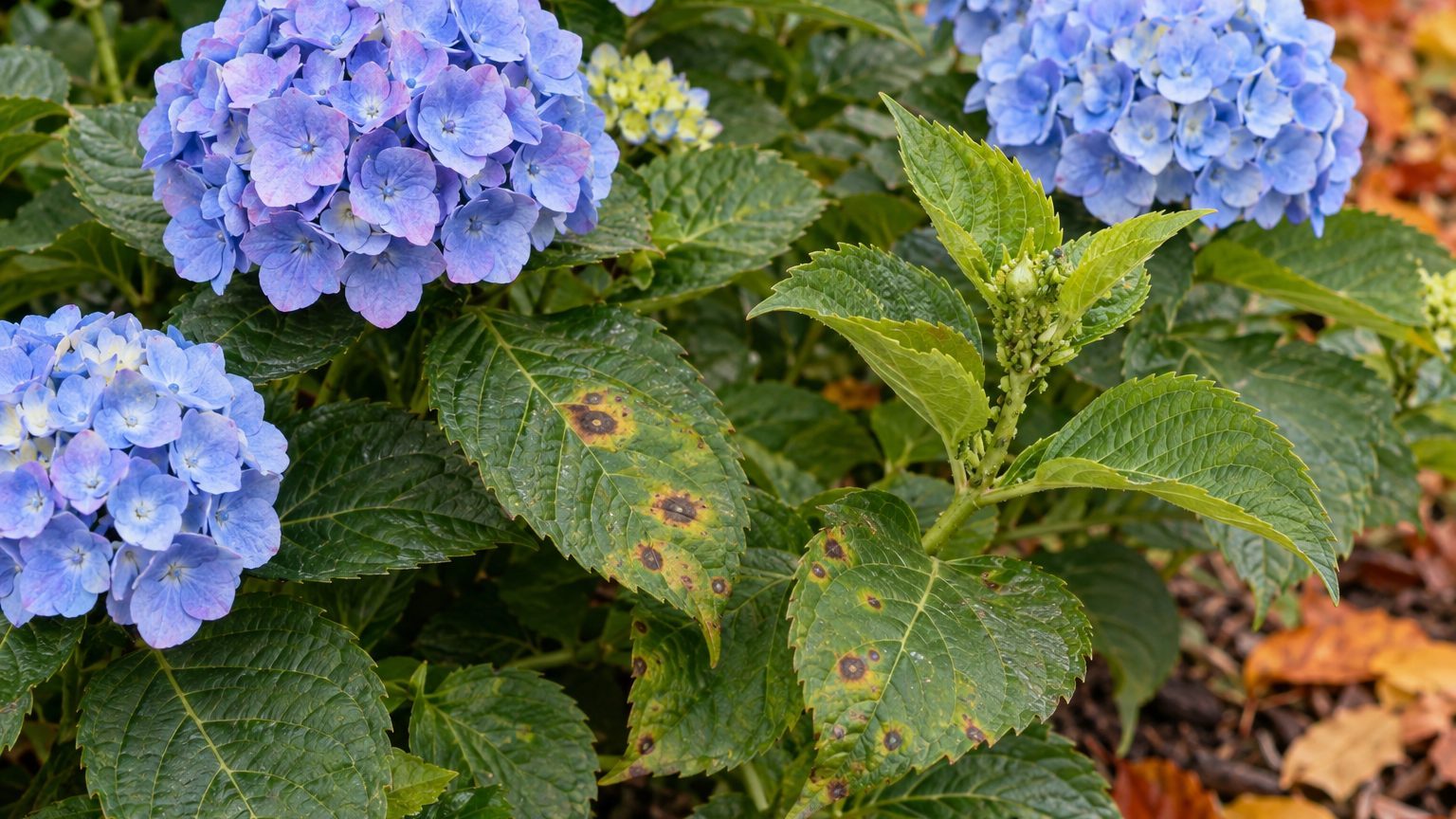
Clusters of small, soft-bodied insects gather on tender tips right as growth resumes after the frost window closes. They leave curled leaves and a sticky residue that draws sooty mold. A strong water spray every few days, timed to the April or May planting window, usually knocks the population down.

Four-lined plant bug damage

Small, round, sunken spots appear on leaves in late spring, usually before the June pruning window opens. The insect feeds and moves on, so by the time damage is visible, spraying rarely helps. Removing affected leaves and cleaning up garden debris in fall reduces next year’s population.

Powdery mildew on leaves

A white, dusty coating spreads across leaf surfaces once summer humidity settles in, typically after the July fertilizing round. It rarely kills a shrub but weakens it over a season. Spacing plants for airflow and watering at soil level, not overhead, does more than any fungicide applied late.

Cercospora leaf spot

Small purple-brown spots with tan centers show up on lower, older leaves first, spreading upward through late summer. Heavily spotted leaves drop early, which looks alarming but rarely threatens the plant itself. Removing fallen leaves before the first fall frost window limits next season’s spore count.

Botrytis blight in fall

Botrytis blight in fall — Hydrangea Pests and Diseases in Maryland

Gray, fuzzy mold covers flower clusters and soft stems after cool, wet weather moves in ahead of the October 26 to November 5 frost window. It spreads fast in crowded plantings. Cutting out affected tissue and improving airflow before that window closes is the gesture that actually works.

How to Work Out the Dates for Your Own Yard

The frost window itself is only a starting point, working out which problem you’re actually dealing with means counting forward and backward from it.

  1. Count forward from the last spring frost: NOAA NCEI 1991-2020 Climate Normals puts Baltimore’s window at April 3 to April 16, so soft new growth appears within two to three weeks after that, which is when slugs and aphids move in first.
  2. Match new plantings to the April or May window: a shrub set out during that stretch is still adjusting roots through June, so yellowing then is more likely transplant stress than disease.
  3. Watch humidity after the July fertilizing round: powdery mildew and cercospora leaf spot both need sustained humidity, so symptoms appearing right after that round point to fungal causes rather than insects.
  4. Hold pruning to June or July: cutting bigleaf wood outside that window removes flower buds and opens fresh wounds right when fungal spores are most active.
  5. Recheck before the first fall frost: the October 26 to November 5 window is the last realistic point for spotting botrytis blight before cooling weather masks the signs under natural leaf drop.

Run through that sequence once and most of what shows up on a Maryland hydrangea sorts itself into pest, fungus, or ordinary stress, without guessing from a single photo.

Maryland North to South: How the Dates Shift

Frost dates and humidity don’t move the same way across Maryland, and that changes which problem tends to show up first in a given yard.

  • Western Maryland (Garrett, Allegany): the mountains push both frost dates weeks later than the state average, which shortens the humid stretch and eases fungal pressure but raises the odds of a late frost catching new growth.
  • Central Maryland (Baltimore, Howard, Montgomery): sits closest to the reference window, with the fullest overlap between the April to May planting stretch and the June to July pruning window.
  • The Eastern Shore (Talbot, Dorchester, Wicomico): the bay’s moderating effect keeps both frost dates milder, stretching out the humid season and giving powdery mildew and leaf spot more weeks to spread each summer.

Whichever part of the state a yard sits in, the calendar still starts from the same two windows, just shifted a few weeks in one direction or the other.

Mistakes Maryland Punishes

Pruning bigleaf outside its window

Cutting old wood before June or after July removes next year’s flower buds and leaves fresh wounds exposed right as fungal spores peak for the season. Bigleaf hydrangea sets buds on old wood, so timing the cut to that stated window matters more than the tool used.

Fertilizing straight into fall

A round outside the March, May, or July schedule pushes soft new growth right before the first frost window, and that tender tissue is the first thing aphids and botrytis attack. Stopping after July gives new growth time to harden off before cold weather arrives.

Planting in full sun without airflow

A shrub set out during the April or May window but crowded against a fence or wall traps humidity against the leaves all summer, which is exactly what powdery mildew and cercospora leaf spot need to spread. Spacing at planting time avoids the problem entirely.

Maryland Extension Offices and County Contacts

The zone and frost figures above are a starting point, your county extension office tracks the pest and disease pressure that actually shows up on your street each season.

  • University of Maryland Extension: extension.umd.edu lists county offices, current pest alerts, and plant diagnostic clinics.
  • Your county office: the nearest branch can confirm whether a leaf spot is fungal or bacterial before you spray anything.
  • Master Gardener volunteers: reachable through the same extension network, for a quick photo-based diagnosis before a problem spreads further.

Common questions

Do brown spots on hydrangea leaves always mean disease?

Not always. Sunscorch from full afternoon sun looks similar to cercospora leaf spot but shows up only on the sun-facing side and doesn’t spread the same way. Checking both sides of the shrub before treating helps tell the two apart.

Can I treat pests and diseases at the same time I fertilize?

The March, May, and July fertilizing rounds are a reasonable time to inspect for both, but any treatment should target the actual problem found rather than being applied on that schedule automatically.

Does one bad season mean I should replace the shrub?

Usually not. Most of the problems listed here, from aphids to leaf spot, weaken a hydrangea without killing it, and a shrub given better airflow and correct pruning timing the following year typically recovers on its own.
When to Prune Hydrangeas in Maryland

When to Prune Hydrangeas in Maryland

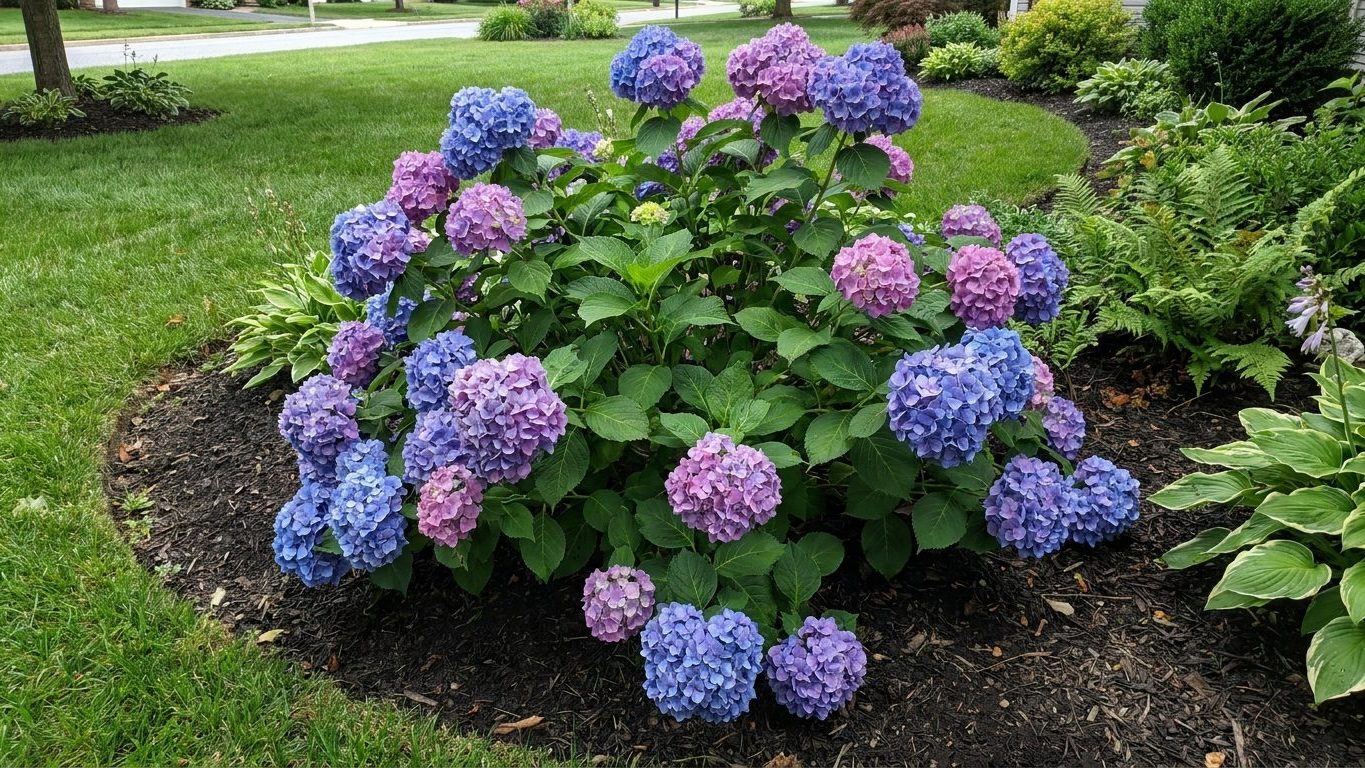
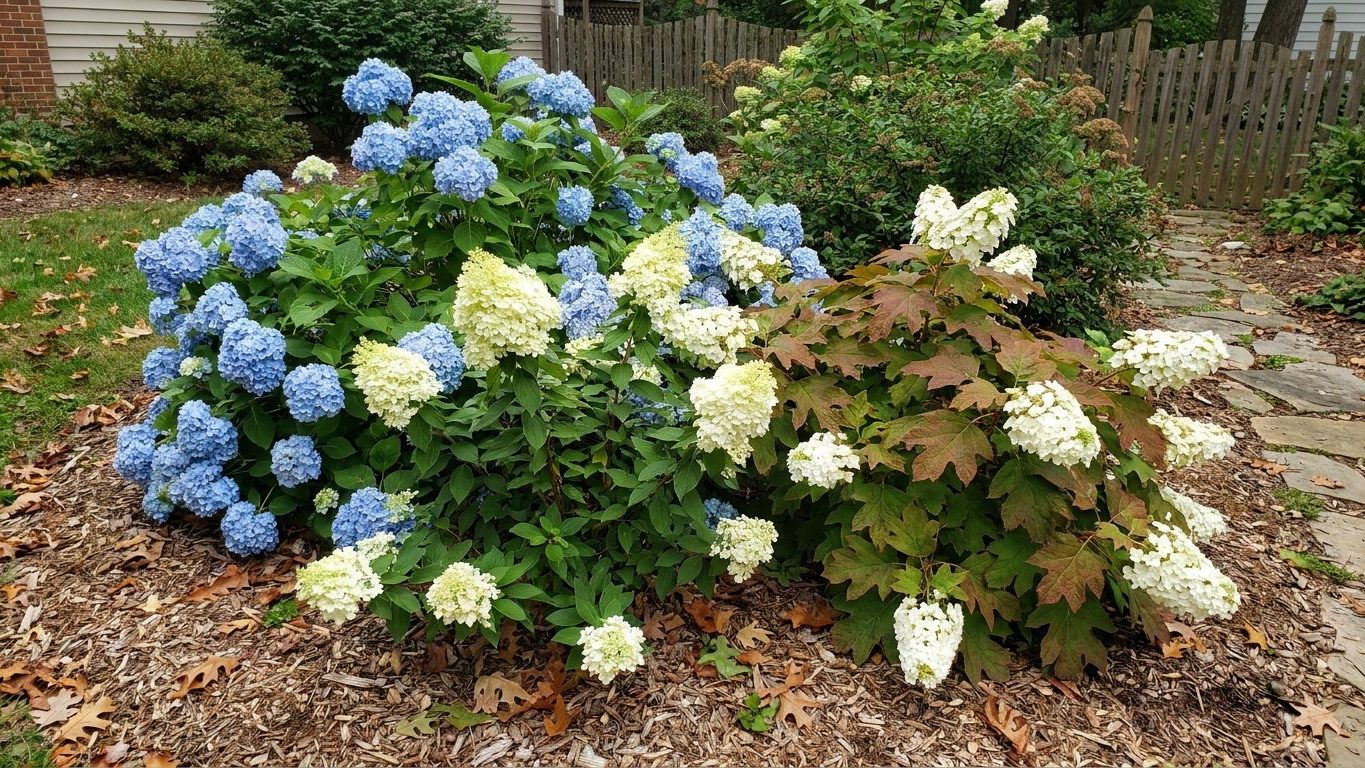
Plant hydrangeas in Maryland during April, May, August, or September, once the soil has warmed past the spring frost line or cooled below summer heat. Bigleaf types get their pruning done in June and July, right after the flowers fade. Baltimore’s frost calendar sets the outer edges of that window, and everything from soil prep to fertilizer timing follows from those two dates.

When to prune hydrangeas in Maryland: The Short Answer

Baltimore’s last spring frost falls between April 3 and April 16, and the first fall frost arrives between October 26 and November 5, according to NOAA NCEI 1991-2020 Climate Normals, and those two windows anchor every date below.

  • January: The garden sits dormant well before any frost math matters. Leave last season’s stems standing for winter interest and don’t prune anything yet.
  • February: Still weeks ahead of Baltimore’s last frost, this is order-and-plan season, not plant season. Check stems for winter dieback so you know what to prune away come summer.
  • March: This opens the first of three fertilizer months. Feed established shrubs lightly, since a hard freeze can still hit through mid-April.
  • April: The last frost window itself runs April 3 to April 16, so plant only after that date passes in your yard. Panicle and smooth hydrangeas tolerate a late cold snap better than bigleaf does.
  • May: With frost risk gone, this is peak planting month for every hydrangea type sold locally. It’s also the second fertilizer month, feeding roots while they’re actively growing.
  • June: Bigleaf hydrangeas finish their first flush now, and this opens the pruning window. Cut spent blooms back to the first healthy bud below the flower.
  • July: The pruning window for bigleaf closes at the end of this month, and it’s also the final fertilizer month of the year. Anything cut later risks removing next year’s flower buds.
  • August: A second planting window opens as summer heat starts to ease. Roots set now have roughly ten to twelve weeks before the first fall frost to establish.
  • September: This is the last practical month to plant, since the first fall frost follows in October or early November. Water new plantings deeply through any dry stretches.
  • October: The first fall frost lands somewhere between October 26 and November 5 depending on where you garden. Stop fertilizing now so new growth doesn’t get caught by the cold.
  • November: Frost has typically arrived statewide by now, and leaves will blacken and drop on their own. Add two to three inches of mulch over the root zone before the ground freezes hard.
  • December: The shrub is fully dormant and needs nothing but occasional water during a dry winter. Skip any pruning entirely until the June window reopens.

That twelve-month rhythm holds for most of the state, though Garrett and Allegany counties in the mountains run weeks behind, and the Eastern Shore runs a little ahead.

How to Work Out the Dates for Your Own Yard

Your own yard rarely matches the reference station exactly, so the real question is how to translate Baltimore’s frost dates onto your specific patch of ground.

  1. Find your local frost dates: Baltimore’s last spring frost runs April 3 to April 16 and its first fall frost runs October 26 to November 5, per NOAA NCEI 1991-2020 Climate Normals, but a valley or low spot on your property can trail those dates by a week or more.
  2. Match your hardiness zone: the USDA Plant Hardiness Zone Map places Maryland between 5b and 8a, and a shrub rated for zone 6 struggles anywhere the state dips into 5b territory, mainly the western counties.
  3. Pick your planting month from the state list: April, May, August, and September are the four months proven to work here, so count backward from whichever frost date is closer and choose the nearest of those four.
  4. Hold bigleaf pruning to June and July: cut spent flowers within that window and the shrub sets next year’s buds on schedule, cut outside it and you risk removing the wood that would have flowered.
  5. Recheck after a hard winter: dieback from a colder than usual stretch pushes the safe planting date later, so wait for new leaf growth before trusting a bigleaf hydrangea to be alive.

None of this replaces watching your own yard for two or three seasons. A microclimate against a south-facing brick wall can run a full zone warmer than the open lawn ten feet away.

Maryland North to South: How the Dates Shift

Elevation, water, and simple latitude push these same dates in different directions across Maryland, without changing the state-wide figures already given above.

  • Western Maryland (Garrett, Allegany): the mountains hold cold air longest, pushing both frost dates later and shortening the whole planting season.
  • Central Maryland (Baltimore, Howard, Montgomery): this stretch tracks closest to the reference dates, since it’s the corridor the reference station itself sits in.
  • Southern Maryland (Calvert, St. Mary’s, Charles): the Chesapeake’s open water moderates temperature swings, nudging the last frost a little earlier than the mountains.
  • The Eastern Shore (Talbot, Dorchester, Wicomico): flat land and bay water on two sides give this region the mildest and longest growing season in the state.

Check the state guide for the county-by-county breakdown before locking in a date.

Mistakes Maryland Punishes

Pruning bigleaf at the wrong time

Cutting bigleaf hydrangeas back in fall or early spring feels tidy, but it removes the buds that were going to flower next summer. Prune only in June and July, right after the blooms fade, and the shrub sets new buds on schedule for next year.

Planting too early in a warm March

A mild stretch in March tempts gardeners to get bigleaf hydrangeas in the ground before the danger has passed. Baltimore’s last frost can land as late as April 16, so hold off until April at the earliest and let panicle types take the early risk instead.

Skipping winter cover in the mountains

A shrub that survives fine in Baltimore can die back to the ground in Garrett or Allegany County without extra mulch. Pile two to three inches over the root zone before November and wrap young bigleaf stems in burlap through the coldest stretch.

Maryland Extension Offices and County Contacts

Baltimore’s frost dates are a starting point, not the final word for your county. The University of Maryland Extension and your local county office track conditions closer to your own soil.

  • Your state page: the frost dates and the pruning window for Maryland, laid out county by county.
  • University of Maryland Extension: county-level advice, soil testing, and plant clinics through extension.umd.edu.
  • Your county extension office: the closest source for microclimate quirks a state-wide figure can’t capture.

Common questions

Can I plant hydrangeas in Maryland in the fall?

Yes, August and September both work, since roots have roughly ten to twelve weeks to establish before the first fall frost arrives between October 26 and November 5.

Why didn’t my bigleaf hydrangea bloom this year?

The most common cause is pruning outside the June and July window, which removes the buds set for the following season. A late spring frost after bud break can do similar damage without any pruning at all.

Do hydrangeas survive winter in western Maryland?

Panicle and smooth varieties generally do, since they tolerate the colder end of Maryland’s 5b to 8a hardiness range. Bigleaf hydrangeas are the least reliable there and often need mulch and burlap to make it through a hard winter.

Hydrangeas That Grow Well in Manitoba

Hydrangeas That Grow Well in Manitoba

Panicle hydrangea and smooth hydrangea are the two names that hold up across Manitoba, Winnipeg included, because both flower on new wood and don’t need last year’s stems to survive the cold. Bigleaf hydrangea is the riskiest common name sold at nurseries here, and most yards that plant it get leaves, not blooms, most summers.

Hydrangeas that grow well in Manitoba: The Short Answer

Winnipeg’s own yard sits in Canadian zone 3b, and that number is most of the story. Natural Resources Canada’s Plant Hardiness Site puts the reference city at 3b under the 1991-2020 normals, a zone built from seven climate variables rather than the single minimum-temperature reading used south of the border.

What actually decides which hydrangea survives here is simpler than a zone map. Does the shrub set flower buds on last year’s stem, or on the stem it grows this spring. A new-wood bloomer regrows and flowers even after a stem-killing winter, an old-wood bloomer does not.

Environment and Climate Change Canada’s Canadian Climate Normals put the average last spring frost at May 23 and the average first fall frost at September 22, a stretch of roughly four months, and that figure is a mean, not a guarantee, so treat it as a midpoint rather than a safe date.

Panicle and smooth hydrangeas flower reliably inside that window because they push new growth fast once the ground warms. A shrub that needs a full season to mature old wood is fighting the calendar as much as the cold.

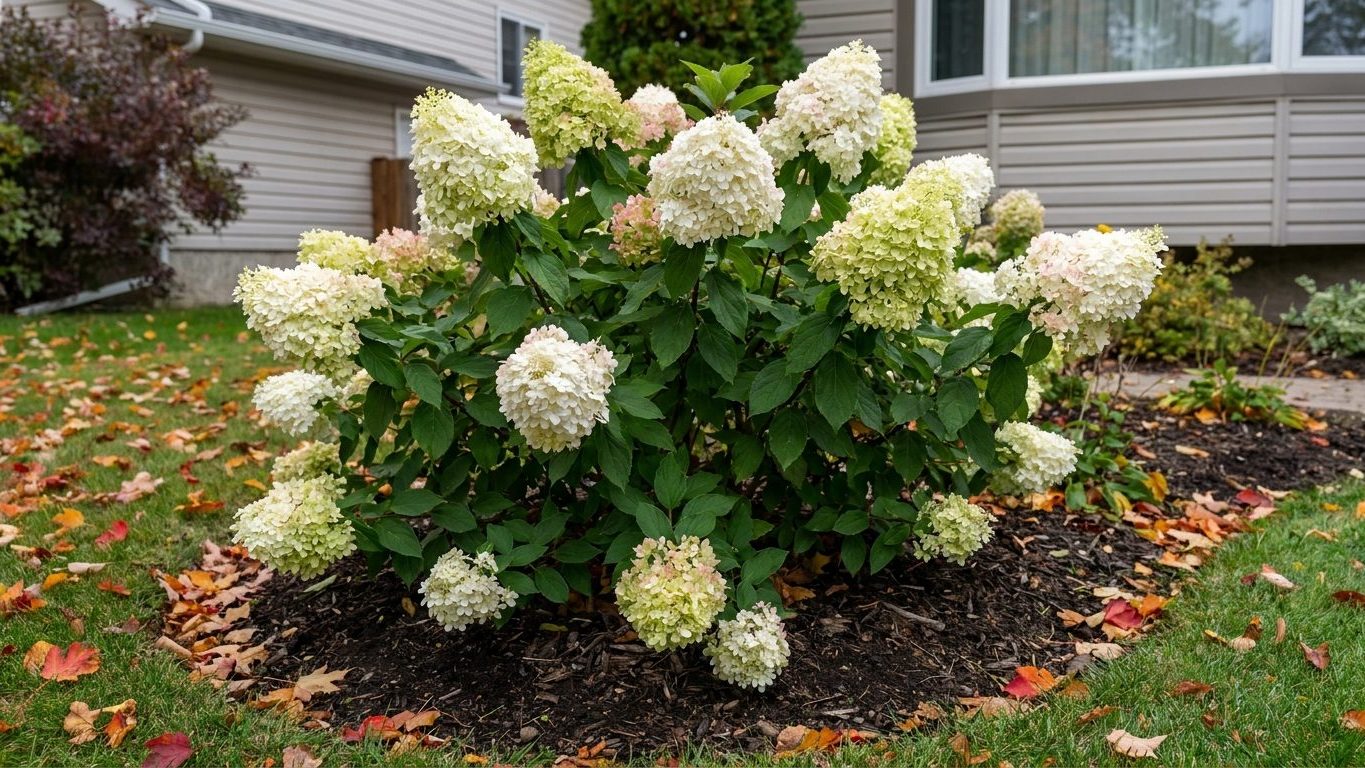
Panicle hydrangea

Panicle hydrangea — Hydrangeas That Grow Well in Manitoba

Panicle hydrangea blooms on new wood, so a winter that kills every above-ground stem still leaves a shrub full of cone-shaped flowers by late summer. It’s the safe bet for zone 3b, and the one most nurseries around Winnipeg actually stock.

Smooth hydrangea

Smooth hydrangea — Hydrangeas That Grow Well in Manitoba

Smooth hydrangea, usually sold as ‘Annabelle’, shares that new-wood habit and takes the same dieback in stride. Its big round flower heads come back reliably after a stem-killing winter, though they can flop without staking after a wet week.

‘Limelight’ panicle hydrangea

'Limelight' panicle hydrangea — Hydrangeas That Grow Well in Manitoba

‘Limelight’ is a panicle cultivar bred for size and a chartreuse-to-pink color shift, and it inherits the same cold tolerance that makes the species safe here. Give it room, since some plants grow well over head-high by midsummer.

‘Pinky Winky’ panicle hydrangea

'Pinky Winky' panicle hydrangea — Hydrangeas That Grow Well in Manitoba

‘Pinky Winky’ is another panicle selection, prized for flower heads that turn pink from the base up while the tips stay white. It carries the same new-wood hardiness as its parent species and asks nothing extra of a Manitoba yard.

Climbing hydrangea

Climbing hydrangea — Hydrangeas That Grow Well in Manitoba

Climbing hydrangea can take years to establish, and its older wood leaves it exposed in an open, wind-scoured yard. It does far better against a sheltered wall than out in open ground where Manitoba wind runs unchecked.

Bigleaf hydrangea

Bigleaf hydrangea — Hydrangeas That Grow Well in Manitoba

Bigleaf hydrangea sets its buds on old wood, the exact habit a Manitoba winter punishes hardest. Most gardeners who plant it here see healthy leaves but no flowers most summers, since the buds died back before they ever opened.

How to Work Out the Dates for Your Own Yard

Work outward from the reference window instead of copying it straight onto your own yard.

  1. Locate your frost window: Winnipeg’s average last spring frost falls around May 23 and its average first fall frost around September 22, source Environment and Climate Change Canada’s Canadian Climate Normals, and both dates are means, not guarantees.
  2. Push both dates later if you’re north or on open prairie: shelterbelts, river valleys, and built-up yards warm faster than an open field, so treat the reference window as the earliest case for your own ground.
  3. Match the shrub’s wood habit to what’s left of the season: a new-wood bloomer like panicle hydrangea only needs enough of that stretch to push stems and set buds, while an old-wood bloomer like bigleaf hydrangea needs its buds to survive a winter the same window doesn’t shelter.
  4. Plant the safer name first: put panicle hydrangea against a wall or fence line for a full season before spending money on anything riskier.
  5. Watch what an old-wood variety does after one winter: if bigleaf hydrangea leafs out from the base only, with no flowers on any stem left from last year, the frost window just made the decision for you.

Apply that same logic to your own slope, fence line, or open field and the list above sorts itself. Panicle and smooth hydrangea pass nearly every winter this method can throw at them, bigleaf hydrangea keeps surviving winters it rarely flowers through.

Manitoba North to South: How the Dates Shift

Manitoba’s frost dates are not one line on a map, and the numbers above hold only for the Winnipeg area.

  • The Red River Valley (Winnipeg, Portage la Prairie, Selkirk): the flattest, most open stretch of farmland in the province, and the closest match to the reference window, though open fields still cool faster than a sheltered yard.
  • The Interlake (Gimli, Ashern, the land between Lake Winnipeg and Lake Manitoba): the two lakes hold warmth into fall and slow the first frost slightly, but the same water can push spring later before the ice clears.
  • Western Manitoba (Brandon, Dauphin, the escarpment country): higher ground and a more continental swing mean a frost that arrives sooner in fall and lingers later in spring than the Winnipeg reference.
  • Northern Manitoba (Thompson, Flin Flon, The Pas): a season short enough that even panicle hydrangea runs out of summer some years, and only the most sheltered yards near buildings buy any extra weeks.

None of that changes what survives, panicle and smooth hydrangea still lead the list everywhere in the province, but it does change how much bloom you get before frost cuts the season short. Check the Manitoba guide page for the dates that match your own part of the province.

Mistakes Manitoba Punishes

Betting on bigleaf hydrangea for old-wood blooms

Bigleaf hydrangea sets flower buds on last year’s wood, and a Manitoba winter kills that wood most years before it ever opens, so gardeners see leaves every summer and almost no blooms. Choose panicle or smooth hydrangea instead, both of which flower on new wood regardless of what the winter did.

Leaving the crown bare before freeze-up

A hydrangea crown left bare into the cold season loses roots before the top growth even shows damage, since Manitoba’s ground can freeze deep even under snow. Mound extra mulch over the base once temperatures start dropping toward freezing, and check the calendar page for the exact planting windows.

Planting climbing hydrangea out in the open

Climbing hydrangea set in an open, wind-scoured yard dries out and burns back faster than the same plant against a sheltered wall, because Manitoba wind runs unchecked across open ground. Site it out of the wind, ideally against a building, before counting on it to establish.

Manitoba Extension Offices and County Contacts

The zone number above is a starting point, not the last word. Manitoba Agriculture and your municipal office carry the soil and microclimate detail a province-wide figure can’t.

  • Manitoba Agriculture: the provincial extension service, with horticulture staff who answer questions on hydrangea hardiness and soil for your municipality (gov.mb.ca/agriculture).
  • Your municipal office: local rules on yard waste and pruning debris that affect how you handle mulch and dead wood.
  • Master Gardener volunteers: often reachable through libraries or garden clubs, and usually the first to know what’s actually surviving two yards over.

Common questions

Can bigleaf hydrangea survive winter in Manitoba?

The plant itself often survives at the root, since Manitoba’s snow cover insulates the base, but the flower buds set on old wood rarely make it through a full winter in zone 3b. Most gardeners get foliage without blooms most years.

What is the easiest hydrangea to grow in Winnipeg?

Panicle hydrangea is the easiest, since it blooms on new wood and regrows reliably after any winter the region throws at it. Smooth hydrangea, sold as ‘Annabelle’, comes in a close second for the same reason.

Do hydrangeas need winter protection in Manitoba?

Established panicle and smooth hydrangea generally don’t, since dieback doesn’t cost them their flowers. Newly planted shrubs of any variety benefit from a mulch mound over the crown for their first winter, and old-wood types like bigleaf need shelter every year to have any shot at blooming.

When to Prune Hydrangeas in Manitoba

When to Prune Hydrangeas in Manitoba

Plant hydrangeas in Manitoba between May and August, once soil has warmed past the average May 23 last frost at Winnipeg. Prune bigleaf varieties only in June or July, since fall cuts remove next year’s buds before Manitoba’s zone 3b winter arrives. Fertilize in May and July, and finish any new planting well ahead of the average September 22 first fall frost that closes the growing season.

When to prune hydrangeas in Manitoba: The Short Answer

Manitoba Agriculture’s growing season runs short and cold, so this calendar marks the only months when planting, fertilizing, or pruning actually pays off here.

  • January: hydrangeas stay fully dormant under snow and mulch, and there is no outdoor gesture to make this month. Just check that wrap or mulch hasn’t blown clear after a windstorm.
  • February: the ground stays frozen solid across the Winnipeg area, so pruning or planting now would only wound stems that can’t heal. Use the month to order stock for the May window instead.
  • March: frost risk stays high a full two months ahead of the May 23 average last frost recorded by Environment and Climate Change Canada, so hold off on any digging. Harden off potted stock indoors near a bright window if you’re getting a head start.
  • April: soil is often still cold beneath a mild surface, so planting or major pruning still waits. Pull back winter mulch gradually as snow melts to let the crown breathe.
  • May: this opens the first month of the plant window, once the last frost has typically passed at Winnipeg. It’s also the season’s first fertilizing month, so feed and plant together.
  • June: planting continues, and this is the first of the two months set aside for pruning bigleaf hydrangeas. Cut only spent flower heads and dead wood, never healthy stems already forming next year’s buds.
  • July: planting and bigleaf pruning both stay open, and it’s the second fertilizing month of the year. Water deeply during dry stretches so new roots don’t stall in summer heat.
  • August: the plant window closes at month’s end, giving new shrubs roughly two months of root growth before the average September 22 first fall frost. Skip any pruning past July.
  • September: the average first fall frost falls this month, so treat any hydrangea still in a nursery pot as urgent. Get it in early, or hold it over to next spring.
  • October: hard freezes are common now, and the plant is settling deeper into dormancy. Build up mulch over the root zone once the ground starts to firm.
  • November: winter protection matters most this month, given Winnipeg’s zone 3b winters ahead. Wrap stems or mound extra mulch before the deep cold sets in for good.
  • December: the shrub is fully dormant under Manitoba’s snowpack. There’s nothing to do but let that snow cover keep doing its job as insulation.

Nothing on this list works out of order: pruning in April or planting in September simply asks a shrub to do more than a short prairie season allows.

How to Work Out the Dates for Your Own Yard

Your own yard may run colder or warmer than the airport station, so start from the same frost math and adjust for what you actually see on the ground.

  1. Mark your last frost window: Environment and Climate Change Canada puts the average last spring frost at Winnipeg on May 23, so treat any date before late May as risky, not safe.
  2. Count backward for hardening off: give potted stock two to three weeks near a bright window before that date, so it isn’t shocked the first day it meets outdoor air.
  3. Watch the soil, not just the calendar: wait until the top few inches feel workable and no longer frozen underneath, since a mild afternoon can still sit over frozen ground into April.
  4. Plant inside the four-month window: May through August is the stretch this province supports for planting, and pushing later cuts into the root-growing time before fall frost.
  5. Prune only in June or July: bigleaf hydrangeas set next year’s buds soon after bloom, so pruning outside those two months removes flowers you haven’t seen yet.
  6. Count forward to first fall frost: the average September 22 date means a shrub planted in August gets barely six weeks of root growth, so earlier planting always has the advantage.

Run this same sequence for your specific lot, then shift the whole thing a week or two earlier or later based on how your yard has behaved in past springs.

Manitoba North to South: How the Dates Shift

Manitoba is not one climate, and the province’s spread shifts these dates by weeks in either direction from the Winnipeg baseline.

  • The Red River Valley (Winnipeg, Morden, Portage la Prairie): this is the warmest strip in the province, home to the May 23 average last frost and September 22 average first frost that Environment and Climate Change Canada records for Winnipeg, so treat it as the baseline rather than the safest case.
  • The Interlake and eastern Parkland (Selkirk, Gimli, Dauphin): closer to the lakes, spring often arrives a little later and pruning may need to slide toward July rather than June.
  • Western Manitoba and the escarpment (Brandon, Killarney, Swan River): higher ground and more open exposure mean frost can linger later into spring and return earlier in fall than the Winnipeg figures suggest.
  • Northern Manitoba (Thompson, The Pas, Flin Flon): the growing season shrinks sharply this far north, and both the plant window and the bigleaf prune window run tighter than in the south.

Check the province’s frost-date guide for the range closest to your own yard rather than relying on one airport reading.

Mistakes Manitoba Punishes

Planting straight from a warm greenhouse

Nursery stock raised under glass gets shocked when it meets open prairie air before the May 23 average last frost recorded by Environment and Climate Change Canada. Harden it off outdoors in a sheltered spot for a week first, then plant once soil has warmed inside the May-through-August window.

Pruning bigleaf hydrangeas in fall

Cutting bigleaf stems after bloom removes buds already set for next year, since this variety flowers on old wood. Keep pruning inside June and July only, and let spent flower heads ride through winter instead of trimming them off.

Leaving the crown bare into winter

Zone 3b winters at Winnipeg can kill stems and buds left uncovered, even on shrubs that survived the year before. Mound mulch over the crown before the ground freezes hard, and check it again after any late-fall melt-and-refreeze cycle.

Manitoba Extension Offices and County Contacts

Winnipeg’s frost dates are a starting point, and Manitoba Agriculture tracks the horticultural detail a single station can’t cover.

  • Manitoba Agriculture: provincial staff answer questions on hardy shrub varieties and soil conditions specific to your municipality.
  • Your municipal office: many towns keep local frost and planting notes that refine the provincial averages for your street.
  • Master Gardener volunteers: several Manitoba chapters run plant clinics, so bring a sample or a photo for a second opinion before you commit to a planting date.

Common questions

What happens if I miss the August planting cutoff in Manitoba?
A shrub planted in September has only a few weeks before the average first fall frost on September 22, leaving roots too shallow to handle a hard freeze. Hold the plant over in a pot in a sheltered spot and plant it in May instead.

Is May 23 a guaranteed frost-free date in Winnipeg?
No. Environment and Climate Change Canada’s figure is an average, not a guarantee, so frost falls later than May 23 in roughly half of all years. Treat it as the middle of a window, not a safe line to plant on.

Can I still fertilize hydrangeas in June?
The province’s calendar sets aside May and July for feeding, so June sits between those two windows. Wait for July rather than fertilizing off-schedule, since late feeding can push soft growth that struggles ahead of fall frost.

Hydrangeas That Grow Well in Maine

Hydrangeas That Grow Well in Maine

Panicle and smooth hydrangeas grow well across the whole state, from Portland’s mild coastal edge to the short-season interior. Bigleaf hydrangea, the classic mophead, only holds up reliably in that same coastal strip, where winter rarely reaches the extreme that kills its flower buds.

Hydrangeas That Grow Well in Maine: The Short Answer

The USDA Plant Hardiness Zone Map 2023 splits Maine between 3b and 6a, and that range is built on a single measurement: the coldest night a location can expect in an average winter. Portland sits at the mild 6a edge near the coast, which is why a shrub that dies back to the ground in the interior can still flower three blocks from Casco Bay.

What actually decides the outcome isn’t the species name on the tag, it’s whether that shrub blooms on wood it grew last year or on wood it’s growing right now. Six species and cultivars cover most of what holds up here, ranked from the one that shrugs off a 3b winter to the one that gambles everything on Portland’s microclimate.

Panicle hydrangea

Panicle hydrangea — Hydrangeas That Grow Well in Maine

Hydrangea paniculata blooms on new wood every summer, so a hard winter that kills the top growth costs nothing but time. It’s the safest bet from the coast to Aroostook County and tolerates the state’s short, cool summers without complaint.

Smooth hydrangea

Smooth hydrangea — Hydrangeas That Grow Well in Maine

Hydrangea arborescens, the native behind cultivars like ‘Annabelle,’ dies to the ground most winters and simply rebuilds. It asks for nothing special, which makes it a reliable choice for a yard that’s cold, shaded, or both.

Climbing hydrangea

Climbing hydrangea — Hydrangeas That Grow Well in Maine

Hydrangea anomala subsp. petiolaris takes years to establish but once it does, it clings to brick or a sturdy fence through southern and central Maine winters. It’s slower to reward a gardener than the shrub forms, so patience matters more here than protection.

Oakleaf hydrangea

Oakleaf hydrangea — Hydrangeas That Grow Well in Maine

Hydrangea quercifolia brings fall color the others can’t match, but it’s a coastal-and-central plant here, not a statewide one. Farther inland or north, winterkill on the flower buds is common enough that bloom becomes a coin flip.

Mountain hydrangea

Mountain hydrangea — Hydrangeas That Grow Well in Maine

Hydrangea serrata sets buds partway between old and new wood, which helps a little in a hard winter but doesn’t make it dependable in Maine’s colder half. It’s worth trying only where the yard already runs mild.

Bigleaf hydrangea

Bigleaf hydrangea — Hydrangeas That Grow Well in Maine

Hydrangea macrophylla, the mophead everyone pictures, blooms on old wood almost exclusively, and that wood has to survive winter intact to flower. Outside the warmest coastal pockets near Portland, it usually lives but rarely blooms.

How to Work Out the Dates for Your Own Yard

Work out your own planting and pruning dates by starting from the windows that already run this state’s calendar and counting backward or forward from where you live.

  1. Check your last spring frost: NOAA NCEI 1991-2020 Climate Normals put Portland’s last spring frost at April 22 to May 1, and every mile inland or north pushes that later.
  2. Hold new stock past that window: don’t set out a young hydrangea before the frost date at your own address, not the coast’s, has cleared.
  3. Plant in the state’s open months: April, May, August, and September are the four months the calendar keeps open for planting, so pick the one that follows your local frost.
  4. Prune bigleaf only in June or July: those two months are the only pruning window for old-wood bloomers, cut earlier and you remove buds already set.
  5. Feed on the March, May, and July schedule: skip a fall feeding, since growth pushed late won’t harden off before frost returns.
  6. Count back from fall frost for last calls: Portland’s first fall frost lands October 9 to October 21, and that’s the deadline for anything that still needs weeks in the ground.

Panicle hydrangea passes this test easily since it blooms on new wood and simply starts over each spring inside these windows. Bigleaf hydrangea often fails it, because old wood carried through a Maine winter rarely survives to flower.

Maine North to South: How the Dates Shift

The hardiness range that spans this state isn’t spread evenly across it, it shifts with the coastline, the lakes, and the elevation.

  • Coastal Maine (Portland, Bar Harbor, the southern beaches): the mildest ground in the state, closest to the warm end of the range, frost arrives latest here.
  • Central Maine and the Lakes Region (Augusta, Sebago Lake): colder than the coast, spring frost lingers longer before it lifts.
  • Western Mountains (Rangeley, Bethel): cold air pools in the valleys, and frost can hold on into what feels like planting season everywhere else.
  • Aroostook County and the North (Presque Isle, Fort Kent): the coldest end of the map, the short season that decides which hydrangea even gets tried.

Anyone weighing a purchase against these shifts should check the state page for the exact frost window where they live before assuming Portland’s calendar applies.

Mistakes Maine Punishes

Setting new plants out before the ground warms

A hydrangea planted ahead of the last spring frost sits in cold, wet soil that stalls root growth and invites rot. NOAA NCEI 1991-2020 Climate Normals put Portland’s last frost at April 22 to May 1, and inland yards trail further behind. Wait for the state’s planting window instead.

Cutting bigleaf hydrangea outside June or July

Bigleaf sets its flower buds on the wood it grew the summer before, and a fall or early spring cut removes them outright. Maine’s calendar only opens pruning in June and July, once the shrub shows which stems survived winter. Cut inside that window and next year’s blooms stay put.

Feeding after midsummer

A late feeding pushes soft new growth that has no time to harden before the first fall frost arrives. The fertilizing schedule stops in July for a reason, tender shoots fed later rarely survive to spring. Stick to March, May, and July, and let the shrub close down on its own.

Maine Extension Offices and County Contacts

University of Maine Cooperative Extension turns the state-wide zone range into county-level advice for your soil, your slope, and your particular frost pocket.

  • Your state page: the frost dates and the pruning window where you live.
  • What goes wrong here: the pests and problems Maine hydrangea growers actually report.
  • University of Maine Cooperative Extension: county offices that can confirm your microclimate before you plant.

Common questions

Can bigleaf hydrangea survive a Maine winter?

It survives in most of the state but rarely flowers outside the mild coastal strip near Portland, since its flower buds form on old wood that needs to make it through winter intact.

When is the best time to plant hydrangeas in Maine?

April, May, August, and September are the four months the state’s planting calendar keeps open, and choosing between them depends on how close your yard sits to the last spring frost.

Do hydrangeas need winter protection in Maine?

Panicle and smooth types don’t need it since they bloom on new wood each year. Bigleaf and mountain hydrangeas benefit from extra mulch and a sheltered spot if you’re gardening away from the coast.

Hydrangea Pests and Diseases in Maine

Hydrangea Pests and Diseases in Maine

In Maine’s cool, damp climate, hydrangea trouble follows a predictable order: winter cold kills flower buds before any insect shows up, cool spring dampness invites fungal blight, summer humidity brings mildew and leaf spot, and deer browse stems all winter long. Matching the problem to the month keeps you from treating the wrong thing.

Hydrangea pests and diseases Maine: The Short Answer

Portland sits at the mild edge of a state the USDA Plant Hardiness Zone Map places at zone 3b to 6a, and that spread is the reason winter injury outranks any single insect or fungus on a Maine hydrangea. The short list, in the order symptoms show up through the season, runs from winter bud kill through botrytis blight, aphids, powdery mildew, leaf spot, and deer browsing.

Winter bud kill

Winter bud kill — Hydrangea Pests and Diseases in Maine

Cold that dips below the shrub’s hardiness limit kills flower buds set the previous fall, so a healthy bigleaf leafs out but stays bare of blooms. Choose reblooming or panicle types and skip fall pruning to protect old wood through a 3b to 6a winter.

Botrytis blight

Cool, damp spring weather lets gray mold settle on soft new growth, leaving water soaked spots that turn brown and fuzzy on flowers and leaves. Space plants for airflow, water the soil rather than the foliage, and clip off infected tissue as soon as you spot it.

Aphids

Small green or black insects cluster on tender new shoots by early summer, curling leaves and coating stems with sticky honeydew that draws ants and sooty mold. A strong hose spray on most mornings knocks the colony down before it needs anything stronger.

Powdery mildew

A white, flour like coating spreads across leaf surfaces during humid stretches of midsummer, especially where plants sit crowded or in shade. Improve air circulation, avoid overhead watering in the evening, and remove the worst leaves rather than treating the whole shrub.

Leaf spot

Purple brown spots ringed with yellow appear on lower leaves during wet summers, spreading upward as spores splash from soil to foliage. Rake up fallen leaves each fall so the fungus has nowhere to overwinter, and keep fresh mulch under the shrub.

Deer browsing

Deer browsing — Hydrangea Pests and Diseases in Maine

Deer strip buds and stems through fall and winter when other browse is scarce, leaving ragged, angled damage rather than the clean cut of pruning shears. Fencing or repellent applied before first frost protects the shrub through Maine’s long dormant season.

How to Work Out the Dates for Your Own Yard

Working out which problem you actually have starts with matching the calendar to the symptom, since Maine’s freeze window frames almost every diagnosis.

  1. Mark the last spring frost: NOAA NCEI 1991-2020 Climate Normals put Portland’s last spring freeze at April 22 to May 1, so bare stems past that window point to winter bud kill rather than disease.
  2. Watch the first month of new growth: soft, curling shoots during the May fertilize window suggest aphids, while brown, fuzzy patches suggest botrytis instead.
  3. Check leaves in midsummer heat: a white film during the June to July bigleaf prune window points to powdery mildew, while spotted lower leaves point to leaf spot.
  4. Look for ragged stems by fall: clean cuts you made yourself look different from the torn, angled damage deer leave behind on unprotected stems.
  5. Count backward from the first fall frost: the October 9 to October 21 window marks when most pest activity slows sharply as nights turn cold.

Match the symptom to the month it appeared rather than guessing from a photo online, since the same brown leaf edge can mean three different things depending on whether it showed up in May or August.

Maine North to South: How the Dates Shift

Portland anchors the mild end of Maine’s frost calendar, and every other part of the state pushes those dates in one direction, which shifts which pest or disease shows up first.

  • The coast (Portland, Bar Harbor, the immediate shoreline): the ocean holds warmth into fall and delays the first freeze, so botrytis blight and powdery mildew get a longer stretch of humid weather to work with than inland gardens see.
  • Interior valleys and lake country (Sebago Lake, Moosehead Lake, the Belgrade Lakes area): cold air settles into these low pockets on clear nights, so flower buds face a harder freeze risk than the official zone number for the area would suggest.
  • The north and high country (Aroostook County, the western mountains near Rangeley): winters here reach the coldest end of the state’s 3b to 6a range, so bud kill and deer browsing matter more than fungus, which struggles in a shorter, drier growing season.

Check the state guide for the frost dates and pruning window that match your own county before acting on any of this, since a shrub in Aroostook faces a different calendar than one three hours south on the coast.

Mistakes Maine Punishes

Pruning bigleaf hydrangea in fall

Cutting stems back after summer removes flower buds already set for next year’s blooms, and Maine’s early fall frost leaves the shrub no time to recover before winter. Prune bigleaf hydrangea only during the June to July window while it is actively growing, and leave the old wood untouched once fall arrives.

Skipping winter protection on exposed sites

An unprotected shrub facing open wind and exposed sites loses more flower buds to winter desiccation than to any single hard freeze number on a hardiness map. Wrap stems loosely once the ground freezes solid and pile mulch heavily at the base, since exposure matters as much here as the zone label.

Fertilizing outside the growth windows

Feeding a hydrangea outside its growth windows pushes soft new growth that never hardens before the first fall frost arrives in early to mid October. Stick to the March, May, and July fertilize windows only, and stop feeding entirely once August begins so stems can toughen ahead of winter.

Maine Extension Offices and County Contacts

The zone 3b to 6a range printed on a hardiness map is a statewide average, and University of Maine Cooperative Extension keeps the county-level detail that map can’t show, including soil results and confirmed pest reports for your area.

  • Your state page: the frost dates and the pruning window where you live.
  • Which ones hold up here: the hydrangea varieties bred to handle a Maine winter without losing next year’s flowers.
  • UMaine Cooperative Extension: county offices that test soil, confirm a pest ID, and answer questions specific to your yard.

Common questions

What is the most common hydrangea problem in Maine?

Winter bud kill leads the list by a wide margin, since the state’s 3b to 6a hardiness range means flower buds set in fall often don’t survive to spring, leaving a healthy shrub with plenty of leaves but no blooms.

Do I need to spray for pests every year?

No. Aphids and mild fungal spotting rarely need chemical treatment in a Maine yard. A hose spray for aphids and good airflow for fungus handle most seasons, with stronger measures reserved for a confirmed, spreading problem.

When can I stop worrying about frost damage?

Once you’re past the last spring frost window of April 22 to May 1, new growth is generally safe from a killing freeze, though a late cold snap in a low pocket or northern county can still catch tender shoots off guard.

When to Prune Hydrangeas in Maine

When to Prune Hydrangeas in Maine

In Portland, the safe planting window runs April through May and again in August and September, once the last spring frost has passed and before the first fall frost locks up the ground. Prune bigleaf hydrangea only in June and July, right after bloom fades on old wood.

When to prune hydrangeas in Maine: The Short Answer

Here’s how the year actually unfolds in Portland, month by month, measured against frost rather than the calendar page on the wall.

  • January: The ground is frozen solid and shrubs sit fully dormant under their mulch. This is a resting month, nothing to do here.
  • February: I check burlap wraps and winter mulch for storm damage. No fertilizing or pruning yet, the soil is still locked.
  • March: This opens the year’s first fertilize window. I feed established shrubs once the soil softens, before any new growth pushes.
  • April: NOAA NCEI 1991-2020 Climate Normals puts Portland’s last spring frost between April 22 and May 1, so planting opens here but I set new shrubs late in the month with frost cloth on hand.
  • May: Planting and the second fertilize window both land here, once frost risk has passed for the coastal reference city. Inland gardeners should wait longer still.
  • June: Pruning bigleaf hydrangea opens now, after the first bloom flush on old wood fades. I cut spent flower heads back to the first strong bud.
  • July: The pruning window closes at month’s end, and a third fertilize round supports next year’s bud set. Cutting past this point risks next summer’s flowers.
  • August: A second planting window opens, giving roots time to settle before soil cools. I water deeply through any dry stretch.
  • September: Planting continues here, the last calendar month for new shrubs before frost returns. Soil stays warm even as the air cools off.
  • October: The first fall frost arrives between October 9 and October 21, closing out the growing season. New planting stops well before this window.
  • November: I wrap young shrubs in burlap and pile mulch over the root zone before hard freezes set in. This protects buds already formed on old wood.
  • December: The shrubs are fully dormant and the year’s active work is done. I only check that mulch hasn’t blown off in winter wind.

Every gesture above ties back to two things: the last spring frost and the first fall frost. Miss either window by much, and the shrub pays for it the following bloom season.

How to Work Out the Dates for Your Own Yard

Working out your own dates starts with your own frost window, not a generic date pulled off a seed packet.

  1. Find your zone: the USDA Plant Hardiness Zone Map 2023 places Maine between 3b and 6a, with Portland sitting near the mild 6a edge and inland valleys running colder.
  2. Count back from your last frost: Portland’s last spring frost falls between April 22 and May 1, so I treat anything planted before mid April as a gamble worth covering.
  3. Count forward to your first fall frost: the October 9 to October 21 range marks when to stop new plantings and start winter mulch, no matter how mild October feels that year.
  4. Match the variety to the zone: panicle hydrangea shrugs off a 3b winter and blooms on new wood even after dieback, while bigleaf hydrangea often loses its flower buds in the colder interior, which is why it does better near Portland than thirty miles inland.
  5. Adjust for your microclimate: a south-facing wall or a steady coastal breeze can shift these windows by a week or two in either direction.

Once you know your zone and your two frost windows, the rest is simple arithmetic. Plant after the last frost, stop well before the first one, and prune bigleaf hydrangea only in the June to July window.

Maine North to South: How the Dates Shift

Maine’s frost dates swing more than most people expect between the coast and the interior.

  • Midcoast and southern coast (Portland, Brunswick, Camden): the mildest air in the state, closest to the 6a edge, with the widest planting window of anywhere in Maine.
  • Central and lakes region (Augusta, Bangor, the Belgrade Lakes): typically a week or two behind the coast in spring, and a week or two ahead of it into fall cold.
  • Western mountains and foothills (Rangeley, Bethel, the Carrabassett Valley): elevation stacks cold on top of latitude, pushing bigleaf hydrangea toward the edge of what actually survives.
  • Northern Maine and Aroostook County (Caribou, Presque Isle, Fort Kent): the coldest corner of the state, where panicle and smooth hydrangea are the dependable choices instead.

None of this replaces the frost dates for your own town, it only explains why the coast and the interior never run on the same clock.

Mistakes Maine Punishes

Pruning bigleaf hydrangea in fall

Cutting bigleaf hydrangea back in September or October removes the very buds meant to open next summer, since this variety blooms on old wood formed the season before. Save the pruners for the June to July window instead, right after flowering fades.

Planting too late into cold soil

Setting a new shrub in October, once the first fall frost has likely arrived, leaves roots no time to establish before the ground locks up. September closes the planting calendar here for that reason. Move planting into April, May, August, or September instead.

Skipping winter protection on exposed sites

A shrub left bare through a Maine winter can lose every above-ground stem, especially bigleaf hydrangea in the colder interior. Wrapping burlap around the plant and piling mulch over the root crown in November protects buds already formed. Skip it, and bloom is the first thing gone.

Maine Extension Offices and County Contacts

The state figures here are a starting point, not the final word for your particular yard. County offices and extension agents fill in the rest, plot by plot.

  • University of Maine Cooperative Extension: soil testing, variety questions, and county-level advice across the state.
  • Your state page: the frost dates and the pruning window for wherever you live in Maine.
  • Which ones hold up here: the variety list ranked from safest to riskiest for this climate.

Call before you plant, not after the shrub struggles.

Common questions

Can I plant hydrangeas in Maine in the fall?

Yes, within the calendar’s September window, but stop well before the October 9 to October 21 frost range so roots have time to grip before the ground freezes.

What zone is Maine for hydrangeas?

Maine spans zones 3b to 6a. The coast sits at the milder end, the interior and north run colder. Portland gardeners work near the 6a edge, Aroostook County gardeners work closer to 3b.

Do I need to cover hydrangeas for winter in Maine?

For bigleaf hydrangea, yes, especially away from the coast, since its flower buds form on old wood and don’t tolerate the state’s coldest nights. Panicle and smooth hydrangea don’t need it.

Hydrangeas That Grow Well in Louisiana

Hydrangeas That Grow Well in Louisiana

Oakleaf and bigleaf hydrangeas grow best across Louisiana, handling both the humid summers and the mild winters that barely dip below freezing in the New Orleans area. Panicle hydrangea comes in close behind for full-sun spots, while climbing hydrangea and smooth hydrangea struggle against the state’s long, hot growing season.

Hydrangeas that grow well in Louisiana: The Short Answer

Louisiana’s growing season rewards species built for heat and humidity over ones bred for hard winters, and that logic decides most of this list. The USDA Plant Hardiness Zone Map puts the state at zone 8a to 10a, with New Orleans sitting near the warm 10a end and the northern parishes closer to 8a.

Oakleaf Hydrangea

Oakleaf Hydrangea — Hydrangeas That Grow Well in Louisiana

Native to the Southeast, Hydrangea quercifolia shrugs off Louisiana humidity and heavy afternoon heat better than any hydrangea on this list. Its flower buds form in fall, so it rides out the state’s freeze-free winters without losing next year’s bloom. Part shade and well-drained soil are all it asks for.

Bigleaf Hydrangea

Bigleaf Hydrangea — Hydrangeas That Grow Well in Louisiana

Hydrangea macrophylla is the classic Southern hydrangea, common in New Orleans courtyards and Baton Rouge front yards alike. It blooms on old wood, so it needs protection from a hard fall prune, and it wants afternoon shade once summer heat sets in. Given that shade, it flowers reliably year after year.

Panicle Hydrangea

Panicle Hydrangea — Hydrangeas That Grow Well in Louisiana

Hydrangea paniculata tolerates full sun better than any hydrangea grown here, which matters in a state with few shady building lots. It blooms on new wood, so a hard prune never costs a season of flowers. It holds up through Louisiana’s long summer without the wilting bigleaf shows by midday.

Smooth Hydrangea

Smooth Hydrangea — Hydrangeas That Grow Well in Louisiana

Hydrangea arborescens, sold as Annabelle in most nurseries, grows here but shows its strain by August, with stems that flop under humidity-heavy blooms. It needs afternoon shade and steady moisture to avoid collapsing in the heat. Treat it as a plant for a protected bed, not an open yard.

Mountain Hydrangea

Mountain Hydrangea — Hydrangeas That Grow Well in Louisiana

Hydrangea serrata shares bigleaf’s old-wood bloom habit but was bred for cooler summers, and it shows more leaf stress once July heat builds in south Louisiana. It fares better in the state’s northern parishes, where summer nights run cooler. Farther south, expect smaller blooms and more wilting.

Climbing Hydrangea

Climbing Hydrangea — Hydrangeas That Grow Well in Louisiana

Hydrangea anomala subsp. petiolaris is the riskiest choice on this list, bred for the cool summers of the Northeast and Pacific Northwest rather than Louisiana’s long, humid growing season. It often takes years to establish here and may never bloom heavily. Most Louisiana gardeners get better results from a native vine instead.

How to Work Out the Dates for Your Own Yard

Matching a hydrangea to your yard means reading Louisiana’s own calendar rather than a nursery tag written for a national audience.

  1. Start with your frost window: NOAA NCEI 1991-2020 Climate Normals puts the New Orleans area’s last spring frost between January 18 and February 8, and the first fall frost between December 17 and January 8, so the frost-free stretch runs nearly the whole year.
  2. Check the bloom wood before you prune: bigleaf and mountain hydrangea set buds on old wood, so they only take a hard cut safely in the June to July window this state’s calendar allows for bigleaf pruning.
  3. Count your afternoon sun hours: more than six hours of direct summer sun calls for panicle or oakleaf hydrangea, both bred for open exposure, rather than bigleaf or smooth types.
  4. Watch for midday wilting in year one: a hydrangea drooping by early afternoon through July is asking for more shade or richer, moisture-holding soil, not more water alone.
  5. Note where a plant lags through summer: repeated leaf stress by mid-July, even with adequate water, usually means the variety was bred for cooler summers than this state delivers.

Oakleaf hydrangea passes both tests here, since its bloom wood forms by fall and the freeze-free winter never threatens next year’s flowers, while its thick leaves resist the humidity that mildews a smooth hydrangea by August.

Climbing hydrangea fails the same test, wanting the cooler summer nights of a northern zone to set buds, and in the New Orleans area it often goes years without a real bloom.

Louisiana North to South: How the Dates Shift

Distance from the Gulf, not elevation, does most of the work moving these dates around inside Louisiana.

  • North Louisiana (Shreveport, Monroe, Ruston): colder winters and a more reliable freeze give bigleaf and mountain hydrangea the dormant rest they were bred for, and pruning mistakes matter less since buds set later.
  • Central Louisiana (Alexandria, Baton Rouge, Lafayette): summers run longer and hotter than the north, and freezes turn less dependable, so panicle and oakleaf hydrangea handle the stretch better than bigleaf types.
  • Coastal and Southeast Louisiana (New Orleans, Houma, Lake Charles): freezes turn rare enough some years to skip entirely, which means heat and humidity, not cold, decide which hydrangea makes it through August.

Check the state guide for the frost windows and hardiness range that apply where you garden.

Mistakes Louisiana Punishes

No Blooms After a Fall Haircut

Bigleaf and mountain hydrangea set next year’s flower buds on old wood by late summer, so a fall or winter prune cuts off the coming season’s blooms before they ever open. The state’s calendar allows a safe cut only in June and July, right after the current bloom fades, so mark that window and skip any other pruning entirely.

Leaves Crisping by Midsummer

A spot with more than six hours of direct afternoon sun scorches bigleaf and smooth hydrangea leaves by July, especially in the long, hot stretch south of Alexandria where humidity traps heat close to the ground. Move new plantings to filtered afternoon shade, or plant panicle or oakleaf hydrangea instead, since both tolerate open sun without curling leaves.

Roots Rotting in Wet Clay

Louisiana’s heavy clay holds standing water for days after a summer storm, and hydrangea roots sitting in that water develop rot within a single season, even on an otherwise healthy plant. Work compost into the planting hole and raise the bed a few inches above grade before setting any new hydrangea into the ground.

Louisiana Extension Offices and County Contacts

The state’s hardiness range is a starting point, and LSU AgCenter Cooperative Extension Service fills in the rest through parish-level offices that know local soil and rainfall patterns.

  • Your state page: the full Louisiana hydrangea guide, with the frost windows and hardiness range for where you garden.
  • The Louisiana hydrangea calendar: month-by-month planting, fertilizing, and pruning windows built around this state’s frost dates.
  • What goes wrong here: the pests and problems this state’s extension offices see most often on hydrangeas, and what actually fixes them.

Common Questions

Do hydrangeas need full sun in Louisiana?

Most need protection from direct afternoon sun once summer heat builds, except panicle and oakleaf hydrangea, which tolerate open exposure. Give bigleaf, smooth, and mountain hydrangea morning sun with afternoon shade to avoid scorched, curling leaves through July and August.

What’s the best hydrangea for New Orleans heat?

Oakleaf hydrangea handles New Orleans humidity and heat with the least fuss, followed closely by panicle hydrangea in sunnier spots. Both set flower buds in a way that survives the area’s freeze-free winters without losing next year’s bloom.

Can hydrangeas grow in Louisiana’s clay soil?

Yes, once the planting hole is amended with compost and the bed is raised a few inches above grade to shed excess water. Left unamended, heavy clay holds water long enough after summer storms to rot hydrangea roots within a season.

When to Prune Hydrangeas in Louisiana

When to Prune Hydrangeas in Louisiana

In New Orleans, hydrangeas go into the ground during the plant windows of January, February, October, and November, once Gulf Coast heat eases and the soil turns workable again. Bigleaf varieties get their only pruning in June and July, right after bloom fades. Freeze risk here is mild enough that summer heat, not frost, actually runs the calendar.

When to prune hydrangeas in Louisiana: The Short Answer

NOAA NCEI 1991-2020 Climate Normals puts New Orleans’ last spring freeze between January 18 and February 8, a freeze so unreliable that about one year in seven skips it entirely, which is why heat, not cold, sets this calendar.

  • January: the plant window opens as the tail of the first fall freeze (December 17 to January 8) clears. Set new hydrangeas now so roots can establish before summer heat arrives.
  • February: still inside the plant window, with the last spring freeze winding down. Finish bare-root or container planting before spring growth pushes hard.
  • March: the year’s first fertilize window. Feed established plants as new leaves unfold, but hold off on pruning bigleaf types, their buds are already set on old wood.
  • April: no listed task this month, just watch. Mulch stays put to hold moisture as buds swell toward bloom.
  • May: the second fertilize window. Most bigleaf varieties are blooming or close to it, so this feeding carries the plant through peak flower.
  • June: the prune bigleaf window opens. Cut spent blooms and shape the plant right after flowering, so next year’s buds have all summer to form.
  • July: pruning continues alongside the year’s third fertilize window. This is the last comfortable stretch for both tasks before the worst of the heat.
  • August: no listed task, and for good reason. Afternoon heat and humidity peak, so the priority is deep watering, not planting or pruning.
  • September: still outside the active calendar. Soil stays hot, so hold new plants in containers and let established shrubs coast.
  • October: the fall plant window reopens. Cooler soil and lower humidity make this one of the two best stretches of the year to set new hydrangeas.
  • November: the plant window’s last month. Get any remaining transplants in before the first fall freeze window arrives.
  • December: outside the plant and prune calendar. The first fall freeze lands somewhere in the December 17 to January 8 window, so mulch is the only real task now.

That twelve-month rhythm holds close to the coast. Further north, real freeze risk shifts the edges of fall and spring, which the next section walks through.

How to Work Out the Dates for Your Own Yard

USDA Plant Hardiness Zone Map puts Louisiana between 8a and 10a, but that range hides a real gap between Shreveport in the north and New Orleans on the coast, so the steps below turn a statewide window into a date for your own yard.

  1. Check your own zone: look up your address against the 8a to 10a range, since a Shreveport yard sits cooler than a New Orleans one even under the same state figure.
  2. Count back from bloom, not from frost: bigleaf hydrangeas set next year’s flower buds on old wood right after the June and July prune window, so cutting outside those two months risks next year’s flowers.
  3. Match the variety to the zone before digging: bigleaf hydrangea (Hydrangea macrophylla) shrugs off the humidity and mild winters across most of the 8a to 9b band. Mountain hydrangea (Hydrangea serrata) tends to scorch once summer heat sets in along the coast.
  4. Pick a plant month over a prune month: with the plant window sitting in January, February, October, and November, choose whichever pair falls furthest from your local peak heat.
  5. Diagnose before you treat: yellowing leaves, dark spots, and sudden wilting each point to a different cause, so match the symptom you’re actually seeing to the fix.

None of this replaces a look at your own yard. Soil that drains slowly, a fence that blocks afternoon sun, or a low spot that floods after storms all move these dates more than any map will.

Louisiana North to South: How the Dates Shift

Louisiana stretches far enough from the Arkansas line to the Gulf that the calendar above doesn’t fit every yard the same way.

  • North Louisiana (Shreveport, Monroe): freezes arrive more reliably here than near the coast, so the spring plant window can run a little later and the fall window a little earlier than the state figures above.
  • Central Louisiana (Alexandria): sits between the two extremes, close enough to the state’s frost windows to use them directly without much adjustment.
  • Southeast Louisiana and the coast (New Orleans, Baton Rouge): freezes are unreliable enough that roughly one year in seven skips winter cold entirely, so summer heat, not frost, actually limits the plant window.
  • Southwest Louisiana (Lake Charles, Lafayette): Gulf humidity keeps summers heavy and long, pushing the safest planting toward the cooler edges of the October and November window.

Whichever part of the state you’re in, your parish office at LSU AgCenter can confirm how far these dates shift for your own soil.

Mistakes Louisiana Punishes

No blooms after a hard prune

No blooms after a hard prune — When to Plant and Prune Hydrangeas in Louisiana

Cutting bigleaf hydrangeas back in fall or winter removes the old wood that already holds next year’s flower buds. Keep pruning inside the June and July window, right after bloom, so the plant has all summer to set new buds.

Wilted new plants in August

Setting a new hydrangea into the ground during peak summer heat stresses roots before they can spread. Hold new plantings for the January, February, October, or November windows instead, when soil gives roots a real chance.

Yellow leaves that never green up

Louisiana’s heavy clay holds water long after a storm, and roots sitting in it long enough start to rot. Work compost into the planting hole and raise the bed slightly so water drains away from the crown.

Louisiana Extension Offices and County Contacts

The 8a to 10a hardiness range and the frost windows above are a starting point, not the final word for your address. LSU AgCenter’s parish offices track local soil and rainfall differences the state figures can’t capture.

  • LSU AgCenter: find your parish office and confirm local soil and frost conditions.
  • Which ones hold up here: the varieties bred to handle Louisiana’s humidity and mild winters, and the ones that struggle.
  • What goes wrong here: the pests and problems specific to hydrangeas grown in this climate, and how to spot them early.

Common questions

Can I plant hydrangeas in Louisiana in summer?

Container-grown plants can go in during summer if you water heavily and provide afternoon shade, but the state’s plant window sticks to January, February, October, and November because soil heat, not frost, is the real obstacle here.

Do hydrangeas need winter protection in Louisiana?

Most of the state rarely sees a hard freeze, and NOAA NCEI 1991-2020 Climate Normals show roughly one year in seven skipping a freeze entirely near the coast, so winter protection matters far more in the northern parishes than near New Orleans.

Why didn’t my bigleaf hydrangea bloom this year?

A prune outside the June and July window is the most common cause, since it cuts off the old wood that already carries next year’s flower buds. Frost damage to spring growth is the next most likely culprit further north.

Hydrangea Pests and Diseases in Kentucky

Hydrangea Pests and Diseases in Kentucky

In Louisville, hydrangea trouble in Kentucky usually starts with the calendar, not the bugs. NOAA’s 1991-2020 Climate Normals put the last spring frost at March 24 to April 4 and the first fall freeze at November 2 to November 12, and that gap decides whether a shrub loses its buds to cold before aphids, leaf spot, or deer ever get a chance to do damage.

Hydrangea pests and diseases Kentucky: The Short Answer

No flowers on a healthy shrub

No flowers on a healthy shrub — Hydrangea Pests and Diseases in Kentucky

NOAA NCEI’s 1991-2020 Climate Normals put Louisville’s last spring frost between March 24 and April 4, and bigleaf sets next year’s buds the summer before, so a freeze in that window can blacken them and erase the season’s blooms. Hold pruning until new growth confirms surviving wood, then check the window on the calendar page.

Aphids on new growth

Aphids cluster on tender new shoots as soon as the soil warms, curling leaves and leaving a sticky residue that draws ants. A hard spray from the hose knocks most colonies loose, and insecticidal soap handles repeat visits without harming the bees working nearby blooms.

Cercospora leaf spot in humid summer

Cercospora leaf spot in humid summer — Hydrangea Pests and Diseases in Kentucky

Purple-rimmed spots that spread across lower leaves through July and August point to Cercospora leaf spot, which thrives in Kentucky’s humid summers. Water at the base instead of overhead, clear fallen leaves each fall, and give plants the airflow that panicle types on the varieties page tolerate better than bigleaf.

Powdery mildew on late-season leaves

Powdery mildew on late-season leaves — Hydrangea Pests and Diseases in Kentucky

A gray-white film coating leaves in late summer is powdery mildew, worse where shrubs sit crowded against a wall with little air movement. Space new plants during the March, April, September, or October planting windows, and thin crowded stems so the foliage dries between rains.

Deer browsing on winter buds

Deer browsing on winter buds — Hydrangea Pests and Diseases in Kentucky

Deer strip flower buds and bark through the winter months when other browse is gone, and a shrub can lose an entire season’s blooms overnight. Fencing or repellent applied ahead of the November 2 to November 12 freeze window protects the buds that open the following June or July.

How to Work Out the Dates for Your Own Yard

Work backward from your own frost windows instead of copying a neighbor’s calendar, and the timing starts to fit your slope, tree cover, and soil.

  1. Mark your last frost: NOAA NCEI 1991-2020 Climate Normals give Louisville a last spring frost of March 24 to April 4, so treat any date inside that window as still risky for open buds.
  2. Count back from bud set: bigleaf forms next year’s flower buds by late summer, so protect fall growth before the November 2 to November 12 freeze window shuts it down.
  3. Test your own microclimate: a slope, a brick wall, or low ground can push your actual frost a week or more earlier or later than the station average.
  4. Pick planting months from the calendar: March, April, September, and October give roots time to establish before summer heat or a hard freeze arrives.
  5. Fertilize on the three set passes: March, May, and July feed the shrub through bud set without pushing soft new growth into the fall freeze.
  6. Prune bigleaf only in June or July: cutting outside that window risks removing the buds already formed for next year’s bloom.

Match the timing to the symptom before treating anything. Bud damage with no insect signs points to frost, while spotting that spreads upward from the lower leaves points to a fungal problem that started with wet foliage back in July.

Kentucky North to South: How the Dates Shift

Elevation and the Ohio River move these dates around the state more than most gardeners expect.

  • The Bluegrass region (around Lexington and Frankfort): rolling elevation keeps frost lingering longer into spring than the urban Louisville station shows, so buds here often stay at risk past the state average.
  • The Ohio River Valley (Louisville and the river counties): pavement and the river’s moderating effect give this corridor the milder end of the state’s 6a to 7a range on the USDA Plant Hardiness Zone Map.
  • Western Kentucky and the Purchase (toward Paducah): flatter, lower terrain softens both ends of the frost window compared with the hills to the east.
  • Eastern Kentucky’s Appalachian foothills (toward Pikeville and Hazard): higher elevation and cold air pooling in the hollows push both frost dates toward the harsher edge of the state’s range.

The full spread for each part of the state lives on the Kentucky hydrangea guide.

Mistakes Kentucky Punishes

Pruning outside the June and July window

Kentucky’s bigleaf sets its flower buds by late summer, so cutting in fall or early spring removes the wood that would have bloomed. Keep cuts inside the June to July window and prune only what’s dead once new leaves confirm live growth.

Planting past the fall window

A shrub planted after October has little time to root before the November freeze window arrives, and a shallow root system struggles through winter. Stick to the March, April, September, and October planting months and water deeply through the first few weeks.

Watering the leaves instead of the soil

Overhead watering in Kentucky’s humid summer keeps foliage wet long enough for Cercospora leaf spot and powdery mildew to take hold. Aim the hose or drip line at the base of the plant, water in the morning, and let leaves dry before evening.

Kentucky Extension Offices and County Contacts

The statewide frost windows above start the conversation, but pests and soil vary by county, so the University of Kentucky Cooperative Extension Service, found through USDA NIFA’s Land-Grant Extension directory, is the next call for a confirmed diagnosis.

Common questions

What is the most common hydrangea disease in Kentucky?

Cercospora leaf spot tends to show up first, since it thrives in Kentucky’s humid summers, especially where irrigation or rain keeps foliage wet. Watch for purple-rimmed spots on lower leaves starting in July.

Do I need to spray hydrangeas for pests in Kentucky?

Most established shrubs get by without regular spraying, since aphids rarely reach damaging levels on their own. Hose off colonies as they appear and save any treatment for a dense, repeat infestation confirmed by your county extension office.

Why did my hydrangea not bloom this year in Kentucky?

The likeliest cause is a frost hitting swollen buds inside the March 24 to April 4 window, or pruning outside the June to July window and cutting off wood that already held next year’s buds.

The almanac, state by state. Every date on this site comes from a state’s own frost facts and its extension service’s calendar — and says where it comes from.