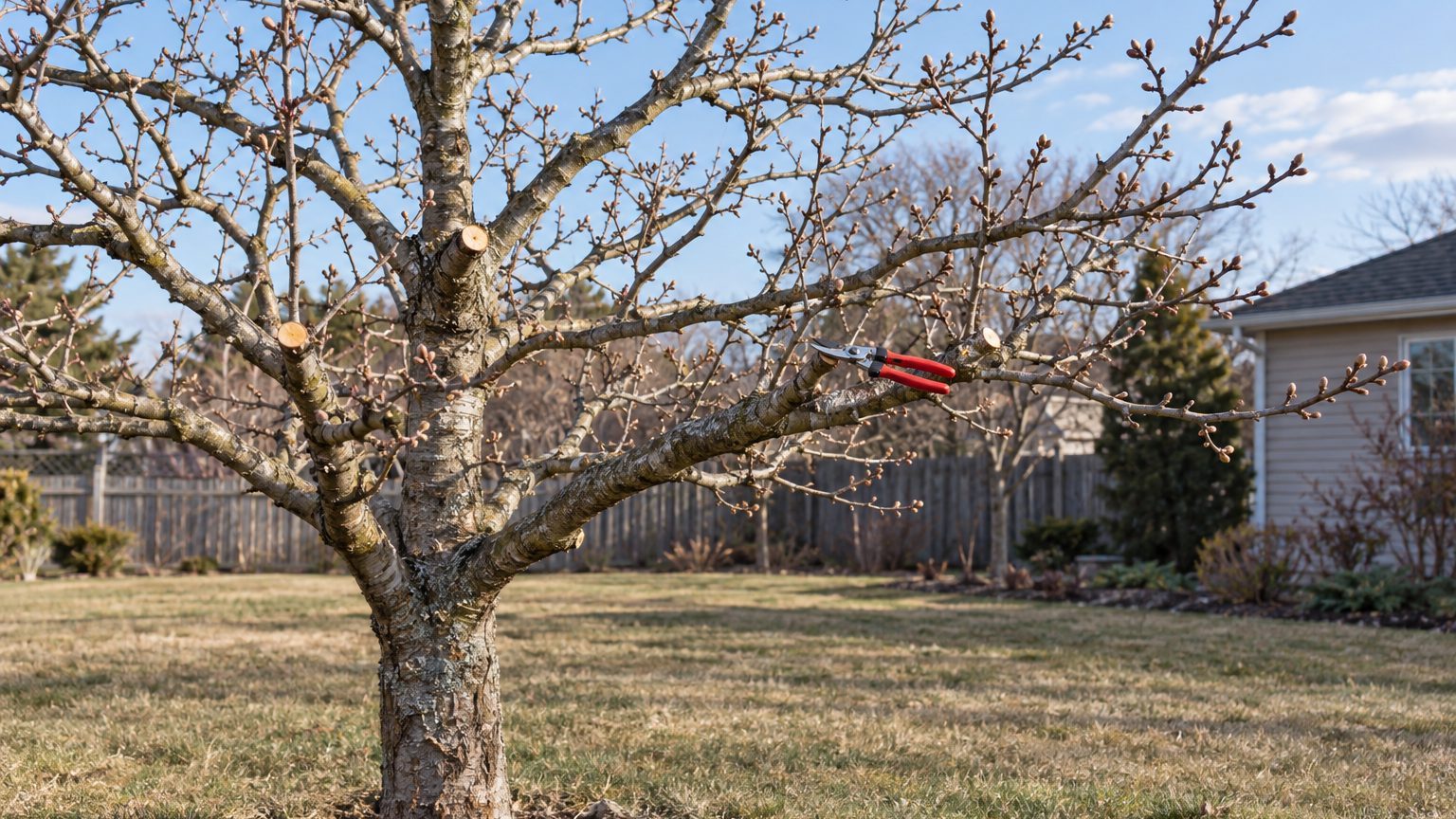
Bare branches against a gray March sky, and a pair of pruning shears waiting in the garage: that is the picture of fruit tree pruning in Manitoba. The job belongs to the stretch when the trees are still asleep, after the hardest cold and before the buds open.
When to Prune Fruit Trees in Manitoba

Dormant pruning of fruit trees in Manitoba fits late winter or early spring, March and April. The dates follow the northern plains, since the nearest comparable climate sets the timing. Confirm local details with a garden centre, a garden society or a provincial gardening group.
| Fruit tree | When to prune in Manitoba | Why |
|---|---|---|
| Apples and pears | March to April, while dormant, before bud break | Pruned first, once the coldest weather has passed |
| Peaches and nectarines | Late in the March to April window, closest to bloom | Flower buds are easily hurt by cold |
| Cherries and plums | March to April, before the buds open | Pruning while dormant keeps cuts ahead of new growth |
| Young trees | March to April, before the buds swell | Shaping is done while the tree is at rest |
Fall and early winter are left alone. Cuts made then can push new growth that has no time to harden before the cold. The average last spring frost in Winnipeg falls on May 23, but that is a midpoint, and frost comes later than that in one year out of two. Northern and upland districts run behind it, so a late cold snap after pruning is always possible.
Manitoba — the year and the numbers
- State
- Manitoba
- Hardiness zones
- 3b
- Last spring frost
- May 23
- First fall frost
- September 22
- Annual rain
- 21 in
- Lawn zone
- cool-season
- Source
- Environment and Climate Change Canada — Canadian Climate Normals 1981-2010, station WINNIPEG RICHARDSON INT'L A · Winnipeg
How to Tell Your Fruit Trees Are Ready to Prune
The tree itself gives better timing cues than a date on the wall, and a few signs line up with the March and April window.
- The branches are bare, which means the tree is dormant and every limb is easy to see and judge.
- The hardest cold of winter has passed, so cuts will not be exposed to a deep freeze right afterward.
- The buds are still tight, because pruning is finished before they swell and open.
- Buds that have started to fatten tell you to hurry on apples and pears, and to wait on peaches.
- Fall growth that never hardened shows up as dark or damaged tips, which are good places to start cutting.
If the buds have already opened, the dormant window has closed for that year, and the cuts can wait until the tree is at rest again.
When to Prune Peach and Apple Trees in Manitoba
Apples are pruned first, in the middle of the dormant period. Once the worst cold has passed, March is a sensible start, with the work wrapped up before bud break in April. A tree at rest has no leaves to hide the structure, so crossing limbs and crowded centers are easy to spot.
Peaches come last, closest to bloom. Their flower buds are easily hurt by cold, so cutting early can remove buds that would have survived or expose a tree to a late freeze. Waiting until the end of the window lets you see which buds came through the winter before deciding what to remove.
Summer pruning is a separate question, and the dormant season remains the time for the main structural cuts on both trees. Plan the peaches for the tail end of your pruning days, after the apples and pears are done.
Where to Get Fruit Tree Advice in Manitoba
Canada has no county extension office, so questions about a specific orchard or backyard tree go to the province and to local growers. Manitoba Agriculture is the main provincial source for fruit growing.
- Manitoba Agriculture offers provincial guidance on fruit growing, worth checking in winter before pruning starts.
- A local garden centre or garden society can tell you how trees are behaving in your district, and is useful to visit in late winter.
Common Questions
Can You Prune Fruit Trees in Fall in Manitoba?
Fall pruning is avoided, because it can push new growth that does not harden before winter. Wait for the dormant season in March and April.
Which Apple Varieties Handle Manitoba Winters?
Cold hardiness varies by variety and rootstock. Honeycrisp is thought to need roughly 800 to 1,000 chilling hours, and Triumph has more scab resistance genes. Budagovsky rootstocks are known for cold hardiness. Check with a local garden centre for what suits your yard.
What Is the Hardiness Zone for Winnipeg?
Winnipeg sits in Canadian zone 3b. That is a Canadian system built on several climate variables, and it does not convert to a USDA zone.