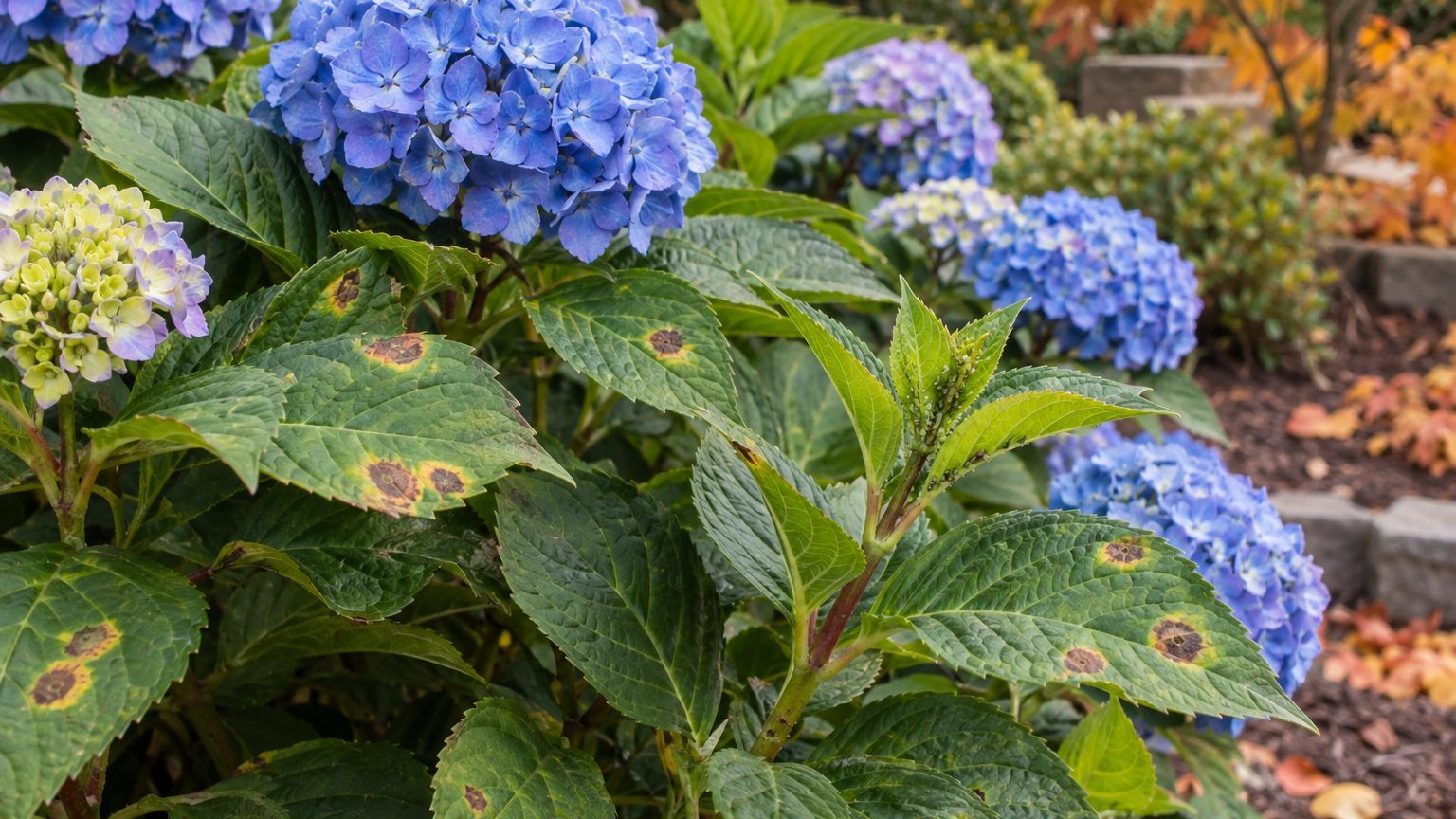
Oklahoma hydrangeas run into a predictable lineup of trouble each year: aphids on tender spring growth, powdery mildew and leaf spot once summer humidity sets in, spider mites during the driest heat, and root rot in the state’s heavy clay. Most of these track the calendar more than the calendar tracks them, and knowing which one you’re looking at saves a wasted spray and a lost bloom season.
Hydrangea pests and diseases Oklahoma: The Short Answer
The USDA Plant Hardiness Zone Map puts Oklahoma at 6a to 8a, and that spread from the Panhandle to the Red River explains why the problem list shifts by county. Oklahoma City sits in the middle of that range, with humidity-loving fungal issues more common on the state’s wetter eastern side and heat-driven pests like spider mites taking over as summer sets in.
Here’s the order I actually see them show up in a typical Oklahoma yard, from the first warm week of spring through the wettest stretch of August.
Aphids on new spring growth
Small green or black clusters gather on tender stem tips as growth resumes, curling leaves and coating them in sticky honeydew. A hard spray from the hose knocks most colonies off, and insecticidal soap handles the rest. Catch it before the March fertilizing round so you aren’t feeding the pest too.
Powdery mildew after May rains

A white, flour-like coating spreads across leaf tops once warm days meet humid nights. It rarely kills the shrub but disfigures bigleaf types before the bloom show. Thin crowded stems for airflow, water at the base instead of overhead, and expect it to ease once the May fertilizing round pushes fresh growth.
Cercospora leaf spot in high summer
Small brown spots with a purple edge appear on the older, lower leaves first, usually after several nights of leaves staying wet. Rake up and discard fallen leaves rather than composting them, since the fungus overwinters there. Avoid wetting the foliage during the June and July pruning window on bigleaf plants.
Spider mites during August heat

Fine yellow stippling and a dusty look across the leaf surface signal mites, usually with faint webbing on the undersides. They thrive on a drought-stressed shrub, not a well-watered one, so deep watering matters as much as any treatment. A strong spray of water under the leaves each morning breaks up colonies fast.
Botrytis blight on flowers

Gray, fuzzy mold covers browning petals and stem tips after a stretch of wet weather, spreading fastest through crowded, low-light plantings. Snip off blighted blooms and dispose of them rather than leaving them to sit through fall. Better spacing at planting time prevents most of it outright.
Root rot in heavy clay

Wilting despite moist soil and a blackened stem base point to root rot, common wherever Oklahoma’s clay holds water after a storm. Raised beds or an amended planting hole at the March, April, August, or September planting dates prevent it more reliably than any fungicide applied after the fact.
Oklahoma — the year and the numbers
- State
- Oklahoma
- USDA zones
- 6a-8a
- Last spring frost
- March 28 to April 10
- First fall frost
- October 29 to November 8
- Annual rain
- 36 in
- Lawn zone
- transition-season
- Source
- NOAA NCEI U.S. Climate Normals 1991-2020, 32F freeze probabilities · Oklahoma City
How to Work Out the Dates for Your Own Yard
Matching a symptom to the right fix starts with the calendar, since NOAA NCEI U.S. Climate Normals puts Oklahoma City’s average last spring frost between March 28 and April 10, and most of what troubles a hydrangea here only shows up in a specific slice of the months that follow.
- Note today’s date against the frost window: aphid curl and early mildew only make sense once new growth is out, so anything showing before mid-April is more likely cold damage than a pest.
- Check which leaves are affected first: bottom leaves point to a soil-borne problem like leaf spot or root rot, while the newest tips point to aphids or mite feeding.
- Look back at the last two weeks of weather: several wet, muggy nights in a row favor mildew and botrytis, while a dry, hot stretch favors spider mites instead.
- Feel the soil at the base: standing water or a sour smell around the root ball points to rot rather than anything above ground, especially in Oklahoma’s clay.
- Match the timing to the calendar window: a problem showing up right before the June or July prune, or right after the March, May, or July fertilizing rounds, usually traces back to that exact task.
None of this replaces a look with a hand lens, but it narrows six possibilities down to one or two before you spend money on a spray that was never going to help. Write down what you find, since the same clay bed tends to repeat the same problem once the weather pattern lines up again.
Oklahoma North to South: How the Dates Shift
The same six problems don’t land on every Oklahoma yard the same week, and the reason is mostly elevation and humidity rather than latitude. The Panhandle sits much higher and far drier than the southeastern corner, and that gradient shows up directly in which pest or disease shows up first.
- The Panhandle and northwest (Guymon, Woodward, Enid): the driest, highest ground in the state keeps mildew and leaf spot uncommon, but spider mites show up earlier in the heat and hang on longer into a dry fall.
- Central Oklahoma (Oklahoma City, Norman, Stillwater): sits in the middle of the state’s climate swing, where aphids, mildew, and mites all show up close to the timing described above, sometimes overlapping.
- Green Country and the northeast (Tulsa, Bartlesville, Muskogee): more rainfall, more shade from mature trees, and heavier clay add up to a longer mildew and leaf spot season along with a higher root rot risk.
- The southeast and Red River valley (McAlester, Ardmore, Idabel): the most humid, longest-summer corner of the state, where botrytis and leaf spot linger well past the point they’ve cleared up elsewhere.
Whichever part of the state you’re in, check the county-level page for the exact frost window before you set a spray schedule.
Mistakes Oklahoma Punishes
Three habits show up again and again in Oklahoma yards, and each one hands one of the problems above a reason to spread. I see the same three mistakes on repeat visits to yards from Tulsa to Lawton.
Watering overhead in the evening
Wetting the leaves late in the day leaves them damp overnight, which is exactly the condition mildew and leaf spot need to spread. Switch to a soaker hose or water early enough that foliage dries before dusk, and expect fewer fungal problems by the time the July prune comes around on bigleaf types.
Skipping the June or July prune
A bigleaf shrub left dense and unthinned traps humidity right where mildew and leaf spot want it. Opening up the center during the June or July pruning window lets air move through, which does more for disease control than any spray applied afterward.
Planting into unamended clay
Digging a hole and dropping the shrub straight into Oklahoma’s heavy clay sets up standing water at the roots after the next storm. Work compost into the whole planting area, not just the hole, at the March, April, August, or September planting dates, and root rot rarely becomes an issue.
Oklahoma Extension Offices and County Contacts
The zone range and frost dates above are a state-wide starting point, and Oklahoma State University Extension staffs county offices that can confirm a specific pest or disease against a sample from your own yard.
- Your state page: the frost dates and the pruning window where you live.
- Which ones hold up here: the bigleaf, panicle, and smooth varieties rated for Oklahoma’s zone range.
- OSU Extension: county agents who can put a name to a sample in person.
Common Questions
Do I need to spray hydrangeas every year in Oklahoma?
Not automatically. Most yards only need treatment once a specific symptom shows up, and healthy airflow from proper spacing and a June or July prune prevents more problems than any routine spray schedule.
Can I treat mildew and leaf spot with the same product?
Some fungicides labeled for general fungal control cover both, but timing matters more than the product. Treating at the first sign, rather than after leaves have already dropped, makes the bigger difference.
Why do my hydrangeas wilt even after I water them?
In Oklahoma’s clay, wilting despite wet soil usually points to root rot rather than thirst. Check the base of the stem for blackening before adding more water, since more water is often the opposite of what the plant needs.