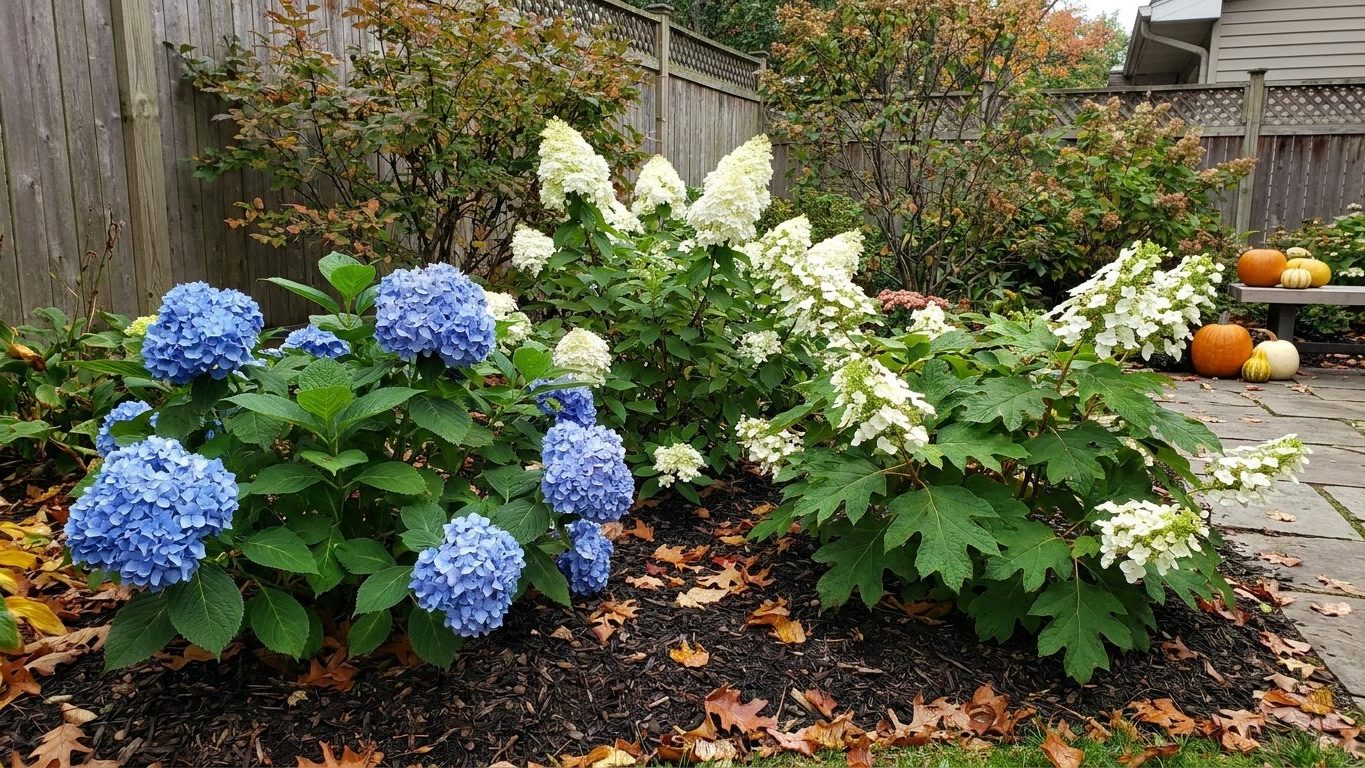
Bigleaf hydrangea (Hydrangea macrophylla) and mountain hydrangea (Hydrangea serrata) grow the most reliably across Hawaii, especially above roughly 2,000 feet where nights stay cool enough for buds to set. Near sea level in Hilo, heat and constant humidity work against the classic mophead types, and panicle or smooth varieties struggle even more without any real winter chill.
Hydrangeas that grow well in Hawaii: The Short Answer
The USDA Plant Hardiness Zone Map puts Hawaii at 9a to 13a, a range wide enough to cover both the humid lowlands around Hilo and the cool uplands above 3,000 feet. Bigleaf hydrangea and mountain hydrangea handle that spread better than any other type, which is why nurseries on the Big Island and in Kula sell them almost exclusively.
Bigleaf hydrangea (Hydrangea macrophylla)

This is the safest pick for most Hawaii yards, mophead and lacecap forms both do well in filtered light at elevation. Soil pH decides the color, acidic soil pulls toward blue and alkaline soil toward pink, and near Hilo it still needs part shade to avoid leaf scorch.
Mountain hydrangea (Hydrangea serrata)

Closely related to bigleaf but with smaller leaves and a lower profile, it tolerates humidity and wind better than its cousin. Exposed upland gardens around Volcano lean on it where bigleaf would get shredded by trade wind gusts.
Oakleaf hydrangea (Hydrangea quercifolia)

A moderate bet, it tolerates heat better than bigleaf but dislikes the constant wet feet common on windward slopes. Sharp drainage matters more here than shade, and it rewards a raised bed on rainy sites.
Panicle hydrangea (Hydrangea paniculata)

This one needs measurable winter chill to set flower buds, something lowland Hawaii rarely delivers. Bloom is sparse below the cooler upcountry pockets, so it makes more sense as a Kula or Waimea planting than a coastal one.
Smooth hydrangea (Hydrangea arborescens)

Native to temperate woodlands on the mainland, it struggles with Hawaii’s mild nights and weak stems that flop further under near-daily rain. It survives in upland gardens but rarely matches the bloom it produces back east.
Climbing hydrangea (Hydrangea anomala subsp. petiolaris)

The riskiest choice on this list, the vine needs a real dormant season that almost nowhere in the state provides. It shows up occasionally in experimental gardens but rarely thrives long term.
Hawaii — the year and the numbers
- State
- Hawaii
- USDA zones
- 9a-13a
- Frost
- none in an average year
- Annual rain
- 16 in
- Lawn zone
- warm-season
- Source
- NOAA NCEI 1991-2020 Climate Normals: not-computable flag for every freeze percentile at 32F and 36F, zero days per year at or below 32F, station USW00022521 — https://www.ncei.noaa.gov/access/services/data/v1?dataset=normals-annualseasonal&stations=USW00022521 · Honolulu
How to Work Out the Dates for Your Own Yard
Because lowland Hawaii never sees measurable frost, the planning method here starts with rainfall and elevation instead of a freeze date.
- Pick the elevation band first: gardens above roughly 2,000 feet get closer to the cool nights bigleaf hydrangea needs to set buds, while anything near sea level runs warmer year round.
- Plant in the cooler, wetter window: set new shrubs out in January, February, October or November, when rainfall is steadier and roots establish without heat stress.
- Fertilize on the growth window: feed in March, May and July, spacing applications so roots take up nutrients while the plant is actively pushing leaves.
- Prune bigleaf only in its window: cut back bigleaf hydrangea in June or July, right after bloom, since next year’s flowers form on the wood left behind.
- Watch the leaves for the real signal: scorched margins on the sunny side mean the site runs hotter than the variety tolerates, a cue to move it or add shade.
Bigleaf hydrangea passes this test almost everywhere above the coastal strip because its buds open before the driest stretch of summer. Climbing hydrangea fails it nearly everywhere in the state, since the vine needs a dormant season that lowland and upland Hawaii rarely deliver.
Hawaii North to South: How the Dates Shift
Hawaii’s own geography, not latitude, decides how these windows shift from one yard to the next.
- Windward coasts and valleys (Hilo, Hamakua, Hana): near-constant rainfall and cooler nights favor bigleaf and mountain hydrangea, though root rot becomes the bigger risk than heat.
- Leeward and dry coastal belts (Kona, Kihei, Waianae): lower rainfall and stronger sun push bloom later and demand afternoon shade, since panicle and smooth types struggle without supplemental water.
- Upcountry and high-elevation pockets (Volcano, Kula, Waimea): cooler nights closest to what bigleaf hydrangea evolved with make this the safest ground in the state for a full range of varieties.
None of this changes the calendar windows themselves, only which variety holds up long enough to reach them, a distinction the state guide walks through yard by yard.
Mistakes Hawaii Punishes
Full sun at low elevation
Near sea level, bigleaf hydrangea planted in full sun scorches leaf margins by early afternoon as heat outpaces what the roots can take up. Give it filtered light or afternoon shade below the cooler upcountry belt, and match the site to one of the varieties listed above.
Waterlogged roots in constant rain
Windward gardens near Hilo see rain nearly every week, and hydrangeas set in heavy clay or a low spot sit with wet roots long enough to rot. Raise the bed or mix in cinder for drainage, and pick oakleaf or mountain hydrangea over the thirstier smooth type.
Wrong variety for the elevation
Panicle and climbing hydrangea rarely bloom well below the coolest upcountry pockets, since both need a real chill that lowland Hawaii never provides. Check elevation against the ordered list above before buying, and lean toward bigleaf or mountain hydrangea anywhere near the coast.
Hawaii Extension Offices and County Contacts
The zone range above is a starting point, not the whole picture, and county extension staff can confirm what holds up on your exact slope. USDA NIFA’s Land-Grant University Extension directory lists the University of Hawaii’s CTAHR extension service as the state’s contact point.
- Your state page: the elevation bands and pruning window where you live.
- Which ones hold up here: the ordered list of varieties from safest to riskiest for Hawaii.
- CTAHR extension: county office contacts for soil tests and variety questions specific to your island.
Common questions
Do hydrangeas need cold winters to bloom in Hawaii?
Bigleaf and mountain hydrangea set buds without a true winter, which is why they dominate island nurseries. Panicle, smooth and climbing types need more chill than most of the state provides, so they bloom thin or not at all outside the coolest upcountry pockets.
Why do hydrangea leaves scorch even with regular watering?
Scorch on the sunny side usually means wind and sun exposure outpace what the roots can pull up, not a lack of water at the roots. Moving the plant to filtered light or afternoon shade fixes it faster than adding more irrigation.
Where in Hawaii do hydrangeas grow best overall?
Upcountry pockets above roughly 2,000 feet, places like Volcano, Kula and Waimea, come closest to the cool nights hydrangeas evolved with. Lowland coastal yards can still grow bigleaf or mountain hydrangea, but they need more shade and better drainage to get there.