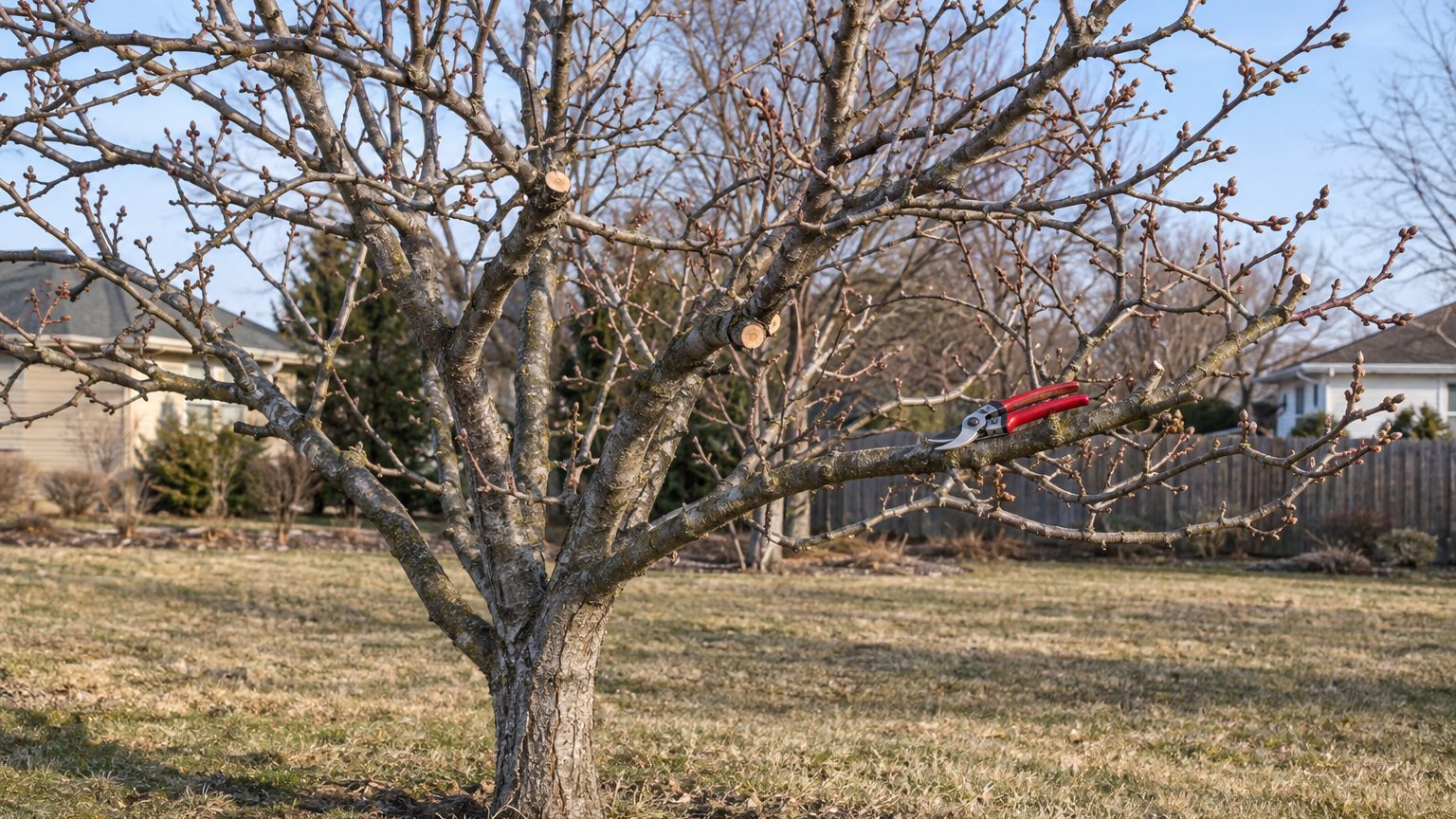
Bare branches against a gray March sky are the sign that fruit tree pruning season has come around in Massachusetts. Apples, pears, peaches, cherries and plums all get their yearly cut while they sleep, in late winter and into early spring. The timing protects the buds and keeps the wounds from running into cold.
When to Prune Fruit Trees in Massachusetts

Prune fruit trees in Massachusetts while they are dormant, in March and April, before the buds swell. Logan is the reference point here, and the Berkshires and inland suburbs warm up later, so their pruning window slides later too.
| Fruit tree | When to prune in Massachusetts | Why |
|---|---|---|
| Apples and pears | March into early April, while fully dormant | Apples are cut first, and the tree has time to heal before growth starts |
| Peaches and nectarines | Late in the window, April, close to bloom | Their flower buds are easily hurt by cold, so they are pruned last |
| Cherries and plums | Late winter into early spring, before buds open | Dormant cuts keep new growth from pushing before the tree is ready |
| Newly planted trees | Early spring, while still dormant | Bare-root trees go in during April or early May, before the buds open |
Fall and early winter are off the calendar. A cut made then can push new growth that has no time to harden before the cold arrives. Hardiness zones in Massachusetts run from 5a to 7b on the USDA system, so a backyard in the Berkshires and one on the Cape can be weeks apart in how soon the buds wake.
Massachusetts — the year and the numbers
- State
- Massachusetts
- USDA zones
- 5a-7b
- Last spring frost
- April 1 to April 8
- First fall frost
- November 3 to November 14
- Annual rain
- 44 in
- Lawn zone
- cool-season
- Source
- NOAA NCEI 1991-2020 Climate Normals, 32F freeze probabilities · Boston
How to Tell Your Fruit Trees Are Ready to Prune
The tree gives better timing than the calendar, and a short walk around the yard is enough to read it.
- Bare branches with no leaves mean the tree is dormant, which is the condition you want for every cut.
- Hard winter cold that has loosened its grip tells you the worst is behind you, so wounds are less likely to suffer frost damage.
- Tight, closed buds mean there is still time, so you can work through apples and pears without hurry.
- Buds that begin to swell are a signal to finish quickly, and to leave peaches for last since they sit closest to bloom.
- Green tips or opening buds mean the window has closed for dormant cuts, so stop and wait for the following winter.
Spend a mild day in late winter looking at each tree’s buds, and let that guide the order of your work.
When to Prune Peach and Apple Trees in Massachusetts
Apples handle the early part of the window. Cut them in March, deep in dormancy, when the tree is least bothered by the work and the bare structure is easy to read. Pears can follow the same schedule.
Peaches wait. Their flower buds are easily hurt by cold, so they are pruned last, in April, close to bloom. That delay lets you see which buds survived the winter before deciding how much wood to take.
Summer pruning in late July or August is a second chance for light work, such as thinning a few overgrown shoots. Severe cuts then weaken the tree, so most of the pruning belongs in winter and early spring. When in doubt about a particular tree, a local extension office can look at it with you.
Where to Get Fruit Tree Advice in Massachusetts
Questions about a particular orchard tree, from odd bud swelling to old neglected limbs, are easier with local backup. UMass Extension covers fruit growing across the state, and your county office can speak to conditions near you.
- The state extension site has fruit growing guidance, and it is worth a look in winter before pruning begins.
- Your county extension office can answer questions about a specific tree, so call in late winter while the buds are still closed.
Common Questions
Can You Prune Fruit Trees in Fall in Massachusetts?
Fall pruning is avoided, because new growth may not harden before winter. Wait until the tree is dormant in late winter.
Which Fruit Tree Should You Prune First?
Start with apples, which tolerate early cuts, and save peaches for last since their flower buds are easily hurt by cold.
Can You Plant Fruit Trees in Fall in Massachusetts?
Fruit trees are not planted in fall here, because the winters are too cold for a newly planted tree. Plant in April or early May, as soon as the ground has thawed.